
You might be working a shift near the bay, picking up kids after school, or watching a Packers game while wondering if a mortgage career could fit your life. The 20 hour SAFE course online for Green Bay, WI is built for that kind of schedule, because Wisconsin ties mortgage licensing to a clear federal education framework that starts with the right coursework, not with a commute across town. For a Green Bay adult who needs a practical path, the first step can be simpler than it looks.
Picture This Before You Start Your MLO Journey
A Green Bay resident can be standing in the kitchen after dinner, laptop open, trying to map out a new career without blowing up the week. That’s usually the moment people realize they don’t need a classroom across the state, they need a course that fits around work, family, and everything else already on the calendar.

Wisconsin follows the national NMLS framework for mortgage loan originator licensing, including in Green Bay. New state-licensed MLOs must complete 20 hours of NMLS-approved pre-licensing education before pursuing licensure, and the curriculum is split into 3 hours of federal law, 3 hours of ethics, 2 hours of non-traditional mortgage lending, and 12 hours of electives. That structure gives the training a clear shape, so you can see exactly what you’re working toward, instead of staring at a vague requirement that feels bigger than it is. Wisconsin’s state-specific education requirements
Practical rule: if a program can’t show how it covers the required hour breakdown, it’s not doing enough to help you move toward licensure.
That’s why this path feels more concrete than many career changes. You’re not reinventing your whole life, you’re clearing one required education step, then moving on to the rest of the licensing process. For a lot of adults in Green Bay, that’s the difference between a dream that sits on the shelf and a plan that starts this week.
What the 20-Hour SAFE Course Covers
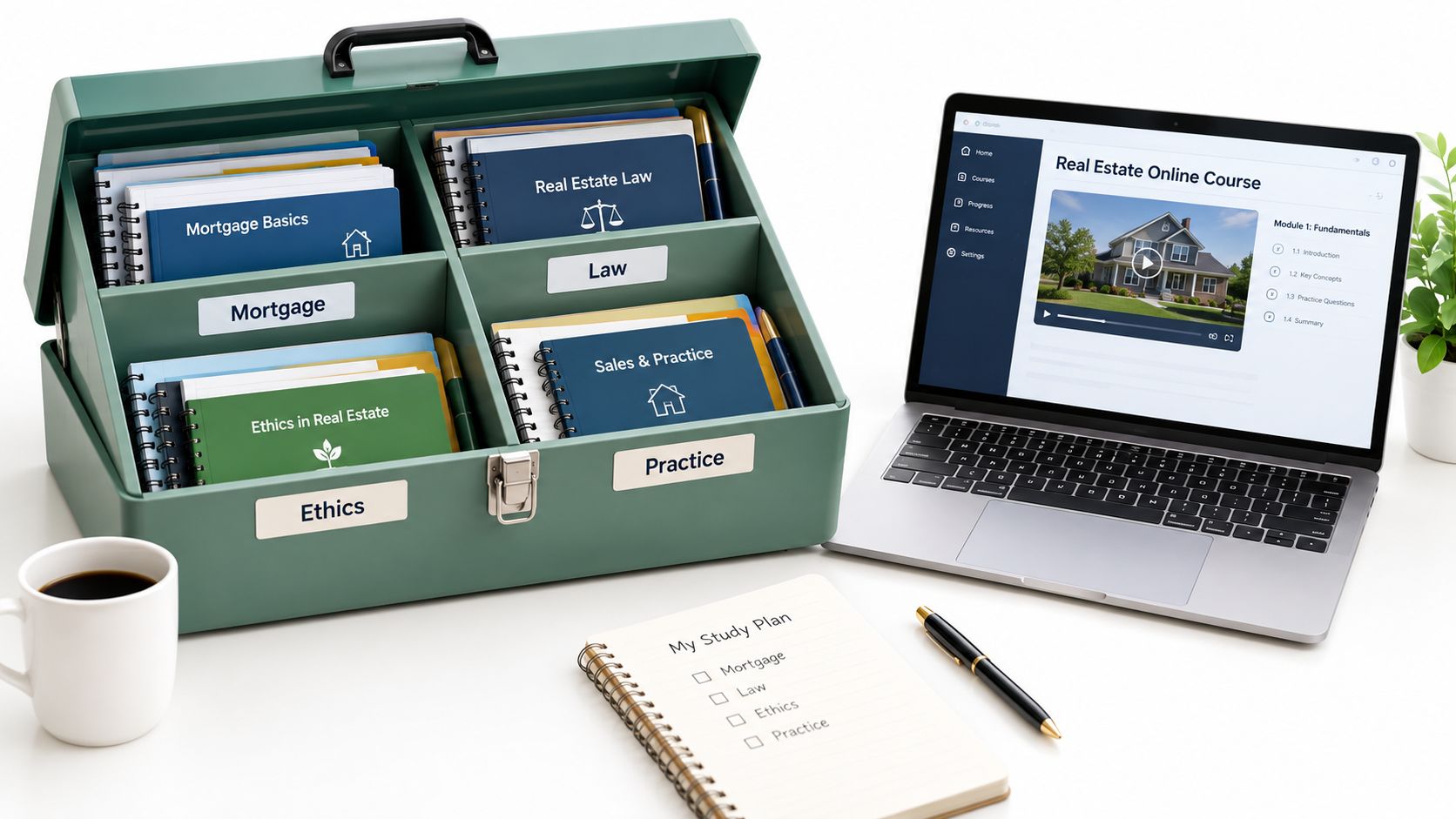
The easiest way to understand the course is to picture it as a toolbox with four labeled compartments. Each part has a job, and the course only works if all four parts are present. A program that spends time on the wrong topics may still look polished, but it will not meet the licensing standard.
The federal minimum is specific. A compliant course must allocate at least 3 hours to federal law and regulations, 3 hours to ethics that include fraud prevention, consumer protection, and fair-lending issues, 2 hours to nontraditional mortgage-product lending standards, and the remaining 12 hours to mortgage-origination instruction. NMLS approval is the technical benchmark, because pre-licensing courses have to be reviewed and approved by NMLS. SAFE Act education requirements
Why the split matters
The 3-3-2-12 structure is not random. The core topics cover the rules, ethics, and lending models a new originator needs before speaking with consumers, and the 12 elective hours build broader mortgage knowledge that supports day-to-day work. The course is a sequence with a purpose, and each part adds a different layer.
One useful way to remember it is this:
- Federal law: learn the rules that shape the job.
- Ethics: learn how to act properly when clients are making major financial decisions.
- Non-traditional lending: learn the product area that needs special attention.
- Electives: build broader mortgage knowledge for real conversations and real applications.
For learners checking provider details, 24hourEDU provider ID 1405107 is a practical reference point when validating NMLS-related records. The important part is not the marketing language around a course, it is whether the course meets the hour allocation Wisconsin recognizes.
A good course should make the compliance structure obvious, not hide it in a long sales page.
If you want to see how one online option organizes the 20-hour requirement, review the 20-hour SAFE MLO course details. The right program should make the 3-3-2-12 split easy to understand before you ever click into a lesson.
Inside the Online Classroom and What Makes It Work
An online mortgage course only helps if it feels usable on a normal day. That means the material has to be easy to open, easy to review, and easy to come back to after work, not trapped in one rigid classroom schedule.
Wisconsin routes mortgage licensing through the Nationwide Multistate Licensing System and Registry, so a Green Bay learner has to treat the course as one part of an NMLS-controlled licensing sequence rather than as a standalone credential. The 20 hours and any state-specific education required by Wisconsin must be completed before license application, so the online classroom has to support completion, documentation, and reporting, not just content consumption. NMLS pre-licensing education guidance
What a practical online setup looks like
The strongest online format gives you a few things at once. You get video lessons you can review again when a rule doesn’t stick, a searchable digital e-textbook you can use on different devices, and a Wisconsin-specific law module that adds state context to the federal foundation. For someone in Green Bay, that means study time can happen at home, on a lunch break, or during a quiet hour in the evening.
A strong course also lowers the friction around testing and paperwork. The free exam prep package matters because it helps learners move from education into test readiness without hunting for extra materials. Unlimited phone and email support from mortgage professionals matters too, because licensing questions are usually clearer after a real person answers them than after you’ve guessed your way through a policy paragraph.
Here’s the kind of feature set busy adults should look for:
- Mobile-friendly access: study on a phone, tablet, or laptop without being tied to one room.
- State law module: get Wisconsin context instead of relying on federal content alone.
- Exam prep included: avoid piecing together separate study resources.
- NMLS reporting support: remove a common administrative headache.
- Instructor access: ask questions before a small confusion turns into a lost evening.
The practical benefit is simple, you don’t need to drive to another city just to satisfy the education requirement. You can keep your schedule intact and still move toward the license at the same time.
A Realistic Two-Week Timeline to Finish the Course
The 20-hour requirement sounds heavier than it feels when you divide it into ordinary chunks. A busy adult doesn’t need a perfect study streak, just a repeatable rhythm that turns short sessions into progress.
A practical pace is about 90 minutes a day for 14 days, with room to use weekends for longer blocks and weekdays for shorter ones. That kind of schedule leaves space for work shifts, family events, and even game-day distractions without forcing you to restart from scratch. If you want a broader timeline view, the MLO license timing guide can help you see how the education piece fits into the bigger process.
A simple pacing pattern
You don’t need to treat the course like a giant project. A short, focused block before work, another after dinner, and a longer weekend session can carry you through the material without stress.
A useful weekly rhythm looks like this:
- Week 1: cover the foundational topics and get comfortable with the platform.
- Midpoint check: review the sections that feel most technical before moving on.
- Week 2: finish the remaining lessons, then use exam prep to lock in the key ideas.
Rule of thumb: if you keep opening the course on ordinary days, you usually finish faster than you expect.
A few things make the finish line easier. A charged phone, a notebook, and a quiet playlist can turn a random half-hour into real study time. If your evenings are crowded, use the course in smaller pieces and keep momentum instead of waiting for a perfect free day that may never come.
Choosing an Online Course That Fits Real Life
Busy adults usually don’t regret paying a little more for a course that saves time and confusion. They regret losing an evening to a clunky platform, or discovering too late that the course wasn’t set up for NMLS reporting and state-specific education.
| Feature | What to Look For | Why It Matters |
|---|---|---|
| NMLS approval | Clear confirmation that the course meets the federal standard | Without approval, the coursework may not satisfy licensing requirements |
| Provider ID | A provider number you can verify in NMLS-related records | Helps you confirm the school is the one it claims to be |
| Mobile-friendly access | Lessons and materials that open cleanly on phones and tablets | Lets you study around work, family, and commuting time |
| Included exam prep | Study tools packaged with the course | Reduces the need to buy separate preparation materials |
| Wisconsin state law module | State-specific content alongside federal lessons | Helps you cover local licensing context, not just national rules |
| Instructor support | Phone and email access to experienced mortgage professionals | Gives you help when a rule or term needs a human explanation |
| NMLS hours reporting | Completion reporting handled for you | Cuts down on administrative work after you finish the course |
The smartest way to compare programs is to focus on outcomes, not just the sticker price. A cheaper course that creates more confusion can cost you extra time, and time is usually the scarcer resource for working adults. One option that fits this model is 24hourEDU, which offers the online 20-hour SAFE course with exam prep materials, support, a Wisconsin module, and completion reporting.
From Course Completion to Your MLO License
Finishing the course is the first leg of a relay. The education requirement is done, and the licensing sequence that follows still matters because mortgage origination is regulated activity.
Federal standards require applicants to complete at least 20 hours of NMLS-approved pre-licensing education, pass an NMLS-approved written test, show financial responsibility, character, and fitness, and meet any applicable state net-worth, surety-bond, or state-fund requirements. The SAFE Act also includes screening rules tied to prior license revocations and certain felony convictions, so the class is one part of the larger process. CFPB final rule on loan originators
The sequence after class
Once the course is finished, the next steps usually look like this.
-
Register through NMLS.
Your licensing record lives in the nationwide system, so that is where the process begins. -
Schedule the written test.
The exam checks whether you can apply the rules, not just recognize the terms. -
Complete the background review.
Character and fitness matter because the role depends on consumer trust. -
Submit the Wisconsin license application.
The state application is separate from the education requirement. Once you finish, your course completion certificate is what NMLS reporting is built around, so keep it handy for the application step. -
Handle bond or financial requirements if needed.
Those requirements depend on the license path and the employer structure.
The course itself does not authorize loan origination activity. It establishes the education component, then the rest of the sequence finishes the job. If you want a useful reference for how licensing credentials are discussed across industries, the HiredBySkill credential guide gives a clear way to think about formal credentials during a career change.
When a school provides complimentary NMLS hours reporting, one admin task disappears from your plate. That matters because fewer loose ends make it easier to move from studying to licensed work.
Why Green Bay Is a Great Place to Launch an MLO Career
Green Bay gives mortgage originators a practical place to build a client base because people are always making housing decisions, moving, refinancing, and comparing loan options. That kind of activity rewards originators who can stay organized, answer questions clearly, and keep their follow-up tight.

This career also fits people who want more control over their schedule. Many MLOs build their business around commission-based work, which means effort, responsiveness, and client service can shape earnings over time. If you’re the kind of person who likes being reachable, staying organized, and working from home when the day allows it, the role can fit a modern adult routine much better than a traditional office job.
For ongoing compliance, Wisconsin requires 8 hours of NMLS-approved continuing education annually, and the annual requirement continues after licensure. That’s a reminder that mortgage licensing is a real profession, not a one-time class, but the first step is still the shortest one.
The AI job application agent can be helpful if you’re comparing career moves and want a cleaner job-search process while you’re building a new professional direction. Still, the licensing path starts with the education requirement, and the 20-hour National SAFE course is the cleanest place to begin.
If you’re ready to move from thinking about the license to working toward it, start with 24hourEDU. It offers the online 20-hour SAFE course, Wisconsin-specific support, and the exam prep materials that help you clear the first licensing hurdle with less guesswork.