

Getting your Mortgage Loan Originator license is a huge career move, but let’s be honest—the NMLS exam can feel like a hurdle standing in your way. With our help, it’s easy to get your MLO license.
This isn’t just another dry study guide; it’s a practical plan to help you conquer the NMLS exam.
Your Clear Path to an MLO License
We’re going to break down the exam content, help you build a study plan that actually fits your life, and get you ready to walk into that testing center with total confidence.
Our NMLS-approved online education comes with a complete exam prep package included for free, giving you a clear roadmap to success. We make it easy to understand everything from confusing federal laws to the tricky ethical scenarios you’ll face, replacing that test anxiety with a solid plan of action.

Let’s start turning those career goals into a reality.
The First Step in Your Journey
Before you can even think about scheduling your exam, you need to get registered in the Nationwide Multi State Licensing System and Registry. The very first step for every aspiring MLO is getting your unique identifier.
If you haven’t done this yet, check out our guide on how to get your NMLS ID number. It’s a non-negotiable first move.
This NMLS-approved education is truly an all-in-one solution. It doesn’t just check the box for your mandatory pre-licensing hours; it also includes our full exam prep package at no extra charge. We’ve made the path to licensure as straightforward as possible.
Our whole approach is designed to make getting your MLO license feel easy. The online format gives you the flexibility to fit your studies into your life, not the other way around.
What the NMLS Exam Covers
So, what are you actually up against? Here’s a quick summary of the key components of the NMLS exam to help you understand what to expect on test day.
NMLS SAFE MLO Exam at a Glance
| Component | Details |
|---|---|
| Total Questions | 120 multiple-choice questions (115 are scored). |
| Time Limit | You’ll have 190 minutes to complete the exam. |
| Passing Score | A score of 75% or higher is required to pass. |
| Exam Fee | The fee to take the test is $110 per attempt. |
| Administration | The test is administered by Prometric at designated centers. |
Knowing these basics from the start helps you mentally prepare for what’s ahead. As we move through this guide, we’ll dive much deeper into each content area, giving you the knowledge and strategies to tackle every single section with confidence.
Deconstructing the NMLS Exam Content
Before you can build a killer study plan, you need to understand the battlefield. The NMLS exam isn’t about rote memorization; it’s designed to test your real-world understanding of the rules and principles that keep the mortgage industry running smoothly. Knowing exactly how the exam is structured is the key to focusing your time where it’ll make the biggest difference.

The test is broken down into five core areas, each with a different weight. Think of it as a blueprint for your study guide. By seeing which sections are biggest, you know exactly where to spend the most time and energy. Let’s break it down.
Federal Mortgage Related Laws (24%)
This is a massive chunk of the exam for a good reason—it’s the absolute foundation of everything you do as an MLO. This section covers the major federal laws that protect consumers and keep the industry in check. You’ll be diving deep into the regulations that will shape your daily conversations with clients.
For instance, you’ll need to know these inside and out:
- The Real Estate Settlement Procedures Act (RESPA): This is all about how settlement costs are disclosed. It prevents kickbacks and keeps the process transparent.
- The Truth in Lending Act (TILA): Governed by its famous rule, Regulation Z, TILA dictates how lenders disclose credit terms, including the all-important APR.
- The TILA-RESPA Integrated Disclosure Rule (TRID): This is where TILA and RESPA come together, creating the Loan Estimate and Closing Disclosure forms your clients will live by.
Mastering these laws isn’t just for passing the test. It’s about guiding your clients legally and ethically through one of the biggest financial decisions of their lives.
Mortgage Loan Origination Activities (27%)
As the single most heavily weighted section, this is where you need to park yourself for a significant portion of your study time. It covers the entire life of a loan, from the moment a potential borrower calls you to the day they get the keys. This is the practical, hands-on knowledge you will use every single day.
You’ll be tested on your ability to properly take a loan application, understand qualification requirements, and navigate the processing and underwriting of a file. This section is all about application, so expect scenario-based questions that ask you to solve a problem a real borrower might have.
General Mortgage Knowledge (20%)
This section ensures you speak the language of the industry fluently. It covers the essentials, from basic mortgage terms and concepts to the nitty-gritty details of different loan products like conventional, FHA, VA, and USDA loans.
You’ll need to know the difference between qualified and non-qualified mortgages and understand what makes each loan program unique. This is the knowledge that helps you become a true advisor, matching borrowers with the perfect financial solution for their situation.
Professional Ethics (18%)
Ethics is the bedrock of a successful MLO career, and the NMLS exam treats it with the seriousness it deserves. This section goes way beyond simple right-and-wrong questions. It throws you into nuanced scenarios where the most ethical choice isn’t always black and white.
Topics include fair lending, fraud detection, and protecting consumer privacy. The goal is to make sure you can spot and navigate the ethical minefields you might encounter, always acting in the best interest of your client.
Uniform State Content (11%)
While it’s the smallest section, don’t sleep on the Uniform State Content (USC). This part is crucial for understanding the specific regulatory world you’ll be working in. It covers the SAFE Act, which created our licensing standards, and the role state regulators play in overseeing the industry.
This breakdown is your strategic map. Notice that Federal Laws and Origination Activities together make up 51% of the exam. That tells you immediately where to concentrate your efforts for the biggest impact.
The exam’s difficulty is no secret. The national pass rate for the NMLS exam hovers between 54% and 58% for first-time test-takers. With an exam fee of $110 for every attempt, solid preparation isn’t just smart—it’s a financial necessity. Getting a clear picture of all the steps is vital, and you can learn more about the complete mortgage loan originator license requirements in our detailed guide.
Building Your Personalized Study Blueprint
Knowing what’s on the exam is one thing. Actually creating a study plan that sticks is a completely different ballgame. Let’s be honest, a generic, one-size-fits-all schedule is a recipe for burnout and frustration. The real key to passing the NMLS exam is building a flexible blueprint that fits your life—your learning style, your schedule, and what you already know.
A rigid study schedule will fall apart the second life throws you a curveball. Think of your plan as a roadmap, not a straitjacket. It’s there to guide you, but you need to be able to take a detour without crashing. This mindset helps you build a sustainable study habit instead of falling into that last-minute cramming trap that sinks so many test-takers.
Structuring Your Study Time
Your personal schedule is the foundation of your study plan. Whether you can go all-in full-time or have to squeeze studying in around a demanding job, the single most important thing is consistency.
Let’s look at two different ways to tackle this.
Sample Schedule for Full-Time Study (4 Weeks)
This is an aggressive approach for anyone who can treat studying like a 9-to-5, dedicating about 25-30 hours a week.
| Day | Morning Session (3 hours) | Afternoon Session (2 hours) |
|---|---|---|
| Monday | Deep Dive: Federal Laws (TILA/RESPA) | Review & Practice Quiz on Federal Laws |
| Tuesday | Focus: Origination Activities (Application/Processing) | Scenario Practice & Flashcards |
| Wednesday | General Mortgage Knowledge (Loan Types) | Review Federal Laws & Origination Activities |
| Thursday | Deep Dive: Ethics & Uniform State Content (USC) | Practice Quiz on Ethics & USC |
| Friday | Full-Length Mock Exam | Detailed Review of Incorrect Answers |
| Weekend | Light Review & Rest | Rest |
Sample Schedule for Part-Time Study (6-8 Weeks)
This plan is built for someone balancing a full-time job, aiming for a much more manageable 10-12 hours per week.
- Weekdays (Mon-Thurs): Carve out 90 minutes each evening for a single topic. Maybe Monday is for TILA, Tuesday is for RESPA, you get the idea.
- Friday: Take a break. You’ve earned it.
- Saturday: Block off 3 hours for a deeper dive into the week’s topics and hit a section-specific practice quiz.
- Sunday: Use 1-2 hours to review your weak spots from the week and map out the coming week.
Remember, these are just starting points. The real magic happens when you tweak them to fit your life. The free exam prep materials included with our NMLS-approved online education are designed to plug right into either approach, giving you the quizzes and resources to make every session productive.
The Power of Topic Blocking and Interleaving
To get the most out of your hours, you need to study smarter, not just longer. Two of the best techniques for this are topic blocking and interleaving.
Topic blocking is straightforward: you dedicate a specific day or a block of time to one core area. For instance, Mondays are for Federal Laws, Wednesdays are for Origination Activities. This lets you get into a rhythm, immerse yourself in a subject, and really nail down the details. It’s perfect when you’re first learning the material.
But once you’ve got a handle on the basics, it’s time to switch to interleaving. This just means you start mixing different topics into your review sessions. Instead of only reviewing Federal Laws, you might tackle a few questions on TILA, then work through a loan origination scenario, and finish with a question on ethical conduct.
It might feel a bit harder at first, but study after study shows that interleaving is way more effective for long-term memory. It forces your brain to switch gears and retrieve different types of information, which is exactly what you’ll have to do on the real NMLS exam.
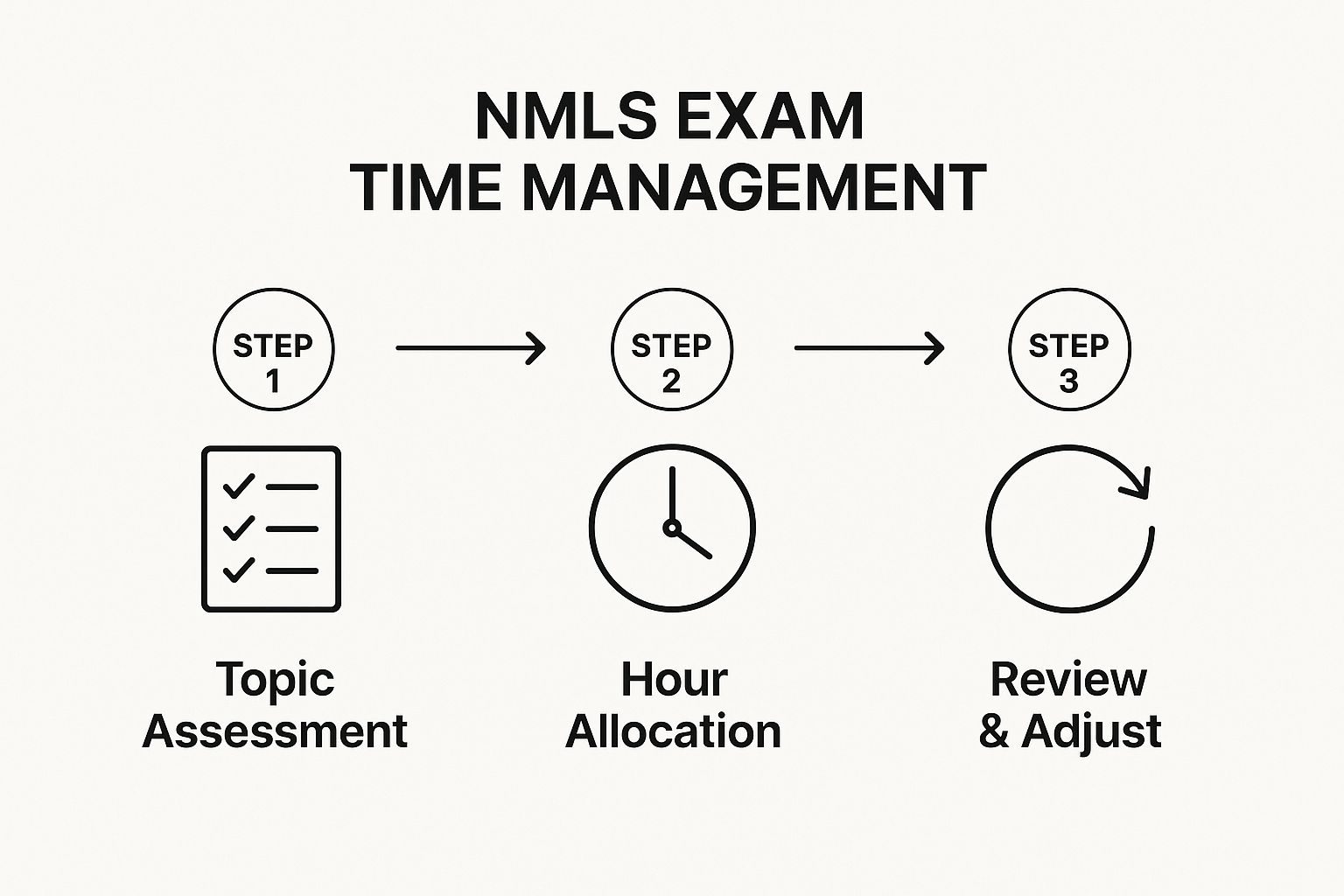
This flow is all about assessing where you are, dedicating your time wisely, and constantly adjusting as you go.
Essential Tools for Your Blueprint
Your plan is only as good as the tools you use to stick with it. Digital flashcard apps like Anki or Quizlet are fantastic for active recall, helping you burn key terms, laws, and timelines into your memory. You can build your own decks or find pre-made NMLS sets to get started quickly.
Also, don’t underestimate the power of a simple checklist. Print out the NMLS content outline and physically tick off each sub-topic as you master it. It’s incredibly motivating and makes sure you don’t accidentally skip anything important. Pairing these simple tools with our free exam prep package gives you a powerful system to make your study time count.
Mastering Core Concepts with Active Learning
Let’s be honest: just highlighting your e-textbook isn’t going to cut it. That’s passive learning. To really conquer the NMLS exam, you have to switch to active learning. This means making your brain work to pull out information, not just nod along as you read.
It’s the single biggest shift you can make in your study habits, and it’s what separates a passing score from a failing one.
Active learning is the foundation of any solid study plan because it builds knowledge that actually sticks. It’s a hands-on approach that ensures you’re not just memorizing trivia for test day, but truly understanding the concepts you’ll use every single day as a licensed MLO.
Use Active Recall to Make Knowledge Stick
The most powerful active learning tool is active recall. Instead of just re-reading the chapter on TILA, close the book. Then, grab a notebook and write down everything you remember about it. What’s the purpose of Regulation Z? What are the key disclosures?
This simple act forces your brain to retrieve the information, which strengthens the neural pathways and makes it easier to remember later. It also instantly shows you what you don’t know. If you can’t explain the Loan Estimate off the top of your head, you’ve just found your next study topic.
Our NMLS-approved online courses are built for this. After you watch a video lesson, hit pause. Try to summarize the key points out loud or jot them down before you click “next.” It’s a small change that pays off big time.
Invent Your Own Scenarios
The NMLS exam is notorious for its scenario-based questions. They won’t ask you a simple definition of RESPA. Instead, they’ll give you a real-world situation and ask you to spot a potential RESPA violation. The best defense is a good offense: start making up your own scenarios.
For example, imagine a real estate agent offers you courtside basketball tickets as a “thank you” for sending a client their way. How does that square with Section 8 of RESPA, which forbids kickbacks? Thinking through these situations makes the abstract rules feel real and practical.
Here’s an easy way to get started:
- Pick a Law: Start with something like ECOA (Equal Credit Opportunity Act).
- Create Characters: Think up a loan officer and a few different borrowers—maybe a recent immigrant, a single parent, or someone on public assistance.
- Build a Situation: Write a quick story. What if the loan officer asks a female applicant if she’s planning to have more kids? That’s a huge ECOA violation, and creating a story around it makes the rule impossible to forget.
This turns dry regulations into memorable cautionary tales, helping you spot ethical red flags when you’re under pressure during the exam.
Use Mnemonics for the Tricky Details
Let’s face it, some parts of the exam are just pure memorization—timelines, acronyms, and long lists. This is where mnemonics, or memory aids, become your best friend. Don’t just stare at a list of terms; give your brain a hook to hang them on.
The goal isn’t just to read the study guide; it’s to internalize it. Active learning techniques like creating scenarios and using mnemonics are the bridge between passively knowing a concept and being able to apply it confidently on exam day.
A classic example is remembering the six pieces of information that trigger a loan application under TRID.
Just remember ALIENS:
- Address of the property
- Loan amount sought
- Income of the borrower
- Estimated value of the property
- Name of the borrower
- Social Security Number
Once you have those six items, the clock starts, and a Loan Estimate is due within three business days. A simple word like “ALIENS” makes that list stick. For a deeper dive into what’s covered, you can explore the essential study topics for the SAFE MLO exam in our detailed guide.
Comparing Active vs. Passive Study Methods
Seeing the difference side-by-side makes it clear why active learning wins every time. Here’s how to upgrade your study sessions from low-impact to high-impact.
| Passive Study Method (Low Impact) | Active Learning Method (High Impact) |
|---|---|
| Re-reading your notes or textbook | Explaining a concept out loud to someone else (or yourself) |
| Highlighting key passages in yellow | Creating your own practice questions based on the material |
| Watching a video lesson without taking notes | After the video, writing a one-paragraph summary from memory |
| Simply reviewing flashcards | Using a spaced repetition system for flashcard review |
By choosing the active method in each pair, you make every hour you study count for more. Our entire education program is designed around these high-impact activities, making your path to getting licensed that much easier.
Using Practice Tests to Simulate Exam Day
Knowing the material is one thing, but performing under pressure on exam day is a completely different beast. This is where practice tests become your secret weapon—if you use them correctly.
Simply taking test after test isn’t the point. The real magic happens when you slow down and actually review your results. Think of each practice exam as a diagnostic tool that shows you exactly where your weak spots are.
Our exam prep package includes realistic simulations that mimic the timing, format, and style of the real NMLS test. Getting comfortable with that environment now means you’ll walk into the testing center feeling prepared and confident, not blindsided.
The Three-Step Analysis Process
Resist the urge to just glance at your score and move on. After every single practice test, you need to dig in and figure out what happened. I recommend a simple but powerful three-step analysis.
Isolate Every Mistake: Don’t just look at the ones you got wrong. Create a running list of every single question you missed. Seriously, write them down.
Figure Out the Why: This is the most critical part. For each wrong answer, ask yourself why you missed it. Was it a topic you genuinely didn’t know? Did you misread the question? Or did you fall for a tricky distractor answer? Be honest with yourself.
Go Back to the Source: Once you know why you missed it, dive back into your study materials and focus only on that specific concept. If you messed up a question on RESPA’s escrow account rules, don’t re-read the entire RESPA chapter. Just master that one rule.
This targeted approach is incredibly efficient. It plugs your knowledge gaps without wasting time on material you already know cold.
Building Your Test Day Endurance
The NMLS exam is a marathon, not a sprint. The national pass rate for first-timers often hovers between 55% and 58%, which tells you just how tough it is to perform under pressure. You’ll face 125 questions with a 190-minute time limit, and you need a 75% to pass. Time and mental energy are just as important as knowing the rules.
You can discover key insights about NMLS pass rates on diehleducation.com to get a better sense of what you’re up against.
Taking full-length, timed practice tests does more than just check your knowledge—it builds mental stamina. You learn how to pace yourself, manage the clock, and stay focused for over three hours.
As you practice, start working on your strategy. One of the best tactics is the process of elimination. When you hit a question that stumps you, immediately start crossing out the answers you know are wrong. Even if you can only eliminate one or two options, you’ve dramatically improved your odds of guessing correctly.
Replicating the Real Exam Experience
To truly get ready, you have to make your practice sessions feel like the real thing. Our online education, which is fully approved by the NMLS Nationwide Multi State Licensing System and Registry, is designed to help you do just that.
When you sit down for a practice test from our free exam prep package, set the stage:
- Find a Quiet Spot: No TV, no phone, no distractions. Mimic the sterile environment of a Prometric testing center.
- Set the Timer: Give yourself exactly 190 minutes and stick to it. Don’t pause it or give yourself a few extra minutes at the end.
- No Cheating: Put away your notes and books. The goal is to rely only on what’s in your head.
By doing this, you aren’t just practicing questions—you’re rehearsing the entire event. It’s the best way to crush test-day anxiety so you can walk in calm, collected, and ready to pass.
Answering Your Top NMLS Exam Questions
As you start prepping for the NMLS exam, you’re going to have questions. It’s only natural. To give you some clarity right from the start, we’ve pulled together the most common questions we hear from aspiring MLOs. Think of it as a quick FAQ from people who’ve been there.
How Long Should I Really Study for the NMLS Exam?
There’s no magic number, but most people who pass put in somewhere between 40 and 60 hours of solid study time. For most folks, that works out to about two or three hours a day over a three to four-week stretch.
If you’re already in the mortgage world, you might get through the material a bit quicker. But honestly, the total number of hours isn’t what matters most—it’s about being consistent. Studying for 90 minutes every single day is way more effective than a panicked 10-hour cram session over the weekend. Our online NMLS-approved course is built to help you keep up that steady, manageable pace.
What Is the Hardest Part of the NMLS Exam?
Time and again, students tell us the Federal Laws and Regulations section is the toughest nut to crack. It makes up a big chunk of the test (24%), and it’s not about just memorizing acronyms like TILA, RESPA, and the SAFE Act. The real challenge is knowing how to apply these rules to messy, real-world loan scenarios.
The questions are often situational. They’ll describe a tricky client interaction and ask you to spot the compliance red flag or choose the most ethical path forward. This is exactly why the free exam prep we include with our course hammers home scenario-based questions that feel just like the ones on the actual test.
The big takeaway here is that the exam is all about application, not just memorization. If you focus on why a rule exists and how it plays out in a real transaction, you’ll be ready for those tough questions.
What Happens If I Fail the NMLS Exam?
Look, failing stinks, but it’s not the end of the road. It happens to a lot of people. If you don’t pass on your first try, you have to wait 30 days before you can sit for it again. That same 30-day waiting period kicks in if you fail a second time, too.
If you happen to fail a third time, the waiting period gets much longer—a full 180 days. And remember, you have to pay the $110 exam fee for every single attempt, which is all the more reason to get properly prepared from the start.
The best way to handle this is to see that 30-day wait as a strategic advantage. Your official score report will show you exactly where you struggled. Use that month to do a deep dive into those weak spots. It turns a frustrating setback into a focused game plan to make sure your next attempt is a success and gets you that much closer to your MLO license.
Ready to stop worrying and start preparing? With 24hourEDU, you get NMLS-approved online education that makes getting your license straightforward. Our course includes our comprehensive exam prep package for free, giving you everything you need to pass with confidence.
Enroll now and start your journey to becoming a licensed MLO!