

A borrower calls right before lunch. They're behind, the servicer keeps asking for more paperwork, and they want to know one thing: “Can you help me keep the house?”
That moment separates order-takers from real mortgage professionals. If you understand the mortgage modification process, you can calm the client, organize the file, and guide the conversation away from panic and toward a plan. If you don't, the borrower hears uncertainty, loses confidence, and starts taking advice from whoever answers the phone next.
For an MLO, modification knowledge isn't just a loss-mitigation skill. It's a trust skill. Clients remember who helped when the transaction wasn't clean, easy, or profitable. They remember who explained the process in plain English and who stayed steady when the servicer workflow got messy.
Why Mastering Modifications Matters for MLOs

Most new originators think of mortgage modifications as a servicing issue. That's too narrow. In practice, distressed borrowers often call the mortgage professional they already trust, even when that person isn't the final decision-maker.
A modification became a central loss-mitigation tool after the financial crisis, when federal programs expanded and aimed to bring total housing expense into a range of 31% to 38% of gross income. Those same programs established a principle that still matters today: a modification is not a new mortgage. It's a change to terms such as rate, term, or principal treatment to create a more affordable payment, as described by the NBER summary of federal mortgage modification programs.
That distinction matters because clients often come in asking for a refinance when what they need is a workout. If you treat every hardship call like a rate-shopping conversation, you miss the underlying problem.
The advisor role clients actually need
Borrowers in trouble usually don't need jargon. They need someone who can do three things well:
- Stabilize the conversation: Help them stop guessing and start collecting facts.
- Set expectations early: Explain that the servicer runs the process and that paperwork quality affects speed.
- Protect affordability: Keep the client focused on the final payment, not just the word “approved.”
Practical rule: A distressed client doesn't need optimism first. They need clarity first. Optimism comes after you've identified the right path.
When you handle these conversations well, your value grows beyond closing loans. You become the person clients call before they make a costly mistake, such as ignoring servicer mail, making undocumented verbal arrangements, or assuming approval means the deal is automatically affordable.
Why this matters for your long-term book of business
An originator who knows purchases and refinances can earn a living. An originator who can also guide borrowers through hardship can build a reputation.
That reputation comes from judgment. You'll know when to coach a borrower toward a complete hardship package, when to tell them the file is weak, and when to say, “This probably isn't a modification case. Let's look at another option.” Clients trust direct answers.
Use visual structure in your own client materials too. A simple checklist with accents in colors like #023374, #29abe3, or #FACC00 can make dense information feel manageable. Small presentation choices matter when people are overwhelmed.
Initial Client Triage Assessing Hardship and Eligibility
The first call should feel calm, but it can't stay vague. Your job is to move fast from emotion to facts.
Start with the borrower's goal. Do they want to stay in the property? A modification is built around retention. If they're already planning to leave, the conversation changes immediately.
The questions that shape the file
Ask these in plain language:
- What changed? Job loss, reduced hours, illness, divorce, rising expenses, or a payment shock all point to hardship, but the story must be coherent.
- Is the income stable now? A borrower needs some ability to support the proposed payment. No income story usually means no workable modification path.
- How far behind are they? Delinquency status can affect available options and program structure.
- Have they spoken to the servicer already? If yes, find out what was requested and whether anything was submitted.
- Do they have documents ready? Missing paperwork is often where good intentions collapse.
Borrowers also need help understanding what a modification is trying to do. Federal modification design focused on making housing costs affordable, not on erasing the debt. That's why it helps to review budget math early and revisit basics like how to calculate debt-to-income ratio before you tell a client a modification looks realistic.
What you're listening for
You're not just collecting answers. You're testing consistency.
A strong conversation usually includes a clear hardship, current income that can be documented, and a sincere desire to remain in the home. A weak conversation sounds scattered. The borrower changes dates, can't explain current income, or believes the servicer will “roll everything to the back” without review.
Borrowers often think modification is a negotiation over sympathy. Servicers treat it as a documented underwriting decision.
That's why your triage call should produce a working file summary. Keep it tight. Hardship type, occupancy, current income, delinquency status, and next documents needed. If you can summarize the case in a few sentences, you're ready to guide the next step.
Red flags that deserve a careful reset
Some situations don't kill the file, but they do require a more cautious conversation:
- Unstable income: Commission, gig, or seasonal income can work, but only if the documentation tells a clean story.
- Incomplete hardship explanation: If the letter says one thing and the bank statements suggest another, expect scrutiny.
- No urgency: A borrower who won't open mail or send documents on time usually struggles later in the process too.
- Unrealistic expectations: If they think modification approval automatically means lower total cost with no added items, fix that now.
A good script is simple: “I can help you organize this, but the strength of the application depends on a complete, current, and consistent package.” That language protects trust because it's honest. You're promising guidance, not control over the servicer's decision.
Assembling the Perfect Modification Application Package
Most modification files don't break because the hardship was fake. They break because the package was sloppy.
Servicers review a hardship package through an underwriting workflow. They want proof, consistency, and current documents. Consumer guidance also notes that a full review can take 90 days or longer, and stale paperwork creates repeat work. If a corrected package is requested and the original documents are more than 45 days old, the borrower may need to update the file before review continues, as outlined in Pennymac's loan modification guide.
That one issue alone causes avoidable delays. A strong MLO manages the calendar as much as the documents.
Build the file for the reviewer, not the borrower
Don't send a pile of PDFs and hope the servicer sorts it out. Label documents clearly. Keep dates visible. Make the hardship explanation match the income proof and bank activity.
If the borrower is nervous about transmitting sensitive paperwork, point them to practical guidance like a 2026 guide on tax document security. That's useful when you're collecting returns, pay records, and account statements that need to move securely between parties.
Here's a clean checklist you can hand to clients or convert into your own branded intake sheet. For a broader file-prep reference, this mortgage documentation checklist is also helpful.
| Mortgage Modification Document Checklist | Purpose & Key Details |
|---|---|
| Proof of income | Shows current ability to support the proposed payment. Use the most recent, complete records available and make sure the income story matches the hardship timeline. |
| Bank statements | Helps the servicer verify cash flow, reserves, deposits, and spending patterns. Review for unusual deposits the borrower should be prepared to explain. |
| Tax returns | Important for self-employed borrowers, commission earners, and anyone with variable income. Confirm signatures and completeness before submission. |
| Hardship letter | Tells the story behind the default or risk of default. It should be specific, honest, and consistent with the rest of the file. |
| Current mortgage statement | Confirms loan details, payment amount, and servicer information. It also helps align the package with the correct account. |
The hardship letter that actually helps
A good hardship letter is short and concrete. It should explain what happened, when it happened, what's changed, and why the borrower believes the modified payment would be sustainable.
What doesn't work:
- Overly emotional writing: The reviewer needs facts.
- Long narratives: Extra pages don't create clarity.
- Contradictions: If the hardship says income fell but the file shows recent strong deposits, explain the gap.
Package discipline that saves weeks
Use a submission routine:
- Check dates first: Review every document for freshness before sending anything.
- Name files clearly: “Paystub_JaneDoe” beats random scan names every time.
- Create a one-page cover summary: Include borrower name, loan number, hardship type, and a list of enclosed items.
- Track every transmission: Save confirmations, upload receipts, and fax logs.
- Prepare for resubmission: Assume at least one follow-up request will happen.
Send modification packages the way you'd send a file to an underwriter you respect. Clean, current, labeled, and easy to review.
The borrower feels relief when documents are finally submitted. That's understandable, but it's not the finish line. It's the point where file management matters most.
From Trial Payments to Permanent Solutions The Timeline
Once the package is in, many borrowers think the hard part is over. It isn't. This is the stretch where uncertainty rises and communication often gets sloppy.
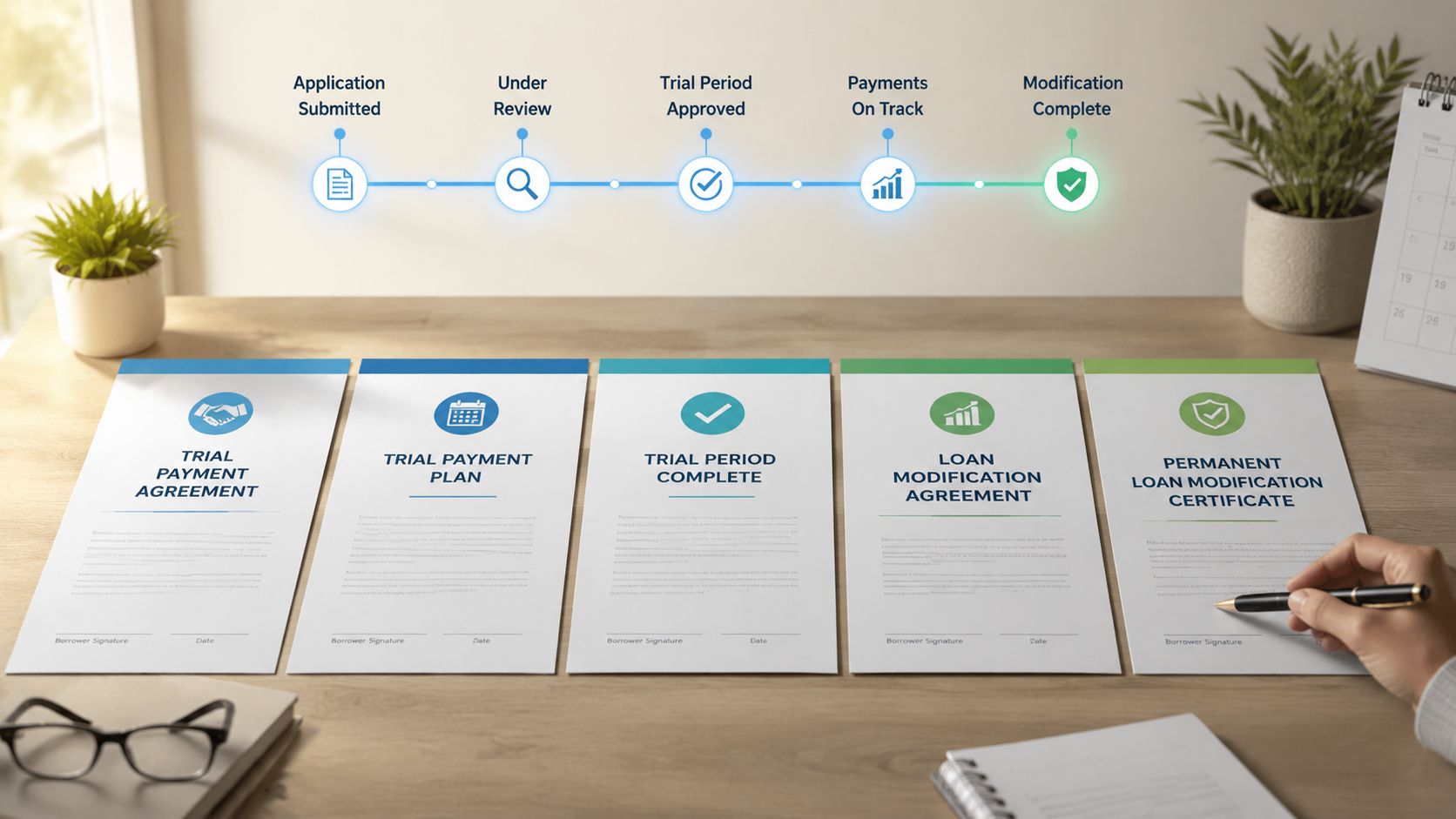
A typical path looks like this: submission, servicer review, additional document requests, decision, and then either denial or a trial payment plan that can lead to a permanent modification if the borrower performs as required. The MLO's role in this phase is part coach, part traffic controller.
What the trial period means
The trial plan matters because it tests behavior, not just paperwork. The borrower has to make the proposed payment exactly as instructed and keep records of each payment.
That's why your coaching must get more precise here. Tell clients to read every page, confirm due dates, and avoid assuming that a verbal statement from a call-center rep changes the written terms. If a payment amount or deadline looks different from what they expected, they need clarification before they act.
What better process design looks like
The best evidence on this point is simple. When Fannie Mae introduced simplified modification in 2013, Urban Institute found participation rose from 20.2% to 29.2%, and the overall success of the program increased by 34% using data from 2012 to 2015, as discussed in Urban Institute's analysis of streamlining mortgage modifications.
For MLOs, that result carries a practical lesson. Process design changes outcomes. Simpler instructions, fewer friction points, and cleaner document flow can help more borrowers get through the pipeline.
If a borrower misses a trial payment or sends it late, don't assume the servicer will “work with it.” Tell the client to document the issue and contact the servicer immediately.
The timeline clients can live with
Instead of giving borrowers false precision, give them a framework:
- Review stage: Expect waiting, follow-up requests, and repeated document checks.
- Decision stage: The file may result in approval terms, a trial plan, or denial.
- Performance stage: The borrower must follow every written instruction during the trial.
- Conversion stage: Permanent terms usually come only after successful completion and final documentation.
The mistake many clients make is emotional. They relax too early. Your job is to keep them engaged until the permanent agreement is signed, returned properly, and reflected in servicing.
Navigating Common Pitfalls and Client Conversations
Strong MLOs earn their reputation navigating the mortgage modification process, which often goes wrong in ordinary, frustrating ways. A document gets misplaced. A borrower talks to three different representatives and hears three different answers. An approval arrives, but the permanent terms contain charges the borrower never expected.

One of the biggest post-approval issues is cost layering. Massachusetts consumer guidance warns that servicers may include attorneys' fees, costs, late charges, and escrow items in the amount owed, which is why borrowers should ask for a detailed breakdown and dispute questionable charges before signing, according to the state's overview of the loan modification process.
Pitfall one: the file keeps “disappearing”
When borrowers say, “I already sent that,” they're often right. The problem is that saying it doesn't fix the file.
Train clients to keep a modification binder or digital folder with:
- Every document version
- Every upload or fax confirmation
- Notes from each call
- The name or department of the representative
- Copies of letters and payment proof
That record changes the tone of escalation. A borrower who can say, “The statement was uploaded on this date and I have the confirmation,” is much easier for a servicer team to help than a borrower who only says, “I know I sent it.”
Pitfall two: the client hears good news and stops listening
Approval language can create false comfort. Borrowers hear “approved” and stop reviewing the details.
Use a script like this:
“Approval is a milestone, not the finish line. Before you sign anything, we need to confirm the full payment structure, the escrow treatment, and any fees or past-due items added into the modified balance.”
That one sentence protects clients from the most common misunderstanding. Lower principal-and-interest alone doesn't tell the whole story if escrow shortages or charges reshape the final payment.
Pitfall three: conflicting guidance from the servicer
This is common enough that you should expect it. Different departments may speak from different screens, and the borrower may not know which statement controls.
Tell clients to anchor everything to written instructions. If they get verbal guidance that differs from a letter or portal message, they should ask the representative to note the file and send written clarification if possible.
A practical escalation script for the borrower:
- Start factual: “I'm calling about my modification file and I need to reconcile a discrepancy.”
- Name the issue: “The letter asks for one item, but I was told something different by phone.”
- Request action: “Please review the notes and tell me what written instruction controls.”
- Close with documentation: “I'm keeping a record of this call and need the next step clearly stated.”
Pitfall four: the final agreement isn't reviewed line by line
At this stage, borrowers need adult supervision. They're tired, relieved, and ready to sign. That's exactly when mistakes get missed.
Review these items with them:
| Item to Review | Why It Matters |
|---|---|
| New payment amount | Confirms whether the modified obligation is actually affordable in real life. |
| Escrow treatment | Taxes and insurance can change the total payment significantly. |
| Added fees and costs | Attorneys' fees, costs, late charges, or other items may have been capitalized. |
| Signature requirements | Some permanent agreements require formal execution steps, including notarization. |
The best client conversation after approval isn't celebratory. It's careful.
If you keep borrowers focused on documentation, written instructions, and the actual final payment, you'll solve problems before they become defaults under new terms.
When Modification Is Not Enough Alternatives and Your Career
Some files shouldn't be forced into a modification lane. A borrower may need temporary relief, a different workout structure, or a broader legal strategy depending on the loan and the hardship.
FHFA and HUD make that clear in different ways. Modification options can vary by loan type and delinquency status, and programs such as Flex Modification may use different payment reduction targets, term extension rules, and principal forbearance limits depending on whether the borrower is less than or more than 90 days delinquent. FHA loans can follow separate pathways such as repayment plans, forbearance, or standalone modifications, as outlined in HUD's FHA loss mitigation guidance.
When another path may fit better
Consider the alternatives side by side:
- Forbearance: Better when the hardship looks temporary and the borrower may recover payment capacity soon.
- Refinance: Only makes sense if the borrower can qualify and the new structure improves the situation rather than delaying it.
- Disposition options: Sometimes keeping the property isn't realistic, and the honest conversation is the right one.
- Bankruptcy-related strategy: In more complex cases, borrowers may need legal guidance on issues such as modifying your home loan in bankruptcy.
A strong MLO doesn't pretend every problem has one answer. The key skill is recognizing which lane fits the facts.
Why this knowledge builds a better mortgage career
This kind of expertise compounds. Borrowers trust the MLO who can explain not just how to take an application, but how to think through hardship, servicing, documentation, and alternatives. That's the difference between being seen as available and being seen as valuable.
If you're building that skill set, reading practical industry content like This Old Mortgage helps sharpen your judgment. So does formal training that teaches how loans work before they become troubled files.
If you're ready to build a mortgage career with that level of confidence, 24hourEDU makes it easy to get started. Their online NMLS-approved training, Provider ID 1405107, includes free exam prep and is designed for future MLOs who want a flexible path into a strong commission-based profession. It's a practical way to gain the knowledge that helps you work from home, set your schedule, and guide clients through both opportunity and hardship.