Reciprocity Mortgage License - How It Works: Your 2026 Guide
You’re doing well in your home state. Past clients trust you, referral partners keep sending business, and then the same problem shows up. A borrower is moving across the border, a past client wants a vacation property elsewhere, or your company wants you to cover another market from home. That’s usually when people start searching for a reciprocity mortgage license and expect an easy transfer.
That expectation causes a lot of confusion.
In the mortgage world, “reciprocity” usually doesn’t mean your current license automatically follows you into another state. Most aspiring MLOs incorrectly assume that holding a mortgage license in one state automatically grants a license in another, when the actual model is multistate licensing through NMLS, with separate applications, state-specific education, and exams for each jurisdiction. That misunderstanding leads to delays when a single-state license doesn’t transfer the way people hoped.
The good news is that the process is far more manageable than it sounds. Once you understand how NMLS handles multistate licensing, expanding your reach starts to feel less like starting over and more like building on work you’ve already done.
Expand Your MLO Career Across State Lines
A strong MLO often hits the same ceiling. You can take applications, build relationships, and grow your pipeline, but only inside the state where you’re licensed. Then one of your best clients refers their sister in another state, or your branch manager asks if you can handle leads just over the line. That’s when career growth turns into a licensing question.
What people usually mean by reciprocity
Most new originators use the word “reciprocity” the way people use it for a driver’s license. They assume one valid license should automatically lead to licensure in another state. In mortgage licensing, that’s not how it works.
Instead, you’re working inside a multistate licensing system. You keep your existing record, then apply into additional states through the same national platform. That’s a major difference. You’re not transferring your identity or wiping out your old license. You’re adding a new state approval to your professional footprint.
Practical rule: A mortgage license doesn’t automatically travel across state lines. Your NMLS record does.
That distinction matters because it changes how you plan. If you expect automatic transfer, you’ll wait too long. If you understand the multistate process, you can prepare early, line up the state-specific pieces, and move with much less friction.
Why this is still a major opportunity
The phrase may be misleading, but the career upside is real. A multistate MLO can serve more borrowers, support referral partners across wider regions, and build a business that isn’t tied to one local market. That’s especially appealing if you want to work from home, set your own schedule, and grow commission income around your strongest relationships.
A lot of promising recruits get discouraged because the wording sounds technical. It doesn’t need to. If you already understand how to manage documents, deadlines, and borrower expectations, you already have the mindset needed for multi-state growth.
The key lies in learning the system that replaced true reciprocity. Once that clicks, the path becomes much clearer.
Understanding the NMLS Multi-State Licensing Framework
The modern framework starts with federal law. The SAFE Act of 2008 created a centralized system through NMLS and established the national baseline for MLO licensing. It also required a uniform 20-hour national pre-licensing education standard for new licensees. A 2019 CFPB study noted that 94% of MLOs now hold licenses in multiple states, showing how widely professionals use this framework to expand their business (Source 1).
That’s the part many people miss. The system was built to make multistate licensing possible. It wasn’t built to hand out automatic reciprocal licenses.
Your core education follows you
Once you complete an NMLS-approved national course, that core education becomes the foundation of your record. You don’t earn a brand-new identity every time you add a state. NMLS tracks your education, testing, and licensing history in one place.
That’s why understanding your NMLS profile matters so much. If you’re fuzzy on that piece, review what an NMLS number means for mortgage professionals. It helps explain why your record is the center of the whole process.
Here’s the practical takeaway:
One national baseline: The SAFE Act made the 20-hour national course the common starting point.
One central record: NMLS stores your education, test results, and license information.
Many state applications: You still apply to each state separately, but you don’t start from zero each time.
Why people call it reciprocity anyway
People use the word because the process feels lighter than starting from scratch. If you’ve already completed the national requirements and passed the right test components, NMLS lets a new state verify what you’ve done instead of making you repeat everything.
Think of it as portability of your verified credentials, not portability of a state license itself.
That’s a much better mental model. It keeps you from making the classic mistake of assuming one state approval automatically opens another.
What the framework changed for your career
Before the national system, state-by-state licensing was much more fragmented. Now there’s a common structure. That structure supports online education, cleaner recordkeeping, and a more realistic path for professionals who want a broader footprint.
For a new recruit, this matters for two reasons. First, it makes the process more predictable. Second, it makes a multistate career feel achievable much earlier. You can build a local pipeline, then expand outward instead of treating every new state like a complete reset.
That’s why the phrase Reciprocity Mortgage License – How It Works can be misleading at first glance. The answer is that NMLS gives you a standardized launchpad, then each state adds its own finishing touches.
Your Action Plan for Getting Licensed in a New State
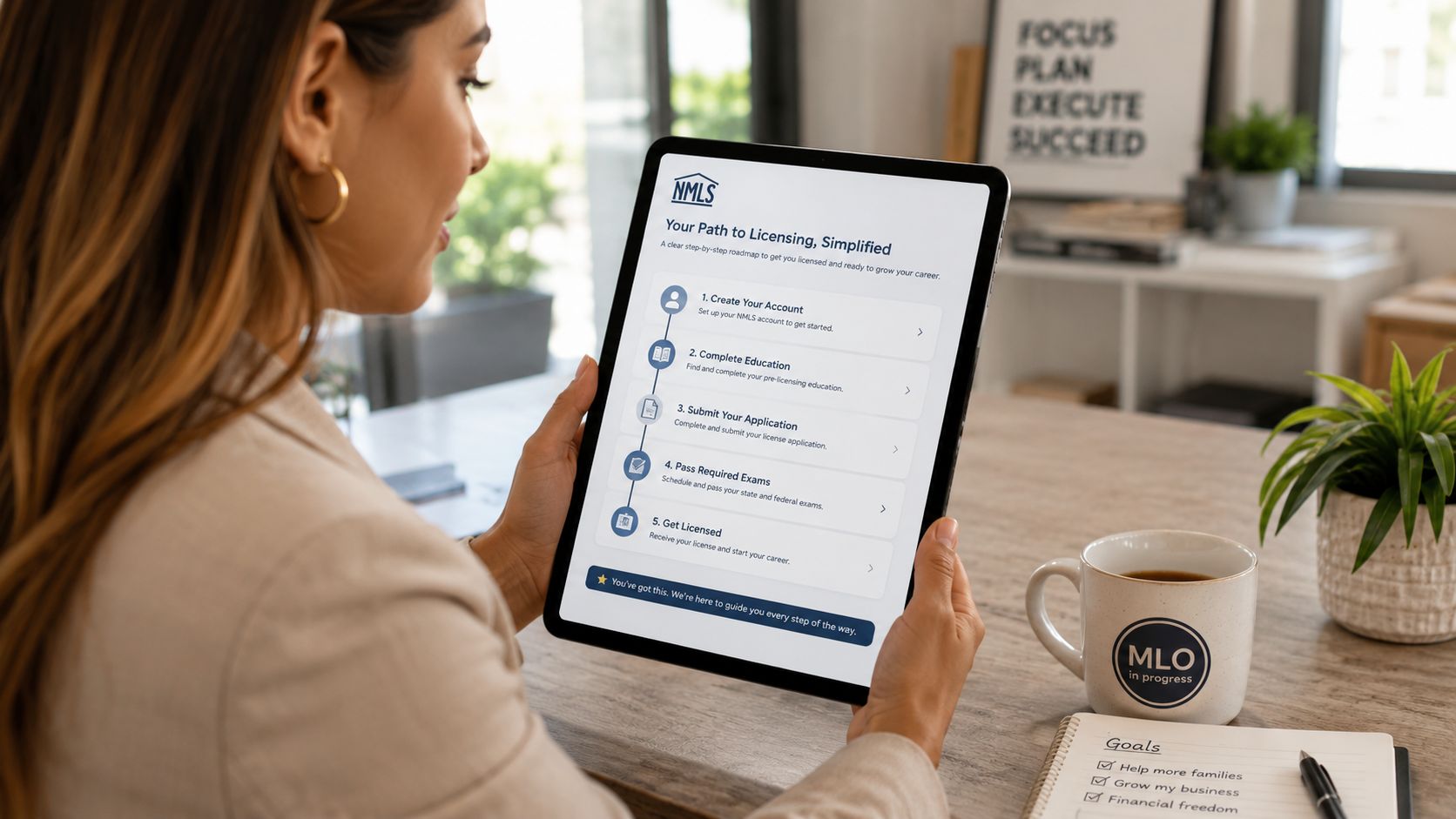
Once you stop expecting an automatic transfer, the path gets straightforward. The process is really a sequence of checks, course completions, and filings. Because there is only one national licensing test with uniform state content, passing that exam allows an MLO to add a new state license by submitting an application, paying the required state fees, and completing any required state-specific pre-licensing modules, as explained in this overview of adding a new state MLO license.
Step one, verify the target state rules
Start with the state you want to add, not with assumptions from your current state. Look at education, testing, sponsorship, and any state-law modules the new jurisdiction requires.
Some states are simple additions. Others want a short law course or another item before approval. This is why experienced originators check the exact requirements first and build their application backward from that list.
If you’re mapping out several states, a practical planning mindset helps. Teams in other regulated industries solve similar compliance problems with structured learning systems. This breakdown of an insurance continuing education LMS is useful because it shows how organized training delivery reduces errors when people manage multiple jurisdiction rules.
Step two, complete any state-specific education
This is the part many people underestimate. Your national education stays with you, but some states still want local law content or another state-specific module. That doesn’t erase your prior work. It just means the state wants to confirm you know its local rules.
Common examples include short state law courses tied to the jurisdiction you’re adding. If you’re organized, this step is usually fast because you’re only filling the gap between the national baseline and that state’s local requirements.
Step three, confirm your testing status
If you’ve already passed the national SAFE test with the required uniform state content, you may not need another full exam. But you do need to confirm whether the state requires anything additional.
That’s where people save time by checking before they file. A complete testing record in NMLS turns this step into a confirmation task instead of a panic moment.
Step four, file through NMLS and submit the required items
Once the education and testing pieces are lined up, you submit your application through NMLS. If you want a more detailed walkthrough of that workflow, this guide to getting a mortgage loan originator license in multiple states lays out the process cleanly.
A simple checklist helps:
Choose the new state carefully: Pick the state tied to real referral flow, employer needs, or borrower demand.
Match your record to that state: Confirm education, exam status, sponsorship, and any bond requirements.
Submit a complete application: Incomplete filings cause the most avoidable delays.
Track follow-ups promptly: If the state asks for an item, respond quickly so your application doesn’t stall.
A second-state license feels hard before you do it. After you do it once, it usually becomes a repeatable business process.
That’s the shift seasoned MLOs make. They stop treating multistate licensing like a mystery and start treating it like expansion.
What to Expect for State-Specific Requirements
The biggest surprise for many originators isn’t the concept. It’s the paperwork. Every new state can add its own fees, timing rules, sponsorship requirements, and compliance details. That’s why budgeting and document prep matter.
Each state application carries a unique licensing fee, ranging from $50 in Wisconsin to $200+ in New York, plus a separate $30 NMLS processing fee per state and state-specific exam fees of $50 to $75. The same set of data also notes a 25% increase in license denials in 2025-2026 tied to applicants who failed to secure sponsorship for the new state before applying (Source 3, Source 5, Source 7).
The documents that commonly slow people down
The state may want more than just a payment and form submission. You may also need sponsorship, a bond, state-law education proof, or other supporting items before the application can move.
That’s why experienced MLOs gather these items early:
Sponsorship details: Sponsorship usually doesn’t transfer automatically from one state to another.
Background and credit authorizations: New applications often trigger these checks through NMLS.
State-law course records: If the target state wants local education, you’ll need proof completed in the right format.
Bond coverage information: Some states require surety bond coverage before approval.
Missing sponsorship is one of the easiest ways to turn a simple expansion plan into a denial.
Sample State-Specific MLO Requirements 2026
Requirement
New York Example
Kentucky Example
Pre-licensing education
20 hours of NMLS-approved pre-licensing education, including a specific 3-hour New York law module
20 hours of pre-licensing education
Test requirement
Pass the national SAFE Mortgage Loan Originator Test
Pass the national test component with uniform state content
Surety bond
Surety bond required
$15,000 surety bond if annual loan volume is under $10 million, or $20,000 if volume exceeds $10 million
If you want a practical budgeting reference before choosing your next state, this breakdown of NMLS license cost by state is a useful planning tool.
Managing Your Multi-State MLO Career
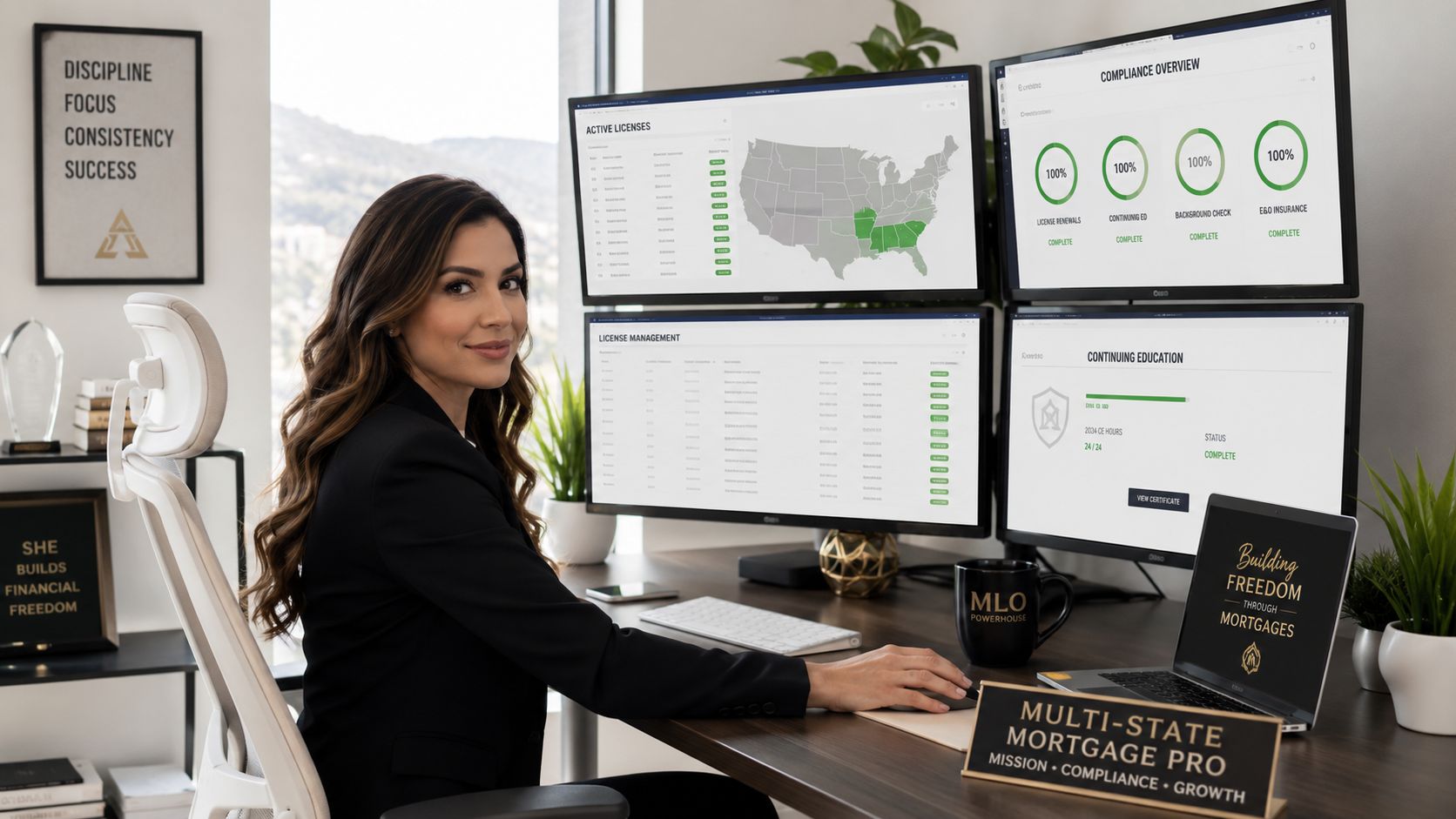
Adding licenses is one win. Keeping them active is the habit that turns a good MLO into a durable producer. Multi-state work gives you more ways to serve borrowers, but it also asks you to stay organized with renewals, continuing education, and state-by-state compliance.
That effort pays off. A 2023 report by the Mortgage Bankers Association found that 68% of MLOs who utilize reciprocity earn 40% more in annual income than those limited to one state. The same data says the average MLO holding licenses in three states spends roughly $450 annually on licensing fees and education costs (Source 2).
The routine that keeps licenses active
You don’t need a complicated system. You need a repeatable one.
A solid multi-state rhythm usually includes:
Calendar discipline: Track renewal windows for every state you hold.
CE planning: Finish annual education before the year-end rush.
Sponsorship review: Confirm your employer setup remains valid in each jurisdiction.
NMLS housekeeping: Keep your record current so nothing lingers unresolved.
Why compliance supports freedom
New recruits often think compliance limits flexibility. In practice, the opposite is true. When your licenses are current, you can work from home, take referrals from more than one market, and build a pipeline that isn’t tied to one zip code or one local cycle.
That’s especially valuable for people who want more control over their schedule. You can name your hours more easily when your business isn’t dependent on one narrow geography. You can also protect your income better when one market cools while another remains active.
The MLOs who stay organized don’t just avoid problems. They create more room to earn.
This is why seasoned originators stop seeing CE and renewals as annoying admin. They treat them as the maintenance cost of a wider, stronger business.
Your Mortgage Reciprocity Questions Answered
A few questions show up every time this topic comes up. They’re fair questions, and the answers are simpler than commonly expected.
Do I have to retake the 20-hour national course for each new state
No. Your national pre-licensing education is your base credential. When people ask about Reciprocity Mortgage License – How It Works, this is often the relief point. You aren’t repeating the whole national course each time you expand. You’re usually adding only what the new state specifically requires.
How do I handle CE for multiple states
Think in layers. You complete your annual core CE requirement, then add any state-specific CE pieces required by the jurisdictions where you’re licensed. That’s why staying organized matters more than anything else.
If you keep a simple renewal calendar and pay attention to your state list, CE becomes manageable. Most experienced MLOs treat it like routine upkeep, not a major obstacle.
Do I need CE in my first year
There’s a helpful exception here. MLOs who complete their pre-licensure education in the same calendar year as their license approval are exempt from completing continuing education for that first year, according to this explanation of multi-state MLO licensing and CE timing.
What’s the biggest mistake to avoid
Assuming a current license automatically opens the next state. That misunderstanding leads people to delay applications, skip state-specific requirements, or miss sponsorship setup. The better approach is simple. Treat each added state as an expansion application built on your existing NMLS record.
Once you understand that, the process feels much less intimidating. It starts to look like what it really is. A practical path to a broader career.
If you’re ready to move beyond one-state production, 24hourEDU can help you build that next step with NMLS-approved online mortgage education, free exam prep, and support from professionals who understand the licensing process. As NMLS Provider ID 1405107, 24hourEDU offers online training designed to make multi-state growth feel organized, achievable, and career-focused. The platform is fully approved by the NMLS Nationwide Multistate Licensing System and Registry.
24hourEDU NMLS Mortgage Loan Officer Course – $189 All States