You’re probably here because you want a career change that feels practical, not vague. You want a path that leads to real work, flexible scheduling, and the chance to build income by helping people secure a home loan instead of sitting in the same role year after year.
That’s why Oregon mortgage lending keeps drawing in career changers, recent grads, sales professionals, notaries, and people who want to work from home. The path is structured, the license is recognized, and once you understand the state rules, the process feels far more manageable than many initially assume.
Why 2026 Is the Year to Launch Your Oregon Mortgage Career
A borrower in Eugene calls at 7:15 p.m. She has found a home, the seller wants a fast close, and she is confused by rate options, disclosure timing, and what her lender needs next. An Oregon MLO who can explain the process calmly and correctly becomes far more than a salesperson in that moment. That person becomes the guide.
That is why 2026 is a smart time to enter Oregon mortgage lending. The field rewards people who can combine people skills with rule-based precision. In Oregon, that second part matters more than many new originators expect.
The opportunity is real, but preparation matters more in Oregon
Mortgage lending still attracts people who want income tied to performance and a workday with some flexibility. The same Milliman report noted earlier also pointed to improving production economics and rate conditions that can revive purchase and refinance conversations. Those trends do not promise results for any one person, but they do help explain why new entrants still see strong career potential in the profession.
Oregon adds another layer. New MLOs here need more than a general understanding of federal lending rules. They need to handle state-specific requirements that can surprise even experienced applicants from other industries.
A good comparison is learning to drive. Anyone can understand the pedals and steering wheel. Oregon asks you to learn the road signs, local speed limits, and the hidden school zone camera that catches people who only know the basics. That is exactly what makes this a strong entry point for serious professionals. If you learn the rules early, you start with an advantage.
2026 favors originators who can explain, document, and stay compliant
Borrowers have more information than they used to, but that does not always mean more clarity. Many come in after reading rate alerts, comparing online offers, and hearing conflicting advice from friends or agents. They need someone who can translate the process into plain language.
That skill matters in every state. In Oregon, it matters even more because state law and disclosure expectations can affect how you structure conversations, document files, and protect your license.
This guide goes past generic licensing checklists for that reason. You will see Oregon-specific rules that often surprise new MLOs, including a real compliance example built around the Five-Year Rule and disclosure details many articles skip. If you want a city-level starting point, this Bend, Oregon mortgage licensing guide shows how the process begins in practical terms.
Flexible work is still part of the appeal
Many loan originators build a schedule around referral meetings, borrower calls, and digital follow-up. Some work largely from home. Others shape their week around evenings and weekends, especially when serving first-time buyers who cannot talk during business hours.
Technology supports that style of work. CRM systems, borrower updates, and lead management tools can help keep communication organized and timely. For a broader look at the software many teams now use, AI solutions for mortgage lenders shows how lending businesses handle outreach and operations more efficiently.
The exciting part is simple. You do not need to know every rule on day one. You do need a clear training path, a respect for Oregon compliance, and the willingness to build your knowledge one step at a time. In Oregon mortgage lending, that foundation can turn into a career with both staying power and momentum. And for people who learn the details early, 2026 offers a real opening to stand out.
Your Simple Path to an Oregon MLO License
You decide to pursue an Oregon MLO license, open a few tabs, and suddenly it feels like you are staring at five different systems, several legal terms, and a process written for people who already work in lending. That reaction is normal.
The good news is that the path is more orderly than it first appears. Oregon licensing works like a checklist with gates. You clear one gate, then the next, and each step builds on the one before it.
At a high level, Oregon uses the Nationwide Mortgage Licensing System as the application hub, and the state regulates mortgage bankers, brokers, and loan originators under Oregon law through the Division of Financial Regulation. If that sounds abstract, simplify it this way. NMLS is your control panel. Oregon law is the rulebook. Sponsorship is your workplace connection.
Oregon MLO License Requirements at a Glance
Requirement
Details
Licensing system
Oregon uses the NMLS for company and individual mortgage licensing.
Pre-licensing education
New Oregon MLOs must complete 20 hours of NMLS-approved pre-licensing education, including 4 hours of Oregon state law, 3 hours of Federal law, 3 hours of ethics, 2 hours of non-traditional lending, and 8 hours of electives, as noted earlier in the article.
Sponsorship
In Oregon, every MLO must be individually licensed and sponsored by a state-licensed mortgage lender company, according to the Oregon mortgage lender licensing page.
Continuing education
After licensure, Oregon MLOs must complete 8 hours of NMLS-approved annual continuing education, including 2 hours of Oregon law, 3 hours of Federal law, 2 hours of ethics, and 2 hours of non-traditional lending, starting the year they are licensed, per the NMLS Oregon state-specific requirements page.
The licensing steps in plain English
Start with your NMLS account. That is the place where your education records, testing status, application items, and license activity come together. If your account setup is sloppy, the rest of the process gets harder than it needs to be.
Next comes education. New applicants often understand the national SAFE requirement but miss Oregon’s state law piece, which later causes delays and confusion. That detail matters more in Oregon than many first-time applicants expect, because state-specific rules affect what you can say, disclose, and document once you begin working with borrowers.
Then comes the practical sequence:
Create your NMLS account and enter your information carefully.
Complete NMLS-approved pre-licensing education with the Oregon law hours included.
Prepare for and pass the SAFE exam so your education turns into a licensure-ready application.
Submit your application items in NMLS and fix any deficiencies quickly.
Obtain sponsorship from a state-licensed mortgage lender company so your individual license can become active.
One point trips up new applicants again and again. In Oregon, getting the education done is only part of the path. You also need the right employer relationship in place.
Why Oregon feels different from generic licensing guides
Many licensing articles stop at “take the class, pass the test, file the application.” Oregon asks for a little more attention to detail.
For example, new loan originators are often surprised to learn how much state-specific compliance shapes daily work. Oregon law is not just background reading for an exam. It affects disclosures, prohibited conduct, and how a file should look when a regulator or employer reviews it. That is why this guide gives extra attention to Oregon-only issues, including the compliance example built around the Five-Year Rule later in the article.
The first is missing the Oregon-specific education requirement because the applicant assumes the national course covers everything needed for the state.
The second is misunderstanding sponsorship. Oregon does not treat an MLO license like a stand-alone credential you can hold in isolation while figuring out employment later. The company relationship is part of how licensure works in practice.
That may sound technical. It is helpful. Once you understand the order, the process becomes much easier to manage.
You are not trying to master all of Oregon mortgage lending at once. You are completing a sequence: account setup, education, testing, application, and sponsorship. Follow that sequence carefully, and the path to becoming an MLO in Oregon starts to feel far more clear and achievable.
The Four-Hour Oregon Law Course You Cannot Skip
A new applicant in Oregon often finishes the national pre-licensing material feeling ready, then hits an unexpected checkpoint. Oregon expects state-specific training too. That extra four hours is where many future MLOs first see how Oregon mortgage lending works in real files, real disclosures, and real compliance reviews.
Oregon’s pre-licensing education includes the national SAFE Act topics and a 4-hour Oregon law component. Treat that state module like the part of driver training where you stop studying general road rules and start learning the local signs, hazards, and enforcement patterns. The national course gives you the map. Oregon law shows you the streets you will drive.
Why this course carries so much weight
State law is where new MLOs begin to understand what regulators, employers, and borrowers will expect from them day to day. You are not just learning terminology. You are learning how Oregon handles disclosures, prohibited conduct, oversight, and documentation standards.
That matters because Oregon-specific mistakes are rarely dramatic at first. They usually look small. A missing written notice. An incomplete file note. A loan term explained verbally but not documented correctly. In class, those details can feel minor. In practice, they can decide whether a file holds up under review.
One Oregon topic surprises students because it is so practical. If a loan includes a prepayment penalty, or if the lender keeps the right to refuse early repayment, the borrower must receive the required written notice. That rule teaches an important lesson early. Oregon expects mortgage professionals to explain meaningful loan terms clearly and document that communication carefully.
What a strong course package should include
Choose a course package that includes the Oregon law hours as part of the full pre-licensing path, not as an afterthought you have to track down later. The best setups make it easy to complete the national material, finish the Oregon-specific training, and prepare for testing in one place.
If you want to compare self-paced Oregon-specific MLO course options, focus on how clearly the provider teaches state rules that show up in real origination work. A useful Oregon course should help you connect the law to borrower conversations, file quality, and compliance habits you will use from your first month on the job.
Students who perform well in Oregon law training are often the ones who slow down, ask why a rule exists, and practice applying it to actual lending situations. That is encouraging news. You do not need years of industry experience to do well here. You need a solid process, careful reading, and the willingness to learn Oregon’s rules the right way.
Navigating Key Oregon Lending Regulations
Your first month as an Oregon MLO can feel straightforward right up until a file, a text message, or a company process raises a state-law question you did not see coming. That is why Oregon rules are best learned like a road map. You do not need every side street on day one, but you do need the main routes that keep you out of trouble.
The rules that shape daily origination work in Oregon usually fall into four buckets. Borrower disclosures. Company licensing structure. marketing and outreach limits. Recordkeeping and investor-related duties. If you learn those buckets early, the state-specific pieces start to make sense.
Disclosure rules that surprise new MLOs
Oregon expects clear communication on loan terms that can materially affect a borrower’s choices. A good classroom example is a loan with a prepayment penalty, or a loan where the lender keeps the right to refuse early repayment. In that situation, the borrower must receive the required written notice. If the notice is missed or handled poorly, the lender may have trouble enforcing that term later.
That point matters because it teaches the habit behind the rule. Oregon does not want meaningful loan costs or restrictions buried inside a stack of forms. Your job is to explain them in plain language, confirm the borrower received the disclosure, and document the file so another reviewer can follow what happened.
There is a second disclosure area that catches beginners off guard. Some Oregon rules reach beyond the borrower and into transactions involving real estate paper or fractionalized interests. In those situations, fair dealing and accurate disclosures matter on the investor side too. New MLOs often expect state law to focus only on consumer-facing forms. Oregon is broader than that.
Company setup matters more than many beginners expect
An MLO works inside a licensed structure, not as a free-floating individual. That sounds obvious, but it has practical consequences. If the company side is not set up correctly, the individual side of the work gets shaky fast.
For example, Oregon requires a mortgage lender company to maintain a $50,000 surety bond as part of licensure. Licensing activity and amendments are handled through NMLS, as noted earlier in this guide. For a new originator, the lesson is simple. Always confirm which entity you are sponsored by, whether a branch is properly authorized, and whether your advertising and disclosures match the licensed business identity the state recognizes.
That is the compliance version of checking the name on a jersey before walking onto the field. If the entity name, branch status, or licensing record is wrong, even otherwise solid loan work can create avoidable problems.
Oregon outreach rules can affect everyday lead follow-up
Many new MLOs think of compliance as something tied only to disclosures and closing files. Oregon also regulates how you contact people.
Oregon enacted HB 3865 in July 2025, which expanded the Unlawful Trade Practices Act to classify text messages as telephone solicitations, prohibited solicitations between 8 p.m. and 8 a.m., and limited daily solicitations to three calls, with the statute taking effect on January 1, 2026.
For a new loan originator, that changes ordinary pipeline activity in very practical ways:
Texts count. A casual follow-up text can fall within solicitation rules.
Quiet hours apply. Outreach between 8 p.m. and 8 a.m. is prohibited unless an exception applies.
Frequency matters. The law limits daily solicitations to three calls in the covered context.
A helpful rule of thumb is document like a regulator will read it and communicate like a borrower will remember it. That mindset protects both compliance and reputation.
Fair lending belongs in file review, not just training
Fair lending is not a one-time exam topic. It shows up in product discussions, pricing conversations, documentation, and follow-up habits.
The Oregon Center for Public Policy discussed racial disparities in Oregon subprime lending. For a new MLO, the lesson is clear even without memorizing historical figures. Watch for patterns. Ask whether the product fits the borrower’s needs. Make sure explanations are consistent from file to file. Keep your notes clear enough that another professional can see why the recommendation made sense.
That is how good origination habits become good compliance habits. In Oregon, those two are closely connected.
A Real-World Oregon Compliance Scenario
The fastest way to understand state law is to see how ordinary mistakes pile up. A useful Oregon training scenario is the Maple Ridge Lending example, often called the Five-Year Rule test.
Maple Ridge Lending is an Oregon mortgage broker with a Portland headquarters and two branches. In March, the company receives a routine data request. The annual report is due by May 1, and while preparing its response, staff discover problems with file storage, record retention, reporting accuracy, and where key communications were kept.
What triggered the trouble
The regulator asked for samples of closed, denied, and withdrawn loan files from the past five years, along with related business records. Staff were also reminded that the Director may examine records at any time and require production at the Director’s office.
That’s when the gaps became visible.
Submitted reports and records are confidential, but the Director may publish aggregate abstracts that do not identify a specific licensee.
Where Maple Ridge Lending went wrong
Record retention and file location
Some loan files from 2019 and 2020 had been moved off-site without prior notice to the Director. The storage boxes were labeled only by month and year, with no index showing exactly which drawer, box, or container held a particular record.
A branch had also kept two years of files locally without filing a branch-record notice. Some records existed only as scans, but the company had no formal policy designating electronic images as the official record copy.
Completeness and accessibility
Several withdrawn files didn’t include final withdrawal notations or confirming correspondence. Messages related to a disputed fee were sitting in personal email accounts instead of the business archive.
Accounting had vendor invoices and bank advices, but those records weren’t exported into the relevant loan-level packets. That slowed production when the request came in.
Annual reporting and corrections
The prior annual report missed a group of brokered HELOC applications because of a filter error. The company had no documented workflow for prompt correction, and no amended filing or notice had been submitted after the mistake was found.
The lessons every new MLO should keep
The Five-Year Rule is a plain-language way to remember Oregon’s expectation that mortgage businesses make and keep prescribed accounts, correspondence, memoranda, books, and records for 5 years from close, denial, or withdrawal. It also reinforces that the Director may require production of records without a subpoena at the Director’s office.
For a new MLO, the practical lessons are simple:
Use business systems only: Don’t leave borrower or fee discussions in personal email or text threads.
Document status changes: If a file is withdrawn, the record should clearly show that and include supporting communication.
Know where records live: If records are stored off-site or at a branch, the location and indexing process should be organized and properly noticed.
Correct mistakes fast: If a filing becomes incomplete or inaccurate, the response can’t be silence.
This scenario sticks with students because nothing about Maple Ridge Lending sounds dramatic at first. That’s the point. Most compliance problems start as ordinary shortcuts.
Understanding The Current Oregon Market Landscape
A new Oregon borrower calls and asks a simple question: “Should I take the lower rate or the lower payment?” If you can answer that clearly, you are already doing one of the most important parts of this job.
That is a key market lesson for a new MLO. Oregon borrowers are not only shopping for a house. They are comparing payment size, repayment speed, cash-to-close, and risk tolerance, often in one conversation.
Current Oregon rate examples borrowers can understand
As of July 2, 2026, Oregon borrowers could find a 30-year fixed-rate mortgage at 6.375% with a 6.444% APR, and a 15-year fixed-rate mortgage at 5.625% with a 5.814% APR, according to OnPoint Community Credit Union’s Oregon mortgage rate page.
On that same date, the estimated monthly payment examples listed there were:
30-year fixed:$2,573.46
15-year fixed:$3,397.89
FHA loan at 6.250% with 6.365% APR:$2,539.83
These numbers help you teach, not just quote. A shorter loan term often works like taking bigger steps up the same staircase. You may reach the top faster, but each step takes more effort each month.
How to explain the tradeoff without confusing the borrower
A 30-year fixed usually gives the borrower more monthly breathing room. A 15-year fixed may reduce total interest over time and may come with a lower rate, but the required payment is much higher because the balance is being repaid faster.
That distinction matters in Oregon, where many borrowers are stretching to balance housing costs with property taxes, insurance, and everyday expenses. A strong MLO slows the conversation down and separates three ideas that borrowers often blend together: rate, APR, and payment.
Use simple language. Rate is the note rate. APR is a broader cost measure. Payment is the cash the borrower must produce every month. In borrower education, those three terms should stand out like brand markers in dark blue and bright blue, because mixing them up leads to bad decisions.
What the Oregon market means for a new MLO
Recent years have trained borrowers to expect quick swings in affordability. Some shoppers pause when rates rise. Others adjust by changing loan type, down payment, price range, or repayment term instead of leaving the market entirely.
That creates an opening for well-trained originators.
Your value is not limited to finding a product. Your value is helping a borrower compare realistic paths and spotting when one option solves today’s problem but creates strain six months later. Oregon-specific training matters here because local practice is shaped by more than general mortgage math. State rules, disclosure timing, recordkeeping expectations, and file discipline all affect how confidently you can guide the conversation from application to closing.
Market awareness is now part of compliance awareness
New MLOs sometimes treat “market knowledge” and “compliance knowledge” as separate buckets. In practice, they overlap. If a borrower is choosing between conventional and FHA financing, your explanation has to be accurate, documented, and consistent with the disclosures and loan terms in the file.
That is one reason this guide puts so much attention on Oregon-specific surprises. The Five-Year Rule case study earlier showed how ordinary process gaps can become compliance problems. The same idea applies to borrower conversations. If you discuss product differences loosely, then the file reflects something else, confusion grows fast.
For a stronger grasp of how housing trends and borrower behavior can be interpreted through data, Supatool on real estate data analytics adds useful perspective.
Borrowers remember the MLO who makes complex choices feel clear, orderly, and achievable. In Oregon, that skill is part teaching, part sales, and part disciplined file practice.
Take Your First Step Today with 24hourEDU
The path into Oregon mortgage lending is clear once you understand the moving parts. You need the right education, a working knowledge of Oregon law, strong exam preparation, and a plan for sponsorship.
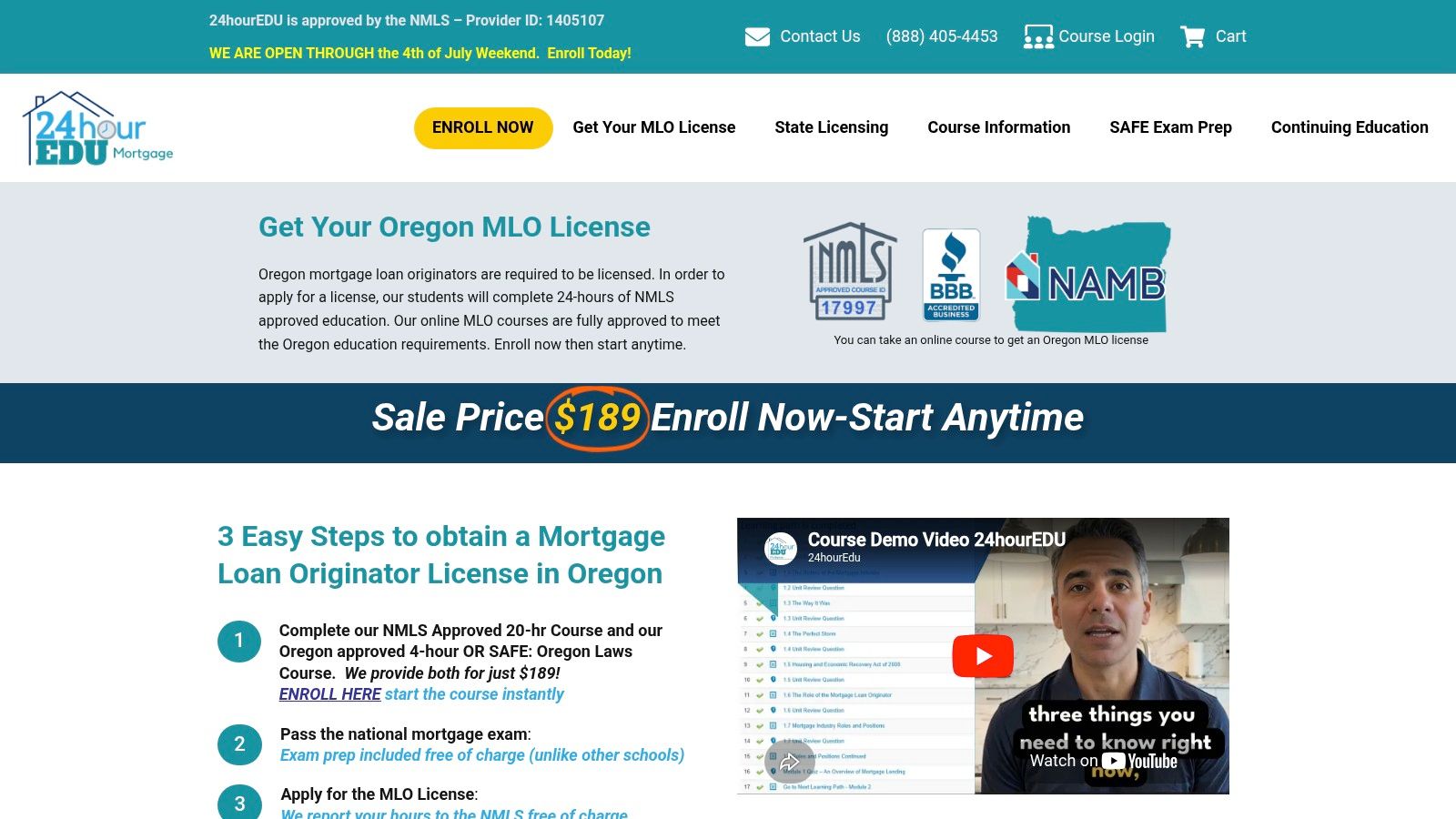
24hourEDU makes that path easier. The program is fully online, fully approved by the NMLS Nationwide Multi-State Licensing System and Registry, and offered by NMLS Provider ID 1405107. It includes the education you need for Oregon, plus a free exam prep package that helps you get ready for the SAFE exam without piecing together separate resources on your own.
If you enjoy learning how data shapes borrower conversations, Supatool on real estate data analytics is also worth reading for added market perspective.
When you’re ready to start, this NMLS-approved 20-hour pre-licensing course is the simplest place to begin. The training is online, practical, and built for people who want a direct route into the profession.
If you’re ready to launch a career in Oregon mortgage lending, 24hourEDU gives you a straightforward way to get there. You’ll get online NMLS-approved education, the Oregon-specific training you need, and a free exam prep package designed to help you move forward with confidence. The profession offers flexibility, commission income potential, and the chance to help borrowers every day. Start now and turn that next career step into a licensed mortgage future.
24hourEDU NMLS Mortgage Loan Officer Course – $189 All States