

There is no true national reciprocity for an MLO license in the United States under the SAFE Mortgage Licensing Act of 2008. What does travel with you is your NMLS ID, your SAFE MLO Test pass, your FBI background check, and your credit report, while each state still issues its own license.
Can you get an MLO license by reciprocity? Not in the simple, automatic sense many hope for. The better question is how to use the NMLS system to add a new state without starting from scratch, and that’s where the process gets much easier than it first looks.

The Short Answer on MLO License Reciprocity
The short answer is no, not as a true nationwide license transfer. For a non-depository Mortgage Loan Originator, the SAFE Mortgage Licensing Act of 2008 requires licensure in each state where you take an application or negotiate terms, even though NMLS makes the process feel more connected than a stack of separate state systems.
That difference matters. People hear the word “reciprocity” and picture a one-step transfer, but the system is closer to a second application built on top of your existing record. Your file already has the important pieces, so you’re not rebuilding your career every time you cross a border.
What carries forward
The reusable pieces are the NMLS ID, the SAFE MLO Test pass, the FBI background check, and the credit report. That’s why multi-state licensing is absolutely doable, even if it isn’t true reciprocity. The state still decides on its own application, fees, disclosures, and sponsorship approval, which is why the final step always feels state-specific.
If you’re just getting started, think of this as a career you can build across markets without redoing the whole national foundation every time. A course path that prepares you once, then helps you add states with less friction, fits the way MLO work happens.
For a plain-English overview of the rules that sit behind the licensing process, this banking regulations and compliance guide is a helpful companion. It gives you context without drowning you in legal jargon.
How the SAFE Act and NMLS Actually Work
The easiest way to understand MLO licensing is to separate the national framework from the state license. The SAFE Act created a shared structure after 2008, but it didn’t erase state authority. NMLS is the common platform, not a single universal license.
The four portable pieces
One source states that the NMLS-approved 20-hour pre-licensing course must be completed before testing and applies to all states, and that the 20-hour course generally only needs to be taken once, even when you later apply in additional states. The same national framework includes the SAFE MLO Test with National Component and Uniform State Content, the FBI background check, and the credit report. Together, those four pieces form the reusable core of your MLO file. The CEShop’s reciprocity overview
Why the state still matters
Each state still controls the rest of the application. That means its own fees, any disclosures it wants, and any education or sponsorship rules it layers on top of the federal baseline. A state can accept your national foundation and still ask for a state law module or a sponsorship record before issuing the license.
Practical rule: NMLS is the shared filing cabinet, but the state is still the office that decides whether you get a key.
That analogy helps because it’s the tension in the process. Your core credentials travel, so the expensive, time-consuming parts of the journey are partly reusable. That’s good news if you want to expand into a second state or build a multi-state book of business.
For a deeper look at how the licensing rules fit together in practice, this mortgage compliance resource is worth reading once you’ve got the big picture.
True Reciprocity vs NMLS Portability vs Transitional Licensing
These three phrases get blended together online, but they do different jobs. If you can label your situation correctly, you’ll know whether you’re applying fresh, adding a state, or using a narrow move-related pathway.
The three paths side by side
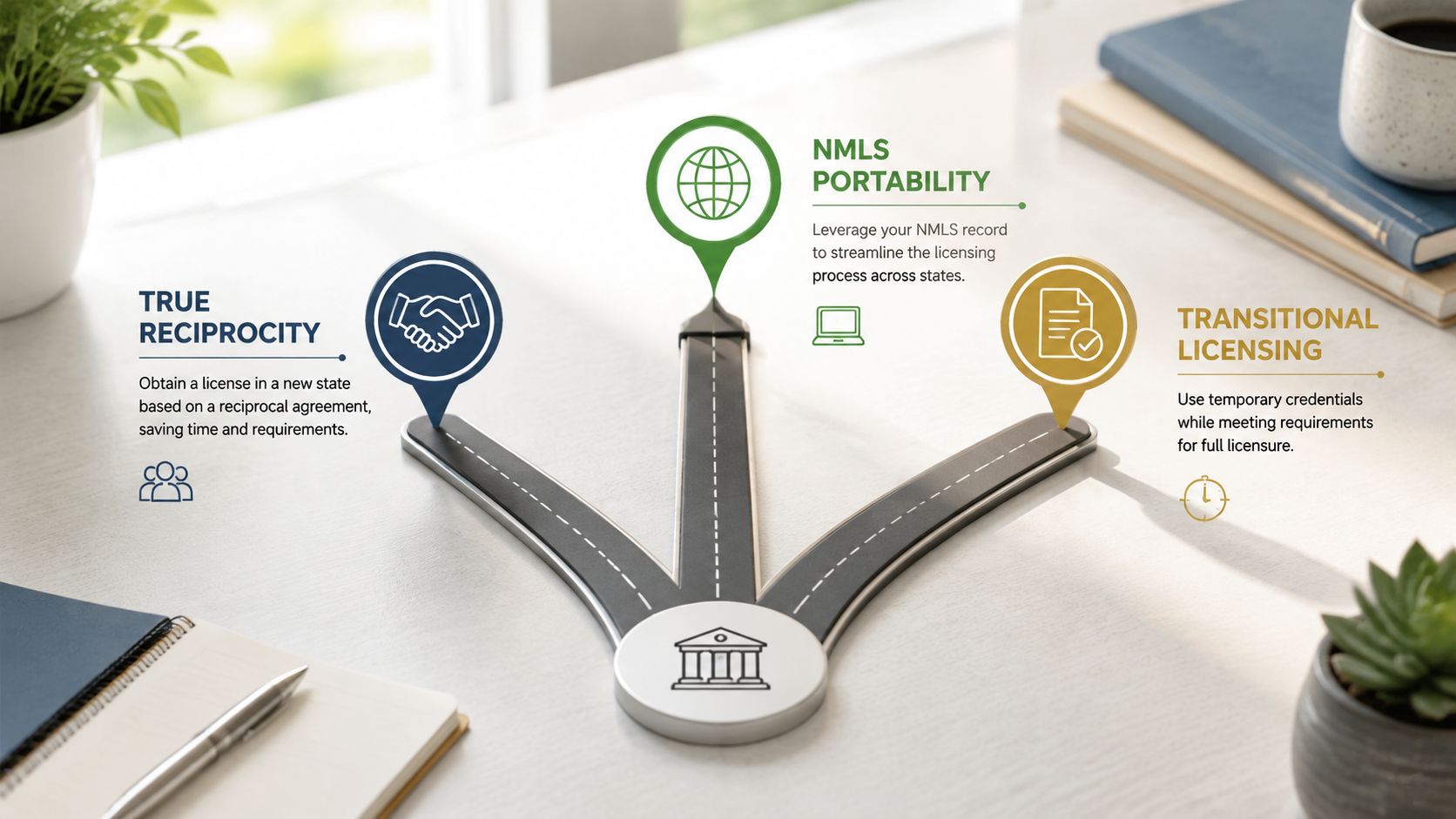
True reciprocity would mean a license in one state automatically authorizes you in another. That’s what is often meant when asking, “Can you get an MLO license by reciprocity?” In practice, that’s not how MLO licensing works in the United States.
NMLS portability is the structure. Your core credentials follow you, but the new state still issues its own license and can require state-specific education or sponsorship. In other words, the file is portable, the authority is not automatic.
The lesser-known third path is the CFPB transitional loan originator license. The CFPB has clarified that federal law can allow that transitional license when a licensed originator moves from one state to another, which gives you a narrower operating window while the new license is processed. CFPB clarification on state reciprocity and transitional licensing
How to recognize your own situation
If you’re brand new, you’re not dealing with reciprocity at all. You’re building your first NMLS record. If you already hold one state license and want a second, you’re using portability through NMLS. If you’ve physically moved and need continuity while the new state finishes review, the transitional path may be the issue to discuss with your employer and state regulator.
A lot of confusion comes from marketing language, not from the law itself. Once you know which lane you’re in, the application is much less mysterious.
That distinction matters because it keeps people from wasting time on the wrong assumption. You don’t need a miracle transfer. You need the right filing, the right state requirements, and a clean NMLS record.
Step-by-Step Process for Adding a New State
Adding a new state is usually a matter of moving through the NMLS workflow in the right order. The core file is already there, so your job is to make sure the new state can see what it needs and approve what it controls.
Start with your existing NMLS record
Log into your NMLS account and confirm your current information is accurate. Then check that your SAFE MLO Test status, background check, and credit report are still available in the file. If you’re adding a state after a recent move or a job change, this is the moment to fix anything outdated before the new application goes in.
Submit the state-specific pieces
Next, choose the new state’s application and pay that state’s fees. Some states also want their own disclosures, state law education, or sponsorship approval tied to the employer that will supervise you. If the state requires sponsorship, don’t assume the license will move forward without it.
The 20-hour federal course usually doesn’t need to be repeated, which is why a strong first-course choice matters. That’s also where a clear multi-state licensing walkthrough can save you time, because it keeps you focused on what’s reusable and what’s state-specific.
Expect a practical timeline, not a magic switch
A straightforward file can move in days to weeks, but the state-specific extras can stretch that out. State law training, sponsorship review, or fingerprint processing can slow things down, especially if you leave out a document and have to resubmit. The fastest applicants treat the process like a checklist, not a guess.
- Confirm your account first: Make sure your NMLS profile is current before paying a new state’s fee.
- Reuse what’s already valid: Keep the SAFE test, background check, and credit report in view so you’re not duplicating work.
- Check state extras early: Find out whether the state wants law education, sponsorship, or other jurisdiction-specific items before you file.
- Use clean documentation: Small data entry errors create avoidable delays, so review every field before submission.
24hourEDU’s online format, free exam prep package, and state law module fit neatly into this workflow because they reduce the number of separate things you have to chase. That matters when you’re trying to keep momentum instead of restarting the process from zero.
A Real-World Multi-State MLO Scenario
A licensed Loan Originator in Texas gets hired by a lender that originates in Texas, Oklahoma, and New Mexico. The move doesn’t require a brand-new career path, it requires three state applications tied to one NMLS identity and one professional record.
The Texas license, SAFE test pass, background check, and credit report already live in the file. That means the applicant isn’t rebuilding the foundation, just extending it to the new states and meeting whatever each one asks for on top of the national baseline. If one of those states wants employer sponsorship, the lender’s NMLS activity becomes part of the approval process.
What changes in a move
If that same originator relocates, the question becomes whether a transitional license applies while the new state reviews the file. That’s a more nuanced issue than “reciprocity,” and it’s exactly why career changers get tripped up when they read forum answers that are too simplistic. The rules are workable, but they’re not automatic.
The career upside is real because the system supports mobility. A prepared MLO can work from home, manage their own schedule, and earn commissions across more than one market, which is one reason multi-state licensing is so appealing for people who want flexibility.
The smoothest multi-state move is rarely the one with the fewest forms. It’s the one where every form is already sitting in the right place.
That’s why the process feels better once you’ve done it once. The second state is not a mystery, it’s a variation on a familiar filing pattern, with the same core credentials doing the heavy lifting again.
Common Pitfalls That Delay or Derail Reciprocal Applications
Most delays come from avoidable paperwork problems, not from some hidden licensing trick. Applicants usually lose time because they assume the old file is still perfect, then discover that one detail no longer matches the new state’s expectations.

The most common slowdowns
- Stale background or credit records: Recheck whether the state still accepts the version already in NMLS, and refresh anything that’s fallen out of range.
- Missing state law education: Complete the extra state module before you expect approval, because the 20-hour federal course doesn’t always satisfy the state.
- Inactive sponsorship: Verify that your employer sponsorship is live in NMLS if the state requires it, since an inactive record can stall the file.
- Simple data entry errors: Match your name, employer, and state details exactly before you submit, because even small mistakes can trigger a correction request.
- Assuming one course covers everything: Confirm whether the new state wants additional training instead of assuming the national course solves the whole requirement.
If you want a cleaner way to prepare for the exam side of the process, a proven exam prep system can help you study with more structure than random flashcards.
Smart applicants spend fifteen minutes preventing these issues instead of weeks resubmitting paperwork. That’s the shortcut, and it’s especially useful when you’re trying to stack states without slowing your pipeline.
24hourEDU’s state law module and unlimited phone and email support fit right into that prevention mindset. They help you handle the common friction points before they turn into a licensing delay.
How 24hourEDU Speeds Up the Multi-State Path
The fastest way to think about multi-state licensing is this. You want one national course foundation, one clean NMLS record, and less rework every time you add a new state. That’s exactly where a structured online program helps.
24hourEDU offers the 20-hour SAFE pre-licensing course, online instructor-led video lessons, an e-textbook, a bonus state law module, free exam prep materials, complimentary NMLS hours reporting, and unlimited phone and email support. It’s also fully approved by the NMLS Nationwide Multi State Licensing System and Registry, Provider ID 1405107, and the state-specific details are organized on 24hourEDU’s state licensing page.
Why that matters in practice
The online format makes the national course easier to fit around work, job hunting, or family obligations. Since the 20-hour SAFE course generally only needs to be completed once, the value is having a training path that carries into later state applications without forcing you back through the same starting gate.
The free exam prep package helps you get ready for the SAFE MLO Test, while the state law module addresses the extra education some states want. Complimentary hours reporting removes one more administrative task, which matters when you’re juggling employer onboarding and state filing at the same time.
For career changers and aspiring remote MLOs, that combination keeps the path practical. You’re not just checking a box, you’re building a license foundation that can support a flexible, commission-based career across more than one market.
If you’re ready to add states without turning the process into a paperwork puzzle, visit 24hourEDU and review the MLO licensing options that fit your goals. You’ll get the online training, exam prep support, and state-specific help that make multi-state licensing feel much more manageable.