


You’re considering a career change, but the licensing process may look more complicated than it needs to be. Perhaps you’re comparing classroom programs with an online SAFE course, wondering whether remote instruction can prepare you for the NMLS exam, or trying to understand what happens after you complete the required education. The path becomes manageable when you separate the process into clear steps, choose an approved provider, and study with a plan.
A Mortgage Loan Originator career can offer client-focused work, commission opportunities, and the flexibility to build a schedule around your professional goals. Your first formal step is completing the education required under the SAFE Act, then preparing for testing and registration through the Nationwide Mortgage Licensing System and Registry, commonly called NMLS.
Why the SAFE Course Is Your Gateway to a Mortgage Career
You may already have skills that fit mortgage lending. A sales representative explains options, an administrator tracks documents, and a property manager handles detailed client questions. Those experiences can transfer because Mortgage Loan Originators, or MLOs, must explain complex information, organize files, communicate clearly, and guide applications through a regulated process.
The Secure and Fair Enforcement for Mortgage Licensing Act of 2008, known as the SAFE Act, established the national framework for mortgage-originator education and licensing. Congress enacted the law on July 30, 2008, giving states two years to establish licensing or registration requirements through NMLS. The framework also includes a national mortgage test, character-and-fitness review, credit report, and FBI background check. The NCUA’s SAFE Act compliance guide outlines these requirements.

What the requirement means for career changers
A SAFE course is a defined pre-licensing requirement, not a general professional-development class. For U.S. mortgage loan originator licensing, it must provide 20 hours of NMLS-approved education covering federal law, ethics, nontraditional mortgage lending, and broader origination instruction. NMLS’s SAFE Act education specifications identify these required categories.
The coursework introduces the vocabulary and responsibilities you will use with borrowers. You study compliance duties, loan products, borrower communication, and the consequences of incomplete or inaccurate information. The exam tests that knowledge, but the same foundation also helps you explain an application with greater confidence.
Practical rule: Choose education that explains why a rule exists, not only which answer to memorize.
Delivery affects how well that foundation sticks. An online course can let you review lessons from home, schedule study blocks around work or family, and revisit difficult concepts. Modern programs may combine instructor-led video with live support, giving you access to explanations and questions in a format that is easier to review than a single classroom presentation. A useful overview of the format appears in this guide to taking a mortgage license class online.
The SAFE Act also makes education an ongoing responsibility. Licensed MLOs must complete 8 hours of annual continuing education, so the first course begins a continuing learning process rather than ending with the exam. Mortgage rules, products, and borrower circumstances demand careful attention throughout the career.
Breaking Down the 20-Hour Curriculum Requirements
Before enrolling, review how the required curriculum is divided. Each hour category serves a different purpose, much like sections of a map. Together, they show whether a course covers the knowledge you need for the NMLS exam and early conversations with borrowers.
Federal law and regulations
Three hours must cover federal law and regulations, according to the NMLS SAFE Act education requirements. Lessons address mortgage advertising, disclosures, consumer protection, lending practices, and originator responsibilities.
Federal law may feel dense because many rules depend on timing, documentation, and the borrower’s circumstances. Study each rule through a practical situation, such as explaining a disclosure, handling an application, or identifying information that needs further review. Instructor-led video and accessible support can make those connections easier to revisit than a single classroom explanation.
Ethics
The course must include three hours of ethics, as specified by 12 CFR 1008.105. This material examines the judgment required when a borrower feels pressured, a file contains incomplete information, or a business goal conflicts with a compliance duty.
Borrowers often depend on an MLO’s explanation when making a major financial decision. Ethical conduct includes communicating accurately, protecting private information, and avoiding practices that could mislead or disadvantage an applicant. Scenario-based questions deserve careful attention because the exam may test judgment rather than simple recall.
Nontraditional mortgage products
The curriculum includes two hours on nontraditional mortgage product lending standards. This material is not intended to make you an immediate expert in every product. It helps you recognize product risks, suitability questions, and disclosure concerns when a loan differs from a standard fixed-rate structure.
Study the borrower impact first. Ask how the product changes payment expectations, qualification, risk, and the way information must be explained. Those questions connect exam preparation with responsible client communication.
Mortgage origination instruction
The remaining 12 hours cover mortgage origination instruction under the SAFE Act structure. This broader component may include the mortgage process, terminology, borrower qualification, documentation, loan structure, and the originator’s role in coordinating information.
A well-designed online course turns abstract requirements into a working foundation through instructor-led video, written materials, knowledge checks, and explanations you can review more than once. For a clearer look at course coverage, compare the 20-hour SAFE MLO course before choosing a provider.
The required hour categories still need to be complete and correctly allocated. An attractive interface cannot make up for missing content. Confirm that the provider’s curriculum is NMLS-approved and designed to satisfy the full national requirement.
Online vs In-Person SAFE Course Delivery
The format affects how you organize your learning, but approval and instructional quality matter more than the location of the classroom. An in-person course gives you a fixed environment and immediate access to an instructor. A modern online program can provide instructor-led video, digital reading, interactive checks, and support through phone or email without requiring a commute.
NMLS policy distinguishes among online formats. The NMLS education functional specifications state that the online instructor-led format is reserved for pre-licensure education, except for pre-licensure state-specific courses that are 10 hours or less, which must use the online self-study format. This makes it important to understand how a provider describes its delivery model.
Online vs In-Person SAFE Course Comparison
| Factor | Online Format | In-Person Format |
|---|---|---|
| Schedule | Study from an approved digital learning environment around existing obligations | Attend scheduled sessions at a specific location and time |
| Instructor contact | May include instructor-led video and responsive phone or email support | Direct classroom interaction during scheduled instruction |
| Review | Revisit digital lessons and written materials as needed | Ask questions during class and review provided materials afterward |
| Travel | No regular commute to a classroom | Requires travel and attendance at the training location |
| Learning structure | Requires a personal study routine and planned checkpoints | Provides a built-in timetable and physical classroom setting |
| Exam preparation | Can combine course lessons with practice questions, quizzes, and study guides | Depends on what the classroom provider supplies outside class |
| Best fit | Professionals who need location flexibility and organized digital access | Learners who retain material through live group instruction |
Online delivery has also moved beyond static reading. Some providers describe virtual programs with live webinars, case studies, homework, and final exams, while others combine instructor-led video with supplemental literature and state-law content. Those features matter because learners need opportunities to apply terminology and identify misunderstandings before exam day.
The cheapest format isn’t automatically the easiest format. The right choice gives you access to the explanations and structure you need to finish prepared.
In-person instruction may suit someone who benefits from a fixed timetable and spontaneous discussion. Online instruction may suit a career changer who works irregular hours, lives far from a training site, or needs to revisit technical lessons. Neither format removes the need to study actively. Ask how questions are answered, how completion is tracked, what exam preparation is included, and whether the provider is approved before you pay.
What to Expect in Your Online Learning Experience
A quality safe course online should feel like a guided learning environment, not a folder of documents. You’ll typically move through instructor-led video lessons, read supporting material in an e-textbook, complete knowledge checks, and return to challenging concepts as your understanding develops.
The video format can make unfamiliar language less intimidating. Hearing an instructor explain a compliance concept, then seeing it connected to a mortgage scenario, gives you two ways to process the material. The e-textbook provides a searchable reference when you need to review a definition or compare related topics.
Build a routine that fits real life
Online access gives you flexibility, but flexibility works best with structure. Before starting, choose recurring study blocks and assign each session a clear purpose. One session might focus on federal law, another on ethics scenarios, and another on reviewing practice questions.
Use a simple cycle:
- Watch actively: Pause when a concept is unfamiliar and write a plain-language explanation.
- Read for detail: Use the e-textbook to confirm terminology and exceptions.
- Test recall: Complete quizzes without looking back at the lesson.
- Log weak areas: Keep a short list of topics that need another review.
- Ask promptly: Contact support when an explanation doesn’t resolve your question.
Mobile-friendly access can help you use small windows of time, but convenience shouldn’t replace concentrated study. A short review on a phone may reinforce a definition, while a longer session on a laptop may be better for complex scenarios and practice exams.
Interactive features help expose gaps that passive reading can hide. If you repeatedly miss questions about a rule, don’t memorize the correct option. Return to the lesson, identify the reason for the rule, and create your own example.
The strongest online experience combines convenience with accountability. Look for clear progress tracking, usable written materials, accessible lessons, and a support channel that answers specific questions. If a course leaves you alone with confusing terminology, its low price or broad access may not provide meaningful value.
Exam Preparation and NMLS Reporting Process
Completing the education is an important milestone, but it isn’t the same as being ready for the NMLS test. Exam preparation should show you which topics you understand, which ones require more work, and how to apply the rules in scenario-based questions.
Start by reviewing the course objectives rather than guessing what to study. Divide your review by the required subject areas, then use practice quizzes to locate weak points. When you miss an answer, write down both the correct principle and the reason your original choice was wrong. That habit builds judgment instead of short-term recognition.
A practical preparation sequence
Begin with the lessons that feel least familiar. Mortgage terminology can sound similar across topics, so create brief comparison notes for concepts that are easy to confuse. Ethics and federal law deserve careful reading because questions may test how a rule applies to a situation rather than asking for a simple definition.
Next, use the provider’s exam preparation materials. A strong package may include a study guide, practice questions, quizzes, and practice exams. You should be able to explain why an answer is correct before treating a practice result as evidence of readiness.
The NMLS SAFE test resource can help you understand the transition from course completion to exam preparation. Keep your focus on comprehension, not on trying to predict exact test questions.
What happens with completion reporting
Education can satisfy the requirement only when you register for and complete an approved course with an approved provider, according to NMLS testing and education guidance. That means the provider’s approval, course design, and completion process all matter.
Ask the provider how course completion is reported and what you need to do after finishing. Confirm that your records are accurate, retain your completion information, and follow the current NMLS instructions for testing and licensing. Reporting support can reduce administrative confusion, but it doesn’t replace your responsibility to verify your account and complete each required licensing step.
Study habit: Treat every missed practice question as a request for explanation. Review the underlying rule before moving on.
How to Choose the Right SAFE Course Provider
A course provider should earn your confidence through verifiable approval, useful instruction, and reliable support. Price matters, but it shouldn’t be the only filter. A low-cost program that leaves you confused can cost you time and create avoidable frustration.
Start with approval and curriculum
Confirm that the provider is NMLS-approved and that the curriculum contains the required hour allocations. The course should clearly identify the federal law, ethics, nontraditional mortgage lending, and broader origination components. If the sales page is vague about those categories, ask for clarification before enrolling.
Check whether the program supports the state where you intend to seek licensing. National education can provide the core requirement, while state-specific material may be necessary for your application and future practice.
Evaluate the learning environment
Look for instructor-led video, an e-textbook, quizzes, practice exams, and a clear progress system. These features don’t guarantee exam success, but they give you more ways to encounter and apply the material.
Support quality deserves a direct test. Send a specific question before purchasing and observe whether the response is clear, prompt, and useful. If the provider can’t explain how students receive help before enrollment, the same uncertainty may continue after you begin.
Compare the complete value
Use this checklist when reviewing options:
- Approval evidence: Verify the NMLS provider information and course approval details.
- Required content: Confirm that the curriculum follows the national hour categories.
- Exam preparation: Check whether practice questions, quizzes, study materials, and practice exams are included.
- Support channels: Look for phone, email, or instructor assistance with defined access terms.
- Access experience: Test whether the platform works comfortably on the devices you plan to use.
- Reporting process: Ask how completion information is submitted and what confirmation you receive.
- Additional material: Review whether state-law resources or supplemental instruction are available.
A flexible program still needs a completion plan. Choose a start date, reserve study time, and set a personal target for finishing. The best provider for you is the one that matches your schedule while giving you enough structure and human assistance to keep moving.
Why 24hourEDU Meets Every Requirement
The provider you choose should align with the practical standards discussed above. 24hourEDU, listed with NMLS Provider ID 1405107, offers an online 20-hour SAFE course with instructor-led video lessons, an e-textbook, and a bonus state-law module. Its program also includes an exam preparation package at no additional charge, along with study materials and practice resources described by the provider.
The platform lists phone and email support, plus complimentary NMLS hours reporting. Those features address common concerns for first-time MLO candidates, especially students who want direct answers while working through technical material.
A clear path from enrollment to preparation
The course has flexible start dates and is designed for online completion. The publisher states that students can complete the program in two weeks or less, depending on their schedule and study pace. That timeline should be treated as a planning target, not a substitute for understanding the lessons.
The course also reflects the central compliance requirement. You’re not buying access to mortgage content. You’re enrolling in an NMLS-approved education program intended to satisfy the national pre-licensing standard, followed by exam preparation and the remaining NMLS licensing steps.
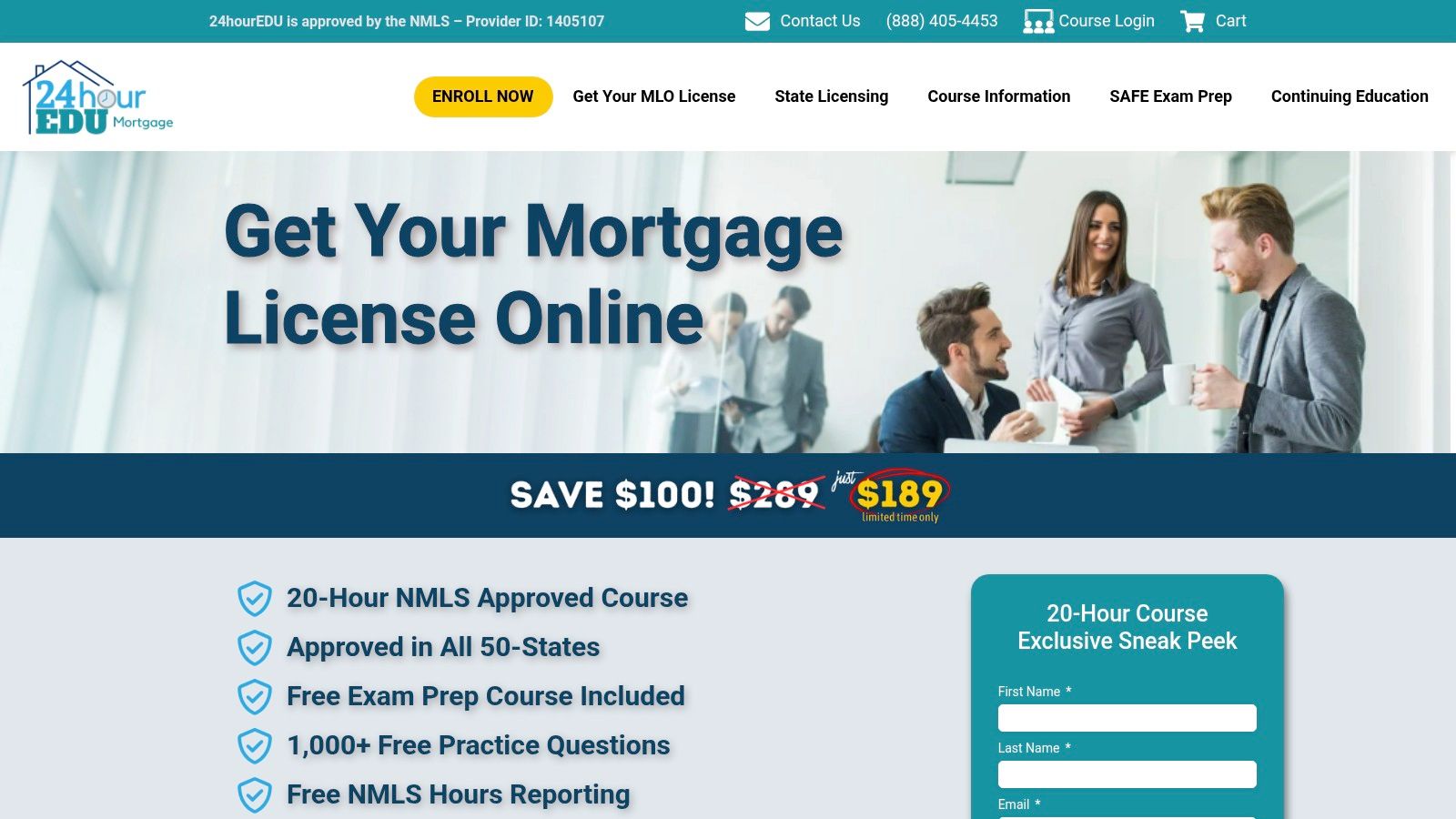
If you’re comparing online programs, review the curriculum, support, preparation materials, reporting process, and state information together. That comparison gives you a better basis for choosing than course price alone and helps you begin your MLO career with realistic expectations.
24hourEDU offers an NMLS-approved online SAFE course with the required 20-hour curriculum, instructor-led video lessons, exam preparation included, and phone and email support. Visit 24hourEDU to review the course and take the next step toward your Mortgage Loan Originator license.

