Loan Officer License Test: What to Expect and How to Pass
You’ve been thinking about a mortgage career for weeks. You can see yourself helping borrowers choose financing, building professional relationships, and creating a schedule with more control than a traditional office job allows. Then you find the loan officer license test and wonder whether one exam could stop the whole plan.
It doesn’t have to. The SAFE Mortgage Loan Originator Test is a structured licensing step, and the right preparation turns it into a practical introduction to the work you’ll perform every day. You’ll learn what the exam measures, how the questions are organized, what to study first, and how an online course with free exam preparation can make the path to licensure feel manageable.
Why the Loan Officer License Test Is Your First Step Into a Flexible Mortgage Career
You have finished another week of fixed hours and limited control over your income. Then you consider mortgage loan origination: guiding borrowers, building referral relationships, and managing a pipeline, with compensation that may include commissions tied to completed business. The loan officer license test is the first formal checkpoint on that path.
Treat the exam like a launch map rather than a barrier. Each subject points to work you will perform with borrowers. Federal law supports accurate guidance, ethics protects trust, mortgage knowledge helps you explain products, and fair lending standards shape every recommendation. Studying in that order connects test preparation to the career itself.
The license opens a practical career path
After licensing and proper sponsorship, an MLO may help with purchases and refinances, explain loan products, collect documentation, and coordinate with processors and underwriters. The day-to-day role combines communication with careful judgment. You must understand disclosures, consumer protection, qualification standards, fair lending, and ethical conduct before you ask a borrower to choose a financing option.
The work can also fit a remote or hybrid arrangement. Digital documents, online systems, video calls, and electronic communication support location-flexible workflows, although your employer, state regulator, and business model determine where and how you work. As your pipeline develops, you may gain more control over your schedule than a conventional office role provides.
Career perspective: The exam is a knowledge checkpoint for responsible borrower service, and it can serve as the launchpad for a commission-based mortgage career with location flexibility.
The education path is focused rather than comparable to a traditional four-year degree. Federal SAFE Act rules require at least 20 hours of NMLS-approved pre-licensing education for a state-licensed MLO. The required instruction includes federal law, ethics, consumer protection, fair lending, and nontraditional mortgage lending standards, as described in the SAFE Act education requirements.
Use your study time for both the exam and the conversations that follow it. Resources such as interactive interview preparation can help you prepare to speak with lenders and brokerages about your experience, learning plan, and career goals. You can also review why now is a good time to become a mortgage loan officer while deciding whether this work matches your preferred schedule and income model.
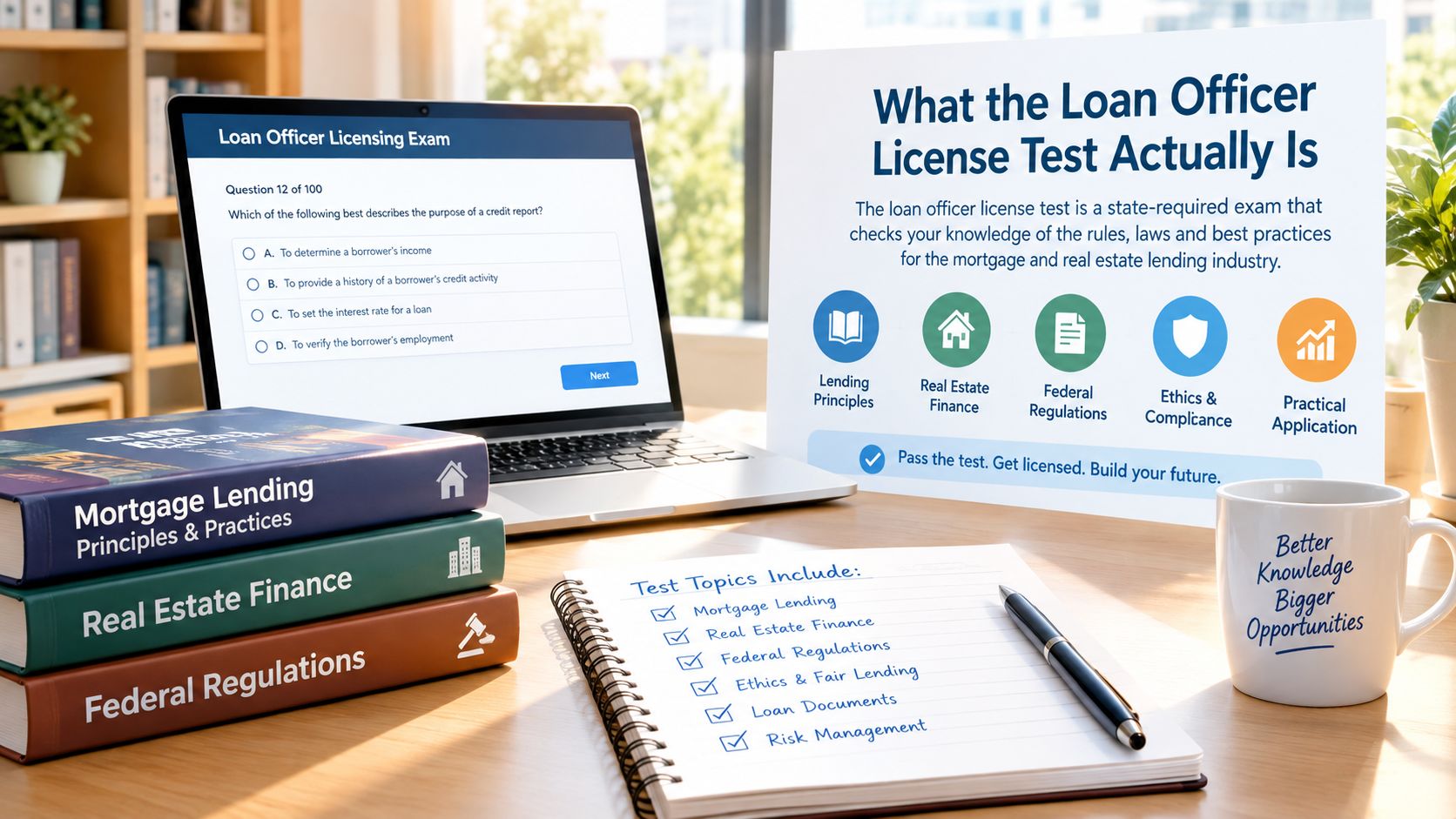
What the Loan Officer License Test Actually Is
A first-time test taker often sees the SAFE MLO exam as a wall between study and a mortgage career. A better view is a shared foundation, similar to a driving test for mortgage origination. It checks whether you can apply federal rules and core mortgage knowledge before working with borrowers. Your state may add its own requirements through state education, testing, or licensing procedures.
The SAFE Mortgage Loan Originator Test operates within the NMLS framework and uses multiple-choice questions. Its subject map follows the work you will perform as an MLO: federal laws, mortgage origination activities, ethics, general mortgage knowledge, and uniform state content. The NMLS testing introduction describes the national test and its scored and unscored items. Study each domain as a job skill, not as isolated vocabulary. Federal law guides compliant decisions, ethics protects borrower trust, and mortgage knowledge helps you explain loan options clearly.
What must happen before testing
Start by creating an NMLS account and completing approved education. The federal minimum includes:
Federal law:3 hours on federal laws and regulations.
Ethics:3 hours on fraud, consumer protection, and fair lending.
Nontraditional lending:2 hours on nontraditional mortgage lending standards.
Afterward, your education record or certificate supports the licensing process. Your state or employer may still require an application, sponsorship, background information, or state education.
Passing the national exam does not by itself authorize origination in every state. It is one checkpoint in licensing. The state regulator sets remaining requirements, while your sponsoring employer or entity determines when you may begin originating.
Inside the SAFE MLO Exam Format, Timing, and Passing Score
A clear format turns exam anxiety into a schedule. The national section contains 120 total items, including 115 scored questions and 5 unscored pre-test questions. The NMLS practice test overview summarizes the current structure, testing time, appointment length, and listed fee.
The five unscored items help develop future exams. They do not affect your result, and the test does not identify them. Treat every question as scored. That approach also matches the work of an MLO, where each borrower detail can affect a file.
SAFE MLO National Exam At a Glance
Exam Element
Detail
Total items
120 total items, including 115 scored questions and 5 unscored pre-test questions (NMLS exam overview)
Scored items
115 questions determine the result
Testing time
190 minutes
Appointment length
225 minutes, including administrative time
Listed fee
$110
Passing standard
75%, a fixed minimum standard mandated by the SAFE Act (NMLS testing FAQ)
The 75% passing standard is fixed, so your result does not depend on how other candidates perform. You need to show the required knowledge level. Treat that standard as a readiness check for the career ahead, not a competition with the people in nearby testing rooms.
The 190-minute testing period gives you about a minute and a half per item. Use a steady rhythm. Read the question carefully, eliminate choices that conflict with the facts, select the best answer, and mark a difficult item for later if the platform allows review. Do not let one unfamiliar scenario consume the time needed for questions you can answer.
Your appointment includes administrative steps beyond the test itself, so arrive prepared to follow the testing provider’s procedures. If you are unsure whether remote delivery is available, review the guidance on whether you can take the NMLS exam online, then confirm current rules through NMLS and the testing provider before scheduling.
The Main Topics You Will Be Tested On
The test becomes easier to approach when you connect each topic to a borrower conversation. You aren’t studying disconnected legal vocabulary. You’re learning how to explain loan options, protect consumers, recognize risk, and move a file through the process without creating compliance problems.
Federal law protects the borrower and the file
Federal law and regulations form a major part of your foundation. You’ll encounter topics involving disclosures, fair lending, consumer protection, and mortgage licensing. The required education specifically includes federal law, ethics, and nontraditional lending, so start there rather than treating those subjects as final-week material.
Understand the purpose behind laws such as the Truth in Lending framework, the Real Estate Settlement Procedures framework, the Equal Credit Opportunity Act, fair housing requirements, the SAFE Act, and other rules included in your approved course. A borrower may ask why information is being collected, when a disclosure should arrive, or why a loan recommendation changed. Your job is to answer accurately and avoid steering, discrimination, misleading claims, or unsupported promises.
General mortgage knowledge gives you product fluency
General mortgage knowledge covers the mechanics behind lending decisions. Study the differences among common loan products, the role of income and assets, credit and liabilities, collateral, underwriting, the secondary mortgage market, and closing procedures.
For example, a borrower might describe a payment preference without knowing which product structure fits the broader file. You’ll need to understand how loan terms, qualification factors, documentation, and lender requirements interact. The exam tests whether you can apply that knowledge, not just recognize a definition.
Origination activities mirror your daily workflow
Origination activities follow the file from the first conversation through application, qualification, processing, underwriting, and closing. Marketing and lead handling matter because inaccurate advertising can create compliance exposure. Application intake matters because incomplete or inconsistent information can delay the file. Ethical conduct matters because borrowers rely on you during a high-stakes financial decision.
Study lens: Ask, “What would I do next for this borrower, and what rule controls that decision?” Scenario questions become more manageable when you connect them to a real workflow.
Nontraditional mortgage products deserve focused attention because they can involve different risks, payment structures, or suitability concerns. Your course should help you compare products and recognize when a borrower needs a clear explanation before proceeding.
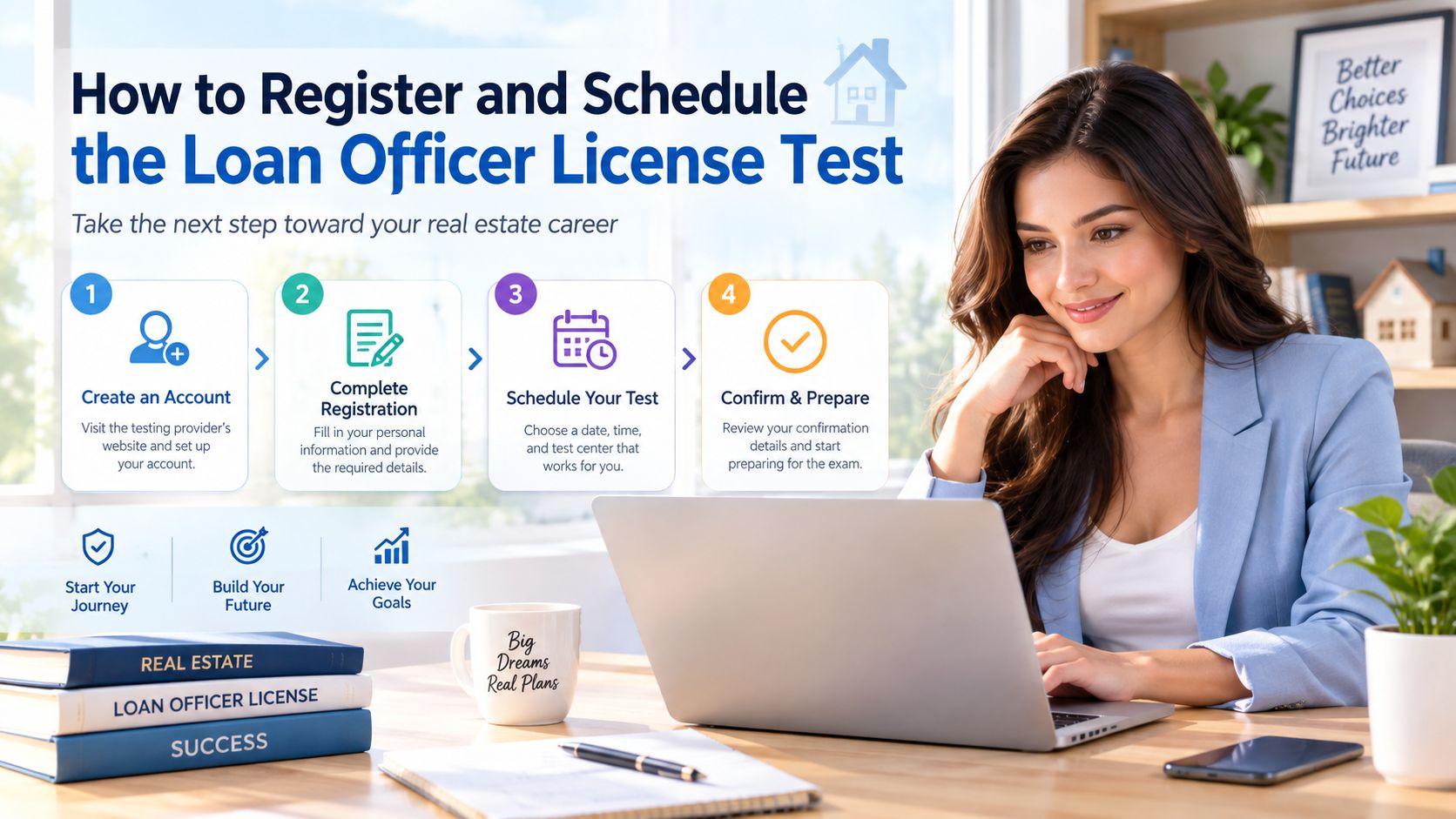
How to Register and Schedule the Loan Officer License Test
A smooth registration starts with sequence. Treat each step like a checkpoint: finish one, save proof, and confirm its status before beginning the next.
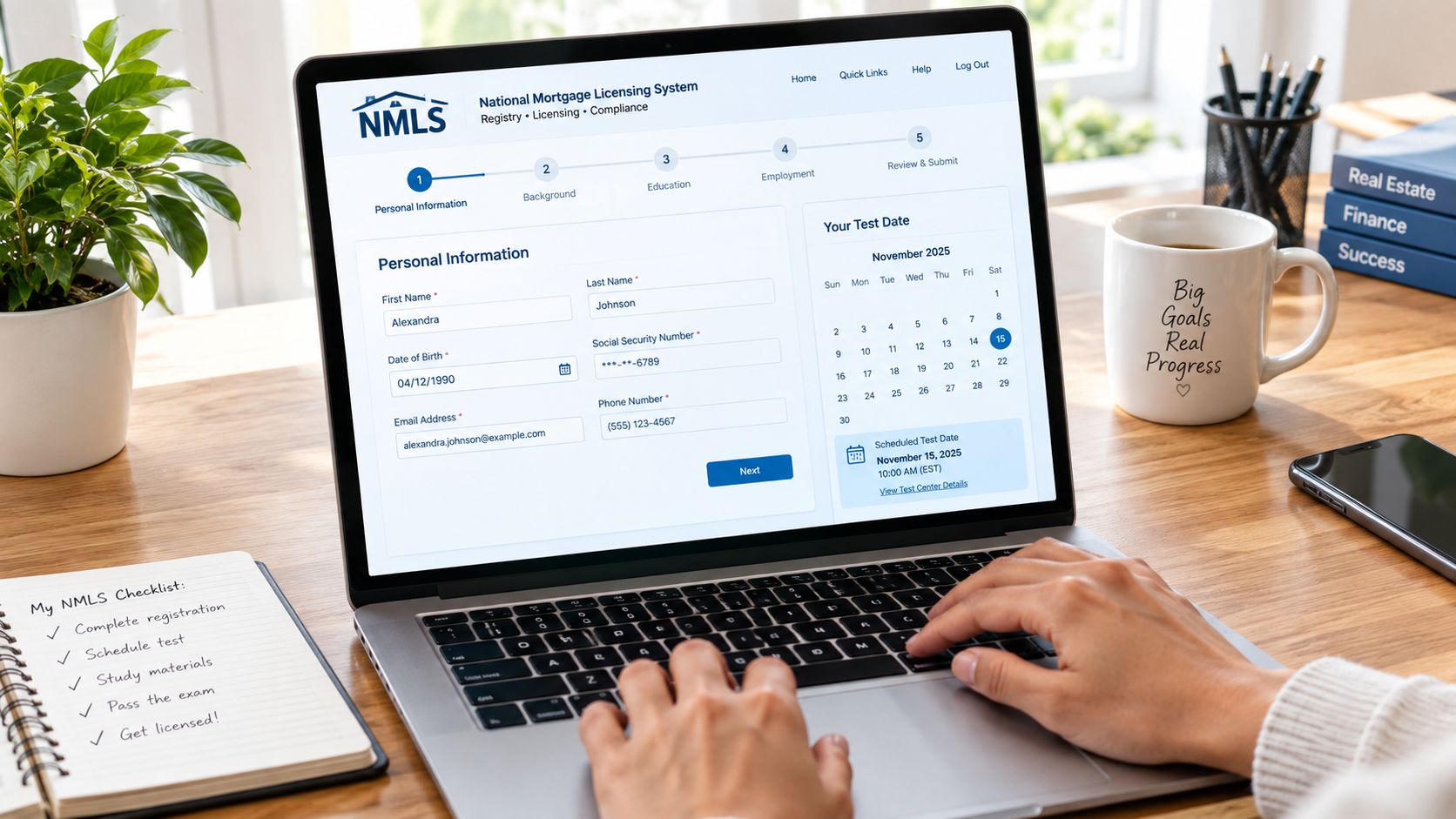
Create your NMLS record. Your NMLS account and unique identifier connect education, test results, and licensing filings.
Complete approved education. Finish the federal SAFE education requirement through an NMLS-approved provider. Add any state-required education to your schedule.
Confirm course completion. Request or download the completion record needed for your NMLS file.
Review state application instructions. Your state may require a MU4 filing, sponsorship, background information, credit authorization, fingerprints, or other documents.
Pay applicable charges. NMLS and testing charges depend on the current filing and jurisdiction instructions. Use the current checklist rather than an older one.
Schedule the examination. Follow the testing provider and appointment directions displayed in your NMLS record. Depending on current policy, appointments may be available at a test center or through an approved remote option.
Bring the identification and documentation listed in your appointment instructions. Plan for administrative check-in in addition to the 190-minute testing period, and arrive early enough to avoid rushing. Testing appointments can include fees and policies that change, so verify the current amount and rules before payment.
A course provider can make setup easier by reporting education hours and organizing your study sequence. 24hourEDU offers an NMLS-approved online 20-hour SAFE MLO course with instructor-led video lessons, an e-textbook, a state law module, and free exam preparation materials. Its NMLS Provider ID is 1405107.
State Variations and Extra Licensing Requirements to Know About
A national exam gives you the shared foundation for MLO work, but your target state sets the final rules. Some jurisdictions accept the standard education structure, while others add state-law education or a separate test. Application, sponsorship, fingerprints, background checks, credit review, renewal, and continuing education can also vary.
North Carolina shows how these details affect your study plan. Its requirements call for 24 total pre-licensing hours, including 4 hours of North Carolina statutes and regulations. The remaining coursework covers federal SAFE Act subjects and 12 hours of electives, according to the North Carolina mortgage licensing requirements.
State Licensing Variations Snapshot
State
Extra Pre-License Hours
State Test Required
Notes
Federal baseline
None beyond the required federal course structure
National SAFE MLO Test
The federal framework requires at least 20 hours of NMLS-approved pre-licensing education, including the subjects established by the SAFE Act.
North Carolina
4 hours of North Carolina law within 24 total hours
Confirm current state instructions
The state also includes federal topics and 12 hours of electives, as described in its requirements.
Other jurisdictions
Varies
Varies
Check the applicable NMLS jurisdiction page before enrolling or scheduling.
Build your checklist around the state where you plan to work. If you expect to originate loans in multiple states, verify each jurisdiction’s education, testing, application, and recognition rules. The national exam prepares you for shared MLO responsibilities, while state approval determines where you can legally conduct business. That distinction matters for a location-flexible career because each new state may require its own setup before you serve borrowers there.
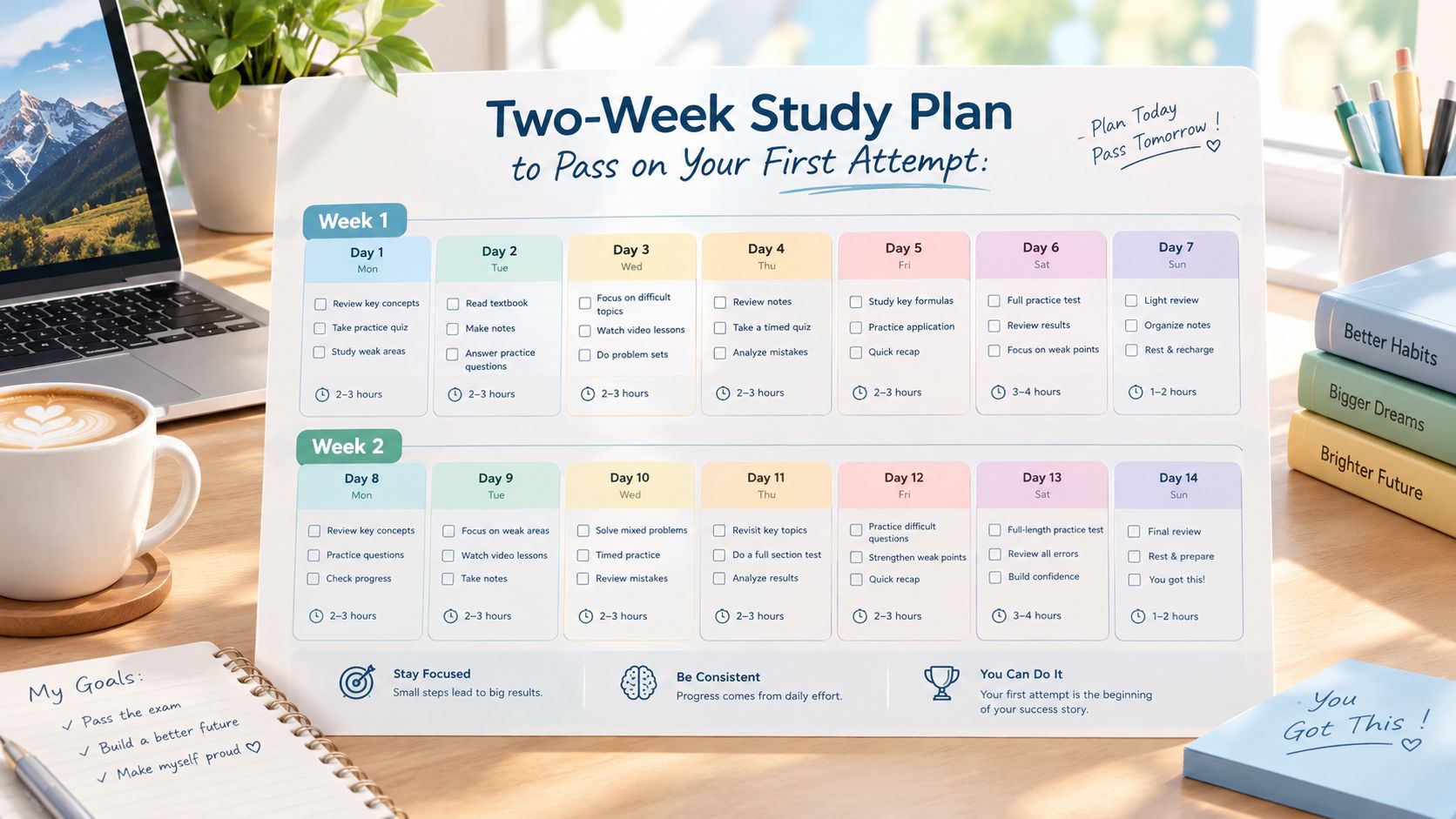
A Two-Week Study Plan to Pass on Your First Attempt
NMLS-published performance data cited by industry summaries places first-time pass rates around 53%, with repeat candidates trending lower, according to industry guidance on SAFE exam difficulty. That benchmark doesn’t predict your result, but it does show why casual reading isn’t enough. Use a short, focused plan that tests your recall under the same time pressure you’ll face on exam day.
Days one through six build the foundation
Days 1 to 3: Complete or consolidate your required pre-licensing education. Give special attention to federal law, disclosure concepts, ethics, and consumer protection. Don’t highlight terms. Explain each rule in your own words and write a short borrower example.
Days 4 to 6: Study nontraditional mortgage products, general mortgage knowledge, and origination activities. Connect each topic to a file: product selection, application intake, documentation, qualification, communication, and closing. Use practice questions immediately after each topic so you can detect confusion while the material is fresh.
The NMLS exam study guide can serve as a structured companion while you organize your review. Keep a mistake log with three columns: the question topic, why your answer was wrong, and the rule or reasoning that supports the correct answer.
Days seven through fourteen measure and repair weaknesses
Days 7 to 9: Take a full-length timed practice exam. Review every missed question, including guesses that happened to be correct. Remediate weak domains instead of rereading the entire course.
Days 10 and 11: Take a second timed practice exam and compare your performance by topic. Look for repeated errors in ethics, federal law, product knowledge, or origination workflow.
Days 12 and 13: Drill definitions, key law concepts, product characteristics, and calculation principles with flashcards. Use active recall, not passive scrolling.
Day 14: Review lightly, confirm your identification and appointment details, and get adequate rest. Your final evening should reduce anxiety, not introduce a new textbook.
Common Myths and Final Confidence Boost
The loan officer license test can feel intimidating because the subject matter is unfamiliar. That’s different from being impossible. Industry summaries citing NMLS performance data place first-time pass rates around 53%, so preparation clearly matters, but the number isn’t a guarantee for any individual candidate. It’s a reason to study deliberately, not a reason to avoid the career.
Myth one says memorization is enough
Memorizing definitions helps, but it won’t replace judgment. Questions may ask you to apply an ethical rule, recognize a disclosure issue, or choose the appropriate action in an origination scenario. Read each question for the borrower’s facts, the timing, the conduct involved, and the answer that best follows the governing rule.
Myth two says previous mortgage experience is mandatory
You don’t need to arrive as an industry expert. The required pre-licensing education is designed to establish the foundation you need before testing. Career changers still need discipline, reading comprehension, communication skills, and a willingness to practice, but prior MLO experience isn’t the starting requirement.
Myth three says one national result licenses you everywhere
The national exam is part of the licensing framework, not a universal authorization to originate in every jurisdiction. States may add education, state-law testing, sponsorship, application, or other requirements. Check your intended state early so your plan reflects the actual path.
Your next move: Complete the approved education, study federal law and ethics first, practice under timed conditions, and review mistakes by topic. You’re not trying to become perfect before you begin. You’re building the judgment borrowers will trust.
Passing the test can lead into a commission-based, location-flexible mortgage career, but the professional value goes beyond earning potential. You’ll help borrowers understand complex choices, coordinate with lending teams, and keep sensitive transactions moving with accuracy and care.
24hourEDU offers an NMLS-approved online 20-hour SAFE MLO course with instructor-led video lessons, an e-textbook, a state law module, and a free exam prep package. Visit 24hourEDU to review the course and start building a clear path toward the loan officer license test.
24hourEDU NMLS Mortgage Loan Officer Course – $189 All States