
You've reached the end of a busy year. Your pipeline is active, borrowers are waiting for updates, and renewal may still be sitting on your task list. The good news is that mortgage loan originator license renewal follows a predictable annual pattern. Once you understand the timing, education requirement, NMLS workflow, and state-specific risks, renewal becomes a manageable part of a successful MLO career.
Why Mortgage Loan Originator License Renewal Matters Every Year
Mortgage loan originator renewal isn't a casual year-end formality. It's part of the compliance structure that allows you to continue originating loans lawfully. The system is highly standardized through the Nationwide Multistate Licensing System and Registry, commonly called NMLS. Federally registered MLOs renew annually during the fixed November 1 through December 31 window, and state-licensed MLOs in most states follow the same annual renewal season. NMLS renewal overview
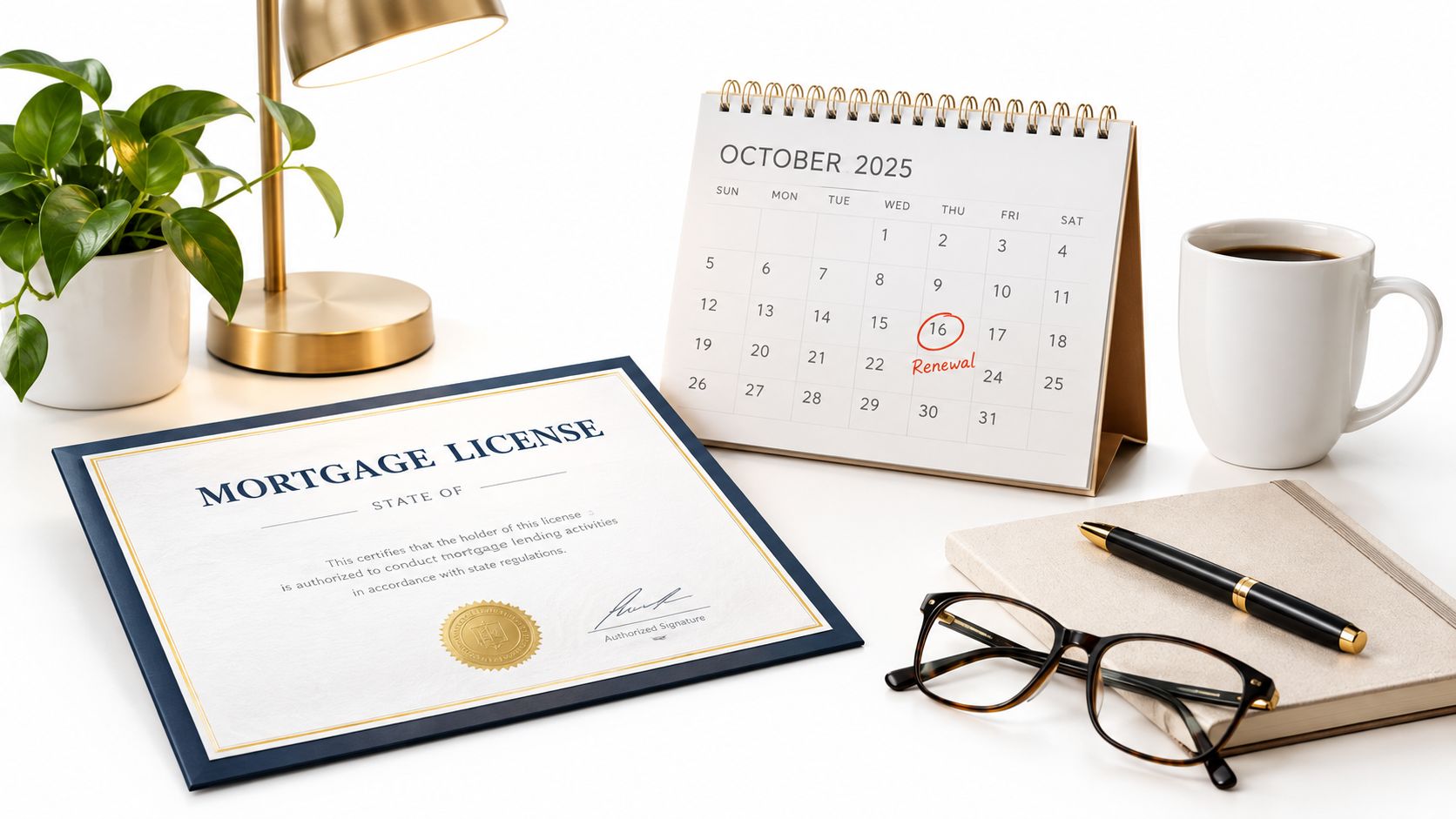
Consider an MLO who waits until the final days of December. The licensee may still need to finish continuing education, wait for the provider to report completion, review the NMLS record, attest that the information is accurate, and submit payment. A delay at any point can turn a routine renewal into a stressful scramble.
The annual cycle has a clear logic
The SAFE Act created an ongoing education standard for state-licensed originators. The annual requirement keeps renewal connected to current legal, ethical, and lending practices rather than treating the original license as permanent permission to originate.
Renewal also includes attestation. You're confirming that your NMLS information and disclosures are accurate. That means the process requires more than clicking through a form. You're taking responsibility for the record regulators use to evaluate your active status.
State agencies often encourage MLOs to complete education early and allow 24 to 48 hours for reporting before renewal availability opens or before a deadline approaches. Regulatory compliance updates can help professionals keep these recurring obligations visible throughout the year.
Practical rule: Treat renewal as a yearly compliance cycle, not a December errand. Education, record review, attestation, and payment each deserve their own checkpoint.
Missing the window can affect your work
If you don't submit a renewal request by December 31, your license can expire. Some states provide a limited reinstatement period from January 1 through the end of February, but reinstatement rules vary and may involve additional costs or restrictions.
For an MLO, an expired license can interrupt lawful origination activity at exactly the time borrowers and referral partners expect reliable service. Keeping your license active protects your professional momentum, your relationships, and your ability to serve clients without an avoidable compliance interruption.
Continuing Education Requirements for Renewal Success
Your renewal year follows a predictable sequence: confirm the education assigned to each license, finish the courses, allow time for reporting, then verify your record before attesting and paying. The education requirement forms the first checkpoint in that cycle. Under the SAFE Act, a state-licensed MLO must complete 8 hours of annual continuing education, including 3 hours of federal law and regulations, 2 hours of ethics, 2 hours on nontraditional mortgage lending, and 1 hour of mortgage origination instruction. SAFE Act education requirements

Each subject addresses a different part of the job. Federal law lessons reinforce the rules behind loan origination. Ethics training supports fair dealing and consumer protection. Nontraditional mortgage lending covers products and standards outside familiar lending patterns, while mortgage origination instruction strengthens broader working knowledge.
Match education to every license
The SAFE Act sets a national baseline, while state regulators may add requirements or designate state-specific content. Holding licenses in several states therefore requires a license-by-license review. Check each requirement in NMLS, then confirm that your provider will report the correct course completion for each jurisdiction.
An NMLS-approved online course can fit around borrower calls and other daily responsibilities. Mortgage continuing education lets busy MLOs study in smaller sessions instead of reserving a full day for renewal. 24hourEDU offers an online MLO continuing education course with NMLS reporting support and an exam prep package for students pursuing the MLO licensing path. The provider's NMLS Provider ID is 1405107.
Leave time for reporting
Course completion and NMLS posting are separate checkpoints. Providers must report completion, and the record may take 24 to 48 hours to appear. An internal December 25 CE cutoff gives you an operating cushion before the December 31 renewal deadline.
Use this annual timeline:
- Early in the renewal season: Check the requirement for every license and select an approved course.
- Before the final week: Finish the required education and save your completion confirmation.
- After completion: Verify that the hours appear in NMLS before starting the renewal request.
- Before year-end: Review your record, attest accurately, and complete payment.
Education also supports the work beyond compliance. Current knowledge of law, ethics, and lending standards helps an MLO explain options clearly and collaborate with borrowers, processors, underwriters, and business partners. A planned CE schedule protects your license while strengthening the skills that support a lasting mortgage career.
How to Submit Your Renewal Through NMLS Without Stress
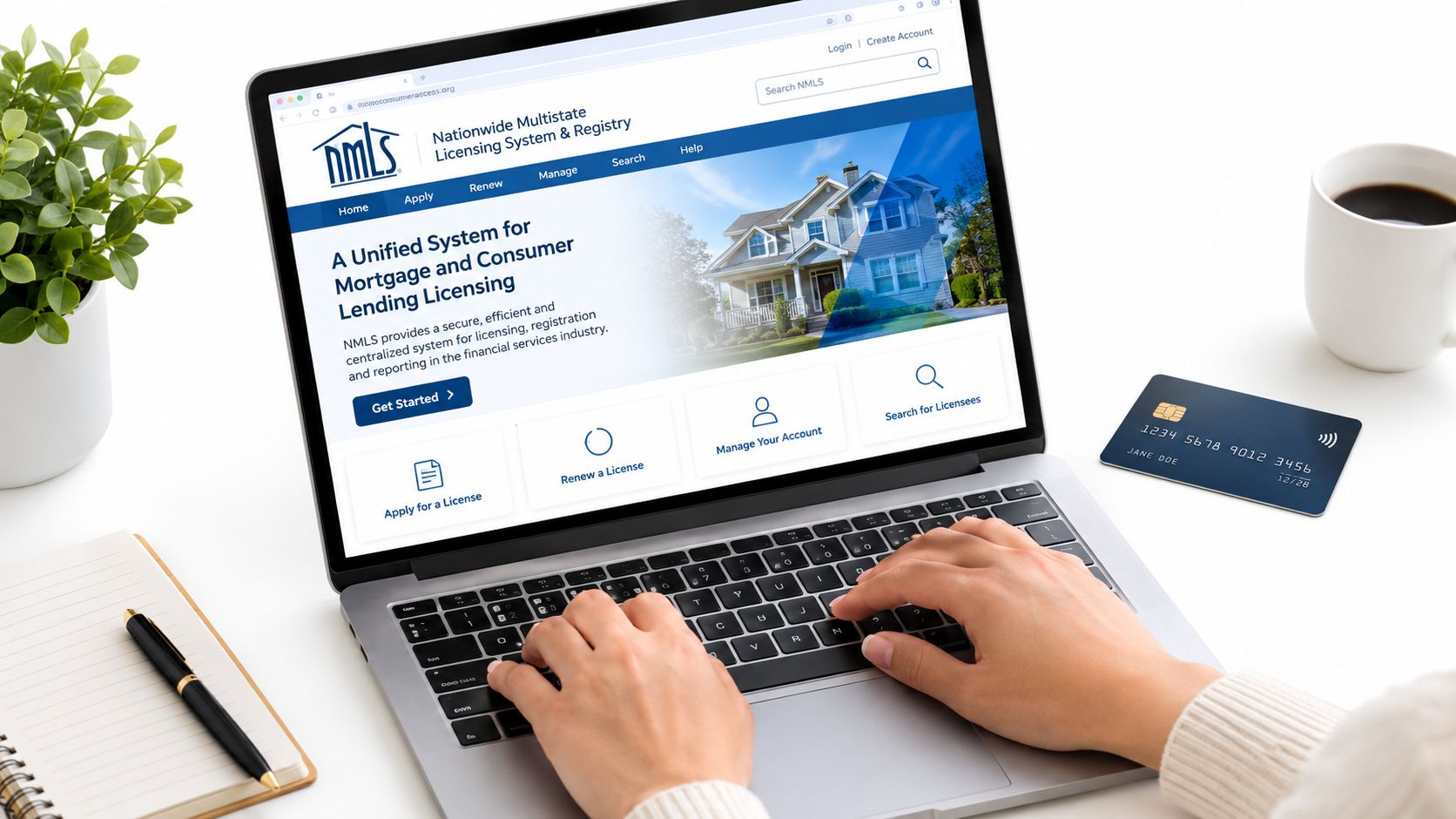
Once your education is posted and your record is accurate, the NMLS submission is a defined online transaction. NMLS describes the process as an attestation-and-payment workflow, not merely a form submission. You log in, open the Renewal Home or renewal dashboard, select the applicable license, apply the selection, and move the request to the cart for payment. NMLS renewal dashboard guidance
Start with a clean record
Before opening the renewal dashboard, check that your personal information, employment details, disclosures, and license information are current. An outdated record can create questions during attestation or require additional follow-up from your regulator.
After signing in, locate the renewal area rather than beginning a new application. The dashboard displays licenses eligible for renewal and provides the controls used to select the license or licenses you want to renew.
Move through the dashboard carefully
The workflow follows a logical sequence:
- Log in: Use your NMLS account and confirm you're working in the correct individual record.
- Open Renewal Home: Review the licenses listed for renewal and any displayed requirements.
- Select licenses: Choose the applicable license or licenses.
- Apply selections: Confirm the renewal choices so NMLS can prepare the request.
- Review the cart: Check the transaction details and payment amount shown for your licenses.
- Submit payment: Complete the transaction and save the confirmation for your records.
Attestation deserves special attention. Read each statement and verify your information before submitting. If a disclosure has changed, don't guess at the answer. Review the applicable regulator guidance and prepare supporting information when required.
The smoothest renewal is usually the one completed after CE has posted and before the final week begins.
Online education and digital NMLS processing make renewal accessible for professionals working from home or managing demanding production schedules. You can complete the education remotely, review your record at a convenient time, and keep documentation in a dedicated compliance folder.
After payment, retain the confirmation and check the license status in NMLS. If the status doesn't update as expected, contact your provider or regulator promptly rather than waiting for the deadline to pass.
Deadlines Fees and State Variations You Must Know
A predictable renewal cycle helps prevent last-minute problems. Complete CE early enough for reporting, review your NMLS record, attest, and submit payment before the state deadline. The national pattern is similar, but each jurisdiction can set different fees, penalties, screening requirements, and reinstatement rules. An MLO licensed in several states must treat each license as its own compliance track.
The renewal season also involves a substantial number of professionals. A 2025 NMLS-related update reported a renewal-eligible base of 54,018, including 44,395 mortgage loan originator renewals. By November 13, 2025, 16,083 requests had been submitted, representing 36.2% of that MLO renewal pool at that point in the season. 2025 NMLS and Texas renewal update
State Renewal Fees and Late Penalties Compared
| State | Renewal Fee | Late or Reinstatement Fee | Deadline Note |
|---|---|---|---|
| California | $300 individual MLO endorsement renewal fee, plus $30 NMLS processing fee | $100 reinstatement fee | Endorsements expire on December 31 and must be renewed through NMLS |
| Illinois | $150 renewal fee | $75 late fee | Late renewal is allowed through the end of February |
| Michigan | State renewal fee varies by applicable record | $25 per day, capped at $1,000 | Renewal and payment must go through NMLS, with the penalty applying after December 31 |
These examples show three different cost patterns. California adds a reinstatement charge, Illinois permits late renewal through the end of February with a fixed fee, and Michigan applies a daily penalty after December 31. Confirm the current amount and deadline with the applicable regulator before you pay.
Use December 31 as the outside limit
Treat December 31 as the final boundary, not your working target. A practical timeline is to finish CE by December 25, confirm that the credit is reported, review disclosures, attest, and submit payment with time left for an unexpected issue.
If a state permits reinstatement, an expired license may still restrict originating activity. The legal effect depends on the regulator and license status, so check the applicable rule rather than assuming a grace period protects your authority to work.
For a state-by-state look at expenses, review this NMLS license cost by state guide, then verify the current requirements directly with your licensing authority.
Troubleshooting Common Renewal Issues and How to Fix Them
Renewal problems usually fall into a few recognizable categories. The earlier you identify the issue, the more options you'll have to correct it without rushing.
Your CE isn't visible in NMLS
A completed course may not appear immediately. Allow 24 to 48 hours for reporting, keep your completion record, and contact the education provider if the hours still don't show after that period. Ask the provider to verify the course status, reporting submission, and NMLS record associated with your completion.
Don't immediately purchase another course because the credit is missing. Duplicate education may not solve a reporting problem and can create more confusion. First compare your certificate details with the information in your NMLS account.
Your record triggers a review
Renewal can involve more than the annual education requirement. Some regulators may require FBI checks, credit checks, fingerprint processing, or disclosure of disciplinary or criminal history at renewal. California DFPI MLO FAQs
California notes that FBI and credit checks may be required at renewal. Florida's 2026 statute explicitly requires an independent credit report and may request extensive supporting documents during eligibility review. If your state requests records, respond completely and promptly rather than leaving an item unresolved near year-end.
A screening request doesn't automatically mean renewal has failed. It means the regulator needs enough information to complete its review.
Payment or attestation doesn't complete
Check that every selected license appears in the renewal cart and that the payment transaction reaches confirmation. If an error occurs, save the message, avoid repeated submissions that could create uncertainty, and contact NMLS or the state regulator with your record details.
For attestation questions, answer accurately and provide explanations or documents when requested. A clean, organized file containing course certificates, payment confirmations, correspondence, and supporting disclosures can make follow-up much easier.
The best troubleshooting strategy is prevention. Finish education early, verify the posting, check your record, and submit before the final week. That sequence gives you time to solve ordinary issues while the renewal window remains open.
Smart Tips to Keep Your License Active Year After Year
A reliable renewal habit starts before the deadline appears. State-licensed MLOs renew through NMLS every year during the November 1 through December 31 window. If you don't submit by December 31, your license can expire and reinstatement may be required. NMLS Individual Renewal Quick Guide

Create a repeatable calendar
Use the opening of the renewal season as your prompt to check requirements, not as a signal to wait. Choose your approved CE, schedule study time around your client workload, and complete the education well before the end of December.
A practical annual routine looks like this:
- November: Confirm each license, review state requirements, and begin CE.
- Early December: Finish education and verify the provider has reported it.
- December 25: Use this as an internal CE cutoff when possible, leaving reporting time.
- Before December 31: Review disclosures, attest, submit the renewal request, and pay.
- After submission: Save the confirmation and verify your license status.
Make compliance fit your career
Online education is especially useful for MLOs who work from home, set their own schedules, or balance production with family responsibilities. A focused renewal routine lets you protect your active status without stepping away from borrower service for an extended period.
That consistency supports the broader opportunity in mortgage lending. Mortgage loan originators, mortgage brokers, and mortgage loan officers can build flexible careers around relationships, expertise, and commission-based production. Staying current with compliance protects the foundation that makes those opportunities possible.
Keep one digital folder for certificates, NMLS confirmations, payment receipts, and regulator correspondence. When renewal season arrives, you'll have the information you need instead of reconstructing the past year under pressure.
24hourEDU offers NMLS-approved online mortgage loan originator education, including renewal-focused continuing education and a free exam prep package for licensing students. Visit 24hourEDU to review the online courses and prepare for your next licensing or renewal milestone with support from an NMLS-approved provider.