California DFPI MLO License: Your Easy Step-by-Step Guide
You do not need a real estate license to become a California Mortgage Loan Originator. To get your California DFPI MLO license, you need 20 hours of pre-licensing education, a passing SAFE test, sponsorship, fingerprints, a credit review, and the required DFPI and NMLS fees.
If you’ve been staring at mortgage job posts and wondering whether you need to go back and get a different license first, you can stop there. California’s process is specific, but it’s manageable when you break it into the right steps, and the path starts with the DFPI, the NMLS, and a clear application plan.
Meet Your Future California Mortgage Career
You can move from curious to licensed faster than you might expect when you know which boxes matter first. The California DFPI MLO license is built around a clear sequence, not a maze, and the biggest relief for first-timers is learning that a real estate license is not part of the requirement for the DFPI path.
A practical way to think about it is this. You prepare the education, line up sponsorship from the right company, complete the background steps, and file through NMLS Form MU4. Once those pieces are in motion, the process feels less like bureaucracy and more like a checklist you can finish.
Practical rule: get the sponsor lined up before you submit the application. That simple move avoids a lot of delay and keeps nonrefundable fees from becoming a frustrating surprise.
California’s mortgage origination rules are handled through DFPI, not through a real estate license requirement for this path. If you’re applying as a person who wants to originate residential mortgage loans for a CFL finance lender or broker, or for a CRMLA lender or servicer, the state expects the mortgage originator license and the related NMLS process, not a separate real estate credential. The regulator, the form, and the employer sponsorship all point to a mortgage licensing track.
That distinction matters because the jobs are different. A real estate professional helps people buy and sell property, while an MLO helps them finance it. The skills can overlap in conversation and client service, but the licenses are not interchangeable.
Who the DFPI license actually fits
If you’re taking residential mortgage applications or offering loan terms for compensation, the DFPI MLO license is the credential you should be looking at. It’s also the right route for many who want to enter mortgage work without already holding a California real estate license. In other words, the absence of that license is not a blocker, it’s often the normal starting point.
A lot of confusion comes from people seeing mortgage and real estate discussed together. They’re related industries, but they are not the same pathway, and you don’t need to build your career backward by adding a real estate license you won’t use for DFPI-originated mortgage work.
You’re not missing a hidden prerequisite. You’re choosing the correct license for the job you want.
Who Qualifies for a California DFPI MLO License
Eligibility is easier to evaluate when you treat it like a short checklist. California expects you to be at least 18, complete the required pre-licensing education, secure sponsorship from an appropriately licensed company with a valid NMLS unique identifier, and pass the required SAFE test components. Those are the gates that matter before DFPI can move your file forward.
Your readiness check
Use this quick self-check before you submit anything:
Age: You’re 18 or older.
Education: You’ve completed the required 20 hours of NMLS-approved pre-licensing education.
Sponsorship: A California mortgage company has agreed to sponsor you and has the proper NMLS identifier.
Testing: You’re ready to pass the SAFE test requirements.
Background review: You can complete fingerprints for the FBI check and authorize the credit report review.
The honesty part matters more than people think. DFPI reviews disclosures on Form MU4, so the safest approach is to disclose everything accurately and let the agency review it. A past issue is not automatically the end of your application, but a missing disclosure can create a problem that is far harder to fix.
If you’ve been out of the licensing world for a while, don’t overcomplicate this step. The question is not whether you’ve had a perfect past, it’s whether you can complete the required disclosures, testing, and screening fully and completely.
The 20-Hour SAFE Course and SAFE Exam Explained
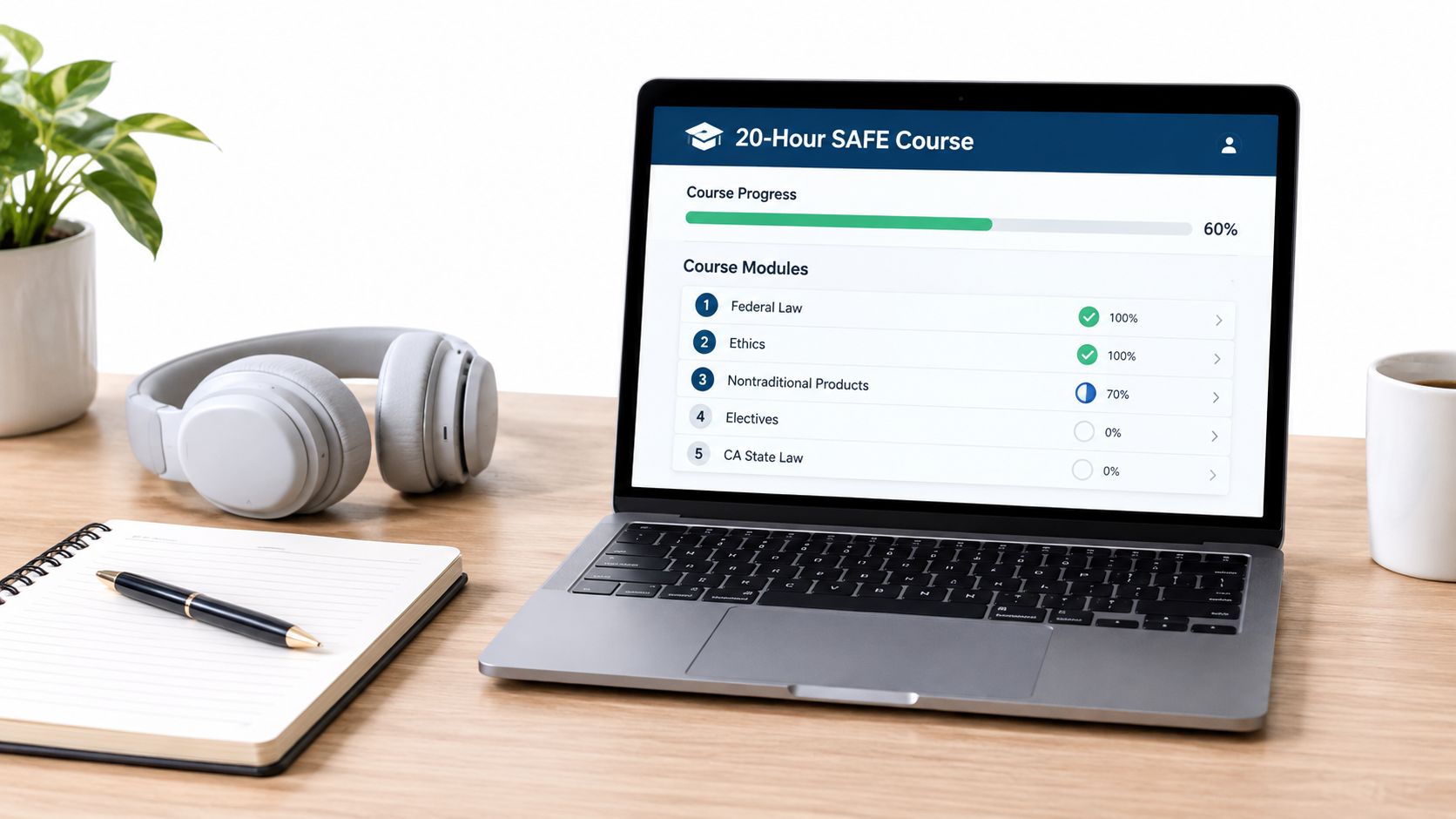
The education requirement is the cleanest part of the process because it has a fixed structure. California requires 20 hours of pre-licensing education, broken into 3 hours of federal law and regulations, 3 hours of ethics, 2 hours on nontraditional mortgage products, 10 hours of elective education, and 2 hours of California DFPI law. That state-specific piece is the part many applicants overlook, and it’s the reason course selection matters.
The point of the course isn’t just to check a state box. It prepares you for the SAFE test by teaching the lending rules, ethics, and California-specific content you’ll need to understand on day one. For readers who want an online option, 24hourEDU’s 20-hour SAFE MLO course is one example of an online path built around that exact structure.
What the SAFE exam means in practice
The SAFE test is the exam hurdle that proves you’re ready for the job. Once your education is completed and logged, you schedule the test through NMLS and take the proctored exam in the required components. Preparation feels much less intimidating when your course includes practice material that mirrors the question style you’ll encounter.
The easiest way to approach this is to treat the course and exam as one workflow, not two separate battles. Study the module topics in order, review the California law section carefully, and move to testing when the education record is complete.
Stay focused on the state module. That’s where first-time applicants often lose time, not because it’s complicated, but because they assume the national material is enough.
Your NMLS Application Step by Step
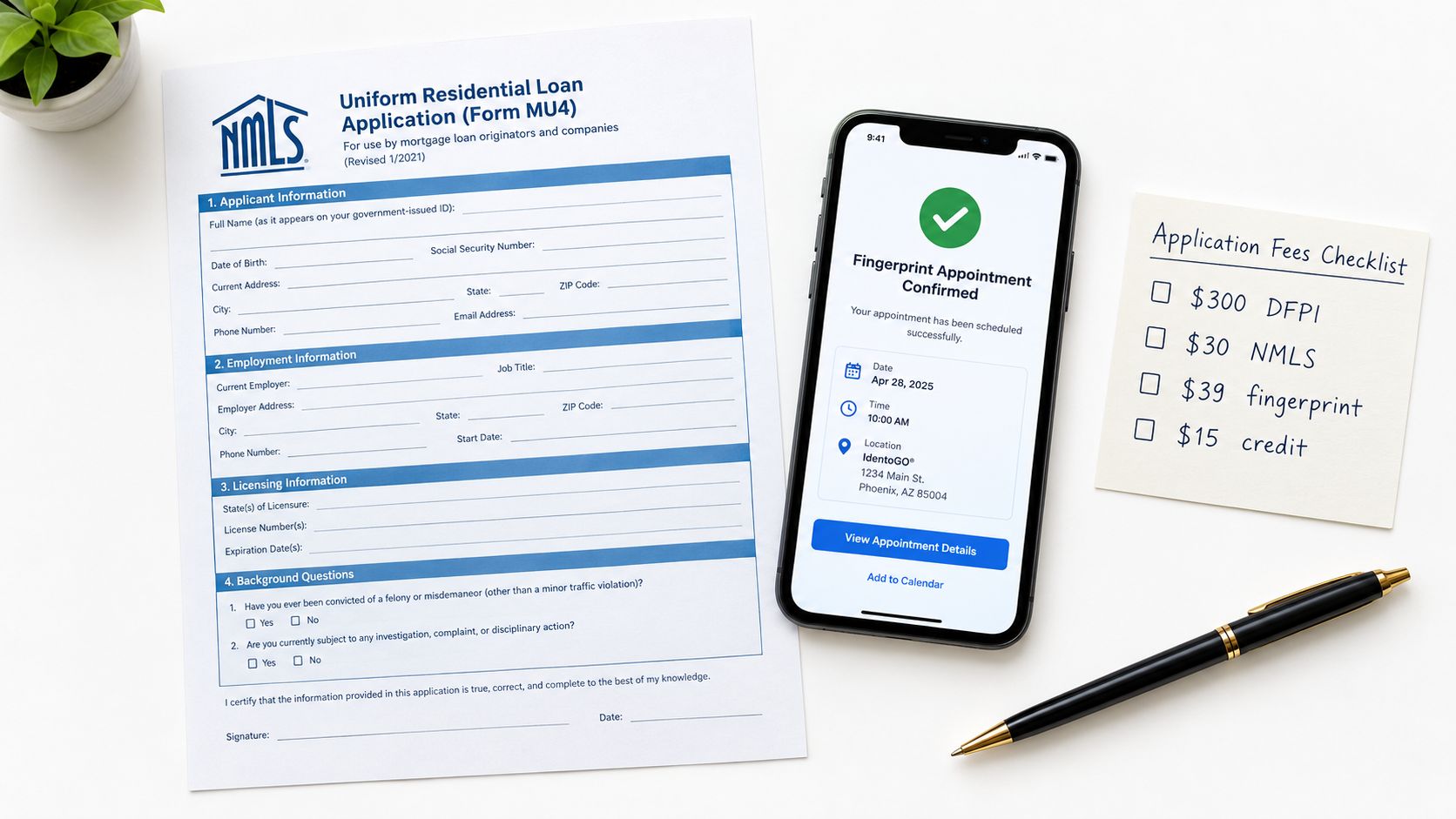
Once your coursework is complete, the rest of the application becomes a paper trail with a few moving parts. You create your individual record in NMLS, file Form MU4, and include your personal history, employment history, disclosures, and your sponsoring company’s NMLS unique identifier. The form isn’t a shortcut, it’s the official record DFPI uses to review you.
Sponsorship has to be in place before approval can happen. Without it, the license can’t be activated the way you need it to be for origination work. For document prep help, 24hourEDU’s MLO documentation requirements page is a useful companion when you’re organizing your file.
Fees, fingerprinting, and credit review
California’s listed application costs are straightforward. DFPI charges a $300 application fee, $30 NMLS processing fee, $39 fingerprint fee, and $15 credit-report fee, and those fees are paid through NMLS and are generally nonrefundable. That’s why it helps to confirm sponsorship and complete your paperwork before you pay.
After you submit, schedule your fingerprints quickly so the FBI background check can move. At the same time, you authorize the credit report review so DFPI can complete its assessment. Applicants who leave either item sitting too long often end up waiting for preventable reasons.
A realistic planning mindset helps here. If your sponsorship is already lined up and your documents are ready, the remaining processing stage can move much more smoothly than people expect.
Real First-Year Costs and Renewal Calendar
Applicants often focus on the application fee and stop there. The smarter question is what the first year costs once you include the course, testing, application fees, and the compliance steps that show up after approval.
Cost Item
Amount
When It Is Due
DFPI application fee
$300
At application submission
NMLS processing fee
$30
At application submission
Fingerprint fee
$39
When fingerprints are taken
Credit-report fee
$15
When the credit report is authorized
DFPI renewal fee
$300
During annual renewal
NMLS renewal fee
$30
During annual renewal
DFPI also requires annual renewal during the November 1 to December 31 window. If that window is missed, the December 2025 bulletin states that reinstatement from January 1 through February 28, 2026 requires the normal renewal fees plus a $100 reinstatement fee, and after February 28 a new license application is required. That turns a routine renewal into a much more expensive reset.
A simple calendar habit helps. Put the renewal window on your work calendar every year, confirm your continuing education early, and avoid treating the license like a one-time purchase.
Common Mistakes California Applicants Make
The most common mistake is submitting Form MU4 before sponsorship is secured. That usually creates a delay, and because the fees are generally nonrefundable, the mistake can get expensive fast. The fix is simple, confirm the sponsor first, then file.
The other traps that slow people down
Late fingerprinting: If you wait too long to complete the FBI background step, the file stalls.
Skipping renewal planning: The license is annual, so renewal isn’t optional.
Ignoring continuing education: California MLOs need annual continuing education, and missed hours can block renewal.
Overlooking credit issues: A credit report with late payments or collections can trigger extra scrutiny, so it’s smarter to review your credit before authorizing the pull.
Practical rule: check your documents before you pay, not after. That one habit saves more time than any shortcut people hope to find.
The best applicants don’t try to rush every step at once. They line up sponsorship, complete the education, file the form carefully, and respond quickly when DFPI asks for the next item.
Launching Your Mortgage Career in California
The full path is more approachable when you stack it in order. You don’t need a DRE real estate license, you complete the 20-hour pre-licensing course & 2-hour DFPI course online, you pass the SAFE test, you file Form MU4, you complete fingerprints and credit authorization, and you pay the DFPI and NMLS fees. Done in sequence, the process becomes a compliance milestone instead of a bureaucratic wall.
California can be a strong place to build a mortgage career because the role rewards organization, people skills, and follow-through. Many originators like the flexibility of working from home and shaping their own schedule, and commissions can scale with the relationships they build. For professionals who want outreach ideas in financial services, Ever Outbound on finance outreach is a useful reference point for how structured prospecting supports that kind of career.
If you want a clean starting point, choose the online course, line up your sponsor, and keep the application moving in the right order. 24hourEDU offers NMLS-approved mortgage pre-licensing training with the California state-law piece and exam prep support built into the learning path, and the Provider ID is 1405107.
If you’re ready to start, 24hourEDU gives you the online California mortgage pre-licensing training, the state-law content, and the exam prep support that help keep the process moving. Visit 24hourEDU to get your course started and take the first step toward your California DFPI MLO license.
24hourEDU NMLS Mortgage Loan Officer Course – $189 All States