Can Real Estate Agents Be Loan Officers as a Side Hustle?
Yes, a licensed real estate agent can work as a part-time mortgage loan originator, but the usual nonbank path requires a separate state MLO license through NMLS, mortgage-company sponsorship, and compliance with dual-role disclosure rules. Your real estate license alone never authorizes mortgage origination, and the federal education minimum for state-licensed originators is 20 hours.
You already help buyers manage offers, inspections, and closing dates. When a buyer asks whether you can handle the financing too, adding mortgage work can feel like a natural extension. It can be, provided you build the licensing, employer approvals, and client protections before you build the pipeline.
The Short Answer for Licensed Agents
Mortgage origination can complement your existing commission business. You don't have to give up your sales license or stop representing property buyers. You're adding a separately regulated service, with its own supervision, compensation agreement, and responsibilities.
Say you're hosting an open house. A buyer likes the property but isn't sure what they can afford. Introducing that buyer to a licensed originator is one activity. Offering to take their mortgage application and recommend financing terms is another.
The distinction matters even when the buyer trusts you and wants a single point of contact. Their permission doesn't substitute for regulatory authorization.
For a typical nonbank side-business arrangement, establish these foundations:
Licensing authority: Obtain the authorization required where you'll originate.
Employer support: Secure an approved mortgage-company relationship and permission for concurrent brokerage work.
Transaction controls: Establish disclosure, consent, and compensation procedures before serving clients.
So, can real estate agents be loan officers as a side hustle? Yes, but the useful question is whether your proposed arrangement works legally and operationally. Relevant buyer relationships give you a starting point, not automatic mortgage volume.
A workable plan identifies what you'll do personally, what your sponsor will supervise, and when you'll hand a client to another originator.
When a Referral Becomes Loan Origination
Taking a residential mortgage application or offering or negotiating mortgage terms for compensation or expected compensation generally brings you into the MLO regulatory framework. The legal trigger is the work you perform, not the title on your business card.
The CFPB's SAFE Act procedures describe the brokerage-only exemption and explain that it generally doesn't apply when a lender, mortgage broker, MLO, or their agents compensate the individual. State law determines the complete licensing requirements, so don't treat a federal exemption as blanket permission.
Which activities require an MLO license
The distinctions below assume you're acting for compensation or expected compensation. A mortgage-related payment also needs its own compliance review, because obtaining a license doesn't automatically make every payment lawful.
Activity
MLO License Needed?
Why It Counts
Referring the buyer to a licensed MLO
No
A referral without an application or terms talk stays outside origination
Earning your normal commission on the sale
No
Brokerage pay comes from the sale, not the mortgage
Taking a residential mortgage application
Yes
Taking an application for compensation is covered origination work
Quoting rates, terms or pre-approval amounts
Yes
Offering or negotiating loan terms enters the SAFE Act regime
Being paid by a lender or broker for the loan
Yes, for covered origination work
Mortgage-source compensation removes the brokerage exemption
A simple introduction leaves the mortgage professional responsible for financing advice. Collecting income, debt, and other application information to help the buyer obtain financing is materially different.
Similarly, telling a buyer that the lender can explain available products isn't the same as recommending a particular rate or loan structure. Don't calculate and present a personalized preapproval amount as though you're authorized to make that determination.
Practical rule: Introduce the client, hand off the contact information with permission, and let the licensed mortgage professional handle the application and terms.
Titles don't override conduct
Calling yourself an assistant or processor doesn't protect you if you perform covered origination functions. Nor should you assume that working as an independent contractor makes licensing optional.
Keep a clean referral boundary until your authority is active. Don't collect mortgage application data, negotiate financing, or accept a fee tied to the loan merely because you've enrolled in a course.
Audit your emails, text templates, buyer consultations, and lender introductions before accepting mortgage-related compensation. If a message promises personalized financing advice, have the sponsoring company's compliance team review it before you send it.
Sponsorship and Employer Rules to Clear First
An MLO license generally isn't a freelance permit. For the typical state-licensed arrangement, you need a sponsoring mortgage company willing to supervise your work and support your proposed schedule.
The Oregon Division of Financial Regulation's mortgage-originator guidance requires individual licensing and company sponsorship, with an application process that includes education, testing, fingerprints, and a credit report. That structure makes employer selection an early decision, not an administrative task to leave until after the exam.
A company might welcome your buyer relationships but decline part-time originators. Another might accept part-time work while requiring daytime availability, approved marketing, and a designated backup for urgent files.
Get approval from both businesses
Your mortgage sponsor controls mortgage supervision, recordkeeping, approved systems, and compensation practices. Your property brokerage may separately restrict outside work, use of its name, access to client information, or activities that create conflicts.
Ask these questions before paying for education:
Outside activity: Will your brokerage approve mortgage origination in writing?
Part-time sponsorship: Will the mortgage company sponsor someone who continues representing property clients?
Availability: Who handles borrower questions and urgent conditions while you're in showings or negotiations?
Referrals and compensation: Which arrangements are permitted, and who approves transactions involving both firms?
Client records: Which company controls each file, and how may information move between their systems?
Branding: Can you mention both roles in advertising, email signatures, and social profiles?
Renewal obligations: How will you schedule mortgage education alongside your existing professional requirements?
Evaluate support, not just the split
A generous compensation offer won't help if you can't get a difficult file reviewed. Ask how new originators receive product guidance, who checks disclosures, and how the company manages absences.
Request the outside-business policy and compensation agreement before committing. Verbal enthusiasm from a recruiter isn't the same as approval from the people responsible for supervision.
A workable side business needs a sponsor that supports your actual operating model, not merely your application.
The license is only part of the project. The employer structure determines whether you can deliver reliable service while maintaining your existing business.
How to Add an MLO License Step by Step
The education and application process is manageable when you complete it in the right order. Start with state requirements and employer feasibility, then organize the course, exam, background review, and sponsorship around those requirements.
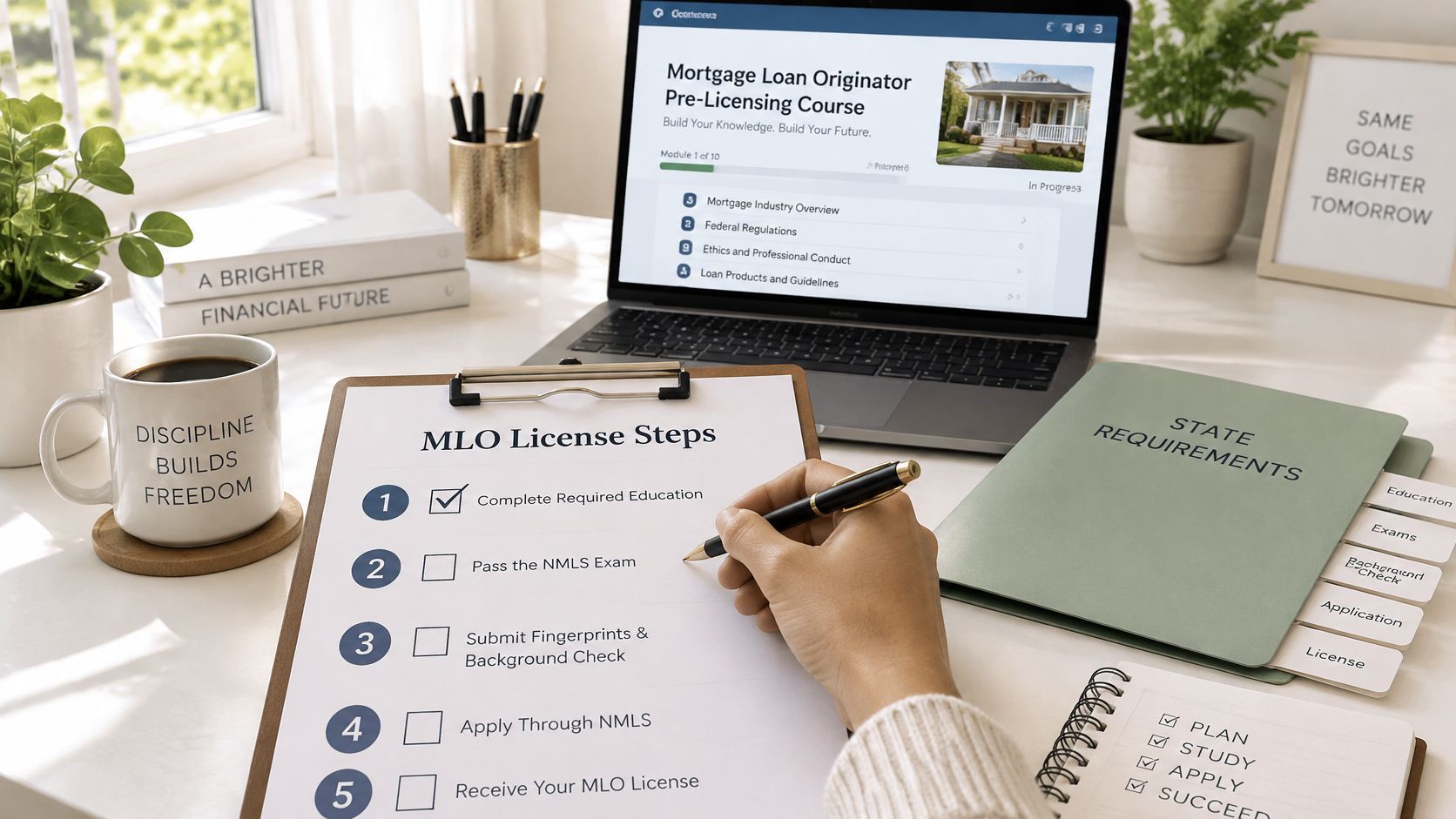
Complete education and testing
Confirm your state's requirements. Identify every state where you intend to originate, then review its education, application, financial-responsibility, and sponsorship requirements. Our MLO license requirements guide helps you organize that review, and our team can answer general licensing questions and point you toward the applicable state requirements.
Create your NMLS account. Establish your individual record and obtain your unique identifier. Use consistent personal information throughout the application, education enrollment, and testing process to avoid unnecessary record-matching problems.
Complete approved pre-licensing education. The federal SAFE Act education regulation sets a 20-hour minimum, including at least 3 hours of federal law, 3 hours of ethics covering fraud, consumer protection, and fair lending, and 2 hours on nontraditional mortgage lending standards. States can add requirements, so verify the correct course combination before enrolling.
Our NMLS-approved online national course includes instructor-led video lessons, an e-textbook, one free state law course, and free exam prep. Students can complete the course in two weeks or less, with phone and email support available for course and licensing-process questions.
Pass the SAFE MLO Exam. For the state-licensed path, you must first earn the 20-hour NMLS Certificate and pass the SAFE MLO Exam. Use practice questions to identify weak subjects, then revisit the underlying concepts rather than memorizing answer patterns; confirm any additional state-specific education or testing instructions that apply to your application.
Finish the application and activation
Complete the required background review. Follow the application instructions for fingerprints, criminal-background authorization, and credit-report authorization where required. Read disclosure questions carefully and gather supporting documents before submitting, especially if an answer needs an explanation.
Submit your application through NMLS and arrange sponsorship. Coordinate with the sponsoring company's licensing staff so your application and employment records align. Passing the exam doesn't authorize you to start originating, so confirm that the required license and sponsorship are active before taking covered business.
Plan for renewal immediately. Put renewal deadlines and continuing education on your calendar when your license becomes active. Treat them as recurring operating responsibilities rather than tasks to squeeze into a busy closing season.
Set a realistic start date
An MLO license can be earned in just a few weeks, but that isn't a promise that every application will clear on the same schedule. Course completion, test availability, background review, state processing, and sponsor readiness all affect your actual start date.
Build your launch around approval, not a hoped-for closing. You can prepare approved marketing, organize your contact list, and establish a handoff process while your application is pending, without performing activities that require an active license.
The simplest approach is to keep an application checklist with an owner and status for each item. That makes it easier to distinguish something you're waiting on from something you still need to complete.
Dual-Role Disclosure Rules by State
Holding both credentials does not automatically authorize you to use both in one transaction. State disclosure rules and employer policies determine whether the arrangement works, and what you must document.
The Texas Department of Savings and Mortgage Lending FAQs say an individual may serve as both a residential MLO and a sales agent in the same transaction, subject to advance written disclosure and the client's written consent.
State rules on serving as agent and MLO in one transaction
State
Dual Role Allowed?
Key Condition
Texas
Yes
Advance written disclosure and the client's written consent before acting in both roles
North Carolina
Separate licensing
The brokerage exclusion ends once covered origination functions begin
North Carolina's Commissioner of Banks licensing requirements distinguish brokerage-only activity from covered origination functions. An agent cannot rely on the brokerage exclusion to perform origination activities that require a mortgage license.
Apply the rule to the file
For a consent-based arrangement, confirm which form is required, when the client must receive it, and how consent will be recorded. Get the sponsoring company's compliance approval before combining roles in a transaction.
If your employer's policies restrict outside affiliations, ask before involving another lender. Use an approved handoff when the borrower needs a product your sponsor does not offer.
Before proceeding: Confirm the applicable state rule and both firms' compliance requirements, then retain the required disclosure and consent in the appropriate files.
For an agent serving buyers in Houston, holding both credentials is only part of the process. The transaction file must show that the required disclosure and consent steps were completed before the agent acted in both roles.
How MLO Pay Differs From Commission Checks
Mortgage compensation can create a useful additional income stream, but your agreement with the sponsor determines what you receive. Compare net compensation and support, not just the advertised commission opportunity.
The CFPB's explanation of mortgage-originator pay describes salary, a fixed amount per loan, a fixed percentage of the loan amount, or combinations of these methods. It also explains that compensation can't vary based on mortgage terms, such as the interest rate or other loan features.
That means you shouldn't carry sales-style commission negotiation into rate discussions. A plan that pays you more for steering the borrower into particular loan terms needs compliance review, not creative labeling.
Use a modest funded-loan scenario first. An existing contact list is a prospecting resource, not a guaranteed mortgage pipeline.
Calculate your break-even point
Build a worksheet around the actual costs you'll incur:
Entry costs: Course, exam, application, and NMLS-related fees.
Recurring expenses: Continuing education and any required technology or company charges.
Time investment: Prospecting, borrower follow-up, training, and file work.
Opportunity cost: Property-business work you might decline or delegate.
Break-even funded loans = total entry and recurring costs, plus unpaid hours multiplied by your hourly value, divided by average net pay per funded loan.
Round the result up and stress-test it against files that don't close. If the plan works only when every interested buyer funds, revise it before enrolling.
Ask the sponsor when compensation is earned, when it's paid, what deductions apply, and what happens if a loan doesn't fund. Don't budget around an assumed application-to-closing interval or treat a pending commission as available cash.
The attractive arrangement is one where a manageable mortgage workload adds worthwhile net income without weakening your primary client service.
Balancing Both Roles and Your Next Step
Part-time mortgage work needs dependable availability, not constant availability. You can build a flexible schedule, including working from home when your sponsor approves it, while still providing clear coverage for borrowers.
Naming your own hours doesn't mean moving every lender deadline to the evening. Set working blocks that overlap with processing, underwriting, and closing teams, then arrange backup for appointments you can't interrupt.
Operating rules for a sustainable schedule
Document permission before taking the dual role. Use the disclosure and consent process approved for the state and transaction. Store the completed records where both firms' procedures require them.
Choose a clear lane for each deal. Acting only as agent or only as originator is often the simpler operating choice. If both firms permit a combined role, make that choice explicit rather than letting it develop unnoticed during the transaction.
Hand off conflicted or overloaded files. Use a partner originator when your availability, product access, or transaction responsibilities make that the better client outcome. Don't assume the introduction entitles you to a mortgage referral payment.
Calendar milestones alongside appointments. Reserve time for borrower updates, outstanding conditions, and closing coordination. Our time-management strategies can help you organize competing responsibilities; for administrative delegation, Approved Lux Personal Assistant's resource on scaling a real estate business offers a useful starting point, while licensed mortgage work stays with authorized personnel.
Maintain separate education calendars. Track each credential's renewal requirements and completion records. Don't assume coursework for one profession satisfies the other.
Build relationships beyond your own buyers. Connect with former colleagues, builders, financial planners, and past clients through useful mortgage education and reliable follow-up. Get marketing and information-sharing arrangements approved before launching them.
Decide what you're ready to offer
Start with your intended service, not the additional credential. If you want to introduce buyers and stay focused on property transactions, a clean referral arrangement may be enough.
If you want to evaluate financing options, take applications, and guide borrowers through the mortgage process, begin the licensing path. Match your planned workload to a sponsor that welcomes it, then protect study time and exam preparation on your calendar.
Our instructors bring 20-plus years of mortgage experience, and our team can help you understand the education process and locate state licensing requirements. That support makes the next step easier without replacing the employer and regulatory approvals your business needs.
Visit 24hourEDU for our NMLS-approved 20-hour online SAFE course, including video lessons, a free state law module, free exam prep, and free NMLS hours reporting. You'll also receive four free bonus courses, Become a Top Producer, Specializing in Jumbo Loans, Lead Generation, and Networking for MLOs, to support your move into mortgage work. Once you've confirmed your state requirements and sponsorship plan, enroll this week and book your SAFE exam date.
24hourEDU NMLS Mortgage Loan Officer Course – $189 All States