
Twenty hours of pre-licensing education, 2 of them covering Tennessee law, is what a new residential Mortgage Loan Originator must complete in Tennessee, according to the NMLS Tennessee education requirements. For a Chattanooga applicant, the practical question is which document proves that each step has been completed.
The process works like a flight log rather than a to-do list. Every course hour, exam, and application leaves a record behind, and the state reviews those records.
Four of them carry you through: your course certificate, your education transcript, your SAFE MLO test result, and the issued license itself. Tennessee’s Department of Financial Institutions MLO guidance directs applicants to use NMLS for license applications, amendments, and renewals, so keeping that record accurate matters as much as finishing the lessons.
A Chattanooga loan officer 20 hour course fits around a full-time job or a career change once the order is clear. Education first, then each checkpoint in turn.
Tennessee’s 20-Hour Course Breakdown
Tennessee requires 20 hours of pre-licensing education before a new state-licensed residential mortgage loan originator can be licensed, including 2 hours of Tennessee law, according to the NMLS Tennessee education requirements. These are fixed subject requirements, not optional topics you can replace with whichever lessons interest you most.
Tennessee 20-hour course breakdown
| Topic | Hours | What It Covers |
|---|---|---|
| Federal law | 3 | SAFE Act and federal mortgage rules |
| Ethics | 3 | Fraud, consumer protection and fair-lending issues |
| Nontraditional mortgage lending | 2 | Interest-only, payment-option and other non-standard loans |
| Elective NMLS-approved education | 10 | Additional mortgage topics approved by NMLS |
| Tennessee law | 2 | State-specific licensing and lending rules |
| Total | 20 | Full pre-licensing requirement |
Federal law gives you the national framework for mortgage origination. Rather than memorizing rule names in isolation, connect each rule to something an originator does, such as collecting application information, explaining disclosures, or discussing loan terms.
Ethics teaches you to recognize situations where a borrower could be harmed. Say an applicant suggests leaving a debt off the application because they intend to pay it soon. Your job is to recognize the accuracy issue, explain why it matters, and follow the proper documentation process.
Connect each subject to a lending decision
The nontraditional mortgage lending lessons help you look beyond the initial payment. An interest-only arrangement, for example, calls for a different explanation than a loan that pays down principal with each scheduled payment.
Say you later help a borrower explore refinancing a mortgage with a balloon payment. You’ll need to understand the existing repayment structure before discussing possible alternatives. The useful habit is asking what the borrower owes now, what changes later, and what risks they need to understand.
Elective education broadens your mortgage knowledge, while Tennessee law makes your preparation relevant to the state where you’re applying. The national subject areas establish the foundation; state instruction addresses Tennessee-specific obligations.
Before enrolling: Confirm that the enrollment package covers every required subject and clearly identifies the Tennessee-law instruction. A national course title alone doesn’t establish that the state component is included.
Some providers package national education and state law together; others present them as separate courses. Check the actual course listing and approval details rather than assuming that a completion certificate automatically proves you’ve satisfied Tennessee’s full education requirement.
Licensing Steps and Timeline From Enrollment to Exam
Four checkpoints stand between a Chattanooga applicant and an active license: an NMLS account, a posted education record, a passing SAFE MLO test score, and a filed Tennessee application. The course is your education milestone, not your license. Tennessee runs its pathway through NMLS and layers the 20-hour pre-licensing requirement, including Tennessee-law instruction, with the national SAFE MLO test with Uniform State Content, an FBI fingerprint-based criminal background check, and authorization for a credit report.
A mismatch between the name on your enrollment and the name in your NMLS record is one of the most common reasons a finished course fails to appear where a reviewer expects to find it. Chattanooga applicants follow the state licensing pathway rather than a separate municipal MLO process, so keep your name, address, and NMLS identifier identical at every step. Your school reports course hours to that identifier, and your test result attaches to it as well.

Follow the sequence and save the proof
- Create your NMLS account. Record your identifier carefully and use it when registering for education. Save your login information somewhere secure.
- Complete the required education. Include Tennessee-law instruction in your plan, whether it is packaged with national education or completed separately. Our 20-Hour SAFE course (NMLS Approved Course #16623) has a 14-calendar-day completion window.
- Confirm your education record. Save the completion certificate, then check that the hours appear under the correct NMLS identifier. Hours reporting is included free with the national course and normally reaches the system within 24 hours of completion, which shortens the gap between finishing and filing.
- Pass the SAFE MLO test. A school’s course assessment is not the separate licensing examination. To become an MLO, you must earn the 20-hour NMLS certificate and pass the SAFE MLO Exam.
- Authorize fingerprints and the credit report. Follow the current application instructions and answer disclosure questions accurately. Authorization starts a review process; it does not guarantee approval.
- Submit your Tennessee application through NMLS. Review the current checklist, address any outstanding requirements, and monitor requests for additional information.
Licensing timeline from enrollment to application
| Phase | Typical Timing | Checkpoint to Confirm |
|---|---|---|
| Create NMLS account | Starting task before course registration | NMLS identifier issued |
| Complete required course | Within the provider’s completion window | Completion certificate and course hours posted to NMLS |
| Prepare for SAFE MLO test | After the course, or alongside it | Practice scores consistently at or above the practice exam’s passing benchmark |
| Pass SAFE MLO test | Plan after education is posted | Passing test result on file |
| Submit fingerprints and credit authorization | With the application workflow | Reports received and any review issues resolved |
| File Tennessee license application | Plan after passing the test | Application approved and license issued through NMLS |
These checkpoints prevent a common misunderstanding: finished studying and ready for approval are not the same status. A certificate proves course completion, while posted hours show that the licensing system has received the education record.
Consider an applicant who finishes all 20 hours on day ten but has not yet sat for the licensing test. That applicant has made real progress, yet the file is not ready for final approval, and any employment start date built on that file is premature. Check the current Tennessee application instructions before paying application fees or making commitments to a brokerage.
The statewide process also applies outside Chattanooga. Our Nashville mortgage loan originator licensing guide offers another Tennessee-focused explanation for applicants comparing where they may work.
Plan for renewal before you begin working
Your first license year ends sooner than most new originators expect. Tennessee licenses renew annually through NMLS, with the renewal period falling at the end of the calendar year. The NMLS education and professional requirements guide identifies at least 8 hours of same-year continuing education as a standard renewal condition, subject to applicable rules and exceptions.
Set a reminder for your first renewal season as soon as your license is issued. Before purchasing continuing education, check which requirements apply to your initial licensing year so you do not confuse pre-licensing education with renewal education.
Online Course Formats and How to Use Them
| Format | How You Use It | Best For |
|---|---|---|
| Online instructor-led video | Watch prerecorded lessons taught by industry instructors | Learners who want guided explanations |
| E-textbook | Read and search reference material you can revisit | Readers who review and mark text |
| Tennessee-law module | Study state-specific licensing rules as a separate block | Every Tennessee applicant |
| Exam practice material | Answer practice questions and review missed topics | Test-takers preparing for the SAFE MLO test |
Online education lets you study from home without adding a classroom commute. That can make a mortgage career transition more manageable, especially when you’re maintaining your current income while preparing for licensing.
The formats serve different purposes. Video explains, text clarifies, state-law instruction localizes, and practice questions reveal gaps. Treat them as complementary tools rather than choosing one and ignoring the rest.
Build a repeatable study routine
Begin a study session with the video lesson, then read the matching e-textbook material. Write unfamiliar terms in plain language and attach each definition to a borrower scenario.
For example, a former retail manager might study after dinner, watch a lesson on application information, and read the corresponding textbook material before stopping. Before the next session, that learner could explain the topic aloud without looking at notes. If the explanation becomes vague, that’s the material to revisit.
Keep Tennessee-law study distinct enough that you can recognize state-specific rules. Don’t assume that a national practice question teaches everything you need to know about Tennessee licensing.
- If you learn by listening, pause the video and summarize the instructor’s explanation aloud.
- If you prefer reading, mark definitions in the e-textbook and rewrite them without copying.
- If you learn by doing, explain a sample lending situation, then check your reasoning against the lesson.
- If your schedule changes often, reserve study appointments in your calendar and leave room for review before the completion deadline.
A useful study session ends with something you can explain, not simply a video you’ve finished watching.
Our online learning best practices can help you organize your study environment and attention. Keep your phone out of reach, close unrelated browser tabs, and leave a short note identifying where to resume next time.
You can control your study schedule at home, but don’t confuse educational flexibility with guaranteed job flexibility. Remote work, appointment hours, and commission arrangements depend on the employer and position you eventually choose.
SAFE MLO Test Specifications and Study Tactics
The NMLS SAFE MLO testing guide lists a $110 test fee, 120 total questions, 115 scored questions, and a 225-minute appointment. Use those specifications to plan your budget and practice, while remembering that appointment time isn’t necessarily uninterrupted answering time.
SAFE MLO test specifications
| Detail | Value |
|---|---|
| Test | SAFE MLO Test with Uniform State Content |
| Total questions | 120 |
| Scored questions | 115 |
| Appointment time | 225 minutes |
| Test fee | $110 according to the NMLS fee schedule |
The difference between total and scored questions means some items don’t contribute to your score. You shouldn’t try to identify them. Answer every question carefully and concentrate on the lending issue presented.
Study the reason behind each answer
- Start with a timed diagnostic practice set. Your first result is a planning tool, not a prediction of your career potential. Identify whether you’re struggling with vocabulary, rule application, or reading the question accurately.
- Give weak subjects more attention. Repeating familiar questions feels reassuring, but it doesn’t repair misunderstandings. Return to the lesson that explains why you missed an item.
- Translate ethics issues into ordinary language. Ask whether information is accurate, whether a borrower could be misled, and whether applicants are being treated fairly. Then connect those judgments to the applicable course material.
- Practice pacing and manage fatigue. Learn the testing provider’s current break rules before exam day. Don’t assume breaks stop the clock or that the full appointment is available for answering questions.
- Schedule when your practice performance is consistently ready. Use fresh questions where possible, and make sure you can explain your answers rather than recognize memorized wording.
Say an applicant repeatedly misses questions about nontraditional lending. Instead of taking another full practice exam immediately, the applicant reviews repayment structures and explains how a payment could change over time. A fresh practice set then tests whether that explanation holds up.
Our NMLS SAFE test guide can help you keep licensing-test preparation separate from finishing coursework. Keep a missed-question log with the topic, your mistaken reasoning, and the corrected explanation.
For later employment preparation, the ParakeetAI interview question collection provides a separate resource for practicing interview responses. It isn’t SAFE exam preparation, so keep that activity outside your licensing study plan.
Exam readiness: You should be able to explain why the correct answer fits and why the alternatives don’t.
Plan to complete education before scheduling the test, consistent with NMLS guidance for most applicants. That’s a practical preparation sequence, not a claim that the SAFE Act universally prohibits testing before coursework.
What to Check in an NMLS-Approved Provider
NMLS approval is the first filter, but the approval must match the course you’re purchasing. A school’s general mortgage expertise doesn’t replace an approved education listing, and a national course doesn’t automatically resolve state-specific requirements.
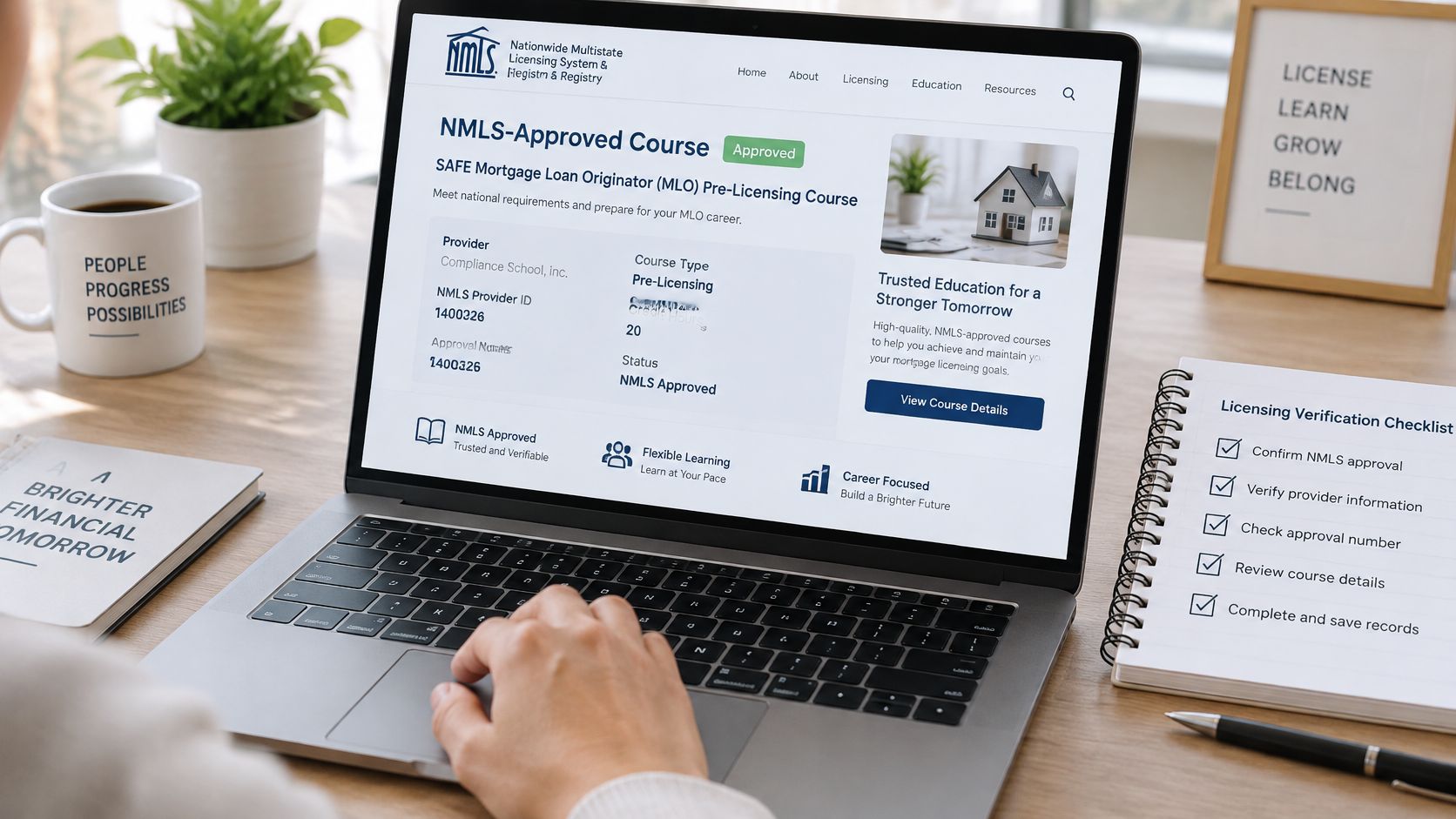
We’re an NMLS-approved education provider, Provider ID 1405107, and our approved National course is Course #16623. Use the provider identifier and course number together when checking the listing rather than relying only on a school name.
Evaluate the record, state coverage, and support
- Approval details. Match the course number, provider information, and education category to the enrollment page. If the information is missing, resolve that before paying.
- Tennessee coverage. Look for a clearly identified state-law course or module. Confirm how its completion will appear in your education record.
- Reporting policy. We report completed online education hours to NMLS within 24 hours. Check your transcript after reporting and contact us if the record doesn’t match your completion information.
- Graduate feedback. Five-star reviews from graduates of our MLO course are posted on the Better Business Bureau website. Read comments about clarity, study experience, and assistance rather than judging by stars alone.
- Help and total cost. Identify the contact method for study questions and read completion, reset, and checkout terms before enrolling.
A missing provider ID, an unclear Tennessee-law component, or charges revealed only at checkout should prompt a closer review. These issues don’t all mean the same thing, but each can leave you uncertain about what you’re buying.
Consider a Chattanooga applicant comparing providers. One page emphasizes speed but doesn’t clearly identify the approved course; another supplies approval details, explains state coverage, and describes reporting. The second page gives the applicant information they can verify.
Separate completion from eligibility
A provider can teach approved material and report hours without deciding whether Tennessee will approve your license. Background disclosures, application review, and other licensing conditions remain separate.
Likewise, graduate reviews describe educational experiences, not a promise that every applicant will pass or receive a license. Choose a provider that makes the education process understandable without presenting course enrollment as automatic career authorization.
Keep an enrollment folder containing the course listing, receipt, completion certificate, and relevant correspondence. Those records make it easier to resolve a reporting mismatch or answer a licensing-file question without searching through old messages.
The best approval check ends with a practical question: Does this exact enrollment package satisfy the education I need for Tennessee? A recognizable approval label is useful only when the underlying course fits your application.
Enroll in the 20-Hour Course and Book Your SAFE Exam
Our 24hourEDU 20-Hour SAFE: Online (OIL) Mortgage Loan Originator Course – National costs $189.00 and provides NMLS-approved online pre-licensing education. The package includes free exam prep, access to the National course’s video content for review, an e-textbook, unlimited phone and email support, and one free state-law course.
NMLS hours reporting is included at no added charge, a service valued at $30. Before enrolling for Tennessee, confirm that your selected state-law course supplies the Tennessee instruction your application requires.
Budget for the pathway, not just tuition
The course price and the licensing-exam fee are separate expenses. Adding the listed tuition to the examination fee produces a $299 course-and-test subtotal, not a complete licensing budget.
- Education and preparation. The enrollment package combines the National coursework with exam-preparation resources.
- Separate licensing expenses. Fingerprint, credit-report, application, and any other applicable charges should be confirmed through the current licensing instructions.
- Time commitment. Put study appointments and the course completion deadline in your calendar before you begin.
Don’t book an exam date to force yourself through unfamiliar material. Choose a realistic target, complete the coursework, and use fresh practice results to decide when you’re ready to commit.
For general calendar planning, the exam scheduling insights from Form Timer offer an additional perspective on organizing exam appointments. Use NMLS and its testing provider, not a general scheduling resource, for the actual SAFE exam reservation and current testing rules.
Studying online from home can make the education phase manageable without putting your existing responsibilities on hold. A focused plan can help you work toward the exam over the coming weeks, although appointment availability, study needs, and licensing review determine your individual timeline.
You don’t need to rush to make progress. Choose the correct Tennessee education package, protect your study time, and finish each checkpoint with the record that proves it.
24hourEDU offers NMLS-approved online mortgage education with included exam prep and complimentary education-hours reporting for aspiring Chattanooga loan officers. Visit 24hourEDU to review the National course, confirm your Tennessee-law selection, and choose a start date that fits your licensing plan.