A borrower is excited right up until the first detailed cost estimate lands in their inbox. They expected a down payment. They didn't expect a page full of charges with names like title fees, prepaid interest, and escrow reserves.
That moment matters more than many new loan officers realize. If you can explain a closing cost breakdown calmly and clearly, you don't just answer questions. You lower anxiety, protect the deal, and show the borrower that you know how to guide them from application to the closing table.
Why Mastering Closing Costs Matters for MLOs
A new MLO often thinks trust is built with rate quotes and fast updates. Those matter. But many borrowers decide whether they trust you when they see costs they don't understand.
Take a common situation. A first-time buyer gets a Loan Estimate, scans the monthly payment, then jumps to cash needed at closing. Their excitement fades. They ask, “Why am I paying all of this if I already have a down payment?” If the MLO answers with jargon, the client gets more nervous. If the MLO explains each category in plain English, the conversation changes.
The moment clients decide whether you're a guide
Borrowers usually don't object to every fee. They object to uncertainty. They want to know:
What each charge pays for
Which costs go to the lender versus outside providers
Why some items are due upfront
Whether the final number might change
An MLO who can answer those four questions becomes more than a salesperson. That person becomes the calm voice in a stressful transaction.
A confused borrower delays decisions. A confident borrower signs documents.
Why this skill shapes your career
Closing costs sit at the intersection of compliance, communication, and sales. You need enough technical knowledge to read disclosures correctly. You also need enough people skill to translate those line items into language a buyer can absorb quickly.
That's one reason mortgage education matters early. If you're learning the business, don't treat closing costs as a side topic. Treat them as a core tool. When you can explain the numbers without sounding defensive, clients feel protected. Protected clients refer friends, come back for future loans, and remember your name when someone asks for a loan officer.
The Four Main Types of Closing Costs
A good closing cost breakdown starts with a simple idea. Closing costs are the collection of fees and upfront payments required to finalize the mortgage and complete the transfer of ownership. If you need an easy analogy, compare them to the taxes, delivery charges, and service fees attached to a major purchase. The sticker price isn't the full amount due. The same is true in mortgage lending.
A simple framework that keeps clients from getting lost
Most charges fit into four buckets:
Lender fees These are charges connected to evaluating, processing, and preparing the loan.
Third-party service fees These go to outside professionals and vendors involved in the transaction.
Prepaid items These are costs paid upfront at closing, even though they relate to future coverage or interest.
Escrow account funding These are deposits collected to set up the borrower's escrow account for ongoing bills like taxes and insurance.
This framework helps new MLOs explain the difference between “fees for getting the loan” and “money collected because homeownership has ongoing obligations.”
Why buyers mix these up
Borrowers often assume every line item is lender profit. It isn't. Some charges pay for services already performed. Others are prepaid obligations the borrower would owe anyway, just collected at closing to keep the loan and property protected.
That distinction matters when clients ask why totals feel high. If you can separate lender compensation from third-party costs and prepaids, the document starts to make sense.
Practical rule: Don't explain line items in the order they appear on the form first. Explain them by category first, then go line by line.
Buyer costs and seller costs aren't the same
A buyer's closing costs and a seller's costs are separate conversations. Buyers usually focus on loan-related fees, prepaids, and escrow setup. Seller-side costs can include other transaction expenses and are often discussed differently in the file.
When clients ask about mortgage insurance, it helps to clarify whether it appears as an ongoing payment, an upfront item, or both depending on the loan structure. A basic explanation of mortgage insurance can make that part of the estimate much easier to discuss.
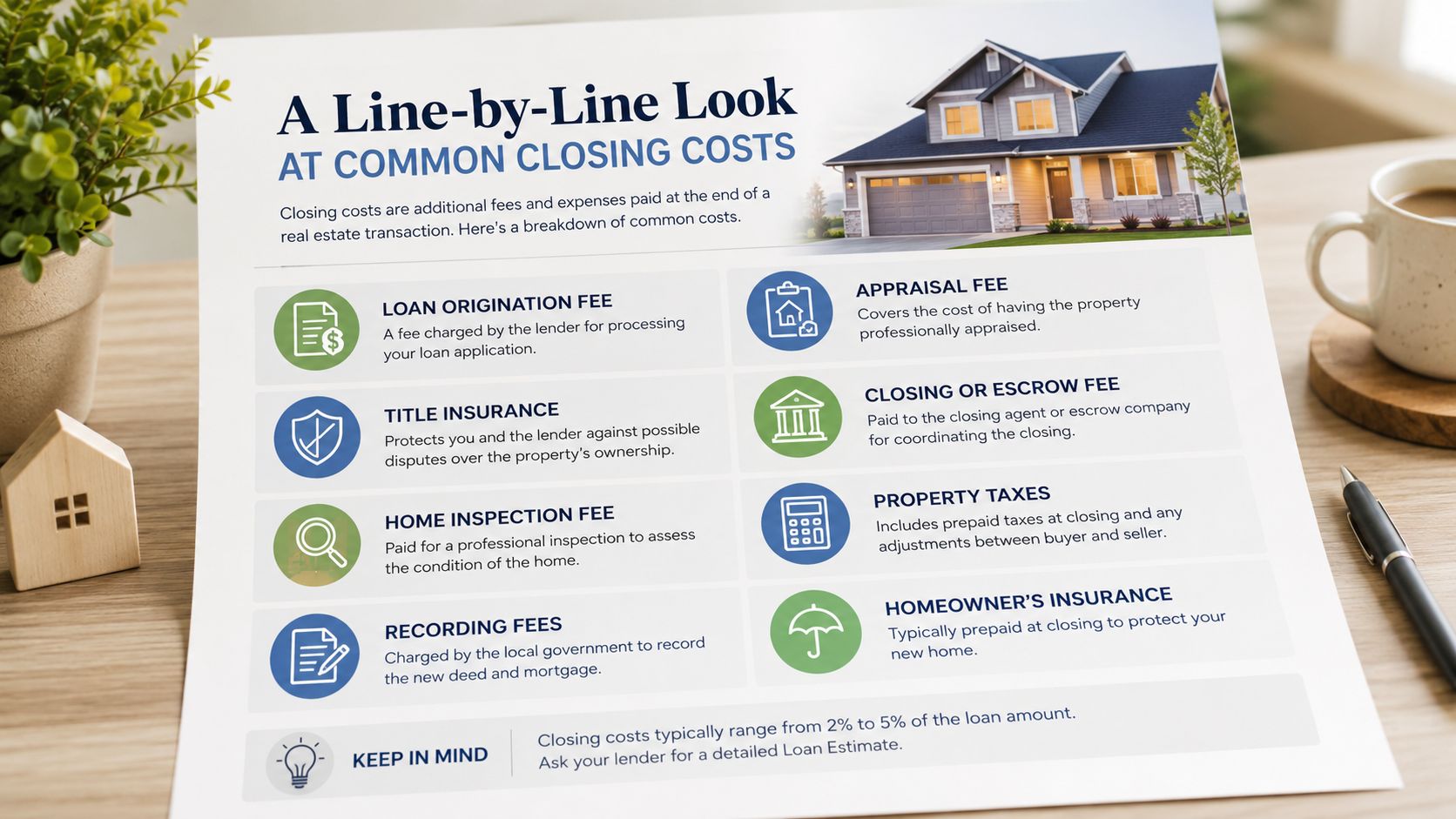
A Line-by-Line Look at Common Closing Costs
A borrower doesn't need a lecture on every line. They need clear answers to “What is this?” and “Why am I paying it?” That's where a disciplined closing cost breakdown helps.
Lender fees
These are the charges most borrowers assume are “the loan cost,” and some of them are.
Origination fee This covers the lender's work in setting up and processing the loan. If you need a plain-language resource to sharpen your explanation, this guide to the mortgage origination fee is useful.
Underwriting fee This supports the review of the file, including analysis of risk, documentation, and qualification.
Application or processing charges Some lenders separate these out, while others roll them into broader origination pricing.
The easiest way to explain lender fees is this: the lender isn't just handing over money. The lender is evaluating the file, documenting the loan, and preparing it for closing under regulatory standards.
Third-party service fees
Many borrowers get lost because the names sound legal or technical.
Appraisal fee Pays for an independent opinion of the property's value.
Credit report fee Covers the pull and review of the borrower's credit data.
Title search and title-related charges These help confirm ownership history, identify liens, and protect parties from title defects.
Settlement or closing services These support the handling of documents and funds at closing.
Attorney or recording charges In some transactions, legal review or local recording work creates additional line items.
If a borrower asks why title work matters, it helps to point them toward the idea behind real estate property deeds. Ownership transfer isn't just symbolic. The transaction has to be documented, verified, and recorded correctly.
Prepaid items
This category causes the most sticker shock because it doesn't always feel like a fee. But these items are often the largest part of cash due at closing.
According to the Urban Institute's breakdown of closing cost components, prepaid expenses can account for about half of the total cash due at closing, and on loans between $400,000 and $500,000, buyers can expect $10,500 to $21,000 at closing. In that same analysis, the top seven non-prepaid fees made up nearly 88% of those charges (Urban Institute closing cost components).
Common prepaid items include:
Prepaid interest Interest collected from the closing date up to the start of the regular payment cycle.
Homeowners insurance premium Often collected upfront so coverage is active immediately.
Property tax prepayments Depending on timing and local practice, funds may be collected in advance.
The best explanation for prepaids is simple. They aren't “extra” in the same way a service fee is extra. They are housing costs collected upfront so the loan starts in a protected position.
Escrow account funding
This bucket is related to prepaids, but it serves a different purpose. Escrow reserves are funds deposited into an account the servicer uses later to pay certain property-related bills on the borrower's behalf.
A quick comparison helps:
Category
What it does
Why borrower pays it
Prepaids
Pays specific upcoming costs upfront
Coverage or interest starts right away
Escrow funding
Seeds the account for future disbursements
Builds a reserve for taxes and insurance
The fastest way to explain the whole page
When a borrower points to a fee and asks, “Do I have to pay this?” use this sequence:
Identify the bucket Say whether it's lender, third-party, prepaid, or escrow.
Name the purpose Explain what service or obligation it covers.
Clarify who receives it Borrowers calm down when they hear not every charge goes to the lender.
Tie it back to the transaction Show how the fee supports approval, transfer, protection, or future servicing.
When clients understand where the money goes, the numbers stop looking random.
Estimating Typical Closing Cost Ranges
Most borrowers eventually ask the same question. “How much should I expect?” You need a benchmark, but you also need to avoid pretending every file behaves the same way.
A widely cited range for buyer closing costs is 3% to 6% of the loan amount, and on a $200,000 mortgage, that works out to roughly $6,000 to $12,000 in upfront costs, paid in addition to the down payment (Rocket Mortgage closing cost guide).
Why the rule of thumb helps and hurts
That range is useful because it gives borrowers a realistic starting point. It also keeps them from assuming closing costs are a small add-on.
But it can also mislead. Some people hear one percentage online and treat it like a guarantee. That's risky. A clean estimate comes from line items, not from one broad percentage.
Local rules can matter more than lender pricing
Closing costs don't move only with loan size. They also change with local recording practices, transfer taxes, title charges, and settlement customs.
Bankrate notes that closing costs can range from less than 1% to nearly 3% of the home's sale price depending on the state, with a national average of $4,661 including recording and taxes, and $3,042 excluding recording and taxes (Bankrate average closing costs by state).
That's why a borrower in one market may see a very different total than a borrower with a similar loan amount elsewhere. As an MLO, this is one of your biggest chances to show value. A generic calculator can't explain local fee design well. You can.
A useful way to frame estimates for clients
Use a three-part explanation:
Start with a broad range Give the borrower a general expectation so they aren't blindsided.
Shift to line-item logic Explain that title, taxes, and reserves drive the actual number.
Flag market-specific variables early Tell them local charges may move the estimate more than they expect.
The strongest estimate isn't the one that sounds lowest. It's the one the client understands and trusts.
How to Read a Closing Disclosure with Clients
By the time a borrower sees the Closing Disclosure, emotions are usually high. They're arranging movers, coordinating insurance, and double-checking funds. If you fumble the review, you add stress. If you lead the review well, you become the person who made the finish line feel manageable.
Start with the borrower's real question
Don't begin by reading every page in order. Start with the borrower's practical concern. They usually want to know three things:
What changed from the estimate
How much cash they need
Whether anything looks wrong
Once you answer those, the rest of the document becomes much easier to review.
Focus on the cost details and cash to close
The most productive conversation usually centers on the area showing the detailed costs and the calculation of cash needed. That's where your earlier categories become useful.
Walk them through the form in this order:
Loan costs Point out the lender-related charges and remind them which items reflect the work of originating and approving the file.
Other costs Show the third-party items and identify title, recording, settlement, and similar charges.
Prepaids and escrow setup Explain that some money is collected upfront because the property must be insured and tax obligations can't be ignored.
Cash to close Tie all the additions and credits together so the borrower sees how the final figure was calculated.
Use plain language, not document language
Borrowers don't need you to read labels back to them. They need translation. Instead of saying “Initial escrow payment at closing,” say, “This is money collected now so the account is ready to pay future tax and insurance bills.”
If they need a basic primer first, this explanation of escrow on a house loan gives helpful background you can build on during the conversation.
A review method that builds confidence
Try this checklist during every CD review:
Compare to the earlier estimate Show whether a fee stayed consistent, changed slightly, or appears due to timing or local settlement details.
Separate fees from funds collected This keeps borrowers from assuming every dollar is a transaction charge.
Pause on unfamiliar labels If the borrower hesitates, stop and explain. Rushing creates doubt.
End with action items Confirm the amount due, how it will be delivered, and who to contact with final questions.
Borrowers rarely remember every line. They remember whether you made the form understandable.
Helping Borrowers Reduce Their Closing Costs
Your job isn't to promise that every borrower can slash their costs. Your job is to show them where flexibility may exist and where it usually doesn't. That distinction is powerful because it sounds honest, not salesy.
Where borrowers may have room to maneuver
Some strategies are worth discussing early:
Shop permitted third-party services In some cases, borrowers can compare providers for certain services rather than accepting the first option presented.
Ask about seller concessions A structured negotiation may shift part of the upfront burden away from the buyer, depending on the transaction.
Review the rate-credit tradeoff Some borrowers prefer less cash due at closing, even if it affects pricing over time.
Check timing-related items Prepaid interest can change with the closing date, so timing may influence the amount due.
One area borrowers often misunderstand is the property valuation piece. A simple explanation of the lender property valuation process can help them see why an appraisal or valuation-related charge exists and why it isn't just arbitrary paperwork.
The trust-building approach
You don't build trust by saying, “I'll get rid of fees.” You build trust by saying, “Here are the costs we may be able to influence, and here are the ones tied to the structure of the transaction.”
That's also where education helps early in your career. If you're preparing to enter the field, one option is 24hourEDU, which offers NMLS-approved online pre-licensing education and includes exam prep materials at no extra charge. Used correctly, training like that helps new MLOs speak clearly about disclosures, fees, and borrower questions without sounding rehearsed.
What not to do
Avoid these mistakes:
Don't treat every fee as negotiable Some charges are fixed by provider, process, or jurisdiction.
Don't oversimplify “no-closing-cost” options Those structures still involve tradeoffs.
Don't wait until the end Cost conversations go better when borrowers hear them early and often.
Become the Expert Your Clients Need
A strong MLO doesn't just quote terms and collect documents. A strong MLO explains the transaction in a way borrowers can follow. That's what a good closing cost breakdown does. It turns a page full of unfamiliar charges into a clear map of what's happening and why.
When you know the four cost categories, recognize common line items, and can walk a client through final disclosures without confusion, you stand out. Not because you used fancy language. Because you made a stressful process feel understandable.
That skill also connects to broader ownership questions. For example, clients sometimes ask about title transfer issues, family transfers, or unusual vesting situations. A simple resource on understanding quitclaim deeds can help you get familiar with one of those ownership concepts without overcomplicating the conversation.
Mortgage is a career where knowledge shows immediately. Clients hear it in your explanations. Referral partners notice it in how you solve problems. Borrowers remember it when closing day feels smooth instead of chaotic.
If you're ready to build that foundation, 24hourEDU offers NMLS-approved online MLO education with free exam prep included. The courses are designed to help you move toward licensure with practical support, and the provider is approved by the Nationwide Multistate Licensing System and Registry. NMLS Provider ID 1405107.
24hourEDU NMLS Mortgage Loan Officer Course – $189 All States