How to Get Mortgage Loan Originator License Online Living in Honolulu Hawaii
You’re in Honolulu, sitting at a kitchen table with a laptop open, trying to work out whether an online mortgage loan originator license is a realistic career move or another maze of forms, tests, and state rules. The good news is that Hawaii’s process becomes manageable once you follow the right order. You can complete much of the education from home, but NMLS registration, testing, background screening, credit authorization, and employer sponsorship still matter.
The practical route is straightforward: establish your NMLS record, complete Hawaii’s approved MLO education, pass the SAFE MLO test, finish the application and compliance checks, then secure sponsorship before active origination begins. This guide shows what you can handle from a Honolulu laptop, what requires scheduling or identity verification, and where applicants most often lose time.
Picture Yourself Signing Your First Honolulu Loan File
Kayla has her laptop open before the morning traffic builds. From her Honolulu kitchen, she can see the green slopes toward Manoa Valley while her husband prepares Kona coffee. Her study module is ready, and she’s imagining the day a client signs a mortgage loan file with her guidance.
That first file feels distant when you’re still learning licensing vocabulary. It isn’t. The path is more orderly than most beginners expect, especially when you separate online education from the compliance steps that must move through NMLS. Every experienced originator remembers starting with unfamiliar forms, test preparation, and questions about sponsorship.
The Honolulu route at a glance
Your sequence has nine practical checkpoints:
Create your NMLS record: Establish the individual account and obtain your unique identifier.
Choose approved education: Complete Hawaii’s required 20-hour SAFE curriculum, including Hawaii law.
Finish the course: Keep your completion record and confirm that hours are reported properly.
Schedule the SAFE test: Use the NMLS process to arrange testing.
Pass the exam: Prepare for both national material and Hawaii-specific requirements.
Authorize screening: Complete the FBI background check process, fingerprinting, credit authorization, and disclosures.
Submit the state application: Hawaii requires completed MLO applications through NMLS.
Secure sponsorship: Link your individual record to the mortgage broker, lender, or other eligible company.
Wait for approval: Active origination begins only after the required license and affiliation records are in place.
The online format is legitimate and practical for working applicants, career changers, and people studying around family responsibilities. Your living room can be the classroom, but NMLS remains the operating center for the license.
Practical rule: Treat the course as one part of licensing, not the entire license.
The Honolulu commute may be unpredictable. Your licensing workflow doesn’t have to be. Keep every receipt, confirmation, disclosure, and completion record in one digital folder, and you’ll have a much cleaner path from the first lesson to your first sponsored role.
What Hawaii Requires Before You Click Enroll
Before opening a course checkout page, confirm Hawaii’s legal requirements. The state requires 20 hours of NMLS-approved pre-licensing education, covering 3 hours of federal law and regulations, 3 hours of ethics, 2 hours of non-traditional mortgage lending, 9 hours of mortgage electives, and 3 hours of Hawaii-specific law. The structure is commonly summarized as 3/3/2/9 plus 3 hours of Hawaii law, for 20 hours total (Hawaii DFI licensing FAQ, Hawaii Revised Statutes Section 454F-6).
Check your personal eligibility before paying for enrollment. Applicants generally must be at least 18 years old, hold a high school diploma or equivalent, have a background suitable for licensing, and be legally authorized to work in the United States. Hawaii DFI also lists application, testing, FBI background check, credit authorization, and disclosure obligations. The course is only one part of the process (Hawaii DFI general FAQs).
Build your NMLS record first
Set up your individual NMLS account before starting education. Request your unique identifier, then use that record for education reporting, exam activity, the state application, and sponsorship. This sequence keeps your records connected and prevents avoidable delays. Hawaii requires completed MLO applications through NMLS, and residential mortgage loan originators must register with NMLS and maintain a unique identifier (Hawaii DFI license status information).
You can complete account setup and course study from a Honolulu laptop. Fingerprinting, testing, and employer sponsorship follow separate NMLS or employer procedures, so do not treat the online course as the whole application.
Before clicking enroll, verify that the provider includes Hawaii law and reports completion through NMLS. A general national course may not satisfy Hawaii’s state-specific requirement. Keep the provider’s approval details and completion record with your licensing documents.
Choosing the Right NMLS-Approved Online Course
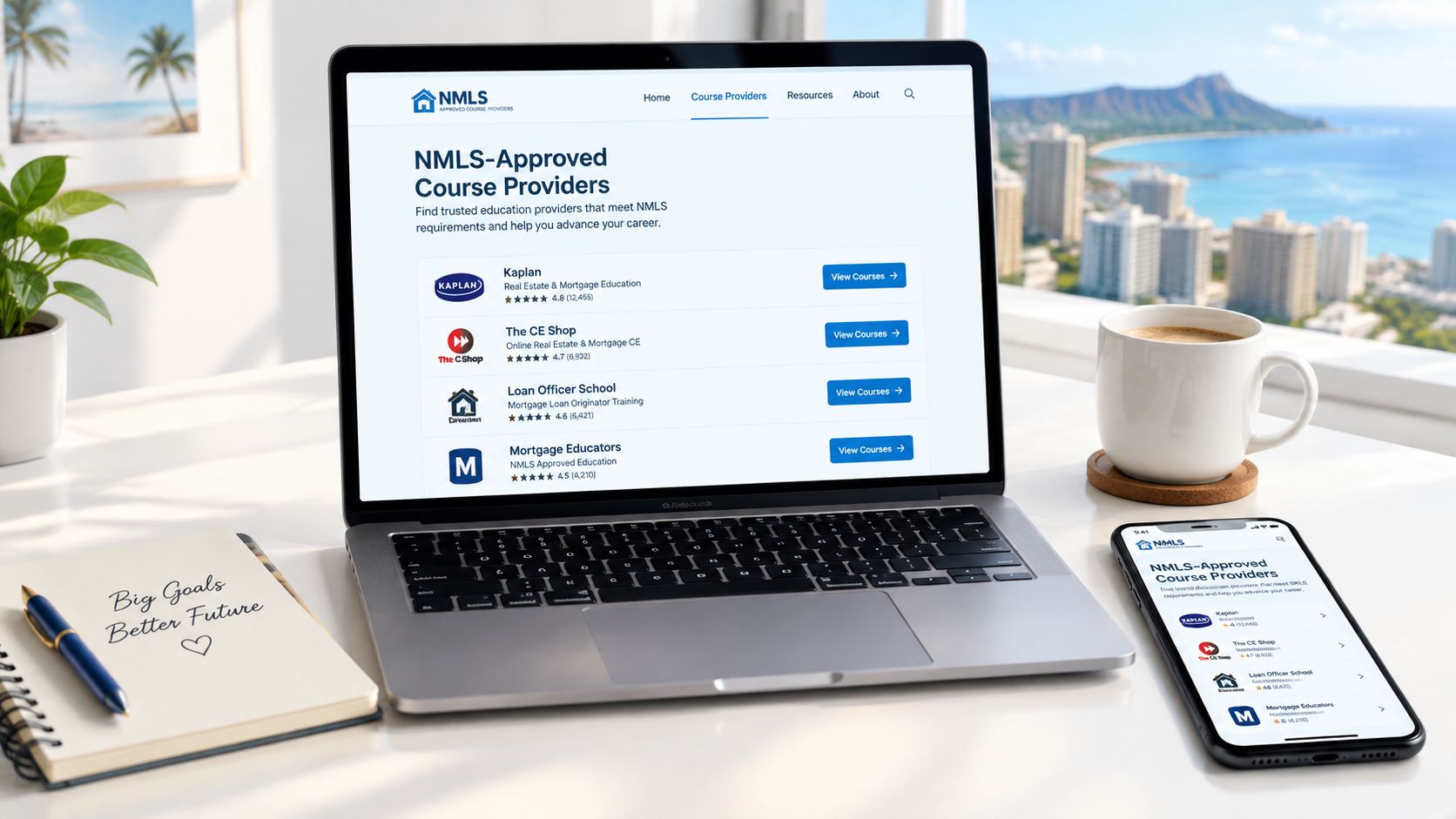
The right online course removes administrative friction before it creates a study burden. Check the provider’s NMLS approval, Hawaii course availability, mobile and Chromebook compatibility, completion-certificate process, support hours, and whether exam preparation is included. You want a platform that lets you study from a Honolulu kitchen, office, or quiet break room without losing track of required content.
Look for a course that uses consistent mortgage vocabulary across lessons, practice questions, and review materials. That connection matters because the SAFE exam tests concepts such as federal lending rules, ethics, loan products, and compliance judgment. A course can be inexpensive and still become costly if you have to buy separate preparation materials or chase missing education records.
A practical provider comparison
24hourEDU, NMLS Provider ID 1405107, offers online NMLS-approved education, a Hawaii-specific course option, and a free exam prep package. Its published course offerings start at $139, and its platform is designed for web access, including Chromebook use. Students can also use online support and request assistance with course completion and NMLS reporting (24hourEDU NMLS education courses).
The CE Shop and OnCourse Learning are other names applicants may compare. Don’t choose based on branding alone. Verify that the specific course you’re purchasing covers Hawaii’s state law requirement and that the provider clearly explains how completion is reported.
Enroll without creating a paperwork problem
Use your legal name consistently across your NMLS record, course account, identification, and application. Save the receipt, enrollment confirmation, course completion certificate, and any education reporting confirmation. If your name differs across records, resolve it early rather than waiting until exam registration or application review.
Online education makes the academic portion convenient. It doesn’t eliminate the need to monitor your NMLS record. A short weekly check of your account can catch a missing completion record before it delays testing or application submission.
Scheduling and Passing the SAFE MLO Exam
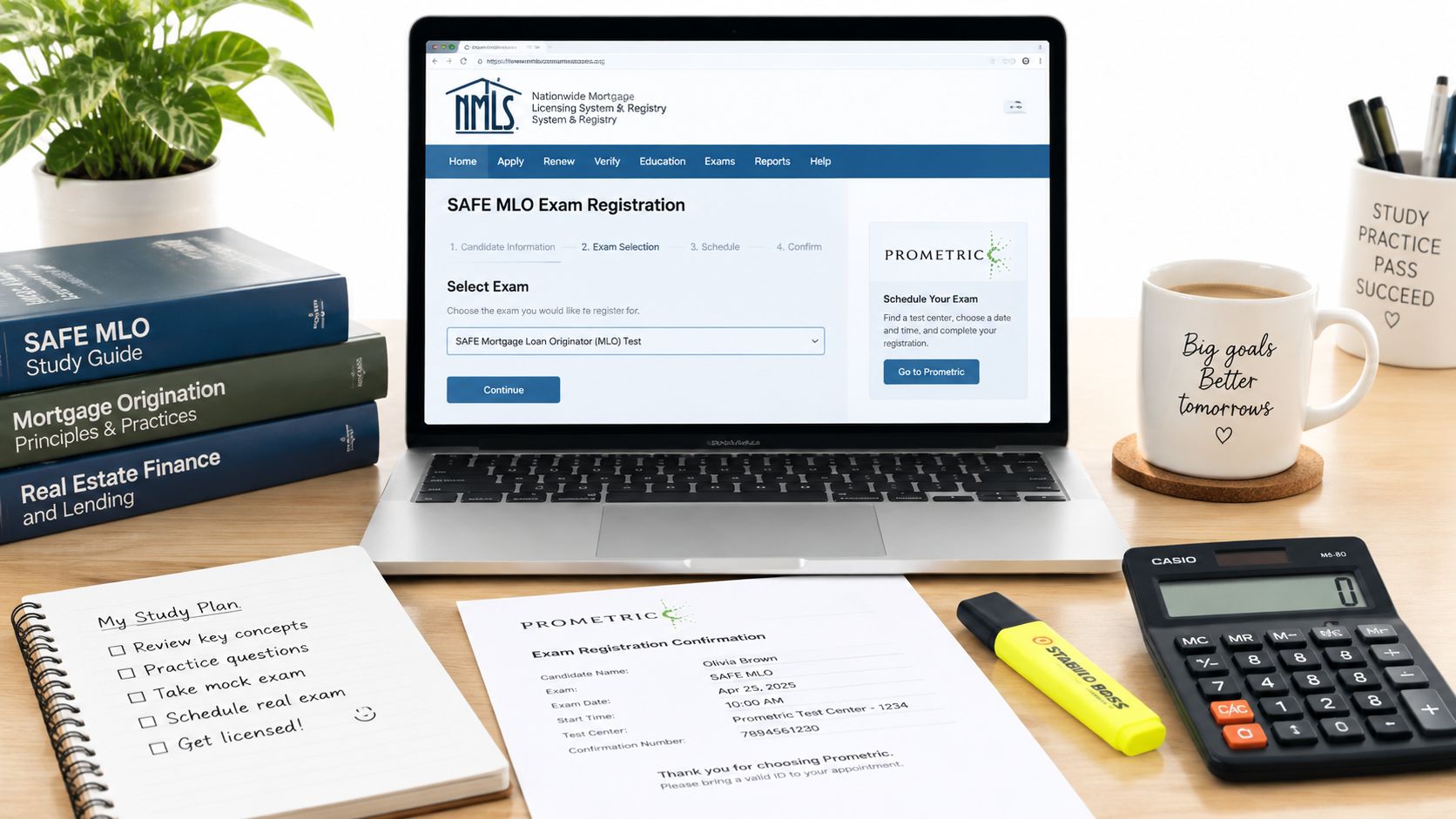
After you finish the required education, register for the SAFE MLO Uniform State Test through NMLS and schedule the appointment through the approved testing process. The exam scheduling fee is $110, and applicants can generally choose between an in-person testing center in the Honolulu area and remote online proctoring, subject to current availability and technical requirements.
Don’t leave scheduling until your course completion feels distant. The NMLS education window matters, and completed education can become void if you fail to schedule within 90 days of completion. Put the exam appointment on your calendar as soon as your education record is ready.
Use a short, focused review cycle
A two-week review plan works better than passive video watching. Use the free exam prep package included with your education, then divide your time between federal law, ethics, mortgage products, and Hawaii-specific rules. The Hawaii law content deserves deliberate review because it’s easy to remember national concepts while overlooking the state material that applies to your application.
A useful routine looks like this:
Early review: Read the day’s concepts before attempting questions.
Active practice: Complete questions without checking the answer immediately.
Error tracking: Write down why each wrong answer was wrong.
Targeted repetition: Revisit weak topics instead of replaying everything.
Final simulation: Take a timed practice exam and review every missed concept.
You’ll face 125 questions over 190 minutes, and you should bring two forms of identification. The exam also includes an optional 40-minute break, which you can use to reset, eat, or step away before continuing. Confirm the current testing instructions before appointment day through the official scheduling portal.
For additional preparation, use this SAFE exam test prep resource as a structured review aid rather than relying on last-minute memorization.
If you don’t pass, NMLS permits unlimited retakes after a 30-day waiting period. That rule gives you another route forward, but passing on the first attempt keeps your application timeline cleaner and avoids another appointment, another review cycle, and another interruption to your launch plans.
Background Checks, Fingerprints, and NMLS Sponsorship
Your Honolulu application leaves the laptop at this stage. Online education covers the academic requirement, while Hawaii also requires the NMLS FBI background check, fingerprinting, credit authorization, employment disclosures, and company sponsorship. Complete them in the right order. An incomplete record will not become complete because the state reviewer has to chase missing information.
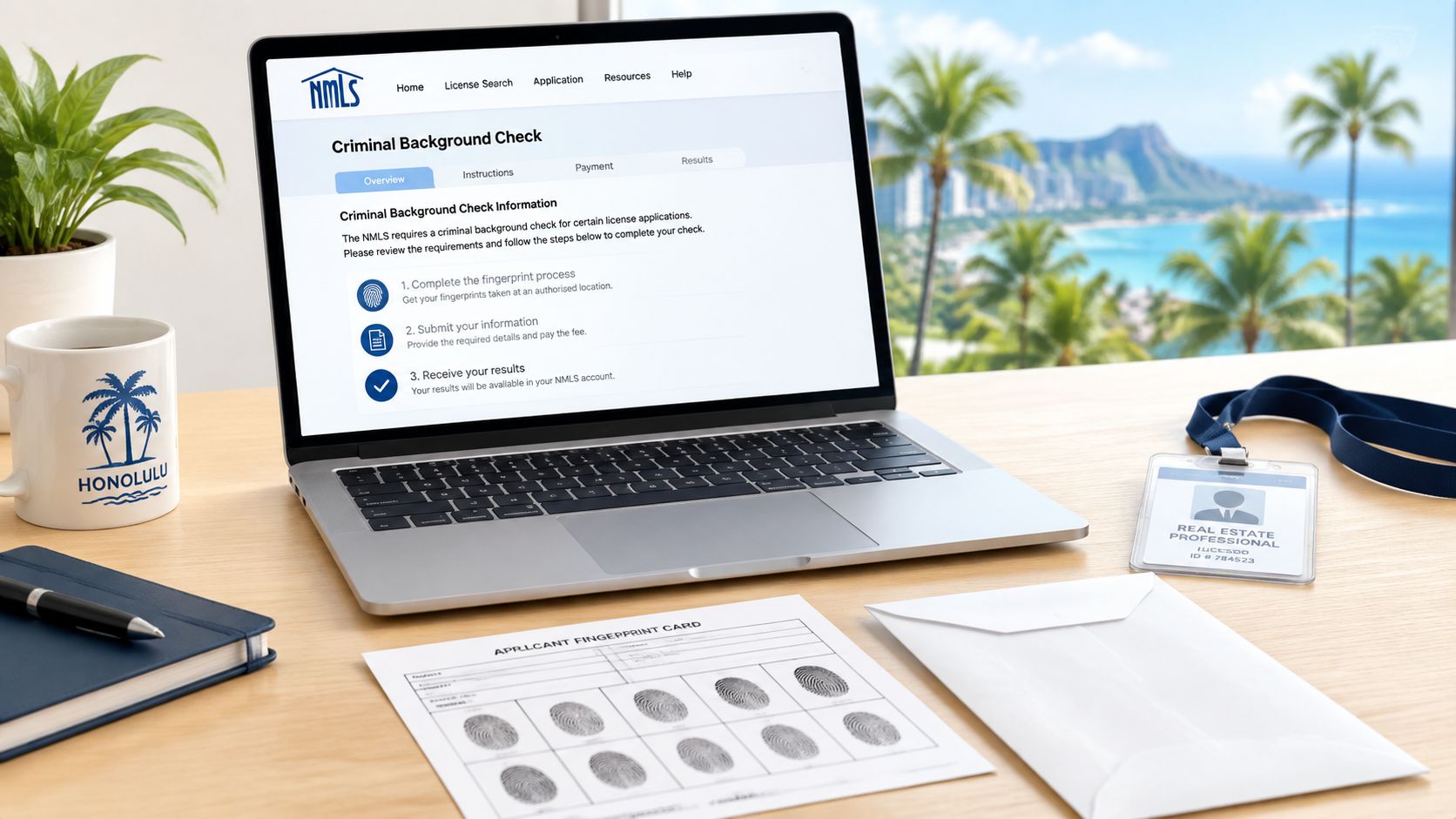
Start in NMLS by opening the Criminal Background Check area and following the FBI check instructions. Fingerprinting may require an appointment or a visit to an approved location, so lessons and application work can happen from home, but this part may require you to leave it. Hawaii DFI can request more information when a record needs clarification.
Complete the compliance record carefully
Authorize the credit check, then inspect every employment and disclosure response before submitting your MU4 record. Your identity, work history, and explanations must align. If a question calls for disclosure, answer fully and accurately, then attach supporting documentation. Omitting a problem creates a larger review issue than explaining it clearly.
For broader document-preparation context, this complete background check guide explains why identity details, record accuracy, and supporting paperwork matter during screening.
Hawaii’s statutory fee structure lists a $600 state application fee, $350 annual renewal fee, $100 reinstatement fee, $25 per day late fee, and $35 criminal background check fee (Hawaii Revised Statutes Section 454F-22). Keep these state charges separate from NMLS, testing, education, fingerprinting, and employer onboarding costs.
Cost or obligation
Amount or requirement
Why it matters
Initial Hawaii application fee
$600
Due for the initial state application
Annual renewal fee
$350
Required to renew the license
Reinstatement fee
$100
Applies when reinstatement is required
Late fee
$25 per day
Can accumulate after a missed deadline
Criminal background check
$35
Required state background check charge
Continuing education
8 hours annually
Required after licensing
Sponsorship is the frequently missed checkpoint
Passing the course and exam does not make you an active independent originator. Every individual MLO must be linked or sponsored by a company in NMLS. Hawaii guidance also states that someone working as an MLO for their own mortgage broker business may need both an individual MLO license and an MLOC license for the company (Hawaii DFI MLO FAQs).
Identify a sponsoring mortgage broker, lender, or other eligible employer before expecting final approval. The company must submit its NMLS affiliation or sponsorship action, and the record must be verified. Without that sponsorship record, the application can remain pending even after education, testing, background checks, and disclosures are complete.
The course gets you educated. Sponsorship connects your license to the business where you’ll originate.
Ask each prospective employer these questions before accepting the role:
Affiliation timing: When will the company submit and verify sponsorship in NMLS?
Disclosure support: Who reviews MU4 disclosures before submission?
Initial expenses: Which approved onboarding expenses does the company cover?
Training structure: Will a producing mentor review your first files?
Compensation model: Is the role salaried, commission-based, or a combination?
Hawaii’s registration-only categories can differ from individual MLO licensing based on the person’s role and legal status. If you plan to open a business, work independently, or move between companies, confirm the correct category with Hawaii DFI and the sponsoring company before filing. You’ve got this. Treat NMLS, fingerprints, and sponsorship as separate checkpoints, and the Honolulu process becomes much easier to control.
Study Tips, Exam-Day Tactics, and Staying Licensed
Strong exam preparation requires active recall. Build a five-day review cycle covering federal lending rules, ethics, mortgage products, and Hawaii law. After each practice set, sort mistakes by cause. A missed definition calls for different review than a compliance scenario missed because you rushed.
Use the final review to test judgment, not recognition. Explain a rule aloud, apply it to a fictional borrower, then answer related questions without opening the lesson. If you cannot explain the decision clearly, return to that topic before exam day.
Make exam day boring
Bring the required identification and arrive early enough for check-in. For remote testing, use a clear desk, stable equipment, and a quiet room that meets the proctor’s rules. For in-person testing, follow the testing center’s instructions and leave unnecessary items at home.
Answer straightforward questions first. Flag items that need more thought, complete the rest of the exam, and use the second pass for review. One confusing question should not consume the session.
Protect the license after approval
Hawaii requires 8 hours of annual continuing education, covering federal law, ethics, non-traditional mortgage lending, and Hawaii-specific content. The required breakdown is 3 hours of federal law, 2 hours of ethics, 2 hours of non-traditional mortgage lending, and 1 hour of Hawaii-specific content. Confirm the current requirement and reporting process through the Hawaii DFI MLO FAQs.
Topic
Hours
Deadline
Federal law
3
Annual CE cycle
Ethics
2
Annual CE cycle
Non-traditional mortgage lending
2
Annual CE cycle
Hawaii-specific instruction
1
Annual CE cycle
Total
8
Before renewal
Set reminders before renewal season, verify that your provider reported the CE, and review your NMLS record for current sponsorship and disclosures. Track these items from your laptop, but handle fingerprinting, testing, and employer actions through the required NMLS or in-person channels. Your license remains an active compliance responsibility, not a certificate you earn once and forget.
Launching Your MLO Career From Honolulu
Your first professional decision is less about finding the flashiest title and more about choosing a structure that supports production. A sponsored employee or contractor role may provide training, systems, and a referral network. A company owner has broader control but also carries business licensing and compliance responsibilities.
Interview Honolulu mortgage companies with practical questions about lead flow, mentoring, product access, compensation, and onboarding costs. Commission upside can be attractive, but it depends on your agreement, production, compliance, and ability to develop trusted referral relationships. Don’t choose a company solely because it promises flexibility.
A 30-60-90 day launch plan
Days 1 through 30: Learn the company’s product guidelines, disclosures, document standards, and file-management system. Work beside a mentor and practice explaining the application process in plain language.
Days 31 through 60: Build relationships with professionals who regularly meet borrowers, including financial professionals, business owners, and housing-service contacts. Keep every conversation compliant and focus on being useful rather than pushing for immediate referrals.
Days 61 through 90: Take ownership of active opportunities under company supervision, track each commission-producing activity, and request appropriate client feedback after successful transactions. Use your records to identify which relationships and outreach methods create the strongest pipeline.
Remote work is a realistic part of the modern mortgage career, but it still requires secure systems, prompt communication, compliant document handling, and reliable availability. Naming your own hours sounds appealing, and many originators do gain flexibility, but clients and referral partners still expect you to respond when decisions matter.
If you’re preparing a professional application for a mortgage company, this banking cover letter guide can help you present transferable experience clearly.
Honolulu MLO questions answered
Can I complete the education from home? Yes. The education component can be delivered online, while NMLS interaction, testing, fingerprinting, and sponsorship still require their own steps.
Can I work from home after licensing? Often, depending on the employer’s systems, supervision, security requirements, and company policy. Confirm the arrangement before accepting a role.
Can I work in more than one state? State licensing and company permissions vary. Ask your sponsoring company and verify each state’s requirements before originating outside Hawaii.
Does Honolulu’s time zone help with mainland relationships? It can support communication with West Coast contacts during overlapping business hours. Your service model still needs clear availability and dependable follow-through.
The simplest route is the disciplined one. Create the NMLS record first, choose education that includes Hawaii law, schedule the exam promptly, complete screening accurately, and secure sponsorship before expecting approval.
24hourEDU offers NMLS-approved online MLO education, Hawaii-specific course content, and a free exam prep package to help Honolulu applicants prepare without assembling separate study tools. Visit 24hourEDU to review the Hawaii course options and begin organizing your licensing path from home.
24hourEDU NMLS Mortgage Loan Officer Course – $189 All States