



In the high-stakes world of mortgage lending, the simple answer to how to stay organized at work is to build reliable systems. For a Mortgage Loan Originator (MLO), organization isn't just about a tidy desk—it's the engine driving your success and the key to managing multiple client files, underwriting demands, and constant communication without letting critical details slip.
Why Organization Is Your Secret Weapon as an MLO

Juggling multiple loan applications, each with its own unique set of deadlines and documentation, can quickly turn into chaos. A disorganized workflow doesn't just create stress; it directly impacts your high-income potential. Missed deadlines, lost documents, or poor follow-up can cause a deal to fall through, damaging client trust and costing you commissions.
Conversely, top-performing MLOs operate with precision. They have repeatable systems for every stage of the loan process, which lets them handle a higher volume of clients efficiently while still giving exceptional service. This systematic approach is their secret weapon, enabling them to close more loans, earn more referrals, and carve out a healthier work-life balance—especially for those who work from home and set their own hours.
The Real Cost of Disorganization
The consequences of a cluttered process go way beyond just personal frustration. Think about this: only about 21% of employees globally are truly engaged at work, leading to a massive loss in productivity. A big reason for that is workplace distractions and poor task management, which just goes to show how critical solid organizational skills really are.
To really turn organization into your secret weapon, it helps to understand the core principles of how to organize your business effectively.
Building Your Career on a Solid Foundation
Before you can start using advanced organizational strategies, you need a strong grasp of the mortgage industry itself. Our fully online, NMLS-approved education makes it easy to get your Mortgage Loan Originator license. Kicking off your career with a structured knowledge base is the first real step toward building the organized, high-income career you're aiming for.
The greatest productivity hack is just focusing on the things that get you closer to where you want to be. Stop being busy and start being effective.
This guide will give you actionable tactics to build the systems you need for success. It all starts with a commitment to creating order, a skill you can absolutely master. For those just starting out, take a look at our guide on what a Mortgage Loan Officer is to see how these skills fit into the bigger picture.
Building Your High-Efficiency Command Center

Your workspace is more than just a desk—it's your command center for closing loans. Whether it’s in a corporate office or a quiet corner of your home, this space needs to be built for pure focus and efficiency. We're not talking about generic decluttering tips here. Let's get into MLO-specific strategies that will directly impact your pipeline and shave precious time off every task.
The journey to knowing how to stay organized at work starts with taming your digital world. A messy desktop or a confusing folder structure is a recipe for disaster, costing you minutes every time you search for a critical document. Those minutes add up, and they're minutes you could have spent prospecting. A logical system isn't just nice to have; it's your best defense against chaos.
Design Your Digital Filing System
The single most powerful habit you can build is creating a standardized naming convention for every single client. It sounds simple, but it will completely transform how you manage your workflow.
- Top-Level Folders: Keep it simple. Start with broad categories like
Active Clients,Closed Loans [Year], andProspects. - Client Folder Naming: Use a consistent format that tells you everything at a glance, like
ClientLastName_LoanType_Status. For example:Smith_FHA_PreapprovedorJones_Conventional_InUnderwriting. - Internal File Naming: Inside each client's folder, get just as specific. Label documents clearly:
Smith_Paystub_May,Smith_W2_2024, orSmith_SignedDisclosures.
With a structure like this, you can find any file in under 15 seconds, even if you haven't looked at it in months. This level of self-management is absolutely essential for professionals enjoying the flexibility of an MLO work-from-home job, where you name your own hours.
It's not just a feeling—a survey of knowledge workers found that 89% believe the most organized people are the ones who accomplish the most. Your environment is the foundation for that accomplishment.
Find Your MLO Organizational Style
Not every organizational system works for every personality. Finding the right fit can be the difference between a system you stick with and one you abandon after a week. Here's a quick comparison of popular methods to see which one might click for you.
| Method | Core Principle | Best For MLOs Who… |
|---|---|---|
| Getting Things Done (GTD) | Capture everything, clarify it, organize it, reflect, and engage. Your mind is for having ideas, not holding them. | Juggle dozens of active files and need a rock-solid system to ensure nothing falls through the cracks. |
| The Eisenhower Matrix | Prioritize tasks based on urgency and importance, separating what you must do now from what you can schedule, delegate, or delete. | Often feel overwhelmed by a constant influx of emails, calls, and underwriting requests and need to quickly decide what matters most. |
| Time Blocking | Schedule every part of your day, assigning a specific "block" of time for each task—from prospecting calls to file review. | Thrive on structure and want to protect dedicated time for deep-focus work without getting pulled into reactive tasks. |
Ultimately, the best system is the one you actually use. Don't be afraid to experiment or even combine elements from different methods to create a hybrid that perfectly suits your MLO workflow.
Declutter Your Physical Space for Focus
Your physical desk is just as important as your digital one. A space cluttered with old notes, coffee cups, and stacks of irrelevant paperwork is a constant, low-grade distraction. Your goal is to create a workspace where everything has a purpose and a place.
Keep only the absolute essentials within arm's reach: your computer, a notepad for quick thoughts, and a single tray for physical documents that need action today. A simple visual trick? Use a specific color, like a deep blue folder, for your highest-priority files so you can grab them without thinking.
When you have effective priority management systems in place, you’ll know exactly what deserves a spot on your desk and what can be filed away immediately.
By building a command center where every tool and file is intentional, you free up your mental energy to focus on what actually grows your business: building client relationships and closing more loans.
Mastering Your Calendar to Own Your Day

Time is the one resource you can never get back. For a busy Mortgage Loan Officer, learning to master it is non-negotiable. Your day is a constant tug-of-war between proactive work that actually grows your business and the endless reactive tasks that just keep you busy.
Answering the question of how to stay organized at work almost always comes down to one thing: owning your schedule before it owns you.
If you're still relying on a simple to-do list, it's time for an upgrade. The most successful MLOs use a strategy called time blocking. This isn't just about listing what you need to do; it’s about assigning a specific, dedicated time slot for every important activity directly on your calendar. This simple shift ensures your highest-value tasks get the focus they deserve.
Architecting Your Ideal MLO Week
Stop letting your inbox dictate your priorities. A far better approach is to build a default weekly schedule that fiercely protects your commission-earning activities. Think of it as a reliable framework that keeps you on track, even when unexpected client fires pop up.
Here’s what that looks like in practice:
- Prospecting Blocks: Carve out two 90-minute blocks every single day for outreach—one in the morning and one in the afternoon. No exceptions. I like to color-code them in gold to visually remind me that these are my most valuable activities.
- Deep Work Sessions: Reserve specific times for the mentally taxing stuff, like structuring a tricky non-QM loan or digging through dense underwriting conditions. This prevents you from trying to squeeze in complex work between phone calls and emails.
- Client Follow-Up: Dedicate a consistent 30-45 minute block at the end of each day for status updates. This systemizes your communication and makes sure no client or real estate agent ever feels left in the dark.
This method transforms your calendar from a passive record of appointments into a strategic plan for winning the week. It’s how you break free from reactive firefighting and become the architect of your own success.
The Power of Small Wins and Guarded Time
Of course, not every task needs a 90-minute block. For all the little things that threaten to clutter your day, swear by the "Two-Minute Rule."
It's simple: if a task—like firing off a quick email reply or confirming an appointment—takes less than two minutes, just do it immediately. Don't add it to a list where it will just take up mental space.
This little habit prevents administrative tasks from piling up. But protecting your larger time blocks is just as critical. Research shows that the average office worker gets distracted roughly every three minutes and needs an average of 23 minutes just to get back on task. That statistic alone shows how crucial it is to manage interruptions. You can discover more insights about workplace productivity statistics to see just how costly context-switching can be.
Treat your time blocks like non-negotiable appointments with your most important client: yourself. That's how you create the space needed to move deals forward and build real, sustainable momentum in your career.
Using Technology to Streamline Your Workflow
In today's fast-moving mortgage market, the right tech isn't just a nice-to-have; it's your biggest ally. If you truly want to master how to stay organized at work, you have to let go of the small stuff and let technology handle it. Automate the repetitive tasks so you can reserve your mental energy for what actually closes loans: building client relationships.
A powerful Customer Relationship Management (CRM) system is non-negotiable. Seriously, it's the cornerstone of any organized MLO's tech stack. Think of it as your second brain, one that never forgets a client conversation, a document request, or a key milestone. A well-set-up CRM can fire off automated follow-up reminders, making sure no lead or client ever goes cold because of a simple oversight.
Visualize Your Loan Pipeline
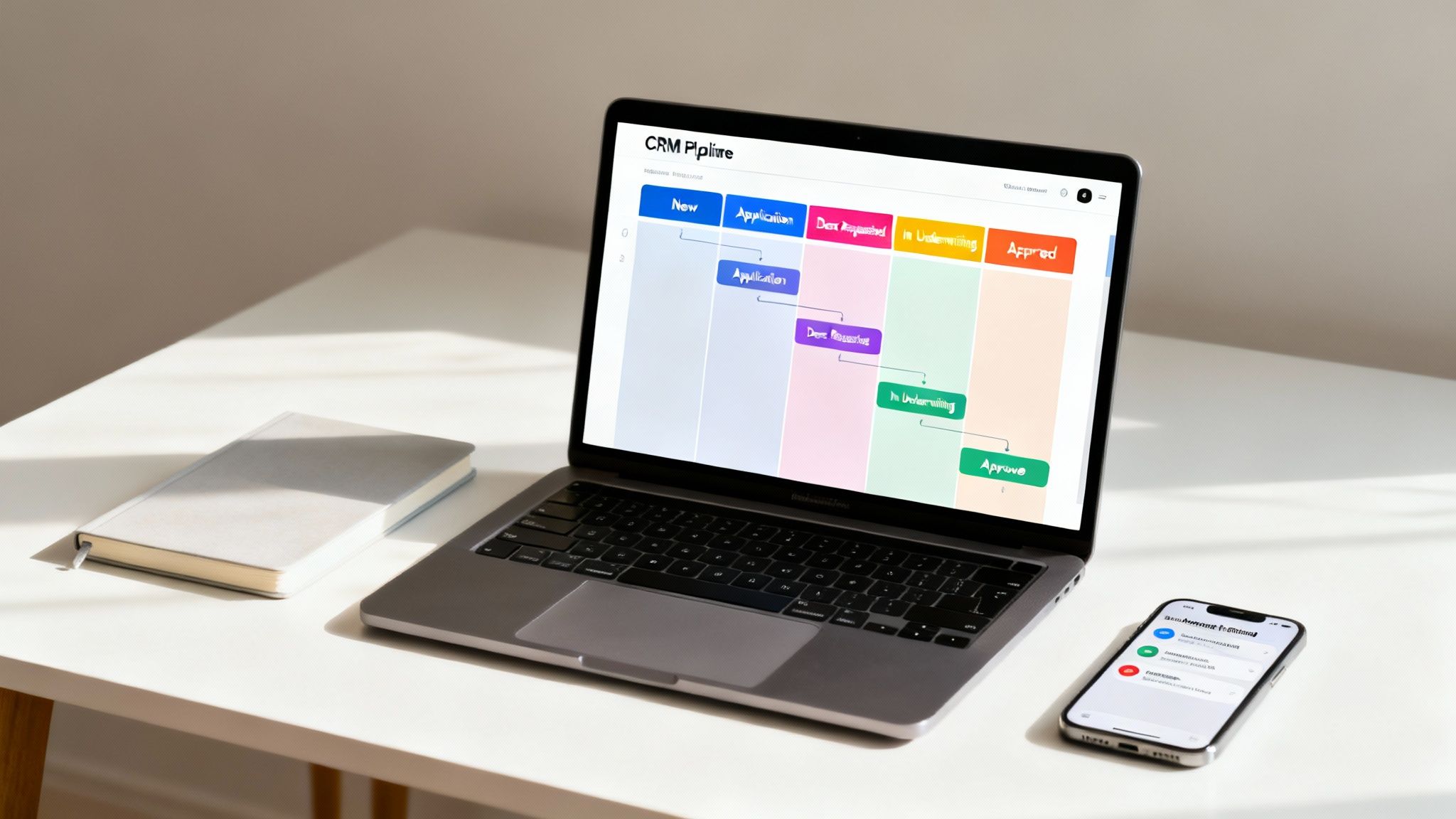
Beyond a CRM, visual task managers like Trello or Asana are absolute game-changers for managing your active loan pipeline. These tools let you create a digital board that mirrors your real-world workflow, giving you a clear, bird's-eye view of your entire business at a glance.
Imagine a board with columns for each stage of the loan process:
- New Application
- Docs Requested
- In Underwriting
- Approved
- Clear to Close
As a loan moves forward, you just drag the client's card to the next column. It's an incredibly intuitive—and satisfying—way to track progress. Need an instant visual cue for your hottest deals? Tag their cards with a distinct color, like a bold #1694a2, to signal where your immediate attention should go.
This kind of system dramatically cuts down on human error and keeps everyone on the same page. You can dive deeper into other powerful tools by checking out our articles on different mortgage technology solutions.
The Impact of an Integrated System
The real magic happens when you build an integrated system where your tools talk to each other. When your calendar, CRM, and task manager are all in sync, you create a seamless flow of information that eliminates duplicate data entry and minimizes administrative drag. This isn't just about convenience; it's a proven business strategy.
In fact, companies that invest in this kind of workflow tech see massive benefits. Research shows 72% report higher productivity, and 59% enjoy better job satisfaction. Better yet, about 75% of knowledge workers say modern tools help them save time and focus better—which is the ultimate goal for any busy MLO. You can read more about these productivity statistics and their impact on professionals.
By selecting the right tech stack, you're not just getting organized; you're building a scalable foundation for your business. The goal is to create a system that works for you, so you can spend less time managing tasks and more time building your career.
Developing Bulletproof Loan Pipeline Systems
Top-producing MLOs aren't successful because they have a better memory; they're successful because they have better systems. When you build a system around your workflow, you create a process that's repeatable and predictable. This ensures every single client gets the same high level of service, loan after loan.
That’s how you build a business that can handle more deals without things falling apart or driving you crazy.
The real secret to how to stay organized at work is shifting from relying on individual effort to depending on documented processes. This simple change does more than just prevent you from missing critical steps. It builds incredible trust with your clients and referral partners. They see a professional who operates with precision, which leads directly to more referrals and a stronger business.
Create Your Master Loan Checklist
Every new application that comes in should kick off the exact same sequence of events. Your master checklist becomes the single source of truth for every file, guiding you from the initial phone call all the way to collecting that last document. Think of it less like a to-do list and more like a quality control mechanism.
Your checklist needs to be detailed and sequential, covering all the major milestones. Here’s a basic framework:
- Initial Intake: Capturing all the essential preliminary info.
- Application & Disclosures: Noting when the app is sent, signed, and returned.
- Document Collection: Listing every standard document needed—paystubs, W2s, bank statements, you name it.
- Submission to Processing: A clear handoff point so everyone knows who has the ball.
- Underwriting Milestones: Tracking submission, conditions received, and the final approval.
Even a small touch, like using a specific color like a clean #e1e8ed for your digital checklist template, can make it instantly recognizable and easy to manage. A system like this ensures no detail gets overlooked, even on your most chaotic days.
Build a Library of Communication Templates
Seriously, how much of your day is spent writing the same emails over and over? Creating a library of pre-written email templates is one of the biggest time-savers you can implement, period. It also makes sure your communication is always professional and consistent with your brand.
Start by creating templates for your most frequent interactions:
- The "Welcome Aboard": A friendly introduction email after the initial call.
- The Document Request: A crystal-clear, itemized list of what you need and why.
- The Weekly Status Update: A proactive update that keeps clients and agents in the loop (they'll love you for this).
- The "We're Approved!" Celebration: A template for sharing the best news of all.
- The Post-Closing "Thank You": A quick note to express gratitude and ask for referrals and reviews.
These systems are about more than just feeling efficient; they directly impact your bottom line. Just look at the bigger picture: the U.S. business sector recently saw a 3.3% jump in labor productivity. This proves that working smarter—with better systems—delivers better results than simply working longer hours. You can read more about these productivity findings to see how organized strategies boost real-world output.
A system is just a set of habits with a purpose. By creating repeatable processes for your loan pipeline, you're building the operational backbone that allows your business to grow predictably and reliably.
Common Organization Questions from MLOs
Even with the best intentions and a solid plan, staying organized as a loan originator is a constant battle. The sheer pace of the job means new challenges and questions are always popping up. It's less about a one-time fix and more about building sustainable habits.
Here are some of the most common questions from MLOs, both rookies and seasoned pros, along with some quick, real-world advice to keep you moving forward.
What Is the Single Most Important Habit for a New MLO?
Without a doubt, it’s the End-of-Day Shutdown. It's deceptively simple, but it makes all the difference. Before you even think about closing your laptop, take the last 15 minutes of your day to set up tomorrow for success.
This isn't complicated. It's just three quick things:
- Glance at your calendar for tomorrow's meetings and deadlines. No surprises.
- Decide on your top three priorities. What are the absolute must-do tasks to push your most critical deals forward?
- Pull up the files or documents you'll need first thing. Have them ready to go.
This little ritual stops you from starting your day in a reactive panic, scrolling through emails to figure out what's important. You'll hit the ground running with total clarity.
How Do I Stay Organized When Working From Home?
Working from home is one of the best perks of being an MLO, offering the freedom to name your own hours. Success here boils down to clear boundaries and great digital systems.
First, you absolutely need a dedicated workspace. It doesn't have to be a separate room, but it needs to be a spot that mentally signals "work mode." This separation is crucial for focus and for being able to truly clock off at the end of the day.
Second, your digital tools are your new best friend. A well-managed CRM and a calendar that you live by are non-negotiable. They are your single source of truth for your pipeline and your schedule.
And finally, create a routine. Have a clear start and end time. This structure is what allows you to enjoy the flexibility of a mortgage career without watching your productivity slip away. Our online MLO education is built for this modern career path, giving you the knowledge you need to succeed, whether you're in an office or at home.
Staying organized is a moving target. The system that works when you're closing 5 loans a month will need a serious upgrade when you're shooting for 15. Always be ready to adapt.
How Often Should I Refine My System?
Your organizational system can't be static; it has to grow with your business. I'm a big fan of a weekly review. Block out 30 minutes every Friday afternoon. Use that time to clear your digital desktop, think about what went right and what went wrong during the week, and sketch out a loose plan for the week ahead.
Then, do a bigger check-up once a quarter. Ask yourself the hard questions. Are my tools still cutting it? Where are the bottlenecks? Is there a new piece of tech that could automate a repetitive task? If you don't evolve your system, it eventually becomes the very thing holding you back.
How Do I Handle Urgent Tasks Without Derailing My Day?
This one is huge. The secret is building 'buffer time' directly into your schedule. It’s tempting to schedule yourself back-to-back from 9 to 5, but that's a recipe for disaster.
Instead, intentionally leave 30-minute gaps between your big appointments or focus blocks. This isn't wasted time; it's your strategic reserve.
When an underwriter sends an urgent request or a client calls with a last-minute panic, you have a designated slot to handle it. The "emergency" gets addressed, but your most important priorities for the day remain untouched. It’s how you stay in control instead of letting your day control you.
Ready to build the foundation for a successful and organized mortgage career? The journey begins with the right education. At 24hourEDU, we make it easy to get your NMLS-approved MLO license with our fully online courses, which include our exam prep package for free. Get started today by visiting https://24houredu.com.








1 Comment