


You’re sitting at your kitchen table in Idaho Falls, comparing course tabs, trying to figure out which one gets you to a Mortgage Loan Originator license without wasting a week on the wrong training. That’s the right problem to solve, because the choice isn’t really about “an online course” in the abstract. It’s about whether the program satisfies Idaho’s 20-hour NMLS-approved prelicensing rule, includes the 2-hour Idaho law module, reports completion correctly, and gives you enough exam prep to clear the SAFE test the first time.
| Course Factor | Strong Choice Looks Like | Why It Matters |
|---|---|---|
| NMLS approval | Provider and course are approved for MLO prelicensing | Without approval, the hours don’t count |
| Idaho state coverage | The package includes the Idaho law module | Generic national content leaves you short |
| Exam prep | Practice questions, review tools, and score tracking | The SAFE exam is not easy to wing |
| Instructor access | Real help by phone or email | Complex compliance topics need support |
| Flexibility | Start quickly and study online | Working adults need fewer scheduling barriers |
| Reporting | Completion is sent through NMLS | Prevents avoidable application delays |
| Pricing clarity | No surprise add-ons | Hidden fees slow down a fast licensing plan |
Why Idaho Falls Residents Are Choosing Online MLO Courses
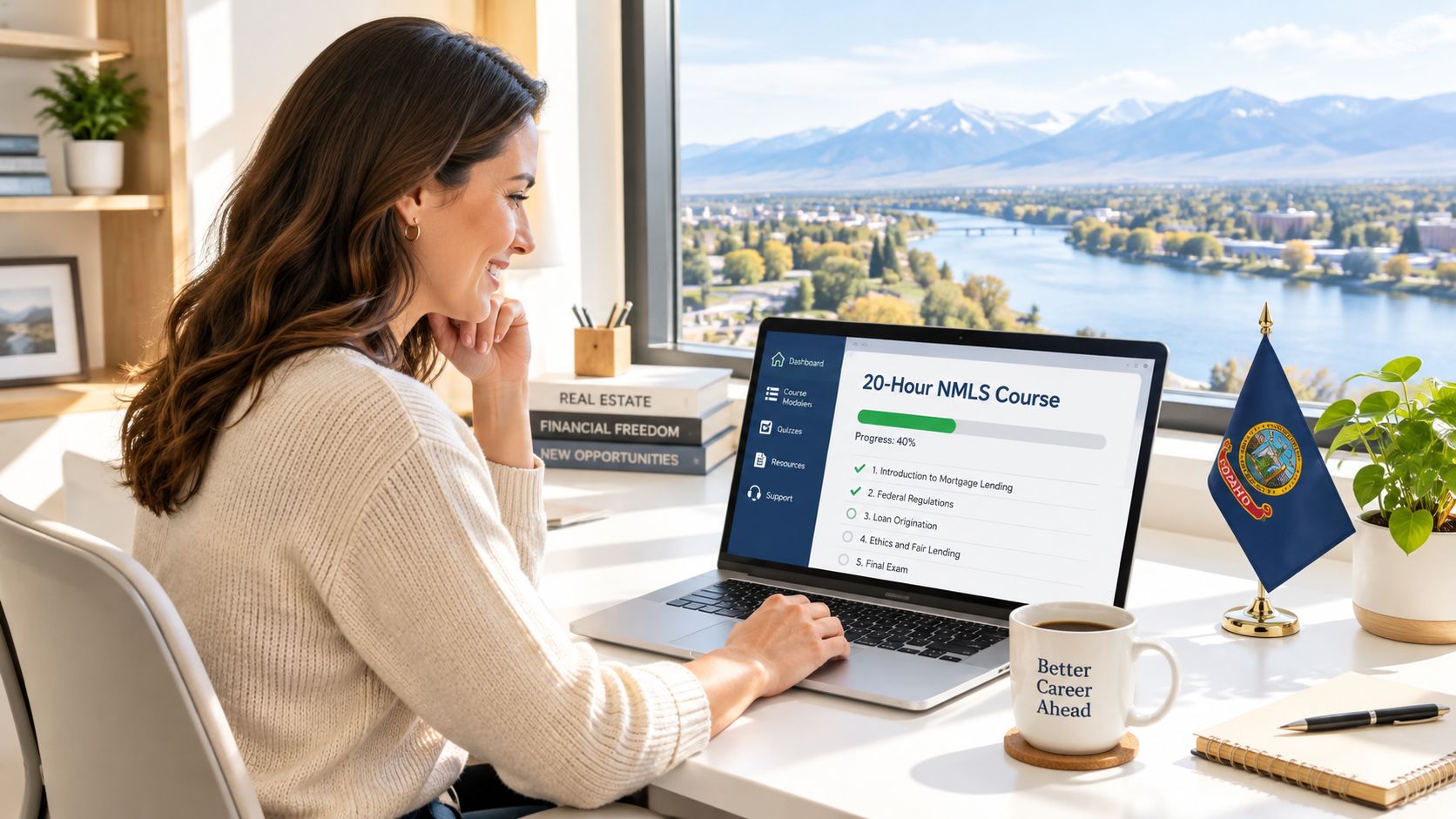
A lot of Idaho Falls career changers end up in the same spot. They want a stable, commission-based mortgage career, but they can’t afford a rigid classroom schedule that eats nights and weekends. An Idaho Falls online mortgage loan originator course solves that problem when it’s built correctly, because Idaho law lets applicants complete the required education online through an approved method, not just in a classroom Idaho Code § 26-31-307.
The real appeal is speed without shortcuts
The federal SAFE Act framework pushed states into a standardized licensing structure using NMLS, with prelicensing testing, background checks, credit checks, and continuing education folded into the process Idaho Department of Finance guidance. That matters in Idaho Falls because people moving into lending usually want a faster path, not a looser one. Online delivery gives them that speed, but only if the course is NMLS-approved and tied to Idaho’s requirements.
I’ve seen too many applicants buy a generic national course because it looked simple, then discover they’re still missing the state-law piece. That’s wasted time and money. The right online course removes friction instead of creating a second round of coursework.
Practical rule: If the course doesn’t clearly show Idaho’s state-law hours, don’t treat it as complete just because the total says 20.
The local market also justifies the effort. Idaho Falls has a large owner-occupied housing base, and many of those homes carry mortgages, which means borrowers constantly need clear guidance on financing choices and compliance-aware advice Idaho Falls housing data. That’s exactly the kind of market where a properly trained MLO can build a real career, not just pass a test.
What the 20-Hour NMLS Curriculum Covers
A compliant course is more than a label that says “20 hours.” It needs a syllabus that shows federal law, ethics, mortgage-product standards, and Idaho law in the right mix. Idaho requires 20 hours of NMLS-approved prelicensing instruction, with 3 hours of federal law and regulation, 3 hours of ethics, 2 hours on nontraditional mortgage products, and 2 hours of Idaho law, while the remaining hours may be filled by electives or approved content Idaho Code § 26-31-307.

The five parts you should expect to see
A serious syllabus should map cleanly to the licensing rule. If it doesn’t, stop there.
- Federal law and regulation: TILA, RESPA, and the SAFE Act’s core licensing duties, taught at the 3-hour depth Idaho requires.
- Ethics: Look for fraud prevention, consumer protection, and fair lending, not vague morality talk.
- Nontraditional products: The course should cover lending standards for mortgage products that don’t fit the standard mold.
- Idaho law: Generic national courses often miss this piece, and Idaho requires it as part of the approved curriculum Idaho Department of Finance newsletter.
- Approved electives: These hours can round out the total, but they don’t replace the required state-specific content.
Read the curriculum before you enroll. Don’t buy a course just because it says “20 hours.” The key question is whether the provider shows the Idaho-specific hours clearly and keeps the structure aligned with the state rule.
If you want a clean example of how a 20-hour course should be organized, the MLO 20-hour course breakdown is a useful reference point for checking whether a provider’s syllabus is complete enough for Idaho applicants.
Key Features to Compare in Online MLO Courses
The best comparison is simple: does the course move you toward licensure, or does it just keep you busy? That’s how I want Idaho Falls applicants to judge every provider, because marketing fluff won’t help when you’re trying to finish education, pass the exam, and submit a clean application through NMLS. For a broader look at online course design and how good platforms organize learning, this guide on improve productivity in online education is a helpful frame for evaluating whether a course is built to reduce friction or add it.
| Feature | What to Look For | Why It Matters |
|---|---|---|
| NMLS approval status | Provider approval and a valid course listing | The hours have to count |
| Idaho coverage | Idaho law is bundled into the package | You avoid a second purchase |
| Instructor support | Phone and email access from mortgage professionals | Compliance questions come up fast |
| Mobile access | Lessons work on a phone or tablet | Busy adults need study time in gaps |
| Exam prep | Practice questions, explanations, and review tools | Finishing the course isn’t the same as passing |
| Pricing transparency | Clear total cost and no surprise fees | Helps you compare courses honestly |
| NMLS reporting | Completion is sent properly to NMLS | Reduces application delays |
Use the course as a licensing tool, not a content library
Here’s the part many borrowers get wrong. They compare course libraries the way they’d compare entertainment, then ignore whether the provider supports licensing progress. That’s backwards. In Idaho Falls, the better question is whether the course covers the state-law module, supports NMLS reporting, and gives you a direct line to help when the compliance language gets dense.
Don’t buy a course because the lessons look polished. Buy it because it closes every licensing gap.
Instructor access matters more than people admit. A course with experienced support cuts down on guesswork when you’re trying to interpret licensing language, map the curriculum, or figure out what NMLS expects next. The same goes for mobile access, because adults don’t study in perfect blocks. They study between errands, after work, and whenever they can get fifteen quiet minutes.
Pricing transparency is also essential. If a course hides the Idaho law module, exam prep, or reporting behind separate charges, the cheap option usually becomes the expensive one. The course should tell you exactly what you are getting before you enroll.
NMLS Approval and State Coverage
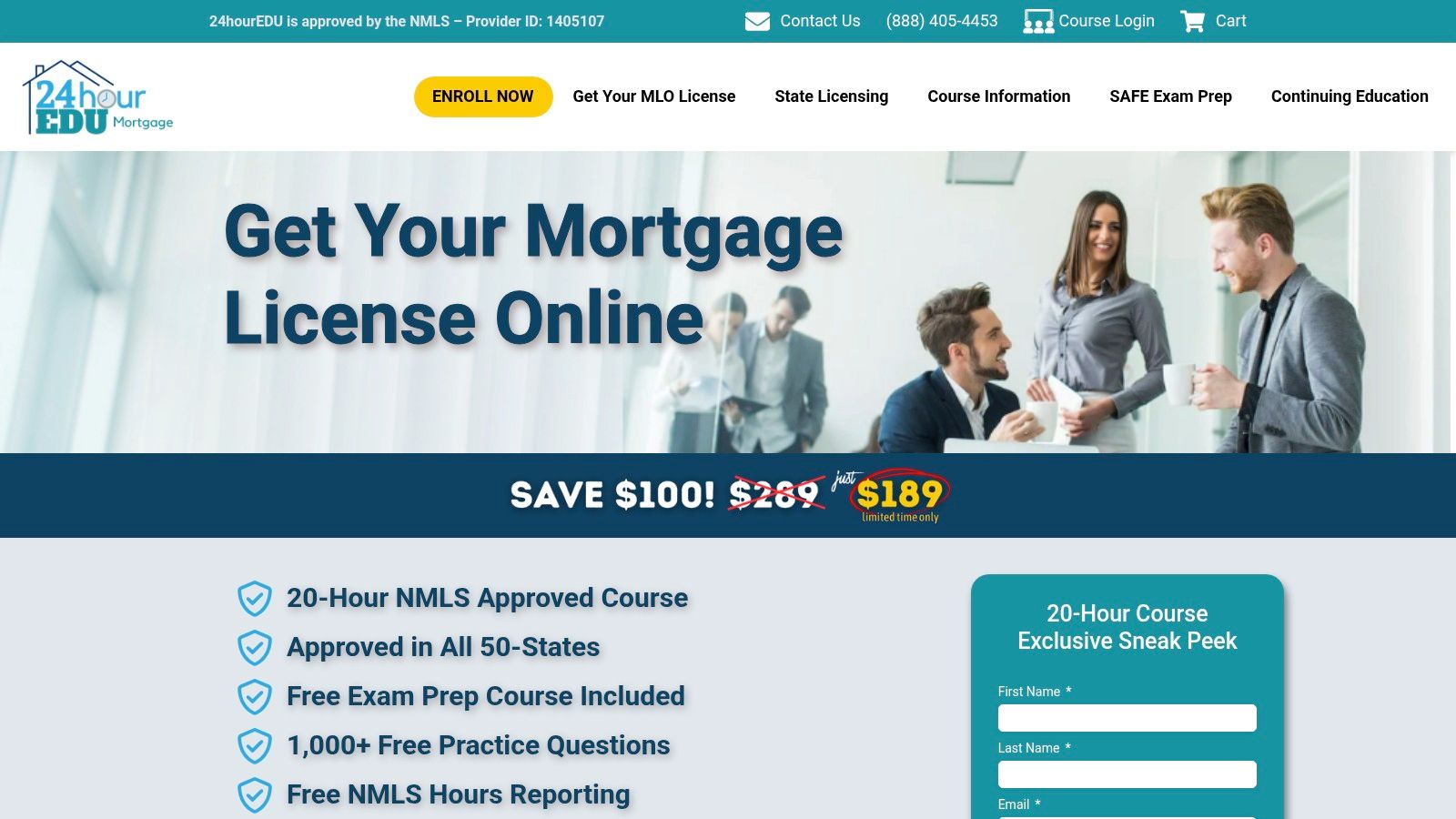
NMLS approval is the gatekeeper. If the provider is not approved, nothing else matters, because Idaho applicants must apply through the Nationwide Multistate Licensing System and Registry and complete approved education through that channel Idaho Title 26 licensing statute. I treat approval and reporting as the first thing to verify, not the last.
How to verify the provider quickly
A legitimate provider makes its NMLS status easy to find. You should be able to confirm the course is approved, see the provider identity, and check that completion is reported correctly. Idaho’s application process runs through NMLS, so a course that does not report properly creates paperwork friction before you even get to testing.
State coverage is more specific than “available in Idaho.” A real Idaho-friendly package includes the 2-hour Idaho law module inside the 20-hour total, instead of forcing you to hunt for a separate add-on later. That distinction saves time and keeps the licensing path clean. It also helps avoid the common mistake of finishing the national SAFE curriculum and still needing the state-law portion afterward Idaho Department of Finance newsletter.
Completion reporting is the last piece people ignore at their own risk. If the provider does not send the hours into NMLS correctly, the course may be finished in your head but not in the system. That is a self-inflicted delay.
What separates a real Idaho course from a generic one
A generic national course can look complete and still leave you short on Idaho law. Ask one blunt question before you enroll, “Where is the Idaho-specific module, and how is completion reported?” If the answer is fuzzy, keep looking.
Check the provider’s NMLS approval listing on the registry. If the listing is easy to verify, names the approved course, and shows how completion flows into NMLS, you are dealing with a course built for Idaho applicants. If it only talks about national coverage, you still have work to do before your licensing file is ready.
Instructor Support, Flexibility, and Mobile Access
A course fails working adults the moment it creates friction. If you are balancing a job, family responsibilities, or a shift from sales or property management, you need fast access, clear support, and a course flow that respects your schedule.

Convenience has to be real, not a slogan
A solid online course lets you start quickly, study on a phone or tablet, and reach a human when the material gets technical. Ethics, fair lending, and state-law content can get dense fast. A short answer from someone who knows the licensing path saves more time than another block of generic text.
For study habits that fit a working schedule, see this guide to online learning best practices.
Flexible starts matter too. They let you begin now instead of waiting for a cohort date that does not fit your schedule. That is how students keep momentum, finish the 20-hour requirement, and avoid turning enrollment into another delay.
Local market conditions also make ease of access matter. Idaho Falls has a meaningful housing market, and new MLOs will be talking to borrowers about payment structures, ownership costs, and loan options. A course built for real-life use should match that reality without making students fight the platform.
Bottom line: If you cannot reach the lessons easily or get help fast, the course is too clumsy for a working adult.
The best programs keep the path short without making it shallow. They let you study when life allows, not when a classroom calendar dictates. That is the kind of structure Idaho Falls applicants need if they want to move from enrollment to licensing without wasted time.
Why Included Exam Preparation Is a Separate Decision
Passing the education course and passing the SAFE exam are two different jobs. Treat them like the same thing, and you’re likely to waste time. The national SAFE MLO Test had a 53% first-time pass rate as of December 31, 2024, while the required passing score is 75%, which tells you plainly that course completion alone is not enough NMLS test performance data.
What good exam prep actually does
A course with real exam prep should give you more than a few practice questions. It should include:
- Topic-level practice: So you can see whether federal law, ethics, or state-law material is your weak spot.
- Timed simulations: Because exam timing changes how people perform.
- Score tracking: So you know whether your review is improving.
- Answer explanations: So wrong answers turn into usable learning.
- Repeatable review: Because one pass through the material isn’t enough for most candidates.
That’s the difference between training and guessing. A candidate can sit through 20 hours of content and still walk into the test underprepared. The pass-rate gap proves it.
For Idaho applicants, exam prep has an extra advantage when it reflects both the national SAFE framework and Idaho-specific law. The education requirement includes state content, so prep that ignores it leaves a blind spot. That’s why bundled prep is worth taking seriously, especially if it comes at no added cost.
Why I prefer bundled prep
A lot of students assume exam prep is something they can buy later. Some can, but many don’t. They get busy, the test date creeps up, and suddenly they’re trying to relearn everything from scratch. A course that includes exam prep from the beginning removes that barrier and keeps the whole licensing process moving.
The most efficient path is simple. Finish a compliant course, use the prep tools while the material is fresh, and test while the rules still make sense in your head. That’s how you shrink the distance between coursework and licensure.
Making the Right Choice for Your Idaho Falls Career
If I were advising an Idaho Falls applicant today, I’d tell them to choose the course that checks every box without making them assemble the licensing path piece by piece. The right option is NMLS-approved, includes the 2-hour Idaho law module, reports completion properly, offers live help when questions come up, and gives you exam prep without making you buy another product later. That combination shortens the path from enrollment to licensure because nothing gets stuck in the middle.
A clean path also matches how the career works. Mortgage compensation can be structured primarily as a percentage of the loan amount originated, with other permissible structures including production volume, hourly pay, fixed per-loan fees, and conversion rates, all subject to Regulation Z limits CFPB Regulation Z guidance. That makes mortgage lending attractive for people who want flexible schedules and commission-based earning potential, but only if they enter the field with compliant training.
If you want a simple decision rule, use this one: choose the course that gets you compliant fastest, not the one that just looks busy. The course should feel like a direct route, not a scavenger hunt. For a broader city-based licensing roadmap, the guide on how to become a Boise, ID mortgage loan officer is a useful adjacent reference for Idaho applicants thinking about the full process.
FAQ
Do I need the Idaho law module if I already took a national mortgage course? Yes. Idaho requires the state-specific portion, and a national course by itself doesn’t finish the requirement if it leaves that content out.
Can the education be completed online? Yes. Idaho law expressly permits online completion through an approved method.
Is exam prep required? No, but it’s a smart buy. The national first-time pass rate shows why prep matters.
Does the provider need to report completion to NMLS? Yes. If it doesn’t, the licensing process gets slower and more annoying than it needs to be.
If you’re ready to get started, choose an NMLS-approved course that includes Idaho law, exam prep, and completion reporting in one package. 24hourEDU offers online MLO prelicensing training built around that exact path, so you can move from enrollment to application without chasing missing hours or extra add-ons. Visit 24hourEDU and pick the course that gets your Idaho Falls license process moving now.

