


You already have a job that pays the bills. Evenings are open, and a commission check sounds better than another shift that ends when you clock out. A friend closed a home loan and made it look like a few calls and a signature. You start wondering whether nights and weekends could cover a car payment, a tuition bill, or a slow month at your main job.
That picture is only half right. Mortgage origination can pay well, and getting licensed is more straightforward than most career changers expect when the classes and exam prep are online. It is not a casual referral hobby. Files move on deadlines, a company has to sponsor you, and staying eligible is yearly work.
Is being a mortgage loan originator a good side hustle? Yes, if you can stay reachable while a loan is live and you accept a sponsored production role. No, if you want money that shows up only when you feel like checking email.
Is a Mortgage Loan Originator Side Hustle Realistic
Maya finishes her day job at 5:15, eats at the counter, and pictures herself on a loan call by 6:30. She has sold services before, she likes explaining numbers, and she wants commissions that are not capped by a timesheet. That hope is reasonable. It only works inside a licensed, sponsored setup.

A borrower appears because a rate quote, a purchase contract, or a refinance idea pushed them to act. From that moment the file is a pipeline, not a hobby. Income documents, disclosures, and conditions all have dates. If Maya goes quiet for three days, the borrower calls another originator, the processor cannot clear a condition, and the closing date slips. Silence does not pause the loan. It stalls it.
Why people ask the question
Loan officers, as a group, earn a professional wage with a high ceiling for people who produce. Those figures describe employed loan officers. They are not a promise of part-time commission checks. Wage tables do not capture split deals, unpaid evenings spent chasing leads, licensing costs, or a month with no applications. Treat any national pay snapshot as a ceiling you might approach, not a side-income floor.
The fit is strongest for people who already sell, work in finance, or handle clients under pressure. You need three things at once: access to qualified borrowers, an employer or mortgage company that will sponsor you, and enough calendar space to answer while a transaction is moving.
Practical rule: If you cannot return a borrower call the same evening a condition hits, do not treat origination as a spare-time gig.
People who build a side hustle around your goals still have to match the work to the hours they have. Origination fails when the second job is only a mood. It works when the sponsor allows evening follow-up and you protect those hours the way you protect a closing.
What Mortgage Loan Originators Actually Do
A mortgage loan originator takes a borrower from a financing question to a lawful loan application and keeps that file moving. You are not handing out business cards and hoping a lender pays you later. You are responsible for the conversation that starts the loan.
The sequence is plain.
- Hear the goal. Purchase, refinance, or a cash-out plan, plus the timeline the borrower actually has.
- Gather the financial story. Income, assets, credit issues, and the property details that will shape the file.
- Match options. Explain which loan types fit, what they cost, and what the borrower must still prove.
- Move disclosures and conditions. Dates matter. Missing a disclosure window or a document request can stop the file cold.
Think of the role as air-traffic control for one family's financing. The borrower, the processor, the underwriter, and sometimes the company compliance team are all in motion. Your calendar does not get to be "flexible" in the middle of that.
Why the license exists
Informal referrals are not origination. Telling a neighbor to "call my lender" is a different activity from taking an application, discussing specific loan terms, and steering a consumer toward a product. The federal SAFE Act pushed states to set minimum standards and to use the Nationwide Multistate Licensing System and Registry (NMLS) so the public can see who is allowed to do that work.
State-licensed originators must complete at least 20 hours of pre-licensing education, pass a national mortgage test, complete 8 hours of continuing education each year, and clear character, credit, and criminal-background screening, as the Conference of State Bank Supervisors summarizes from the SAFE Act framework. The same report notes that nearly 621,000 mortgage loan originators were licensed or registered through NMLS in the prior year, and that by December 31, 2024, all 50 states, the District of Columbia, Puerto Rico, Guam, and the U.S. Virgin Islands used NMLS.
That scale is the point. This is a standardized profession, not a side badge you print at home. A license can travel across major U.S. markets, which is useful if you move or your sponsor lends in more than one state. It is not a general referral credential, and it is not finished after one course. A clear look at what an MLO does day to day keeps the job separate from "I know someone who lends."
The license proves you may originate. It does not create borrowers, and it does not answer the phone for you.
Licensing Rules That Shape Part-Time Work
A side effort is lawful only through the right channel. Employees of federally regulated depository institutions generally register in NMLS. People who originate for non-depository mortgage companies generally need a state license plus NMLS registration. There is no third path where you originate "just on weekends" with no company behind the file.
State-licensed applicants clear a fixed set of gates, in order:
- Approved education first. You complete NMLS-reviewed pre-licensing education before you apply.
- A qualifying written test. The national SAFE MLO exam is a separate step, not a quiz inside the class.
- Background and financial-responsibility review. Credit, character, and criminal history are part of the application, not a surprise at the end.
- State money rules. Some states add a surety bond or a net-worth requirement for the company or the individual. Check the state where the loans will be made.
The 20 hours, broken into topics
Federal regulations require at least 20 hours of NMLS-reviewed pre-licensing education. The NMLS pre-licensing education outline splits that block so you can see it is concrete.
| Topic | Minimum hours |
|---|---|
| Federal law and regulations | 3 |
| Ethics, including fraud, consumer protection, and fair lending | 3 |
| Lending standards for nontraditional mortgage products | 2 |
| Mortgage-origination instruction | 12 |
State regulators may add state-specific hours on top of that national block. Do not assume the federal 20 covers the state where you will work. Confirm the extra module before you pay for class, or you will finish the national course and still be short.
Pay for class only after four checks
Sponsorship is the gate people skip. You cannot hold the activity as a private side business with no licensed entity.
- Confirm the state where you will take applications, not just where you live.
- Confirm an employer will sponsor the license or registration.
- Ask about outside employment. Some companies ban a second job, or they ban evening borrower contact.
- Ask whether weekend follow-up is allowed before a live file hits your phone.
Only then should you pay for training. The state license requirements overview is the checklist to read beside your state's own page, so the start stays a short list instead of a rumor.
Income Time and the Real Tradeoffs
The pay question is why people tolerate the licensing work. In May 2025, the U.S. Bureau of Labor Statistics reported a median annual wage of $76,690 for loan officers, or $36.87 per hour, across about 283,000 jobs. The highest-paid 10 percent earned more than $153,180. The lowest-paid 10 percent earned less than $39,430.
Read those numbers as employed-loan-officer wages. They are not a quote for Saturday commissions. A strong year at the top of that range is real for people who originate steadily. A thin year near the bottom is also real. Part-time hours do not automatically land you in the middle.
What the wage table leaves out
BLS projects only 1 percent employment growth from 2025 through 2035, and about 17,100 openings per year, largely because people leave the occupation or retire. Slow growth means relationships still decide who gets the file. Openings exist. They are not a wide-open hiring boom.
The wage table also skips the costs that hit a second-job originator first:
- Commission splits with the sponsoring company, which can shrink a "big" loan fee fast.
- Contractor versus employee status, which changes taxes, benefits, and who pays for leads.
- Unpaid prospecting, the evenings with no application and no check.
- Licensing costs for education, the exam, renewal, and any state bond.
- Quiet months, when rates or inventory stall and your pipeline goes flat.
A good side fit depends on qualified borrowers you can reach, a sponsor that supplies compliance support, and time to respond during a live transaction. If your main job blocks you from 9 to 7, you need a written plan for who covers a borrower at 4 p.m.
Choosing this work is a trade, not a vibe. The Fluidwave guide to trade-offs is a useful lens: every evening you give the pipeline is an evening you do not give your other job, your family, or rest. High earning power is attractive for people who can stay available. It is not automatic side income. For a closer look at how pay is discussed in the field, see what mortgage loan officers earn.
How a Part-Time Mortgage Schedule Can Work
Two weeks look nothing alike, even when both people say they "do mortgages on the side."
Sponsored production, blocked hours. Jordan keeps a day job and a sponsoring mortgage company. Early evenings, Monday through Thursday, are for borrower calls. Friday night stays clear. When a closing is inside ten days, Saturday morning is document follow-up, not optional. The company knows this schedule. Compliance review and processing still happen on the company's clock. Jordan does not originate from a personal inbox with no supervisor.
Referral fantasy. Casey expected to text friends a lender's name and collect a fee. Disclosures, compliance review, processing, and borrower availability still attach to the loan. Casual texts are not a production role, and they can cross into activity that needs MLO authority.

Roles that sit beside origination
State-licensed MLO activity is tied to regulatory supervision, company sponsorship, and local rules. NMLS professional requirements treat state-licensed MLOs as the people subject to testing, pre-licensing education, and annual continuing education, not as holders of a general-purpose referral license.
| Role | What you actually do | License pressure |
|---|---|---|
| Part-time originator | Take applications and keep files moving after hours | Full MLO authority and a sponsor |
| Licensed assistant | Support a producing originator on tasks the company assigns | Often still inside the licensed structure |
| Processor | Chase documents and conditions after the application exists | Usually not the person offering loan terms |
| Referral partner | Introduce people without discussing loan terms or taking an app | Stops being "just a referral" the moment you originate |
| Lead generation | Find prospects for a licensed team | The handoff must stay short of origination |
California shows why changing employers is not a private toggle. Annual endorsement renewal stays connected to the relevant company and licensing structure. If you leave the sponsor, the authority to originate does not float with you as a personal weekend permit.
Before you chase commissions, ask the sponsor two questions. Which tasks may I do after hours? Which activities need MLO authority before I touch them? Working from home and naming your call blocks is realistic inside those answers. It is not realistic outside them.
Compliance Ethics and Staying Eligible
Passing the exam feels like the finish line. It is the start of the year you have to repeat.
State-licensed MLOs must complete at least 8 hours of approved continuing education every year. The NMLS continuing-education rules describe a recurring mix that generally covers federal law, ethics, nontraditional mortgage lending, and an elective. An MLO generally cannot repeat the same approved course in the same year or the next year. You plan the hours. You do not replay last year's video and call it done.
One state add-on, then the yearly bill
Texas is a clean example of the add-on. The state requires the federal 20-hour pre-licensing curriculum plus 3 additional hours of Texas-specific education. Other states write their own extras. Entry cost and upkeep cost are different piles of time and money.
Separate them on purpose:
- One-time entry. Pre-licensing education, the national test, the first background check, and the first sponsorship.
- Every year after. Eight hours of CE you have not just repeated, renewal, and whatever your state adds.
- When life changes. A new employer, a new state, or a license you let sit while the market is cold. Each one can restart sponsorship steps, background work, or state education.
Ethics is the consumer-protection duty inside those hours, not a slogan on a slide. Fair lending and honest cost explanations apply on a two-loan month the same way they apply on a twenty-loan month. Low volume is not a waiver. BatchData's real estate compliance insights make the same broader point from the housing side: rules do not relax because your production is occasional.
An inactive or low-volume license still asks for renewal attention. If you only want the credential during hot markets, price the admin before you pay for year one.
The durable version of this side hustle belongs to people who will keep the license alive between slow quarters. If you expect the license to sit in a drawer until rates feel friendly, the fixed compliance load can erase the point of a thin pipeline.
Choosing Training and Your Next Step
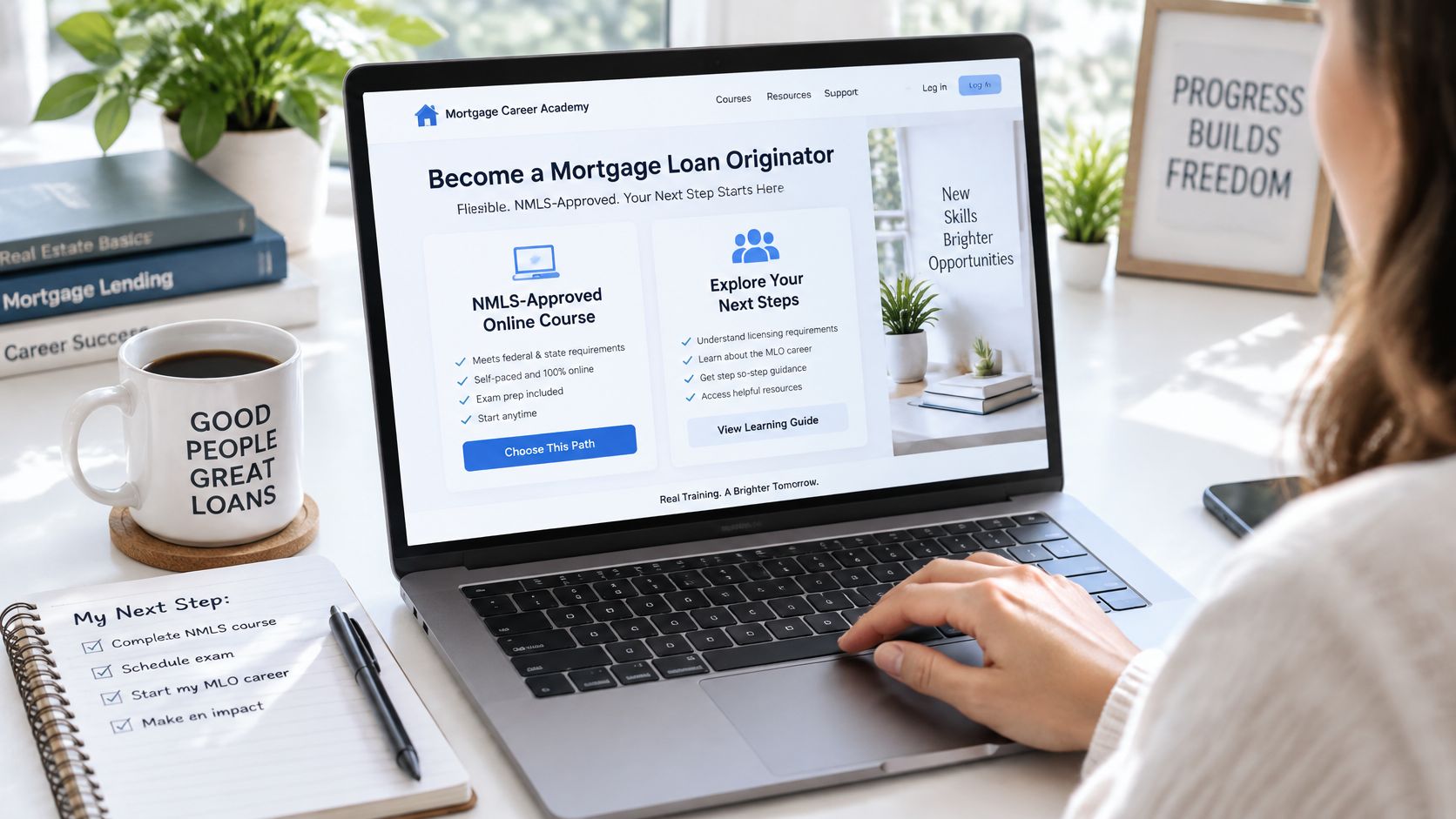
You can stack random classes and hope the hours count. Or you can take one NMLS-approved online path that makes the 20-hour start obvious, then use exam prep before you book a test date. I recommend the second option for anyone who still has a day job. Mystery schedules are how people miss a sponsorship window.
24hourEDU, NMLS Provider ID 1405107, offers the full 20-hour SAFE course online. The package includes instructor-led video lessons, an e-textbook, a bonus state-law module, free exam prep, unlimited phone and email support, and complimentary NMLS hours reporting. Core approval covers all U.S. states, and flexible start dates let a working professional finish in two weeks or less. That two-week start is the bridge from interest to application. It is not the yearly work of staying eligible, which you already saw is separate.
Why the free prep matters
Applicants must score at least 75 percent on the written SAFE MLO test. Federal rules allow three consecutive attempts, with at least 30 days between each attempt. After three failures, you wait at least six months before testing again. The national test has 120 multiple-choice items, 115 scored and 5 unscored, under Regulation H testing standards. A missed score is not a same-week redo. Prep is how you protect the calendar you already gave your main job.
Do this in order. Confirm the state where you will originate. Confirm a sponsoring employer and that evening or weekend follow-up is allowed. Then enroll in the online 24hourEDU package and use the included prep before you schedule the SAFE exam. Online education plus that prep package is the cleanest way to make the license start feel manageable without pretending the side hustle is casual.
Is being a mortgage loan originator a good side hustle? It is a good one when sponsorship, deadlines, and annual education are part of the plan. It is a poor one when you want referral fees without a file, a sponsor, or a phone you will answer.
24hourEDU gives career changers an NMLS-approved online 20-hour SAFE course, a bonus state-law module, and exam prep at no extra charge, so a sponsored side path can start in two weeks or less. If you are ready to test whether evening origination fits your real calendar, visit 24hourEDU and line up the course before you book the SAFE exam.

