

Your renewal deadline doesn't care that you're closing loans, answering borrower texts, and trying to keep family life moving. If your license is sitting 60 days from expiration, the smart move is to treat this like a compliance appointment, not a panic event. Get the education done, clear the filing items, and keep your pipeline moving.
Why Renewal Feels Stressful Until You See the Path
The stress usually starts with a simple thought. Your calendar says renewal is close, your inbox is full, and you still do not know whether the hold-up is CE, fees, sponsorship, fingerprints, credit checks, or something buried in NMLS. Good MLOs lose time when they stare at the whole process instead of separating it into clean, manageable steps.

The Goal is to Remove Friction
Renewal gets easier the moment you stop treating it like a mystery. The job is to clear the blockers in order, because the pressure usually comes from delay, not from the requirements themselves.
States set the cadence. Georgia uses a year-end renewal cycle, and the state's SAFE Act guidance lays out the timing and filing expectations that MLOs need to follow (Georgia DFI SAFE Act guidance). That kind of structure tells you what matters most, your expiration date, your filing window, and the items that must be finished before the deadline.
The practical takeaway is simple. Renewal is a calendar task with compliance checkpoints. Once you know the sequence, you can plan around it instead of letting it sit in the back of your head.
Practical rule: Start early enough that a slow NMLS update cannot disrupt your renewal.
That is why the process feels lighter once you accept the rhythm. You are not fighting the system, you are working to its schedule. A licensed originator who starts early, gets the education done first, and then clears the filing details usually ends up with a calm renewal season instead of a rushed one.
How the NMLS Renewal Cycle Works
NMLS is the central hub, not a side tool. It keeps the renewal workflow in one place, so education reporting, license records, and filing status stay tied together. For most MLOs, the yearly or biennial rhythm matters more than any single form.
What the cycle depends on
The SAFE Act framework is what gives the recurring renewal structure its shape across states. Fixed expiration dates drive the process, so your job is to know your state's timing and work backward from it. Once you have that date, you can plan instead of scrambling at the end.
NMLS-approved education providers report completed hours directly to NMLS, and that step matters because your renewal cannot move forward if your record does not show the required coursework. Provider approval matters for that reason. If the hours are not reported correctly, a certificate sitting in your inbox does nothing for your renewal.
The practical workflow is straightforward:
- Confirm your expiration date in NMLS.
- Complete the required CE with an approved provider.
- Check that hours posted to your record.
- Submit renewal filings and fees.
- Resolve any state-specific add-ons before the deadline.
Plain truth: The renewal portal only helps if every upstream item is already in place.
Start with a provider that reports hours reliably and keeps the process simple. If you want the education piece handled without confusion, 24hourEDU's mortgage continuing education page is the kind of resource MLOs use to keep that step clean and low-cost.
Breaking Down the 8-Hour NMLS Continuing Education Requirement
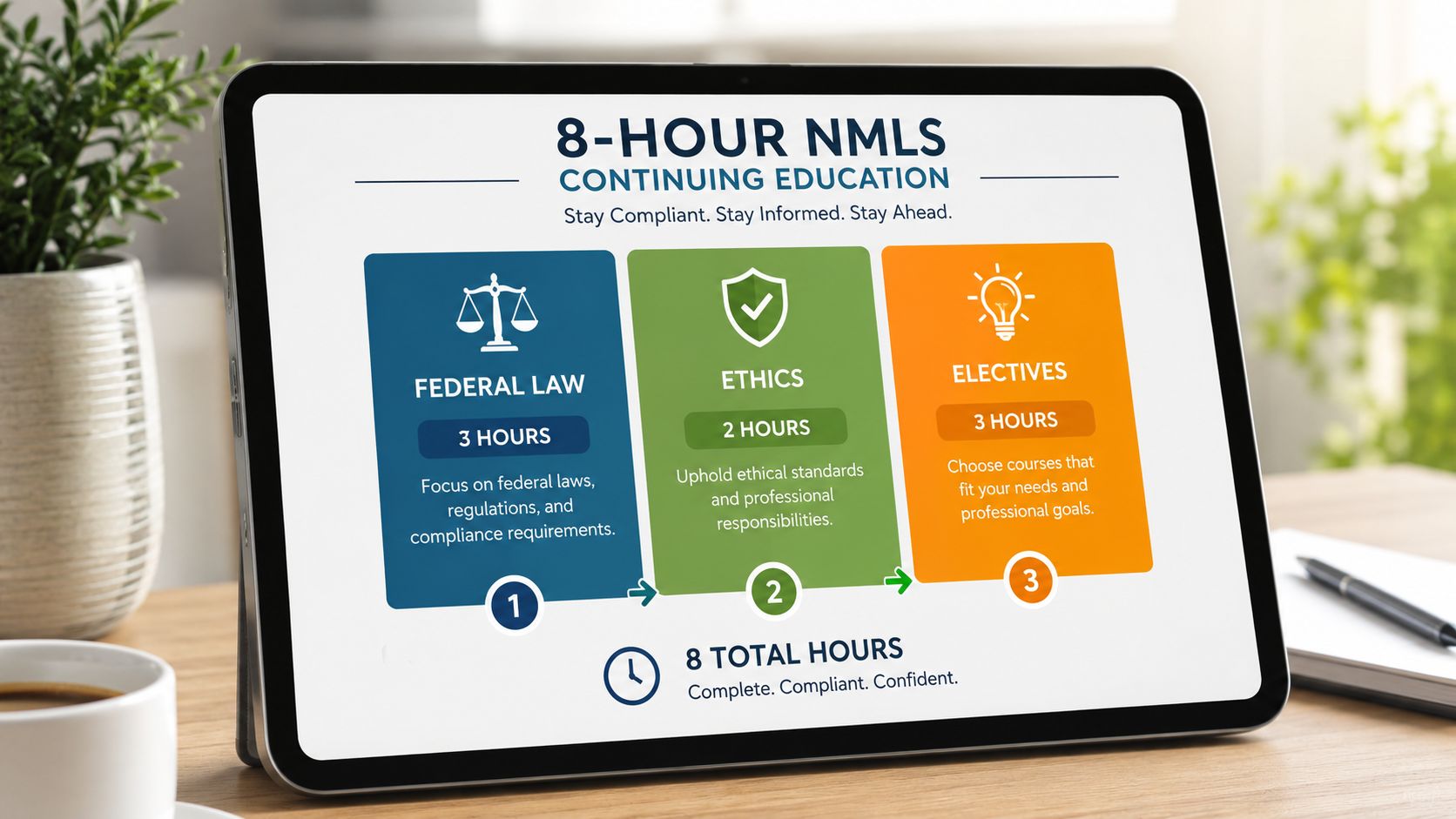
The standard NMLS continuing education package keeps originators current on the parts of lending that matter most. California's renewal rules point to 8 hours of NMLS-approved CE, and other jurisdictions use similar structures with their own state-specific twists. The job is not to collect hours for the sake of it. The job is to stay current on compliance, consumer protection, and product risk.
Why each block exists
The standard structure includes 3 hours of Federal law and regulation, 2 hours of ethics, 2 hours of non-traditional mortgage lending, and 1 hour of elective. That mix tracks the key risks in the job. Federal law keeps you aligned with the rules that shape origination. Ethics hours protect borrowers and keep bad habits from settling in. Non-traditional lending matters because originators keep seeing more varied loan structures in actual files.
The elective hour is where state variation often shows up. Florida, for example, can require a state-specific elective tied to its renewal rules, so one generic package does not fit every license authority. If you work across multiple states, your renewal file needs to match each state's requirement, not just the national baseline.
Here's the clean way to look at it:
- Federal law hours keep your compliance foundation current.
- Ethics hours keep your judgment sharp under pressure.
- Non-traditional lending hours help you stay fluent in real-world products.
- Elective or state-specific hours close the gap between national and local requirements.
If you are comparing course options, 24hourEDU's mortgage continuing education page is worth a look because it keeps the education step simple and tied to renewal reporting. Start with the right hours, finish them early, then verify they post before you touch the rest of your filing.
Beyond CE Hours, The Other Pieces of a Complete Renewal
A lot of renewal guides stop at the course line and miss the rest of the file. That is how delays show up. Renewal is about education, yes, but it also depends on status, fees, disclosures, and state-level admin items that have to be right before the filing clears.
The Essential Renewal Checklist
Start with active brokerage sponsorship. If your license depends on sponsorship, that relationship has to be current in NMLS. Handle the renewal fees next, because a finished education record does not move a filing forward if payment has not been made.
Residency and contact details matter too. Ontario requires Canada residency status, an Ontario mailing address, brokerage authorization, and any required CE before renewal (Ontario regulation). Florida shows how detailed renewal can get, since renewal can require a renewal form, fees, new-control-person fingerprints, independent credit reports for control persons, and any additional documentation the regulator requests (Florida Statutes, Chapter 494).
The full checklist is straightforward, but each item has a job:
- Sponsorship: Confirms you are attached to the right brokerage or firm.
- Fees: Pays for the filing to move through the system.
- Background items: Fingerprints and credit reports support the regulator's review.
- Address and residency updates: Keep your record valid and reachable.
- Disclosures: Make sure disciplinary or criminal history is not hiding in the file.
Renewal delays usually happen at the edges, not the center.
That is why a disciplined MLO checks the whole record, not just the course hours. If you need a quick reference point for state-by-state licensing costs, 24hourEDU's mortgage license cost by state page is a useful starting point for budgeting the filing side, not just the education side.
The Smartest Budget Move for 2026 Renewal
A renewal year should be a budget year, not a surprise year. If you watch costs closely, the cleanest move is to keep education spend low and skip extras you do not need. A simple online course setup does that job well.
What the pricing looks like
24hourEDU's 2026 renewal pricing is direct, $59 for the 7-hour Federal Core Course and $10 for any elective or state-specific course. That keeps the education side easy to budget for, especially if you are renewing on a tight calendar and want to avoid unnecessary overhead. The course setup is online, includes the exam prep package for free, and is fully approved by the NMLS Nationwide Multistate Licensing System and Registry under Provider ID 1405107.
| Course Type | 24hourEDU 2026 Price | Typical Competitor Price |
|---|---|---|
| Federal Core Course | $59 | $75-$120 |
| Elective or State-Specific Course | $10 | $75-$120 |
| Renewal Education Bundle | Low-cost online option | Typically $75-$120 or more |
That pricing matters because renewal already brings fees, background items, and filing steps. If you keep CE lean, you protect margin in a business where cash flow can swing with closings. For a consumer-side look at mortgage tradeoffs and long-term costs, Peaceful Mindful Pocket's mortgage guide on whether you should pay off your mortgage is a solid reference.
Why low-cost doesn't mean low-value
Online education works because overhead stays low and the savings get passed along. That is the point. You are paying for the hours NMLS accepts and the reporting that keeps your record clean.
A stripped-down online course and an inflated package usually deliver the same compliance outcome. A broker renewing for 2026 should care about three things, approved content, clean reporting, and the lowest reasonable cost. 24hourEDU's mortgage license cost by state page helps you keep the full renewal total in view before the deadline hits.
State-Specific Rules That Catch MLOs Off Guard
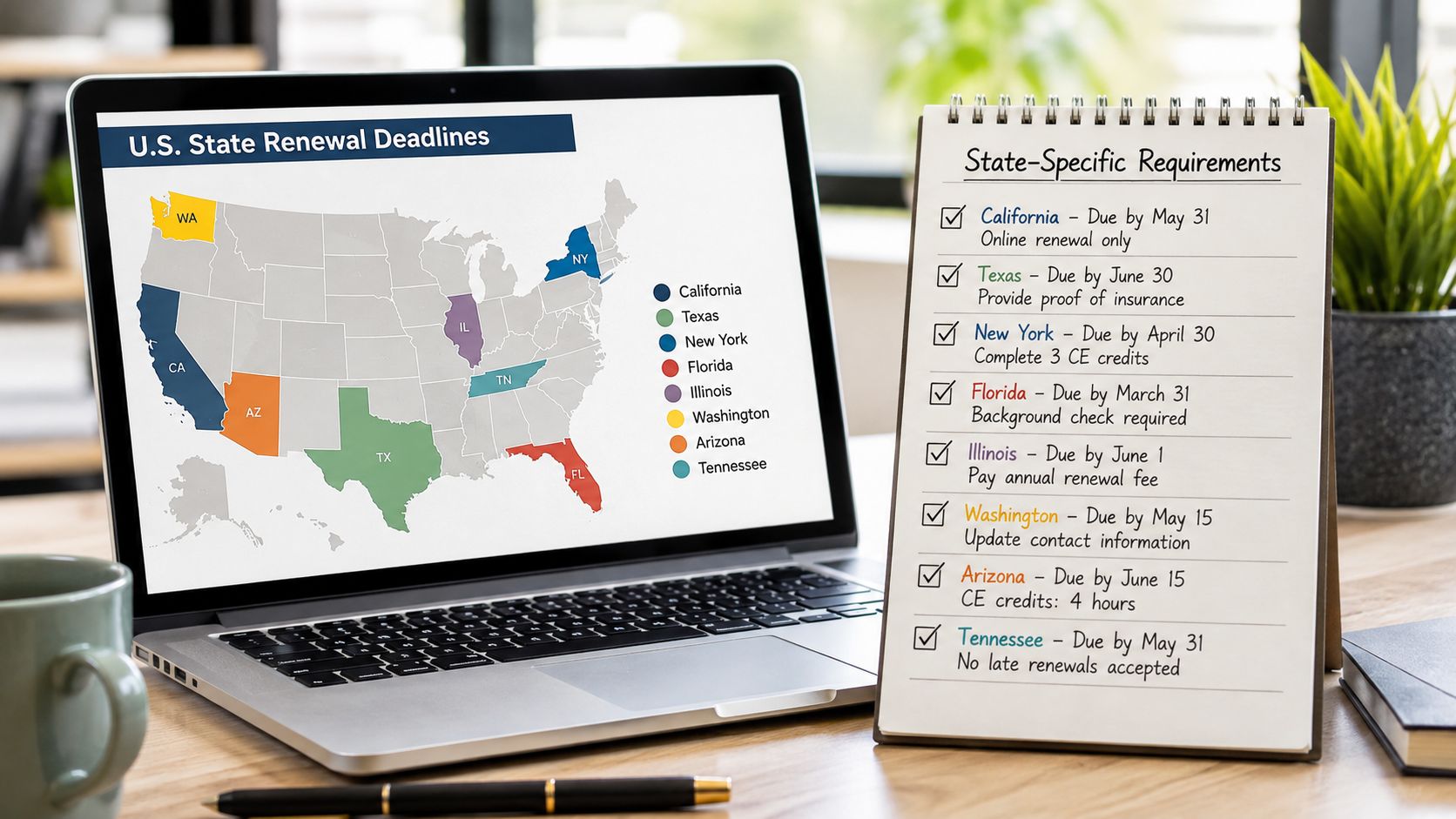
Federal rules set the floor, but the state page decides whether renewal clears without friction. That is the part many originators miss. They finish CE and assume the file is done, then a timing rule, sponsorship issue, or extra filing step holds the license up.
The rules are not uniform
State renewal rules vary enough to trip up experienced MLOs. Georgia's renewal cycle can bring deadline pressure if the filing is not handled on time, and the broader lesson is simple, you have to read the state page before you assume the federal deadline is the whole story. Oregon requires mortgage broker or banker renewal requests at least 30 days before expiration, and the license expires on December 31 each year (Oregon rule). Florida shows how costs can stack, since the renewal must be submitted through the Registry by December 31 and requires $475, made up of a $375 nonrefundable renewal fee and a $100 nonrefundable guaranty fund fee, plus an independent credit report for each control person (Florida regulation).
British Columbia is another reminder that renewal can hinge on education and testing before the license date rolls over. Applicants have to complete the applicable continuing education courses and pass the related exams, and at least one Legal Update course must be completed during the two-year licence term (British Columbia regulatory statement).
If you work across states, stop treating every file like it follows the same rulebook. Use the state page, confirm the timing, and check whether the record needs extra documentation. For brokers handling multi-state movement, 24hourEDU's reciprocity guide helps explain how licenses and requirements can differ from one jurisdiction to another.
Don't skip the paperwork side
State rules often care about more than CE completion. Residency status, mailing address, sponsorship, and disclosure updates can all decide whether renewal clears on time. If you are comparing administrative checklists, a resource like CPA tips on exemption paperwork from Bookkeeping and Accounting of Florida Inc. is a useful reminder that paperwork problems usually come from missing details, not from the big requirement everyone already knows about.
The direct lesson is simple. Read your state page early, not the week before expiration. Renewal gets messy when MLOs treat every state like California, or every deadline like Georgia, because those details are not interchangeable.
Your 90-Day Renewal Timeline From Start to Finish
A 90-day runway is enough time to renew without stress, if you use it well. The mistake most MLOs make is waiting until the deadline month to think about CE, then trying to cram filing, reporting, and payment into the same week. That creates avoidable risk and turns a routine renewal into a scramble.
Month 1, lock the education plan
At 90 days out, check your state rule first, then enroll in CE right away. Start with the state deadline, because some states tie renewal to annual expiration windows, while others want filings done before the end of the month or before expiration. Finish the coursework in the first 30 days so your record has time to update.
If your renewal budget is tight, make the education spend your first clean decision. A low-cost provider keeps the front end of renewal under control, which leaves you room for the rest of the process. 24hourEDU's affordable pricing fits that mindset well, especially if you want to keep renewal costs down without putting the filing at risk.
Good habit: The moment CE is complete, verify that NMLS shows the hours.
Month 2, clear the record
In the middle 30 days, confirm sponsorship, update contact details, and handle any state-specific disclosures. If your state requires fingerprints or a credit report for renewal, start those requests now instead of waiting. Check the mailing address and employment status too, because stale information can slow review even when the education is done.
Use this stretch to organize the money side of renewal as well. Set reminders for fees, payment confirmations, and any recurring obligations so nothing slips past you. A bill reminder tool can help keep renewal fees from sneaking up on you. If you like using app-based reminders, manage bills with Koru is a practical place to see how recurring payment tracking works in everyday life.
Month 3, file and verify
During the final 30 days, pay the fees, submit the renewal, and check your NMLS record for status changes. Georgia's late-fee cutoff shows why this final window is not the time to improvise, and Oregon's 30-day-before-expiration rule shows the same thing. Treat the last month as a filing window, not a planning window.
If the record still is not right, keep following up until the issue is resolved. One missed detail can hold up the entire renewal, and the fix is usually faster when you catch it before the deadline week.
A clean timeline leaves no room for panic. It also keeps your license from becoming a last-minute obstacle when your next deal is already in motion.
Keep Your Career Moving With Easy, Affordable Renewal
A current license is the engine behind an MLO career that can be flexible, remote, and commission-driven. You control your calendar, you build your own pipeline, and you get paid when loans close. None of that works if renewal drags because you treated compliance like an afterthought.
The smartest mindset is to see renewal as a low-cost tune-up. Handle the CE, pay attention to the state specifics, and keep your licensing record clean. That's a better use of energy than sitting in the last week of the year wondering whether a course posted or a fee cleared.
If you want the most cost-conscious path for 2026, keep the education spend simple. A $59 Federal Core Course and $10 elective or state-specific course gives you a clear, affordable way to stay active without overpaying for the same NMLS-approved requirement. That matters more than ever when you're trying to keep overhead down and keep commissions flowing.
24hourEDU fits that practical mindset because it keeps the renewal education side online, approved, and easy to budget for. If you're ready to get your Mortgage Loan Originator renewal done without wasting time or money, visit 24hourEDU and handle the course work before the deadline starts working against you.