


You’re about to send a loan application, hire a new originator, or approve an employment file, and one question needs a reliable answer first: is this mortgage loan originator currently authorized to operate where the transaction will occur? A quick name search on a third-party directory isn’t enough. Records can be stale, names can differ, and a person’s status can change after an employer transition.
The official answer comes from NMLS Consumer Access, the free public lookup created under the SAFE Act of 2008. It’s available 24/7 without an account or fee, and it lets consumers and employers search by NMLS ID or name to review identification details, employment history, current employer, and license or registration status. The portal is separate from the main NMLS platform and displays only records in a reportable status, meaning approved or otherwise active records that regulators can show publicly. (Official NMLS Consumer Access information)
Why Verifying an MLO License Matters Before You Work with One
A borrower may be days from closing when a lender changes the assigned professional. A recruiter may be ready to send an offer. A compliance officer may be screening a new hire before granting system access. In each situation, the sensible checkpoint is the same: verify the individual’s public licensing record before money, contract terms, or employment paperwork moves forward.
NMLS Consumer Access is the official public verification layer for checking whether an individual is licensed or registered in a particular state. The SAFE Act framework requires state-licensed mortgage loan originators to complete education and testing requirements, undergo fingerprinting for an FBI background check, and authorize NMLS to obtain an independent credit report. (SAFE Act requirements from NMLS)
A lookup helps prevent three practical problems:
- Unlicensed origination: You may discover that the person isn’t authorized to take or negotiate a residential mortgage application in the state involved.
- Missed regulatory information: A public record may show reportable actions or status information that a casual directory doesn’t provide.
- Employer-transition risk: A professional can move between companies, and the current employer or sponsorship line may matter to the record you’re reviewing.
The distinction between state licensing and federal registration also matters. Both are handled through NMLS, while the SAFE Act distinguishes federally registered MLOs at insured depository institutions from state-licensed MLOs working outside that category. (CFPB SAFE Act examination procedures)
Practical rule: Treat a business card, email signature, or referral as a starting point, not proof of current authorization.

Borrowers who want broader guidance on evaluating a professional can also review how to choose the right loan officer. The verification itself, however, should begin with Consumer Access and continue through careful record interpretation.
What to Gather Before You Open NMLS Consumer Access
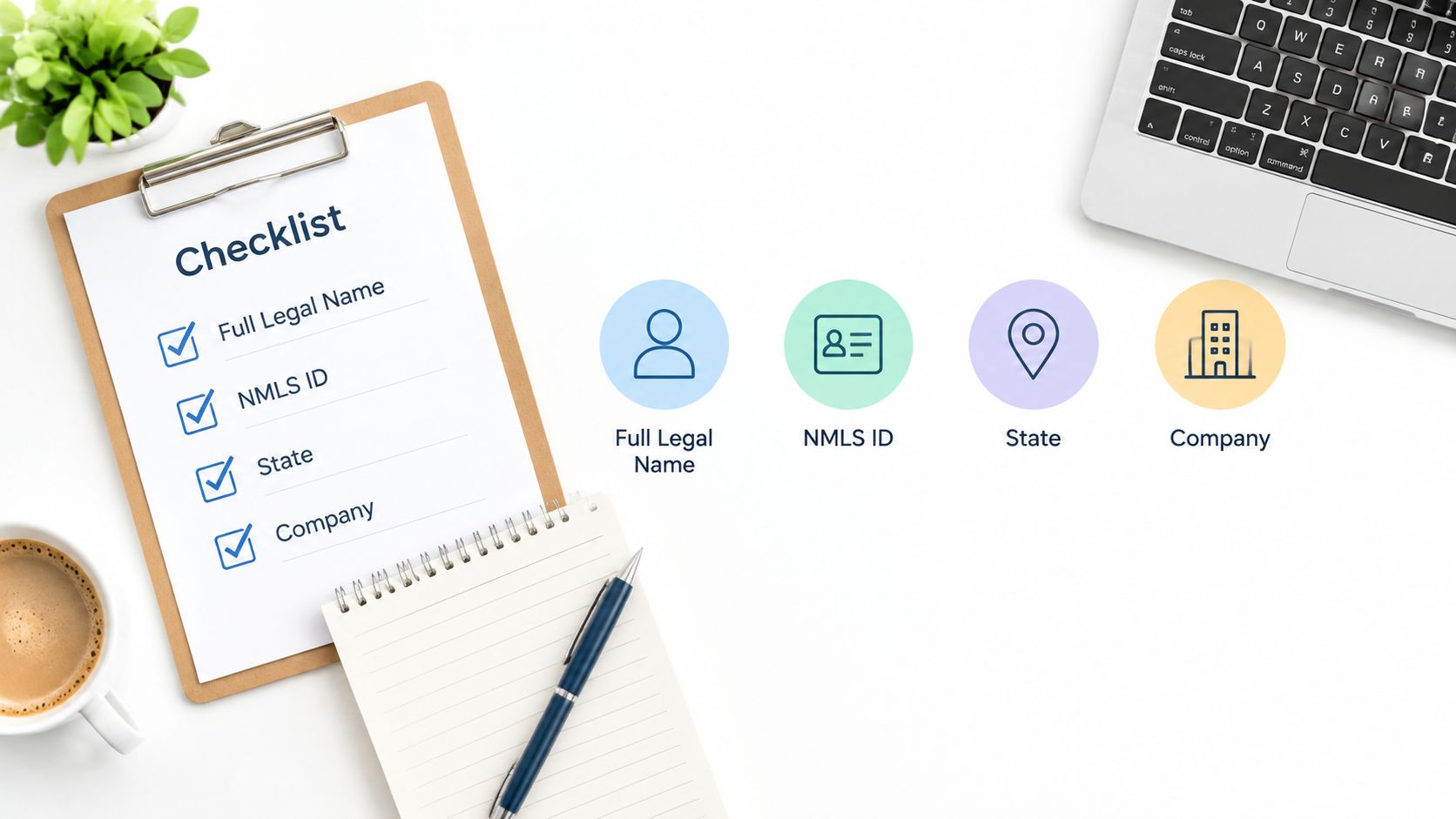
The best lookup starts before the website opens. Gather the person’s full legal name, individual NMLS ID, intended state of origination, and sponsoring company name. These details give you several ways to confirm that the record belongs to the person you’re evaluating rather than someone with a similar name.
The NMLS ID is the most precise input. It identifies the individual record, while a company-level identifier belongs to a different entity. Don’t copy the number from a company website without checking whether it belongs to the person, the branch, or the company. A useful explanation of this distinction appears in this guide to NMLS numbers.
If you don’t have the individual ID, use the legal first and last name and narrow the search by state when the portal permits it. Nicknames create avoidable failures. Someone who introduces themselves as “Mike” may be listed under “Michael,” and a professional using a married or hyphenated surname may have a different public record from the name shown in an old email.
Before searching, make a small comparison list:
- Legal name: Copy the spelling from formal loan documents or the individual’s licensing information.
- NMLS ID: Confirm that it belongs to the individual, not the employer or branch.
- State: Identify where the person intends to originate, not merely where the company has an office.
- Company: Use the employer name to compare the record against the person’s current materials.
Third-party directories can help you locate a starting point, but they shouldn’t be your final authority. They may mirror older information and fail to reflect a recent sponsorship or status change. The official NMLS guidance specifically directs users toward Consumer Access for current public authorization information. (Official NMLS Consumer Access portal guidance)
Check hyphenation, suffixes, middle names, and alternate first-name forms. If the first attempt fails, keep both the complete legal version and the likely record variation available for a second search.
Running the Mortgage Loan Originator License Lookup Step by Step
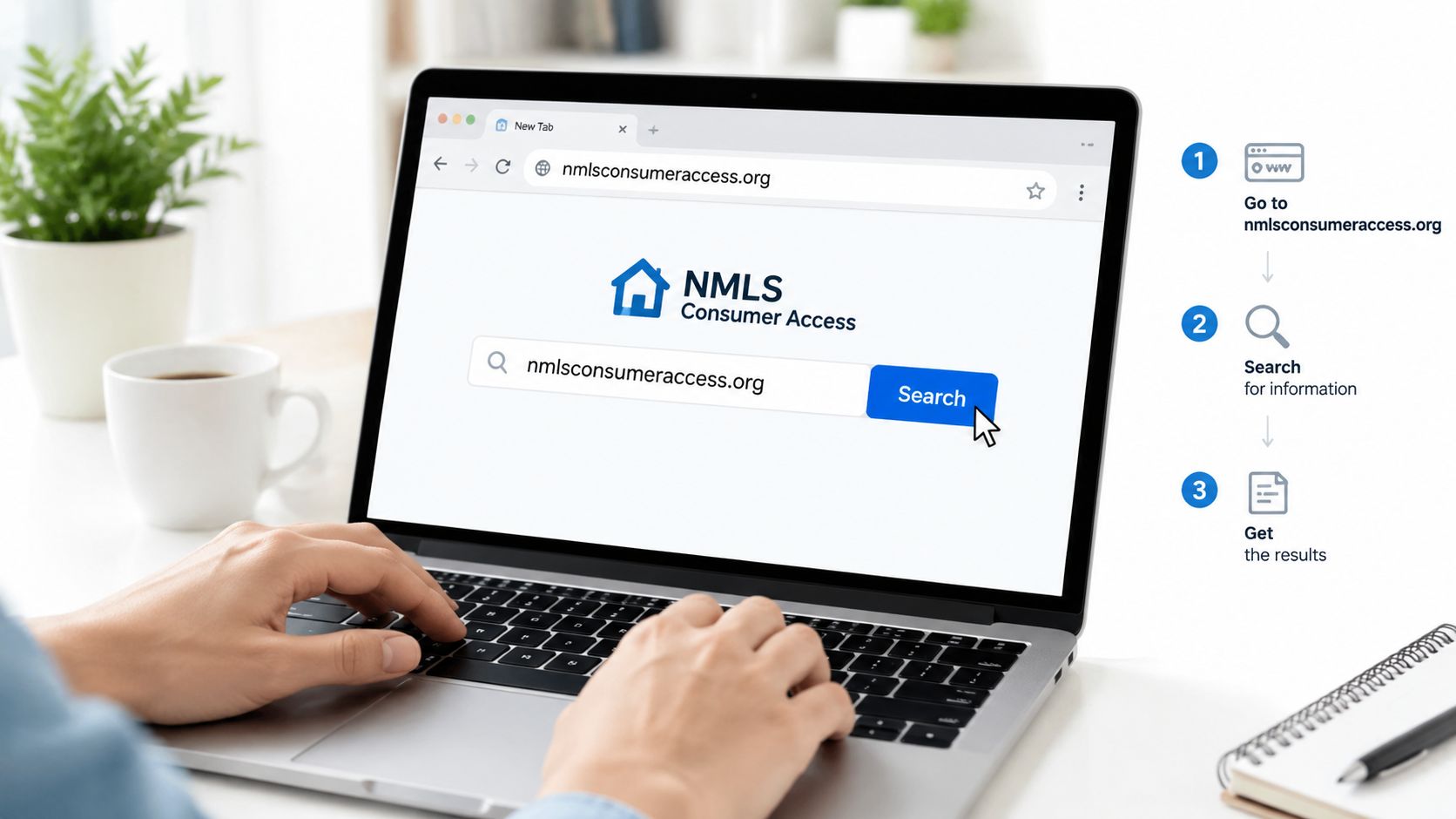
Start at the official public Consumer Access website, NMLS Consumer Access, rather than an unfamiliar mirror or directory. Look for the individual search option, not the company or branch search. The goal is to open the person’s record and compare it with the information you already gathered.
Begin with the most precise identifier
Enter the individual’s NMLS ID first if you have it. An ID search is less vulnerable to spelling variations and common-name collisions. If you don’t have the number, choose the name-search route and enter the person’s legal first and last name, then narrow by state if that filter is available.
Run the search and study the result list before opening anything. Compare the displayed name, NMLS Unique ID, employer, and state information with the business card, email signature, or loan paperwork in front of you. Don’t select a record because the first and last names match.
Open the individual record
Select the matching person to reach the detailed Consumer Access page. Start at the status header, then identify the sponsoring employer and the states associated with the individual’s licenses or registrations. Record the NMLS ID in your internal file, and save a dated screenshot or PDF according to your organization’s retention policy.
The public record confirms what was reportable when you searched. It doesn’t replace a final review of the transaction’s state requirements or guarantee that every internal employment detail is current. If the record conflicts with the information supplied by the MLO, pause and resolve the discrepancy before relying on it.
A visible profile is evidence you can evaluate, not a substitute for judgment. The strongest workflow searches by ID, confirms the identity, checks the status and employer fields, and documents the date of the query.
Reading the Consumer Access Record the Right Way
The record contains more than a name and a green-looking status. Read it as a structured compliance document, with each field answering a different question about identity, authorization, employment, and regulatory history.
Start with identity and status
The full legal name should match the person you’re screening. The NMLS Unique ID is the permanent identifier that lets you distinguish that individual from other professionals with similar names. Save it before reviewing the remaining fields because it anchors future searches and internal records.
Status labels require context:
- Approved: The record reflects an approved license or registration in the relevant record.
- Inactive: The record isn’t currently active for the authorization shown.
- Approved-Inactive: Approval exists, but the record isn’t presently active under the conditions displayed.
- Denied or Revoked: The record reflects a serious adverse licensing outcome and requires careful review before any engagement.
Sponsorship can affect the practical meaning of a status. An individual may have completed licensing steps but become inactive when the required sponsoring relationship isn’t current. Don’t read “approved” as permission to operate everywhere. Review the state row and the sponsorship information together.
Read the authorization and employment fields
The authorized-states list tells you where the individual’s authorization applies. One federal NMLS ID can connect records across multiple jurisdictions, but each state entry still matters independently. A person authorized in one state may not be authorized to take applications in another.
The sponsorship or employer line identifies the institution associated with the record. Compare it with the company named in the borrower’s documents. An unexpected employer can indicate a recent transition, a data-entry issue, or a relationship that needs confirmation.
Employment history can help explain the timeline. Look for prior companies, changes in affiliation, and whether the current record aligns with what the individual told you. Effective and expiration dates add another layer. A status can be accurate for a particular period while still requiring rechecking before a later milestone.
Review actions and disclosures
Regulatory actions and public disciplinary disclosures deserve a deliberate reading. Note the regulator, action type, relevant date, and whether the entry appears resolved or ongoing. Don’t treat every disclosure as proof of misconduct, and don’t ignore it either. Obtain the underlying state or agency information when the record raises a question.
Interpretation rule: Identity tells you who the record belongs to. Status tells you its current condition. State authorization and sponsorship tell you where and under which relationship the person may operate.
The public record is designed for verification, not speculation. If a field is unclear, ask the individual or employer for documentation and confirm the issue with the appropriate regulator rather than drawing a conclusion from a partial entry.

What to Do When the MLO Does Not Show Up in the Search
A missing result doesn’t automatically prove that the person is unlicensed. Consumer Access displays reportable records, and a person may be between employers, newly entering the process, listed under a different name, or outside the category you expected.
Start by removing assumptions from the search. Search the complete legal name, then try a version without a middle name, with the middle initial, or with a different hyphenation pattern. Check suffixes such as Jr. or Sr., and don’t rely on a nickname that may never have been reported to NMLS. The NMLS Consumer Access FAQ specifically addresses name matching and missing-search scenarios.
If you have the NMLS ID, stop using the name field and search by that identifier. If you don’t, broaden the search by removing a state filter and then compare every plausible result against the employer, location, and documents you have. A nationwide search can reveal that the individual’s record is associated with another jurisdiction or a different current affiliation.
Also confirm the role. A loan processor, assistant, or marketing employee may support a mortgage transaction without being the licensed MLO who takes or negotiates the application. Job titles aren’t reliable substitutes for the person’s actual regulatory function.
Use a clear escalation path:
- Ask the individual for the NMLS ID shown in their official records.
- Contact the current or prior employer to reconcile a sponsorship transition.
- Request a dated Consumer Access profile screenshot from the individual.
- If the discrepancy remains, contact the relevant state regulator before proceeding.
Don’t allow urgency to turn an unresolved identity problem into a compliance decision. A missing result is a reason to investigate carefully, not a reason to guess.
Cross-Checking With State Regulators and Spotting Red Flags
Consumer Access should be the primary verification source, but state regulators can add enforcement context. Depending on the jurisdiction, state records may provide information about complaints, settlements, or state-only disciplinary events that deserve review alongside the NMLS profile.
Useful regulator resources include the California Department of Real Estate, New York Department of Financial Services, Texas State Mortgage Regulator, and Florida Office of Financial Regulation. Use the regulator’s official website for the relevant state and confirm that the search applies to mortgage licensing rather than an unrelated professional category. A broader directory of financial oversight agencies is available through financial services regulators.
Common warning signs
A recent employer change isn’t automatically a violation, but it creates a reason to reconcile the sponsorship line. Multiple surrendered state licenses, an active record in one state paired with an inactive record in another, or a disclosed regulatory action should receive specific follow-up.
| Red Flag | Safe Indicator |
|---|---|
| Current employer doesn’t match the supplied loan documents | Sponsoring employer matches the transaction materials |
| Authorization is inactive in the transaction state | Relevant state shows an appropriate active status |
| Regulatory action appears without an internal explanation | Action history has been reviewed and documented |
| Several state records show unexplained changes | Each state authorization has a clear business reason |
| Name or NMLS ID differs across documents | Identity fields match the official record |
Compliance teams should preserve the search date, record URL, and supporting documents. Guidance on building consistent master compliance documentation can help teams organize these records without relying on scattered emails or screenshots.
Recheck close to a major transaction milestone, particularly when employment or state authorization has changed. Verification works best as a repeated control, not a one-time checkbox.
Building a Reliable Verification Habit That Sticks
A dependable process turns the mortgage loan originator license lookup into a recurring control. For an MLO you work with regularly, set a quarterly reminder to review Consumer Access for status changes, a new sponsoring employer, added states, or altered public disclosures. Pair that review with a state regulator search when the transaction or hiring decision carries higher risk.
Keep a shared compliance spreadsheet with the individual’s NMLS ID, legal name, employer, states reviewed, search date, source URL, and result. That record prevents teammates from repeating inconsistent searches and gives managers an auditable explanation for the decision. Hiring teams should check on the day an offer is extended and again when active licensing sponsorship begins.
Aspiring MLOs should monitor their own public profile during the application-to-licensed period. Confirm that the name, sponsoring company, and state authorizations appear as expected, then raise discrepancies with the employer or regulator promptly.
The broader licensing path has defined education requirements. State-licensed MLOs must complete 20 hours of NMLS-approved pre-licensure education, including 3 hours of federal law and regulations, 3 hours of ethics, 2 hours of nontraditional mortgage lending, and 12 hours of mortgage origination instruction. (NMLS education requirements) Online training can make that preparation easier to fit around work, especially when it includes exam preparation and support. 24hourEDU offers an NMLS-approved online MLO pre-licensing course with a free exam prep package, and its NMLS provider ID is 1405107.
Document every lookup with the date, URL, identity match, status, sponsorship, authorized states, and action review. That small habit protects borrowers, supports hiring decisions, and helps future MLOs keep their professional records accurate.
If you’re preparing for an MLO career, visit 24hourEDU to review its NMLS-approved online education and free exam prep package. Use the course to build the licensing knowledge you’ll need before your own Consumer Access record becomes part of every professional verification.

