
If you’re looking to start a career as a Mortgage Loan Originator (MLO), the path begins with a few key steps: getting the right education, passing the SAFE MLO Test, and meeting national and state standards. While it might sound like a lot, the requirements for a mortgage loan originator license are designed to give every professional a solid foundation in federal law, ethics, and industry best practices before they ever sit down with a client.
Let’s break down exactly what you need to do.
Your Roadmap to a Mortgage Loan Originator License
Jumping into the financial world as a licensed MLO is an exciting career move, and it all starts with a clear, achievable plan. Think of this guide as your roadmap, laid out to make the entire journey feel direct and manageable. We’ll walk through the process step-by-step, showing you exactly what it takes to earn your unique NMLS license number.
You can forget the confusing jargon and overly technical explanations. Our goal here is to explain everything in plain language, focusing on the three essential pillars of success: education, examination, and application. Each one builds on the last, creating a logical path toward your new career.
The Three Pillars of MLO Licensing
The journey to becoming a licensed MLO is built on a solid foundation. Here are the three non-negotiable components you’ll need to complete:
- Education: Your first and most important step is completing NMLS-approved pre-licensing education. This is where you’ll learn the laws and best practices that will guide your entire career.
- Examination: After you’ve finished your coursework, you’ll need to pass the SAFE MLO Test. This exam proves you have the knowledge and competence to work in the field.
- Application: Finally, you’ll submit your official application through the NMLS. This includes a background and credit check to ensure you meet the high professional standards of the industry.
This handy visual breaks down the essential steps you’ll follow on your path to getting licensed.
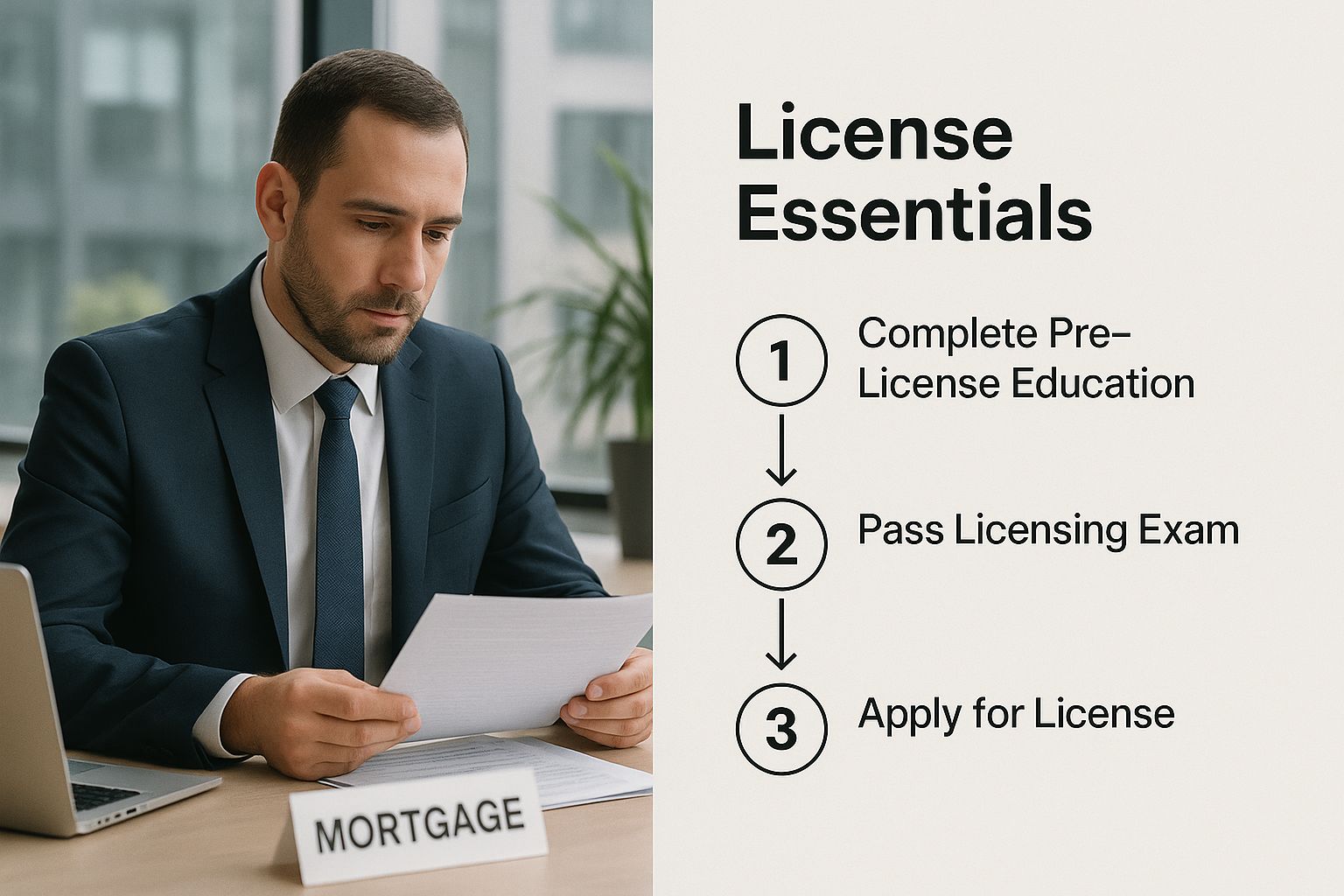
As you can see, the process flows logically from building your educational foundation to proving your expertise and, finally, to formalizing your professional standing.
To help you see the big picture, here’s a quick summary of what the licensing process involves.
MLO License Requirements at a Glance
| Requirement | What It Involves | Why It Matters for Your Career |
|---|---|---|
| Pre-Licensing Education | Completing 20 hours of NMLS-approved courses covering federal laws, ethics, and lending standards. | This is your foundational knowledge. It ensures you understand the rules of the road and can advise clients responsibly from day one. |
| SAFE MLO Test | Passing a 120-question national exam that tests your comprehension of the pre-licensing material. | Passing this test is your ticket into the industry. It proves you have the necessary expertise to operate ethically and legally. |
| Application & Background Check | Submitting your application, fingerprints, and personal history through the NMLS for review. | The industry requires professionals with integrity. This step confirms you meet the character and fitness standards to handle financial matters. |
Each step is a building block, ensuring that when you earn your license, you’re not just certified—you’re genuinely prepared for the job.
It all starts with that first pillar: education. Our flexible online NMLS-approved courses are designed to set you up for success right from the start. Better yet, they include our complete exam prep package for free, giving you all the tools you need to feel confident and ready for the test. We make getting your education done as simple as possible.
Building Your Foundation with NMLS-Approved Education

The very first milestone on your path to becoming a licensed MLO is completing your pre-licensing education. Don’t think of this as just a box to check off—it’s the absolute bedrock of your future mortgage career. This is where you’ll build the essential knowledge needed to guide clients responsibly and handle the complexities of the lending world.
It’s like an architect studying blueprints before a single brick is laid. This education ensures you grasp the fundamental structures of law, ethics, and practice, allowing you to build a career that’s stable, successful, and trustworthy from the ground up.
The Core Curriculum: What to Expect
To ensure a high standard of professionalism across the entire industry, the Secure and Fair Enforcement for Mortgage Licensing Act (SAFE Act) of 2008 set a specific educational framework for every aspiring MLO. This federal law was a direct response to the 2008 housing crisis, created to bolster consumer protection and establish uniform licensing standards.
A key piece of these mortgage loan originator license requirements is completing a minimum of 20 hours of NMLS-approved pre-licensing education. You can dive deeper into these foundational requirements over at nationalmortgageprofessional.com.
This isn’t just a random assortment of classes. The 20-hour curriculum is precisely structured to hit the most critical areas of modern mortgage lending.
Here’s how it breaks down:
- 3 Hours on Federal Laws and Regulations: This is a deep dive into the landmark legislation governing the mortgage industry, like the Real Estate Settlement Procedures Act (RESPA) and the Truth in Lending Act (TILA).
- 3 Hours on Ethics: You’ll explore professional conduct with a sharp focus on preventing fraud, protecting consumers, and ensuring fair lending practices.
- 2 Hours on Non-Traditional Mortgage Products: This unit covers the specifics of loans that fall outside the standard 30-year fixed-rate box, such as adjustable-rate mortgages (ARMs) and interest-only loans.
- 12 Hours of General Mortgage Origination Electives: These hours round out your knowledge base, covering everything from loan application procedures and underwriting basics to the closing process.
This structured curriculum guarantees that every licensed MLO in the country starts with the same high-quality foundation.
Completing your NMLS-approved education is more than a requirement; it’s a declaration of your commitment to professional excellence and consumer protection. It’s the first step in building a reputation that clients can trust.
A Modern Approach to MLO Education
Gone are the days of being chained to a physical classroom. We get that your journey to becoming an MLO needs to fit into your life, not the other way around. That’s why we make it simple to meet these mortgage loan originator license requirements with our fully NMLS-approved online courses.
Our program is designed for your schedule, letting you learn from anywhere with an internet connection. This flexibility means you can keep up with your current responsibilities while taking a huge step toward your new career. You have the freedom to structure your learning in a way that truly works for you.
Integrating Education with Exam Preparation
Finishing your coursework is one thing, but feeling ready to ace the official exam is something else entirely. Many programs treat these as two separate challenges, forcing you to hunt down and pay for exam prep materials after you’ve already completed your education. We believe in a more integrated, supportive approach.
That’s why our online education program comes with a complete exam prep package—included for free.
This means that as you’re learning the material, you’re also building the skills and confidence you need to pass the SAFE MLO Test. You’ll get access to practice questions, study guides, and other tools designed to lock in the key concepts. Our approach ensures you’re not just memorizing facts for a test; you’re truly understanding the principles that will guide your entire professional life. We make the transition from learning the curriculum to mastering the exam seamless.
Passing the SAFE MLO Test with Confidence

Once you’ve wrapped up your pre-licensing education, the next big step is passing the SAFE MLO Test. While any official exam can feel a little daunting, this one is completely manageable if you prepare the right way.
The test isn’t designed to trip you up. It’s built to confirm you have the professional know-how needed to meet your mortgage loan originator license requirements. Think of it as the final checkpoint that validates all the expertise you just worked so hard to gain. It’s your chance to prove you can apply the legal and ethical principles you learned to real-world situations, showing you’re ready to serve clients responsibly.
Understanding the SAFE MLO Test Structure
The SAFE MLO Test is the national standard, covering the core knowledge every MLO needs. Administered by the NMLS, the exam has 120 multiple-choice questions. Here’s a little inside baseball: only 115 of those questions are scored. The other 5 are trial questions being tested for future exams. You won’t know which is which, so give every single question your best shot.
You’ll have 190 minutes to complete the exam, and a passing score is 75% or higher.
The test is cleverly designed to make licensing in different states much easier.
- The National Component: This is the meat of the exam. It covers federal mortgage laws, MLO ethics, and the fundamentals of mortgage origination.
- The Uniform State Test (UST): This section covers model state laws and regulations. The good news? Most states have adopted the UST. This means you can take one combined test that satisfies the requirement in multiple states, which is a huge time-saver if you plan on getting licensed across state lines.
This integrated structure is all about efficiency. By passing the National Test with the UST Component, you knock out a key requirement for licensure in the vast majority of states. No more juggling multiple, unique state exams.
Key Content Areas Covered on the Exam
Success on the SAFE MLO Test comes down to knowing where to focus your energy. The exam questions are spread across five major content areas, and some are weighted more heavily than others.
| Content Area | Percentage of Exam | What It Covers |
|---|---|---|
| Federal Mortgage Laws | 24% | Key legislation like TILA, RESPA, and ECOA. |
| General Mortgage Knowledge | 20% | Terminology, loan products, and market concepts. |
| MLO Activities | 23% | Loan origination, qualification, and processing. |
| Ethics | 18% | Professional conduct, fraud prevention, and consumer protection. |
| Uniform State Content | 15% | Model state laws and regulations (the UST portion). |
As you can see, a solid grasp of federal laws and the practical day-to-day activities of an MLO makes up nearly half of the entire exam. For a deeper dive, you can explore the various study topics for the SAFE MLO exam.
Strategies for Success
Passing the exam is all about smart, effective prep. Since our NMLS-approved education includes our powerful exam prep package for free, you’re already set up with the tools you need to succeed. We make it simple to go from learning the material to mastering it for test day.
The goal isn’t just to pass the test—it’s to walk in feeling so prepared that passing is the natural outcome. Your confidence is your greatest asset on exam day.
Here are a few practical tips to make the most of the resources you have:
- Focus on Practice Exams: The best way to get comfortable with the test format is to take practice exams over and over. This is how you’ll find your weak spots, get your timing down, and learn how questions are phrased.
- Review Key Concepts Daily: Ditch the cramming sessions. Instead, spend a little time each day reviewing core concepts. Flashcards or summary notes are perfect for locking in federal laws and ethical scenarios.
- Simulate Test Conditions: When you take a practice test, try to mimic the real thing. Find a quiet spot, set a timer for 190 minutes, and work through it without any interruptions. This builds the mental stamina you’ll need when it really counts.
By using these strategies and the exam prep tools we provide, you can walk into the SAFE MLO Test feeling confident and ready to nail it.
You’ve done the coursework and passed the big test. Now it’s time for the final administrative leg of your journey: the NMLS application and background check.
Think of it this way: the education and exam proved you know the material. This next phase is all about showing regulators you have the character and financial responsibility to match that knowledge. It’s where you build the foundation of trust your entire career will stand on. Let’s walk through it so you can submit your application with total confidence.
Getting Your NMLS Account and Submitting the MU4 Form
First things first, you need to create an account in the NMLS. This is a crucial step because it generates your unique NMLS ID number—a number that will stick with you for your entire mortgage career. If you need a hand with this part, our guide on how to get your NMLS ID number breaks it all down.
With your account set up, you’ll tackle the Individual Form (MU4). This is the heart of your application, where you’ll lay out your personal, residential, and employment history. Be meticulous here. Accuracy and honesty are non-negotiable, as even small discrepancies can bog down your mortgage loan originator license requirements and cause serious delays.
The Two Pillars of the Background Check
Once the MU4 is in, you’ll authorize and pay for two mandatory background screenings. These aren’t meant to trip you up; they’re designed to give state regulators a clear, transparent view of who you are, ensuring you meet the high ethical standards the SAFE Act demands.
Here’s what’s involved:
- Criminal Background Check (CBC): You’ll schedule an appointment to get your fingerprints taken. These are sent directly to the FBI for a comprehensive national criminal history check.
- Credit Report Review: Regulators will request a copy of your credit report. They aren’t looking for a perfect 800 score, but they do want to see a pattern of financial responsibility.
These checks are a huge reason why the industry is more professional and trusted today. Since the SAFE Act was put in place, the number of licensed MLOs has climbed to over 121,000 nationally by 2024. More importantly, these rigorous standards have helped drive a 25% drop in enforcement actions against originators over a five-year period. It’s a system that works, and you can dive deeper into its impact with this expert analysis from Wolters Kluwer.
Regulators see the background check as a critical consumer protection tool. A clean, honest application is your first opportunity to demonstrate that you’re committed to the integrity of the mortgage industry.
Meeting the Character, Fitness, and Financial Standards
State regulators use your application and background checks to confirm you meet their standards for “character, fitness, and financial responsibility.” That phrase can sound a little intimidating, but the criteria are actually pretty straightforward.
Here’s what they’re really looking at:
- Character and Fitness: This is all about your criminal record. The SAFE Act is clear on this: felonies involving things like fraud, dishonesty, breach of trust, or money laundering are disqualifiers. Regulators need to see a history that reflects integrity.
- Financial Responsibility: On the credit side, regulators are looking for red flags that suggest serious financial mismanagement—things like outstanding judgments, tax liens, foreclosures, or a pattern of unresolved collections. A low credit score on its own isn’t usually a deal-breaker, but you absolutely must be ready to explain any major blemishes on your report.
The absolute best policy is transparency. If you have a potential red flag, address it head-on in your application with a clear, honest explanation. This builds credibility with regulators and can be the key to a smooth and quick approval.
Get this part right, and you’re just one step away from getting that license in hand and officially starting your career as a Mortgage Loan Originator.
Understanding State-Specific Licensing Requirements
While the NMLS provides a fantastic national framework for getting licensed, your journey doesn’t stop there. Think of the federal requirements—the 20-hour education course and the SAFE MLO Test—as building the foundation and frame of a house. It’s strong and essential, but you can’t move in until you follow the local building codes.
In the mortgage world, those “local codes” are the state-specific rules.
Your mortgage loan originator license is ultimately granted by an individual state. This means that after you’ve met the national standards, you also have to satisfy the unique requirements of the state (or states) where you plan to do business. This two-layer system is smart—it ensures every MLO shares a common baseline of knowledge while also being an expert on the specific laws protecting consumers right in their own backyard.
How States Build on the National Foundation
Each state regulator has the authority to add layers on top of the federal baseline, and they often do. These additional rules are typically designed to address local market conditions or beef up consumer protection. And while most states have adopted the Uniform State Test (UST) to make the exam process a bit simpler, their other requirements can vary quite a bit.
Getting a handle on these differences is critical for a smooth application process and is a key part of your mortgage loan originator license requirements. Trust me, you don’t want to get held up by a minor state-specific rule you didn’t know about.
Common areas where you’ll see state-specific variations include:
- Extra Education Hours: Some states want you to have a few more hours of pre-licensing education focused entirely on their local laws.
- Surety Bond Amounts: Most states require MLOs to be covered by a surety bond, but the dollar amount can be vastly different from one state to the next.
- Net Worth Rules: Certain states might mandate that you or your sponsoring company maintain a minimum net worth.
- Application & Licensing Fees: The costs to get and keep your license will definitely change depending on the state.
A Look at Texas: A Major Mortgage Market
To see how this plays out in the real world, let’s look at a massive market like Texas. As one of the biggest mortgage markets in the country, Texas has a very clear set of rules for residential mortgage loan originators (RMLOs), which are governed by the Texas SAFE Act and Finance Code Chapter 157.
In Texas, if you take a residential mortgage loan application or negotiate loan terms for pay, you absolutely must hold an RMLO license. The state requires the standard 20 hours of NMLS-approved education, a passing score on the National SAFE exam (which includes the Texas state component), and full registration with the NMLS. This setup perfectly illustrates how a state can adopt the federal core while tailoring the final process to its own legal framework. You can dig into the specifics directly on the Texas Department of Savings and Mortgage Lending website.
Navigating state requirements might seem complex at first, but it’s a totally manageable process. The key is simply knowing where to find accurate, up-to-date information for each state you plan to operate in.
To give you a clearer picture, here’s a table showing how some of these state rules can differ from the federal baseline.
Example State Requirement Variations
This table highlights just a few of the common ways state licensing rules can diverge from the national standards set by the NMLS.
| Requirement Area | Federal Baseline (NMLS) | Potential State Variations (Examples) |
|---|---|---|
| Pre-Licensing Education | 20 hours of core curriculum. | Some states require 1-5 additional hours on state-specific laws (e.g., New York, California). |
| Surety Bond | No federal requirement for individuals. | Varies widely; states may require bond coverage from $10,000 to over $150,000. |
| Credit Report | Required for review. | States set their own standards for what constitutes “financial responsibility.” |
| Application Fees | Standard NMLS processing fee. | Each state adds its own licensing fee, ranging from under $100 to over $500. |
Remember, these are just examples. Always check the official NMLS state-specific checklists for the most current information before you apply.
Expanding Your Business Across State Lines
One of the biggest advantages of the NMLS system is how much easier it makes multi-state licensing. Gone are the days of starting from scratch in every new state. Once you have your initial license, you can apply for licenses in other states right through your existing NMLS account.
The NMLS Resource Center will quickly become your best friend in this process. It provides incredibly detailed, state-by-state checklists that outline every single requirement, fee, and form you need. It makes planning your expansion a breeze.
Our goal is to make your path to licensing as straightforward as possible, no matter where you plan to work. We offer NMLS-approved online education that gives you the strong national foundation you need to get started. You can find detailed breakdowns for each state by exploring our guide on state-specific MLO licensing requirements. Plus, with our included exam prep package, you’ll be ready to crush the national exam and any state components that come your way.
Your MLO Licensing Questions Answered
Even with a clear roadmap, it’s completely normal to have a few questions about getting your mortgage loan originator license. This last section is all about tackling the most common things we hear from aspiring MLOs like you.
Think of it as your personal FAQ. We want to clear up any lingering confusion so you can move forward with confidence and get your new career off the ground.
How Long Does the MLO Licensing Process Take?
This is usually the first question on everyone’s mind. While the timeline can shift depending on how quickly you move and how busy your state’s regulators are, most people get through the entire process in about 8 to 12 weeks.
Here’s what that schedule might look like:
- Week 1: Knock out your 20-hour NMLS-approved online course.
- Weeks 2-5: Buckle down to study for and pass the SAFE MLO Test.
- Weeks 6-12: This is the home stretch—submitting your application and waiting for the state to run background checks and officially issue your license.
Our online education is built for efficiency, and the included exam prep helps you power through those first two stages. That last part of the timeline, though, is really in the hands of the state licensing agencies.
Do I Need an Employer to Get My MLO License?
It’s the classic “chicken or the egg” scenario, but the answer here is simple. You absolutely do not need an employer to complete your pre-licensing education or pass the SAFE MLO Test. In fact, most successful candidates get these big steps out of the way first.
However, you will need a licensed mortgage company to sponsor your application before you can receive an active license. Regulators want to make sure you’re supervised by an approved employer right from the start. Getting your education and exam done beforehand makes you a much more appealing hire, showing top companies you’ve already cleared the major hurdles and are serious about the job.
Completing your education and exam independently shows initiative and makes you a hire-ready candidate. It signals to employers that you are serious about your career and ready to start originating loans.
What Happens if I Fail the SAFE MLO Test?
It’s natural to have some anxiety about the exam, and it’s not unheard of for people to need a second try. A failed attempt is not the end of the road—the NMLS has a clear, structured process for retakes.
Here’s the official retake policy:
- After a first failed attempt, you must wait 30 days before trying again.
- After a second failed attempt, the waiting period is another 30 days.
- If you fail a third time, the waiting period gets much longer: 180 days (that’s six months).
This is exactly why solid preparation is so crucial. Our NMLS-approved education comes with a powerful exam prep package for free, giving you all the practice you need to walk in feeling confident and pass on your first try.
Can I Get an MLO License with Poor Credit or a Criminal Record?
This is a sensitive question, but an important one. The answer really depends on the specifics of your history. The SAFE Act is crystal clear about certain things that will automatically disqualify an applicant.
When it comes to a criminal record, you will be denied a license if you’ve ever been convicted of a felony involving fraud, dishonesty, a breach of trust, or money laundering. For other types of felonies, there is a seven-year look-back period from the conviction date.
As for credit, regulators aren’t looking for a perfect score. What they’re really looking for are patterns of financial irresponsibility. Big red flags can include things like outstanding judgments, tax liens, or recent foreclosures. The best strategy is always transparency. Be upfront on your application and provide a clear, honest explanation for any bumps in your financial or legal past.
Ready to start your journey? 24hourEDU makes it easy to complete your NMLS-approved education with our comprehensive online course and included exam prep. Start your MLO career today!