New York Mortgage Loan Originator License: How to Apply
What if filing your application feels like permission to start, but New York treats that first loan conversation as the moment you needed the license? That gap trips up career changers and out-of-state movers more than the exam does. Get the order right, and earning your New York Mortgage Loan Originator license becomes a clear, manageable path you can finish in just a few weeks.
New York MLO Licensing Steps at a Glance
Start by seeing the whole route, then work it in order. New York requires individuals who engage in residential mortgage loan origination, with limited statutory exceptions, to obtain a license from the Superintendent of Financial Services under Article 12-E of the New York Banking Law, and the New York Department of Financial Services MLO guide explains that the Nationwide Mortgage Licensing System (NMLS) is the initial application channel. NMLS takes and tracks your application, but DFS decides whether to grant authority.
That distinction matters. Creating an NMLS account isn't approval, and submitting forms isn't a license. You'll move fastest when education and testing come first, because your application can't gain real momentum until those pieces are ready.
Your Roadmap in Order
Confirm you need a license: Check exemptions and your employer's status before enrolling.
Complete pre-licensing education: Finish the required NMLS-approved course, including New York law.
Pass the SAFE test: Schedule after your course certificate is complete.
Apply through NMLS: Submit the New York application for DFS review.
Clear screening: Provide fingerprints and complete criminal background review.
Finish post-approval items: File the surety bond and certification after approval.
Wait for authorization: Don't originate any loan until DFS approves you.
Step
What You Do
Where It Happens
Typical Time
1. Confirm license need
Check exemptions and employer status
DFS guidance
Before enrolling
2. Pre-licensing education
Complete 20 NMLS-approved hours
Online course
A few weeks at a steady pace
3. SAFE test
Register and pass the SAFE MLO Test
NMLS scheduling
Days to weeks, depending on availability
4. Application
Submit New York MLO application and fees
NMLS, then DFS
Set by DFS review of your file
5. Fingerprints and background
Submit prints and clear criminal review
NMLS and DFS process
Complete promptly after applying
6. Surety bond and certification
File after approval
DFS requirements
Right after DFS approval
Build your calendar backward from the job start date you want. Put the course first because it's the longest item you control, then leave space for test scheduling and DFS review. A Mortgage Loan Originator, also called a Mortgage Loan Officer in many workplaces, helps borrowers compare loan options and move an application toward approval. It's client-facing sales and guidance work, often with commission-based earning potential.
Keep one folder, physical or digital, for your certificate, test confirmation, receipts, and NMLS login details. Small delays usually come from missing documents, not hard requirements. Stay organized and each step hands you cleanly to the next one.
Who Needs a New York License and Who Does Not
Say you're joining a non-bank mortgage company in Buffalo or Brooklyn and you'll take applications from New York homebuyers. You need a New York MLO license before originating those residential loans. The framework rooted in Article 12-E of the New York Banking Law, redesigned on July 11, 2009 to comply with the federal SAFE Act, generally requires individuals who originate mortgage loans for residential property in New York to obtain authorization from DFS, and the DFS industry letter on MLO authorization states that conducting origination without the required license is prohibited.
Your employer's type changes the answer. Employees of covered banks and credit unions may qualify as federally registered MLOs instead of state-licensed MLOs. Ask your employer which category covers your role before you pay for the wrong path.
The Temporary Authority Trap
Temporary Authority isn't a separate license and it isn't automatic for licensed MLOs moving into New York. The DFS Temporary Authority page describes eligibility that includes an NMLS New York application, W-2 employment and sponsorship by a DFS-licensed or registered mortgage banker or broker, work from an authorized location, recent credit authorization, criminal checks, a New York affirmation, and qualifying prior licensing or federal registration history. Miss one piece and you don't have a bridge to originate.
Location works the same careful way. You don't need a physical presence in New York, but origination must come from a branch location authorized by DFS, even if that branch sits outside the state. Working from home can fit this career well, but your home setup still has to align with your employer's authorized branch structure. Confirm that before your first borrower call.
Your Situation
What New York Requires
Next Step
Independent loan officer at a non-bank lender
NY MLO license before originating NY residential loans
Complete the full NMLS application and DFS approval
Employee of a covered bank or credit union
May qualify as a federally registered MLO
Confirm federal registration with your employer
Licensed MLO from another state moving to New York
NY application required; Temporary Authority only if eligible
Confirm W-2 sponsorship by a DFS-licensed or registered firm
Applicant with a pending application
No origination until DFS approval
Wait for authorization before taking any applications
Out-of-state branch serving New York borrowers
Origination must come from a DFS-authorized branch
Verify branch authorization first
A pending application is paperwork in progress, not permission to originate.
That single rule protects your new career. Don't let an eager start date push you into borrower conversations you're not yet authorized to have.
Pre-Licensing Education Hours and the New York Law Module
Subject
Required Hours
What It Covers
Federal law and regulations
3
Federal lending rules under the SAFE Act framework
Ethics
3
Fraud, consumer protection and fair lending
Nontraditional mortgage products
2
Lending standards for nontraditional loans
New York law and regulations
3
State-specific licensing and lending rules
Other SAFE Act subjects
9
Remaining approved national topics
Total minimum
20
NMLS-approved pre-licensing hours
Applicants must complete at least 20 hours of NMLS-approved pre-licensing education, including 3 hours of federal law and regulations, 3 hours of ethics, 2 hours on nontraditional mortgage products, and 3 hours of New York law and regulations, according to the DFS education and course providers page. Only courses from NMLS-approved providers count, so approval status is the first thing to verify, not an afterthought.
The math helps you spot a complete program. The named blocks add to 11 hours, leaving 9 hours across other approved SAFE Act subjects like loan products, calculations, and origination practice. If a course page doesn't clearly show the total and the New York module, keep looking.
How to Check a Course Before You Enroll
Look for the provider's NMLS approval information and the specific course number on the course page. For example, our 20-hour SAFE MLO course is NMLS-approved course #16623, and we're fully approved by the NMLS Nationwide Multistate Licensing System and Registry. Confirm that the New York law module appears by name, because a national-only course leaves a gap you'll have to fill later.
To become an MLO, you must first earn the 20-hour NMLS Certificate and pass the SAFE MLO Exam. Finish the certificate before scheduling the test so your study flows straight into exam prep while the material is fresh. Our education is online and includes our exam prep package for free, which keeps course and test study in one place.
Study in a way that matches how you'll work:
Treat New York law separately: Make its own notes page, since state rules differ from national content and blend easily in your head.
Practice ethics as scenarios: Ask what you'd say to a real borrower, not just which definition sounds right.
Save your certificate immediately: Download it, back it up, and keep it with your application records.
If a course isn't NMLS-approved, don't count its hours toward the requirement, no matter how useful the lessons feel. Check approval in NMLS or on the provider's course page before you pay. That five-minute check protects weeks of study time.
Passing the SAFE Test and Clearing Background Checks
The certificate gets you into the testing process. It does not finish the license. Once course completion is on record, the SAFE Mortgage Loan Originator Test is a scheduled project: confirm the account, book the seat, study national and New York material, then submit fingerprints and background answers. Applicants usually slow down when they leave those last two steps for "later." Screening time sits on the same calendar as study time.
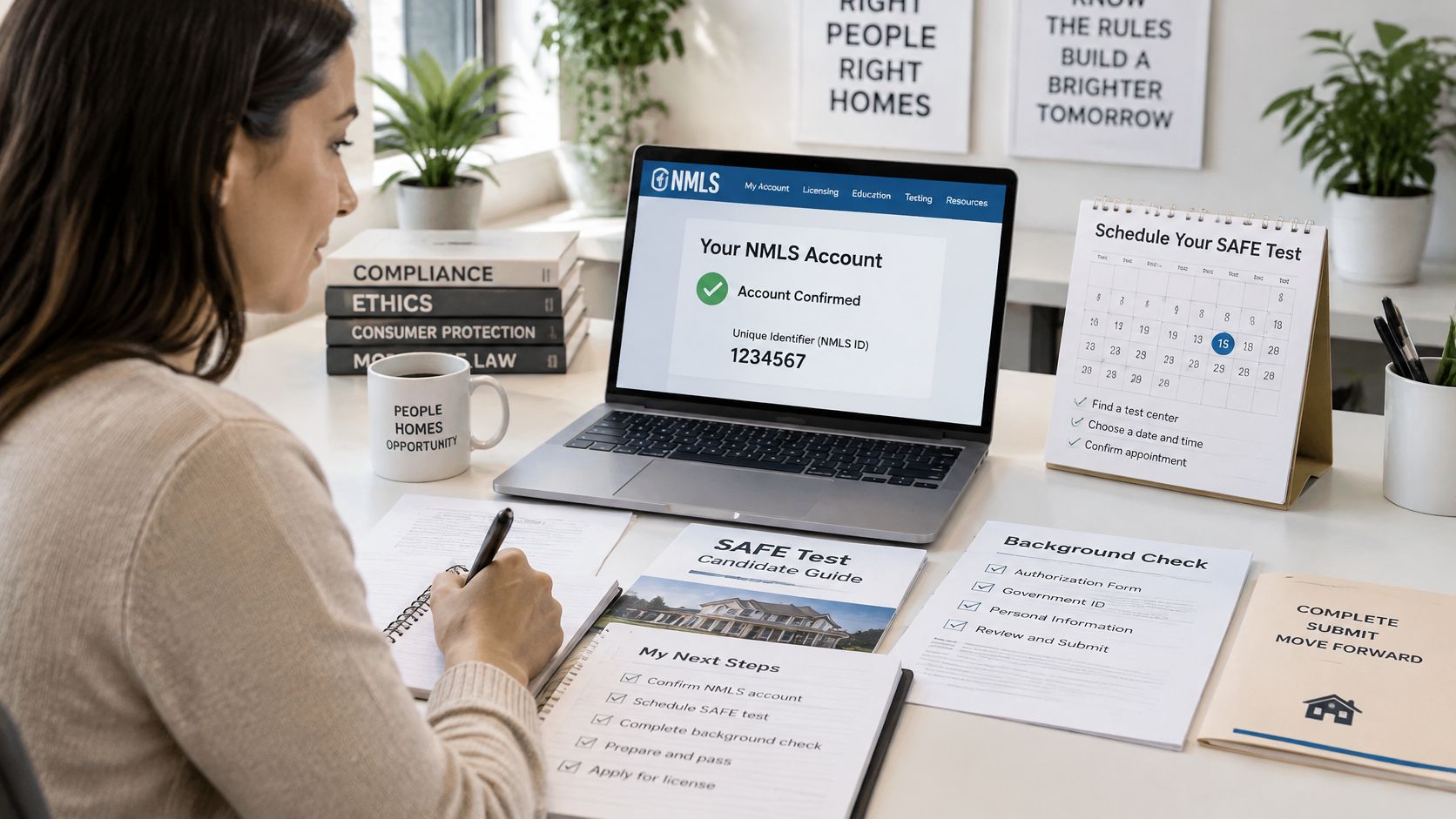
Start with the NMLS account. It holds the unique identifier the rest of the file depends on, so keep that number and your login in the same folder as the certificate. Book the test after completion is recorded, not before. Then review uniform state content beside New York rules. The two sets of rules look similar on a page and split apart on the exam.
Study Habits That Raise Your Score
A timed practice set works like a leak map. The clock tells you whether pacing is steady. Each miss tells you which rule failed. Sort those misses by subject, and keep a short log with three columns: topic, why you missed it, and the rule you needed. One sitting then becomes a study plan instead of a score you shrug at. Our NMLS SAFE test prep resources can help you structure that review.
Watch three numbers while you prepare: overall practice score, ethics score, and New York law score. The overall number shows readiness. The two subject scores show where points leave. When the weakest subject rises, the margin above the line rises with it.
Schedule when you're fresh: Pick a morning slot if you think clearly early, not the end of a long workday.
Review misses within a day: Waiting a week lets the wrong reasoning settle in as if it were right.
Plan a retake window: Put a backup date on your calendar so one bad day delays you briefly, not indefinitely.
Passing threshold: The SAFE test requires a minimum score on each required component, so study until your practice scores sit comfortably above that line.
Questions come up while you study, and support covers MLO licensing requirements, NMLS-approved education, the SAFE Mortgage Loan Originator Test, continuing education requirements, course access, certificates of completion, and technical support. The team can answer general licensing questions and help point you toward your state's MLO licensing requirements.
Fingerprints and background review move faster when the file matches itself. Use the same legal name format everywhere. Gather a short explanation for any item that needs context before you are asked for it. Answer every background question completely. Full, honest disclosure keeps the file from bouncing back for a missing detail. If DFS or NMLS requests more information, reply quickly so screening does not stall an otherwise ready application.
Fees Surety Bond and What the Application Costs
Have you priced this license from a screenshot saved last year? An old total can look friendlier than the bill you will pay.
The current DFS MLO application page lists a $125 investigation fee, a $254 license fee, and a $30 NMLS processing fee. Those three lines add up to $409.
An earlier DFS fee structure produced a lower published total. Treat that older figure as a comparison only, the way a last year's grocery receipt shows what milk used to cost, not what the register charges today. Your quote is the current page.
Fee
Amount on the current DFS page
Investigation fee
$125
License fee
$254
NMLS processing fee
$30
Fingerprint processing
Not listed
Federal criminal background check
Not listed
Total for listed items
$409
Fingerprint and background check amounts sit outside that $409, so confirm them with DFS and NMLS before you submit. Leaving them off your budget is how a "ready to file" application stalls at the last screen. Our guide to Mortgage Loan Originator license costs can help you organize the full picture, including course and exam costs that never appear on the state fee page.
A Simple Budget Checklist
State and NMLS fees: Start with the current $409 for listed items.
Screening costs: Add fingerprint and background amounts once confirmed.
Education and exam: Add your course and test costs.
Time buffer: Keep a cushion for the weeks between submitting and approval.
Applicants must also submit a surety bond and certification after approval. Check the required bond amount with DFS, because that figure is not something to guess. A bond is a promise a surety company makes to the state that you will follow the rules. The premium is separate from the $409, and it is set after you know the amount DFS requires. Save a dated copy of the current fee page, then match it line by line against your NMLS invoice before you pay. If a charge does not match, pause and ask.
Start Your New York MLO Application This Week
Can you name the three decisions that have to be settled before a New York application is worth filing? Enrollment starts the clock only after those answers are honest. Applicants usually slow down here, not on the study material.
Your Decision Checklist
License or registration: Have you confirmed whether your employer type means a New York license or federal registration?
Sponsorship: If you're counting on Temporary Authority, is your W-2 sponsorship with a DFS-licensed or registered firm confirmed?
Branch authorization: Is the location you'll work from tied to a DFS-authorized branch?
Start date honesty: Does your target start date leave room for DFS approval, not just course completion?
Temporary Authority is the misconception that trips up people moving in from another state. It works like a visitor badge, not a key to the whole building. The badge only helps after a DFS-licensed or registered firm has you on a W-2 and the branch you will use is already authorized. Originating loans before those pieces are confirmed is how movers start too early. Lock sponsorship and branch authorization first. Treat your start date as the day DFS says you may work, not the day a course certificate lands in your inbox.
If you need the license, the practical next move is the 20-Hour SAFE Online (OIL) Mortgage Loan Originator Course, National. It is NMLS Approved Course #16623 from 24hourEDU and costs $189.00. A mortgage loan originator license can be earned in just a few weeks. Because the course is delivered online, you can study around your existing schedule and work through it at your own pace.
One free state law course is included with the purchase, so your New York state law requirement is covered without a separate module. The package also includes exam prep materials at no extra charge, NMLS hours reporting valued at $30, and four bonus courses: Become a Top Producer, Specializing in Jumbo Loans, Lead Generation, and Networking for MLOs. Phone and email support comes from instructors who are mortgage professionals with 20+ years of real-world mortgage experience.
What to Do in the Next Seven Days
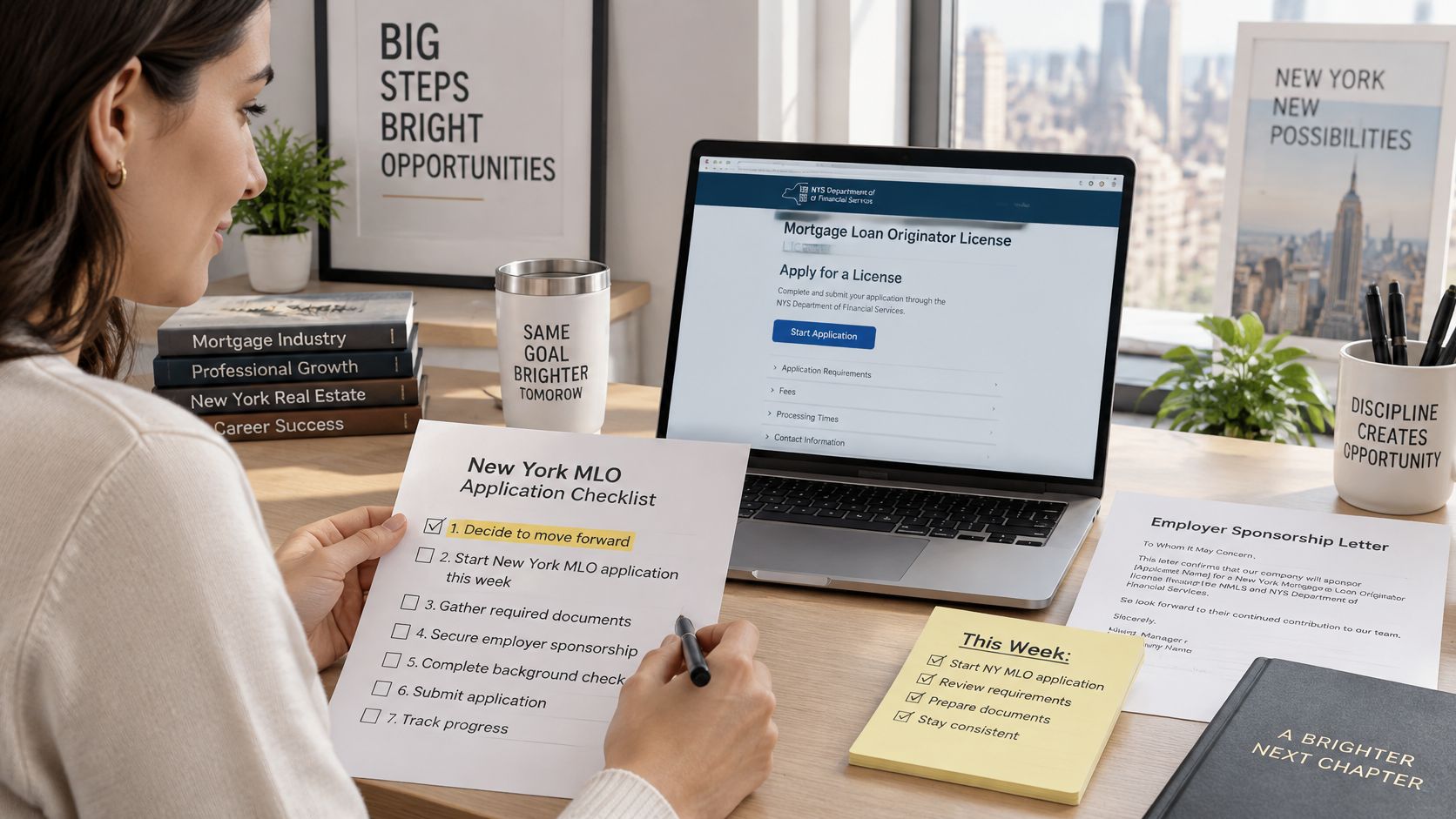
Enroll, then block study time on your calendar before the week fills up. As you near course completion, schedule the SAFE test, start your NMLS application, and set the DFS fees aside so payment never becomes the holdup. Each finished item makes the next one smaller.
Say you're coming from sales, banking, or customer service. Those roles already train you to explain options clearly and follow up until a decision is made. The license adds the compliance and product knowledge that lets you use those skills in mortgage lending. Career changers do well for that reason: you bring the communication, and the course builds the rules around it. The work on the other side is relationship-based, often with hours shaped around clients and family, and pay that follows the loans you close.
Once the paperwork is in order, the path is clear and manageable.
Start the course this week, keep your documents in one folder, and let each completed step pull the next one closer. Borrowers are already looking for a guide they can trust.
Ready to begin your New York Mortgage Loan Originator license journey with online, NMLS-approved education and free exam prep included? Visit 24hourEDU to enroll in the 20-hour course with your New York state law course included, and take your first step toward a flexible, commission-based mortgage career this week.
24hourEDU NMLS Mortgage Loan Officer Course – $189 All States