NMLS Practice Exams Free: Your Complete Prep Guide
“Every practice question is a pointer back to one segment of your required curriculum. Follow the pointer, and review sessions get shorter and sharper.”
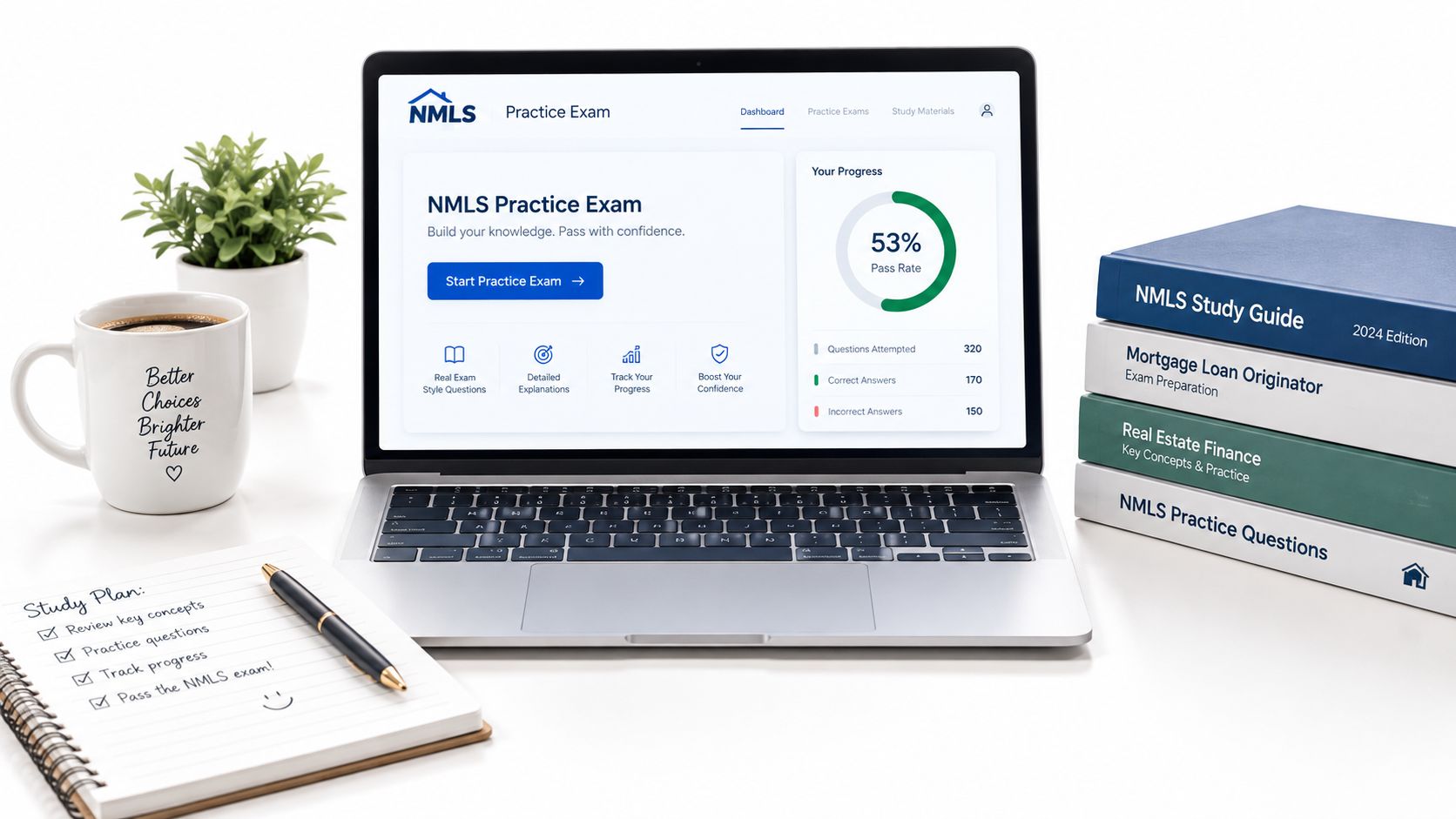
Only 53% of first-time candidates passed the SAFE MLO Test as of December 31, 2024, even though the passing bar sits at 75%, according to the official NMLS testing handbook performance summary. That gap is not a reason to panic. It's a reason to practice with a plan.
You're not trying to collect random questions. You're trying to find out, before test day, which topics you know cold, which ones you half-know, and which ones would drag your score down. Used well, NMLS practice exams free tools can show you all three things, and they can do it while you're completing your required online education.
What a Free NMLS Practice Exam Should Really Give You
That 53% first-time pass rate tells you the SAFE MLO Test is fair, but it's not forgiving of casual preparation. You need at least 75% to pass, so your practice work has one job, to show you whether you can stay comfortably above that line across every topic, not just the topics you enjoy.
A Mirror of the Real Test, Not a Vocabulary Quiz
A useful practice exam mirrors the official structure. That means multiple choice questions that put you inside a borrower scenario, ask you to pick the compliant action, and force you to tell federal requirements apart from state requirements. If a free quiz only asks you to define terms, you're getting a vocabulary check, not a readiness check.
Look for explanations with every answer. A right or wrong mark tells you almost nothing. A short explanation that names the rule, explains why your choice fails, and points you back to the concept turns a missed question into a lesson you can fix that same day.
Metric
Value
First-time pass rate
53%
Minimum passing score
75%
Why One High Score Proves Very Little
Students get confused here, so let's clear it up. Scoring well once can mean you've seen those exact questions before and remembered the answer positions. That is recognition, not understanding, and the official exam will phrase things differently.
A practice score only counts when you can explain, in your own words, why the right answer wins and why the best wrong answer loses.
That's why randomized questions and repeated attempts matter. When fresh questions appear in a new order and your score holds up, you've learned the rule. When your score drops, you've found a topic that looked familiar but wasn't solid.
A Diagnostic Tool, Not a Confidence Boost
Treat every free attempt as a measurement. Finish it, sort your misses by topic, and write down what went wrong. Did you miss a federal law deadline, misread a scenario, or pick an answer that sounded ethical but broke a specific rule?
Topic sorted results: Your misses should sort cleanly into law, workflow, product knowledge, ethics, or state content.
Explanation based review: Every missed or guessed item gets reviewed, not just the ones you got wrong.
Fresh retests: You confirm the fix with new questions, not the same set you just memorized.
Done this way, practice stops feeling like a pass or fail quiz. It becomes a study tool that tells you exactly where your next hour of study will do the most good, and that's how candidates close the gap between where they start and that passing score.
The Official Question Blueprint and What It Means for Free Practice Tests
The SAFE MLO Test is a 120-question multiple choice exam administered through the Nationwide Multistate Licensing System and Registry, with 115 scored questions and 5 unscored questions used for statistical evaluation, according to the NMLS test outline and blueprint page. You won't know which five are unscored, so every question deserves your full effort.
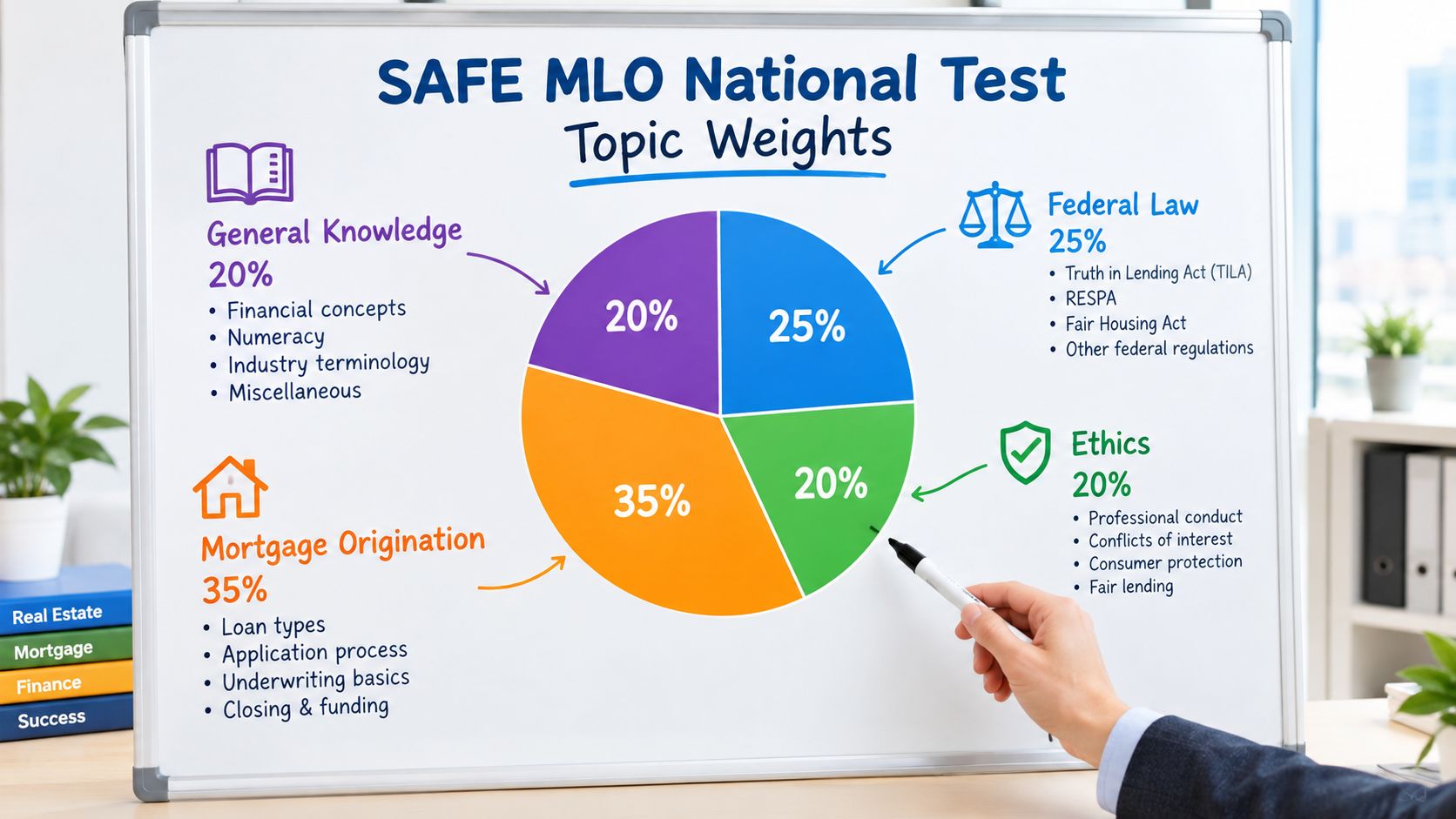
The Five Scored Areas and Their Weights
Domain
Weight
Mortgage Loan Origination Activities
27%
Federal Mortgage-Related Laws
24%
General Mortgage Knowledge
20%
Ethics
18%
Uniform State Content
11%
Read those numbers as a study map. Origination Activities and Federal Laws together represent 51% of the published weighting. If you're shaky in both, no amount of strength in smaller areas will rescue your score, because more than half the exam sits in those two domains.
Why Even Study Time Is a Mistake
Many beginners split study time evenly across five topics because it feels organized. The blueprint says otherwise. More than one quarter of the test covers how an originator performs core activities, things like taking applications, handling disclosures, and moving a file through processing. Nearly one fifth covers ethical conduct. Definitions alone won't carry you through scenario questions in either area.
When you open any set of NMLS practice exams free online, check its proportions first. A set that gives equal weight to every topic, or one that leans heavily on general vocabulary, is training you for a test that doesn't exist. You want origination and federal law questions to feel like the largest blocks, because on test day they will be.
If you want to see how the national test itself is organized before you start drilling, the walkthrough at the SAFE test overview and preparation guide lays out the structure in plain language.
The State Content Trap
Uniform State Content is the smallest area at 11%, and that's exactly why students underprepare for it. Federal scores start looking strong, confidence rises, and state specific rules get skipped. Then state questions cost points that a borderline candidate can't afford.
Practical rule: Judge every free practice tool by one question, does it reflect these proportions and separate federal from state material, or does it just sprinkle questions at random?
Tracking your score separately by category makes this visible fast. A strong overall score can hide one weak domain, and the blueprint tells you how much that weak domain will cost you. Once you can scan a practice exam and spot whether it matches the official weights, you'll never waste an evening on a random question dump again.
How to Choose Free Practice Tools That Match an Approved Online Course
Free quizzes scattered across the internet share a common weakness. You can't tell who wrote them, whether they follow the current blueprint, or whether the answer key is even right. A structured online pre-licensing course solves that problem by building practice directly into the lessons you're required to take anyway.
Check Approval Before You Check Price
Start with the provider number. A legitimate school is fully approved by the NMLS Nationwide Multistate Licensing System and Registry and publishes its provider ID where you can verify it. That number, 1405107, is your quickest legitimacy check, and it takes less time than reading a sales page.
Approval matters because your education hours only count when an approved provider reports them. A bargain course that isn't approved doesn't move you toward a license, no matter how polished it looks. Check the ID first, then look at what's included.
Compare What You Actually Get
Standalone free tools and bundled course prep solve different problems. Here's how they stack up side by side.
Standalone free quizzes: You get quick access and no cost, but question quality varies, explanations are often thin, and nothing connects a missed question back to a lesson you can review.
Bundled online course prep: Your practice questions sit inside the same system as your video lessons and e-textbook, so a missed question points you straight to the material that fixes it.
Instructor access: With a real course, you can reach an instructor by phone or email when an explanation doesn't click, instead of searching forums at midnight.
Online access from any device: Online lessons let you study on a laptop at home or review flashcards on a phone during a break, which suits working adults far better than a fixed classroom.
One option to evaluate against those criteria is 24hourEDU, which delivers its 20-hour SAFE course online with instructor led video lessons, an e-textbook, a bonus state law module, and an exam prep package included for free, along with unlimited phone and email support and complimentary reporting of your completed hours to NMLS. Judge it the same way you'd judge any provider, by approval, access, support, and what's bundled.
Why Bundled Prep Removes Friction
Every hour you spend hunting for trustworthy free questions is an hour you didn't spend learning. When exam prep is included with your required education, that friction disappears. You finish a lesson, take a topic quiz, review the explanations, and move on, all in one place.
That simplicity matters more than it sounds. Getting a Mortgage Loan Originator license is a sequence of manageable steps, and a bundled online program keeps those steps in order. You complete your education, practice with questions built to match it, and walk into the test knowing your prep and your coursework were teaching the same thing.
Mapping the 20-Hour Pre-Licensing Curriculum to Practice Questions
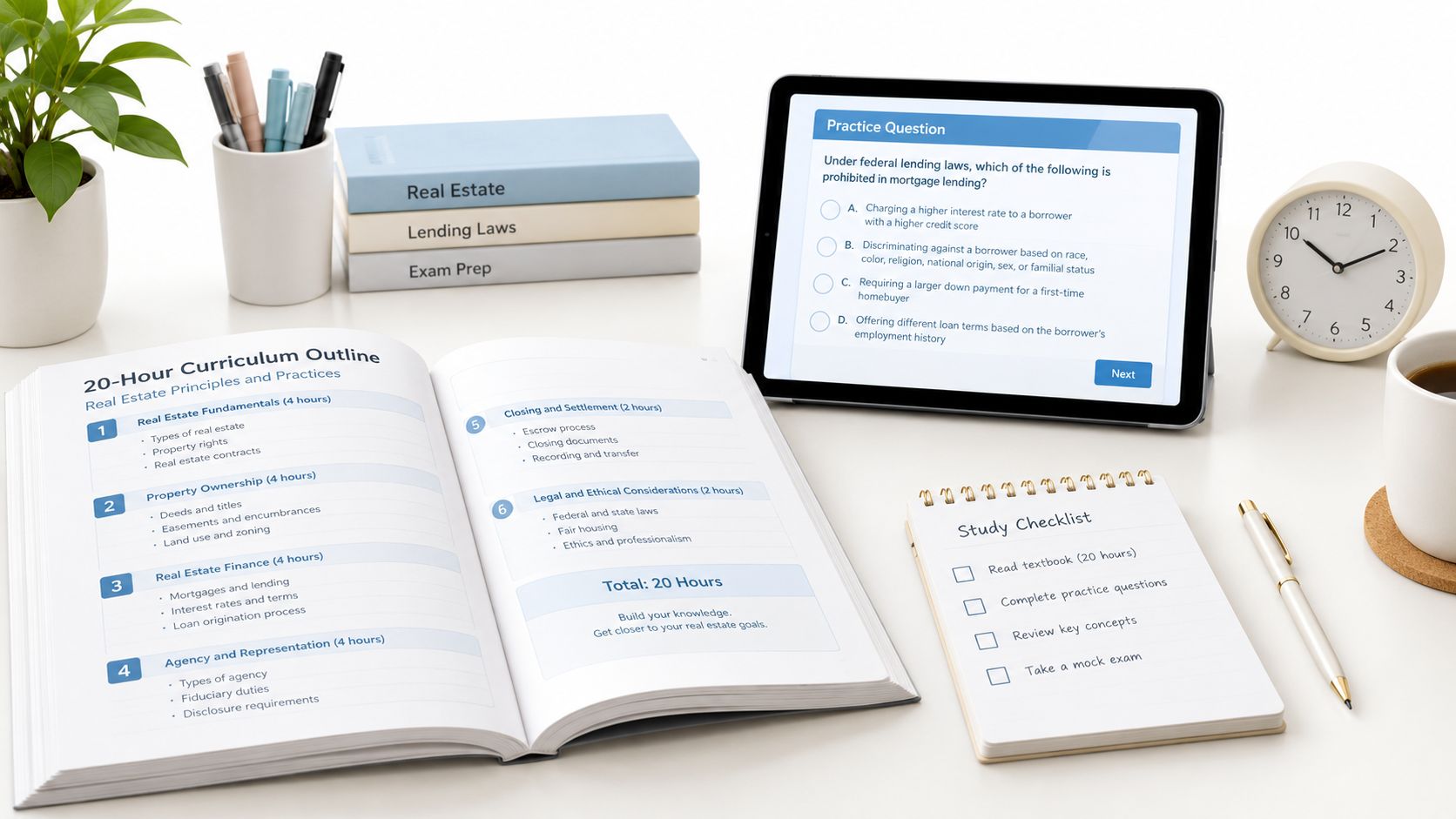
Before you can apply for a state license, you must complete at least 20 hours of NMLS approved pre-licensure education, made up of 3 hours of federal law and regulations, 3 hours of ethics, 2 hours on nontraditional mortgage products, and 12 hours of general mortgage origination instruction, as set out in the NMLS pre-licensure education FAQ. States may add state specific education on top of that federal minimum.
Reading a Question and Naming Its Hour
Once you know the four components, practice questions stop looking random. A question about disclosure timing or a prohibited fee is testing your 3 hours of federal law. A question about steering a borrower or handling a fraud red flag is testing your ethics hours, which cover fraud, consumer protection, and fair lending issues.
Questions about adjustable rate products, interest only features, or other nontraditional structures map to the 2 hour nontraditional segment. Everything about loan programs, calculations, processing, and closing flows from the 12 hours of general instruction, which is why that block is the largest in your course.
Here's where students save the most time. When you miss a question, label it by curriculum component before you do anything else. Three ethics misses in one sitting isn't bad luck, it's a signal to reopen your ethics lessons rather than reread the entire course.
Federal law misses: Go back to the specific rule and its trigger, what event starts the clock or creates the obligation.
Ethics misses: Slow down and identify who could be harmed and which fair lending or fraud principle the scenario is testing.
Nontraditional product misses: Rework the payment and risk features until you can explain them to a borrower in plain words.
General instruction misses: Rebuild the workflow step by step, from application through closing, until the sequence feels automatic.
Every practice question is a pointer back to one segment of your required curriculum. Follow the pointer, and review sessions get shorter and sharper.
This mapping habit also answers a question beginners ask constantly, which is whether course time and practice time compete with each other. They don't. Your 20 hours teach the concepts, your practice exams test them by category, and the categories are the same in both places. That alignment is what makes NMLS practice exams free inside a course more efficient than random quizzes, because every question reinforces a specific hour you've already studied.
A Diagnostic Scoring Method That Beats Guesswork
Most students use practice exams backwards. They take a test, glance at the total score, feel good or bad about it, and take another one. A diagnostic method flips that. The total score matters least. Your accuracy inside each domain, weighed against the blueprint, is where the useful information lives.
Step One and Two, Baseline Then Breakdown
Start with one full timed attempt, mixed across all domains, before you drill individual topics. Don't pause to look things up. You're measuring what you can do unaided, under mild pressure, the same way the actual exam will measure you.
Then calculate your accuracy separately for each of the five areas. A single overall number can hide a serious problem. You might average out fine while one heavily weighted domain sits well below passing level, and that domain will decide your result on test day.
Step Three, Weight Your Weakness by the Blueprint
Now combine two facts, how weak you are in a domain and how much that domain counts. The method described in the official NMLS test content outline guidance points the same way. A learner scoring 60% in Origination Activities should prioritize that domain over Ethics even if both feel equally hard, because Origination Activities is the largest tested area at 27%.
Think of it as points at risk. Weakness in a big domain puts more points at risk than the same weakness in a small one. Your study schedule should chase the biggest pool of recoverable points first, then work down the list.
Step Four, Keep a Simple Error Log
For every missed or guessed question, write three things in a notebook or spreadsheet. First, the rule or concept you misunderstood. Second, the distractor you chose and why it looked attractive. Third, the authoritative concept that resolves the item, in your own words.
Instructor note: The distractor column is the one students skip and the one that helps most, because exam writers reuse the same tempting wrong answers in new clothing.
After a few sessions, patterns jump out. You may find you rush calculation setups, misread questions with negative wording, or confuse two similar federal rules. Each pattern has a different fix, and the log tells you which fix you need instead of sending you back to page one.
Step Five, Retest With Fresh Questions
Close the loop with a new randomized set, not the questions you just reviewed. If your weak domain climbs and stays up across fresh material, the repair worked. If it doesn't, your log gets another entry and your next study block gets narrower.
Aim for stability, not a single peak. Multiple full attempts with no major category consistently below the passing threshold is a far better readiness signal than one great score. When your diagnostic numbers hold steady across several mixed, timed runs using NMLS practice exams free of repeated questions, you've replaced guesswork with evidence.
Building a Realistic Two-Week Study Schedule Around a Busy Life
Consider a common situation. You're working full time, evenings are spoken for, and the idea of 20 hours of coursework plus exam prep sounds like it needs a vacation week you don't have. It doesn't. It needs short, planned sessions and an online course you can open whenever a gap appears.
Week One, Lessons in Short Blocks
Flexible start dates mean your two weeks begin whenever you enroll, not when a classroom calendar says so. In week one, pair a morning video lesson with an evening review of the matching e-textbook section. Keep each block focused on one domain so the material stays connected.
End each study day with a short topic quiz while the lesson is fresh. Ten focused questions right after a lesson will tell you more than an hour of rereading, and any confusion you hit can go straight to instructor support by phone or email before it snowballs into the next topic.
If balancing shifts, family, and coursework is your main worry, the practical strategies in this guide to balancing work and study were written for exactly that juggling act.
Week Two, From Topics to Timed Practice
By week two, your lessons are mostly complete and the emphasis shifts. Move from single topic drills to mixed, timed practice sets that force you to identify the domain before you solve the question, because the actual exam never announces which rule it's testing.
Early week two: Finish remaining lessons and clear your oldest error log entries with targeted review.
Mid week two: Take full timed practice exams and score them by domain using the diagnostic method.
Late week two: Rework repeat misses, lighten new material, and protect your sleep before test day.
Two weeks works when every session has a job. Lessons build knowledge, quizzes check it the same day, and timed exams prove it holds together.
There's a career payoff waiting on the other side of this short push. Licensed Mortgage Loan Originators, Mortgage Brokers, and Mortgage Loan Officers build careers with strong commission based earning potential, the ability to work from home for many employers, and real control over their own hours. That flexibility is a big reason career changers choose this field, including in large United States cities where housing activity keeps skilled originators in demand.
Completing an online course in two weeks or less isn't a stunt. It's what happens when the education, the free exam prep, and the support all live in one place and your schedule only needs to give up short, steady blocks.
Exam Day Logistics and the 180-Day Enrollment Window
Strong students sometimes stumble on mechanics rather than material. The scheduling process is simple once you see it laid out, and knowing it early lets you plan your practice calendar backwards from a real test date instead of studying indefinitely.
How Enrollment and Scheduling Work
NMLS requires you to create an enrollment, accept the candidate agreement, schedule through the testing provider, and complete the exam within a 180-day enrollment window. That window is generous, but treat it as a deadline, not a suggestion. Pick a target date, count backwards through your study plan, and let the date keep your practice honest.
One related timing rule catches people out. Your pre-licensure education doesn't stay valid forever, because under the NMLS three-year pre-licensure education expiration policy, you must retake the full 20-hour course if three years pass without a valid state license or federal registration. Finishing your application promptly after your coursework protects the hours you've already earned.
Two Licensing Paths You Must Not Confuse
The SAFE Act, enacted on July 30, 2008, created different paths depending on your employer, as explained in the CFPB guide to SAFE Act examination procedures. Employees of covered banks and credit unions register federally through the registry. Employees of non-depository mortgage companies generally must obtain a state license, meet financial responsibility and character requirements, pass the approved written test, and satisfy applicable net worth or surety bond rules.
That distinction matters on the exam and in real life. State licensed originators also complete 8 hours of approved continuing education and renew their licenses annually, and the CFPB loan originator rule summary confirms those ongoing obligations. State law adds its own requirements too, so you must satisfy every state where you want authority to originate, a point covered in the CFPB SAFE Act frequently asked questions. Practice questions on the 20 hour requirement, the 8 hour annual requirement, and the 2008 milestone are testing whether you understand this whole sequence, not just isolated numbers.
Skills to Drill in Your Final Practice Sessions
Your last few practice runs should train test taking mechanics alongside content. Work under a clock so pacing feels familiar. Read slowly enough to catch words like except and most likely, which flip what a question is asking. Eliminate options that are plausible but wrong for the role or rule in the prompt before you commit.
Pacing: If a question stalls you, mark your best elimination and keep moving rather than burning minutes.
Controlling facts: Identify the one detail in the scenario that changes the answer before reading the choices.
Guessed items: Flag questions you guessed on, even if you got them right, and review them afterward.
Once you're licensed and taking borrower calls daily, staying organized matters as much as passing did. Many working originators use call notes to track borrower details and follow ups, and VoxNote's guide for mortgage brokers is a helpful resource on choosing tools for that part of the job.
Your Same-Day Action Checklist
You can start all of this today. Take a baseline diagnostic test under timed conditions. Calculate your accuracy by domain and rank your weak areas by blueprint weight. Match each weak area to the matching component of the 20-hour curriculum, then pair every future practice attempt with explanation based review and an error log entry.
Baseline, breakdown, targeted review, fresh retest. Run that loop and the official exam becomes the last step in a process you've already rehearsed.
Schedule your official exam only after several full attempts sit comfortably above the passing threshold with no major domain lagging behind. That's the moment practice has done its job, and a high income, flexible career helping borrowers into homes stops being an idea and starts being your next step.
Ready to turn practice into a passing score without hunting all over the internet for questions you can trust? 24hourEDU offers a fully NMLS approved 20-hour online pre-licensing course with instructor led video lessons, an e-textbook, unlimited phone and email support, and a complete exam prep package included for free. Enroll today, start your first lesson online, and put your two week study plan in motion toward your Mortgage Loan Originator license.
24hourEDU NMLS Mortgage Loan Officer Course – $189 All States