

You've finished your mortgage training, opened your laptop, and you're ready to help a borrower with a residential mortgage application. Then someone asks for your NMLS record, employment confirmation, fingerprints, and registration status. The process can feel more complicated than the career itself, but NMLS SAFE Act registration becomes manageable when you understand who files what, why each checkpoint exists, and what must happen after approval.
The SAFE Act created a consistent foundation for mortgage loan originator oversight. Your job is to complete the right education, provide accurate information, pass the required screening and testing, work with the right employing sponsor, and keep your record current. The guidance below focuses on practical decisions that help new MLOs move forward without avoidable corrections.
What the SAFE Act Actually Does for New MLOs
A borrower is ready to discuss a home loan, and your employer asks for your NMLS record, education history, fingerprints, disclosures, and employment details. You may know how to guide the application while still asking why so much information is required. The SAFE Act connects those checkpoints to your authority to work as a Mortgage Loan Originator. If you want the broader distinction, learn what an MLO license covers.
The Secure and Fair Enforcement for Mortgage Licensing Act, known as the SAFE Act, became law on July 30, 2008, as part of the Housing and Economic Recovery Act. It required residential mortgage loan originators to be either state-licensed or federally registered through the Nationwide Mortgage Licensing System and Registry, or NMLS. States received a two-year period to adopt compliant standards and participate in NMLS, making 2010 a key implementation milestone for mortgage regulation. The NCUA's SAFE Act compliance guide provides the regulatory foundation.

Each requirement has a practical purpose
The requirements show up in real borrower interactions:
- Education: Before advising borrowers, coursework builds your foundation in federal law, ethics, and mortgage origination.
- Testing: The written qualified test checks whether you can apply rules, not only recognize industry terms.
- Fingerprinting and screening: Background review helps regulators assess professionals handling sensitive financial transactions.
- Public identification: NMLS assigns a persistent identifier that supports electronic tracking and public access to employment history and disciplinary actions. Many state mortgage laws require that identifier on documents and advertisements, as explained in NMLS guidance on unique ID use.
For state licensing, the SAFE Act requires 20 hours of NMLS-approved pre-licensure education. The coursework includes 3 hours of federal law and regulations, 3 hours of ethics, 2 hours on lending standards for nontraditional mortgage products, and 12 hours of mortgage origination instruction, according to the NMLS pre-licensure education FAQ.
Practical rule: Treat your NMLS record as a professional credential that borrowers, employers, and regulators may review.
You are building proof of preparation, identity, accountability, and authorization. That mindset makes each requirement easier to complete accurately and maintain after registration.
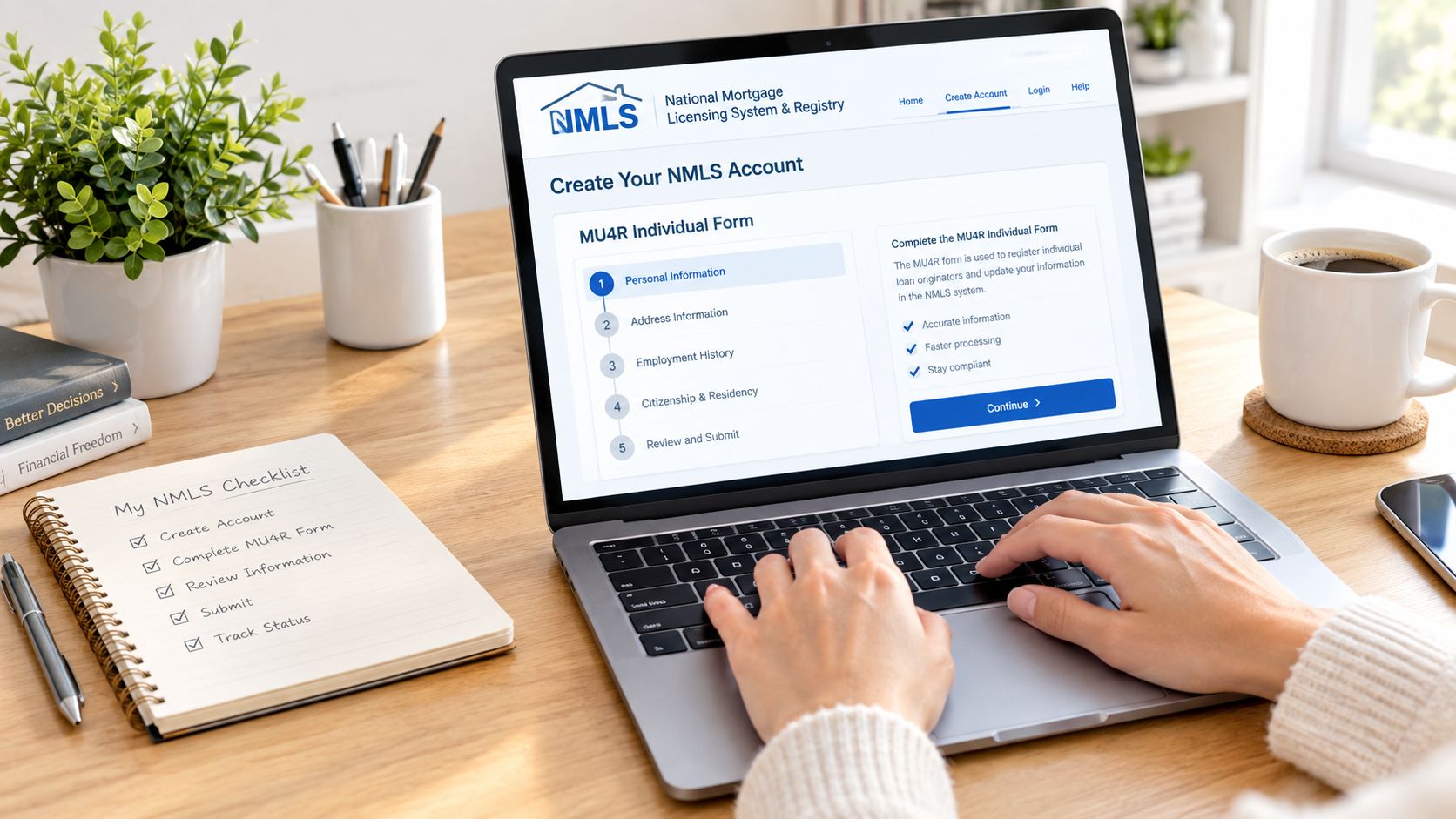
Creating Your NMLS Account and Filing the MU4R
Your NMLS account is the starting point for the federal registration workflow. A common mistake is rushing through account setup and then discovering that a legal name, address, or employer detail doesn't match the supporting records.
Start with your individual NMLS record and enter your personal contact information exactly as it appears on your government identification. Use an email address you monitor consistently, because account notices and requests for clarification can affect your next action. Choose login credentials you can protect, and save your account information in a secure password manager rather than in an unsecured document.
Build the record carefully
The MU4R filing is the individual record used to operationalize federal registration through NMLS. The employing institution can initiate it through a batch upload or file directly on the MLO's behalf. The NMLS federal MLO registration instructions explain that the filing includes employment confirmation, attestation, payment, and assignment of a unique identifier.
Work through the form in stages. Save after each major portion, then return to review before submitting.
- Personal details: Match your legal name, identifying information, and contact details to your official documents.
- Residence history: Enter the requested history completely and avoid unexplained gaps.
- Employment history: Prepare your financial-services employment history before opening the form. Regulators may require 10 years of history, so gather dates and employer names in advance. The OCC Comptroller's Handbook SAFE Act materials describe this documentation expectation.
- Disclosure questions: Read every question about criminal, civil, financial, and regulatory matters. If an answer requires an explanation, attach the supporting documents in the format NMLS accepts.
- Employer and sponsorship information: Confirm the company name and employment relationship before filing. A small mismatch can create a correction request or delay employer confirmation.
Honesty matters more than presenting a perfectly clean-looking record. A disclosed issue can be reviewed with context. An omitted issue can create a mismatch that forces amendments and additional documentation.
Review before attestation
Don't treat the attestation screen as a routine click. Compare every answer with your identification, employment records, and disclosure documents. Once you attest, you're confirming that the record is accurate to the best of your knowledge.
For a plain-language overview of the identifier tied to your record, review this guide to what an NMLS number means. Keep copies of submitted documents and confirmation screens. That simple habit gives you a reliable reference if your employer or regulator asks about a filing later.
Passing Identity Verification and the FBI Background Check
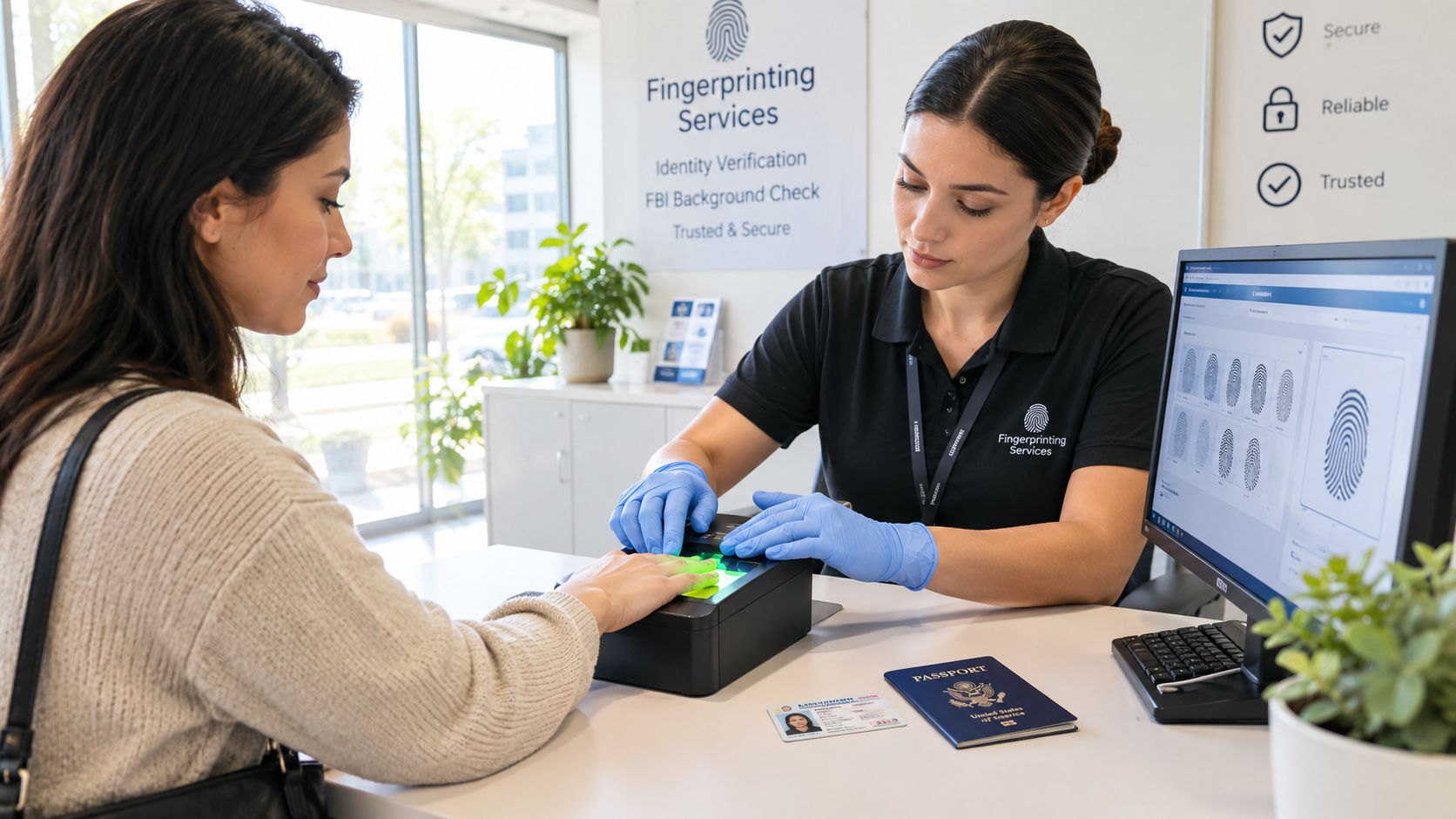
Identity verification, fingerprinting, and the FBI background check should be treated as one connected screening checkpoint. NMLS first needs confidence that the applicant is the person attached to the record. The fingerprint submission then gives the FBI background check a dependable basis for reviewing criminal history.
Prepare before scheduling anything. Use valid government identification, check that your name is consistent across the NMLS account and documents, and keep every appointment or submission confirmation number. If a livescan location is available through the approved process, follow its instructions for digital fingerprints and arrive with the identification it requires.
Disclosures must match the screening record
The FBI background check can surface information that you must already have addressed in your MU4R disclosures. Don't wait to see what appears in the report before deciding how to answer the form. Review the disclosure questions carefully, gather court or agency documents when applicable, and provide a clear explanation where the filing requires one.
The SAFE Act also requires state-licensed MLOs to submit fingerprints to NMLS for FBI background checks and authorize an independent credit report. These requirements sit alongside education and testing, as summarized in NMLS's SAFE Act overview.
A prior issue doesn't automatically tell the whole story. An incomplete or inconsistent disclosure gives reviewers a reason to pause the file.
At a fingerprint appointment, verify that the technician submitted the transaction correctly before leaving if the location provides that confirmation. Store the receipt or confirmation with your licensing documents. If NMLS requests additional information, respond directly and keep the communication trail.
Remove avoidable friction
Schedule fingerprinting early enough that it doesn't become the last unresolved item in your registration file. Confirm whether the location uses the channel and format required for your NMLS submission, and don't assume a previous fingerprint submission for another purpose will automatically satisfy this process.
You can also review the MLO background check requirements before your appointment. The objective is straightforward: make your identity, fingerprints, disclosures, and supporting documents tell the same story.
Federal Registration Versus State Licensing at a Glance
Your employer determines which NMLS path applies. A loan originator working for a qualifying financial institution generally needs federal registration. An originator working under state regulatory authority needs a state MLO license. Both records use NMLS, but neither authorization replaces the other.
Regulation G established the federal registration framework. It took effect on October 1, 2010. The initial federal registration period ran from January 31, 2011, through July 29, 2011. Covered employees had to satisfy the registration requirements before originating residential mortgage loans after that period, as explained in the CFPB SAFE Act examination procedures.
| Aspect | Federal Registration, SAFE Act and NMLS | State MLO License |
|---|---|---|
| Scope | Covered employees of qualifying financial institutions | Individuals subject to state MLO licensing |
| Authority | Federal registration recorded through NMLS | License issued under state authority through NMLS |
| Education | Depends on the applicable federal registration framework | 20 hours of NMLS-approved pre-licensure education is required |
| Screening | NMLS registration, identity information, and background requirements | Fingerprints, FBI background check, credit authorization, and other state requirements |
| Maintenance | Annual renewal during the November 1 to December 31 renewal window | Annual continuing education and state renewal requirements |
| Career fit | MLO employment with a covered financial institution | MLO work with a licensed mortgage company or other sponsoring employer |
The day-to-day difference appears when you change employers. A mortgage company typically expects you to complete the state licensing requirements for the jurisdiction where you will work, while a covered financial institution handles the federal registration process for its employees.
Opening an NMLS account does not authorize loan origination by itself. Confirm your employer's classification and target jurisdiction before paying for education, filing the wrong record, or assuming you can begin taking applications. That check keeps your registration plan aligned with the job you want.
Securing Sponsorship, Attestation, and Registration Fees
Sponsorship connects your individual record to the institution where you work. You can prepare much of the record yourself, but the employing institution must confirm the employment relationship and handle the employer-side submission required for federal registration.
The workflow is easier when each person knows their role:
- You identify the employing institution and confirm that it uses the federal registration pathway.
- The institution creates or uploads the MU4R filing through NMLS, either by batch upload or direct filing.
- The employer confirms employment and submits the applicable sponsorship or registration action.
- You review and attest that your personal information and disclosures are accurate.
- The responsible party completes payment for the applicable filing and registration charges.
- NMLS processes the record, and the institution responds to any request for correction or additional information.
Clarify payment responsibility before filing
Ask your employer which charges it will pay and which charges you must pay personally. The NMLS registration charge, FBI background check charge, testing charge, education cost, and state licensing charges may appear as separate parts of your overall licensing budget. The exact amount and payer can vary by employer and jurisdiction, so get the answer in writing before you submit.
Don't rely on a promised processing timeline. The verified guidance identifies the registration and renewal windows, but it doesn't establish a universal number of days for every payment or review. A payment may clear while another item, such as employer confirmation or disclosure documentation, remains pending.

Attestation deserves your full attention
Attestation is your formal confirmation that the record is complete and accurate. Read the entire record before accepting it, especially if someone else uploaded information on your behalf. If your employer enters a detail incorrectly, ask for a correction before attesting rather than hoping the issue will resolve later.
The registration process assigns your unique NMLS identifier and requires the record to remain current. Certain information changes must be updated within 30 days, so sponsorship isn't the end of your compliance responsibility.
Employer checkpoint: Before your first origination activity, confirm that your registration status is active and that your current employer appears correctly in NMLS.
That check protects you from relying on an incomplete sponsorship action. It also gives your manager a clear opportunity to resolve a pending item before it affects a borrower file.
Staying Active After Registration and Avoiding Lapses
Registration does not end when your record is approved. A new job, legal name change, or missed renewal can affect your ability to originate, so build maintenance into your regular work routine.
Federally registered MLOs renew annually during the November 1 through December 31 renewal window. State-licensed MLOs also complete annual continuing education, and state rules may impose requirements beyond the federal baseline. Review your status before the renewal period begins, not on its final day.
The 30-day update rule matters
Certain significant changes must be reported within 30 days. The CFPB's Nationwide System Registry privacy impact assessment identifies changes such as a name change, termination, and certain legal or regulatory actions.
Turn ordinary workplace events into compliance reminders:
- You change your legal name: Confirm the required NMLS update and gather supporting documentation.
- Your employment ends: Verify that the termination appears correctly. A new employer must complete the appropriate confirmation before you resume originating.
- A legal or regulatory matter arises: Review the disclosure questions promptly and submit any required update.
- Your contact information changes: Update the record so notices and compliance communications reach you.
A missed renewal makes the registration inactive. You cannot act as a federally registered MLO until the renewal requirements are met again. Check your renewal status directly in NMLS, and keep confirmation records with your compliance files.
Use a simple monitoring rhythm
Set calendar reminders before the renewal window opens. During the year, review your employment status, contact details, disclosures, and continuing education record. Check your public NMLS information after an employment change, because Consumer Access can display employment history, license and registration status, current employer, and other identifying details.
Accuracy serves two audiences. It helps regulators and employers maintain a reliable record, and it lets borrowers verify who is handling their application. Make record reviews part of your normal professional routine rather than waiting for a notice or a new job.
Your Quick-Start Checklist and What Comes Next
A clean filing now prevents delays later. Use this sequence:
- Confirm the path: Determine whether your target employer requires federal registration or state licensing.
- Create your NMLS account: Enter your legal name and contact information exactly as they appear on official documents.
- Prepare the MU4R: Gather residence, employment, and disclosure information before filing.
- Complete identity verification: Follow the NMLS process and save the confirmation details.
- Schedule fingerprinting: Use the approved channel and bring valid government identification.
- Authorize screening: Complete the FBI background check and any required credit authorization.
- Complete required education: State-licensed MLOs must complete the verified 20-hour pre-licensure education requirement, covering federal law, ethics, nontraditional lending standards, and mortgage origination instruction.
- Secure sponsorship: Have the employing institution confirm your employment and submit its NMLS action.
- Review and attest: Correct discrepancies before accepting the filing.
- Track maintenance: Record the annual renewal window and monitor updates that may be due within 30 days.
Registration starts your MLO career, but it does not finish the setup. Prepare for the SAFE MLO test, choose an employer that supports your goals, build referral relationships, and complete continuing education as required. Online pre-licensure education can fit well if you are balancing current employment with a career change.
24hourEDU offers an NMLS-approved 20-hour SAFE online mortgage loan originator course with video lessons, an e-textbook, a bonus state law module, and a free exam prep package. The provider is approved through the NMLS Nationwide Multistate Licensing System and Registry under Provider ID 1405107. Review the course details and use them to organize your MLO licensing plan.
After registration, treat every workplace change as a compliance checkpoint. Keep your NMLS record accurate, check renewal status directly, and save confirmation records with your compliance files. That routine protects your ability to keep originating and gives employers and borrowers a reliable record to review.