
Most advice about NMLS SAFE exam practice questions is backwards. Grinding through a giant question bank doesn't prove you're ready. It often proves only that you've memorized familiar wording. The SAFE MLO exam uses plausible distractors, applied judgment, and a strict time limit, so your practice must show you why you miss questions, not merely how many questions you've completed.
The effective approach is diagnostic. Map your work to the official blueprint, rehearse under realistic timing, and tag every mistake by root cause. With an NMLS-approved online pre-licensing course that includes exam preparation at no extra cost, you can turn each practice session into a focused study decision and make the licensing path feel far more manageable.
Why Most Practice Question Strategies Underperform
Many candidates adopt a “do more questions” routine, but repetition alone creates false confidence. They cycle through one bank until the answer choices look familiar, then mistake recognition for knowledge. That confidence vanishes when the SAFE MLO exam changes the fact pattern, rearranges the information, or places two plausible answers together.
The SAFE MLO National Test is a high-stakes assessment. NMLS requires a minimum passing score of 75%, and the official outline lists 115 scored questions in a test containing 120 total items, with 190 minutes to finish. Review the NMLS testing outline for the current structure. Untimed trivia does not prepare you for that environment.
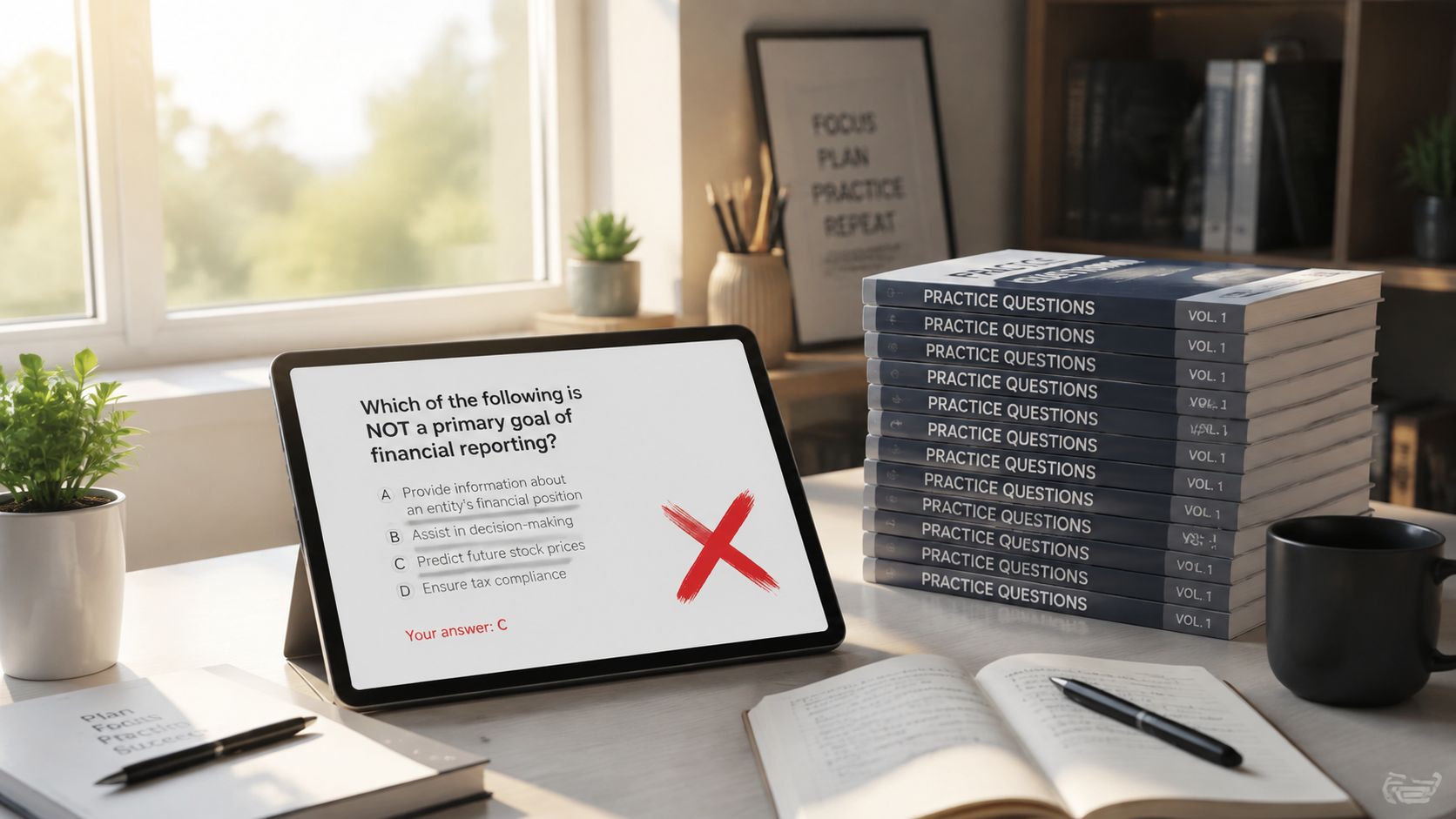
Treat every wrong answer as evidence
A missed item usually identifies a specific weakness:
- Content gap: You do not know the rule.
- Vocabulary gap: You misunderstand a term in the question.
- Reading error: You miss “except,” “best,” or “not.”
- Calculation setup error: You choose the wrong inputs before calculating.
- Scenario judgment error: You know separate rules but cannot apply them together.
- Pacing problem: You rush, freeze, or spend too long on one item.
Passive repetition conceals these causes. You may answer the same question correctly several times without explaining why the other choices fail. That builds familiarity, not durable recall.
Practical rule: Record the reason behind every miss, not only your score.
Use practice questions diagnostically. Tag each item by weakness, review the exact concept in your fully online, NMLS-approved pre-licensing course with exam preparation included at no extra cost, then retest later with unfamiliar wording. Timed mixed sets should come after that review, so you learn whether the problem is knowledge, application, or pacing. Question volume matters only after question quality, analysis, and timing are in place.
Mapping the SAFE MLO Exam Blueprint Before You Practice
A long practice set can hide poor preparation. The SAFE exam does not distribute scored content evenly, so your study plan should follow the blueprint rather than treat every topic as equal. Mortgage Loan Origination Activities carries the largest share, followed by Federal Mortgage Related Laws, General Mortgage Knowledge, Ethics, and Uniform State Content. Review the SAFE MLO exam study topics to organize notes, then label each practice question by its tested area.
Use the official outline as the authority for the current category weights, but do not turn those weights into a score-chasing exercise. Practice questions work best as a diagnostic instrument. Each answer should show whether you know the rule, can apply it to a borrower scenario, or need to improve your reading and calculation setup.
Match study time to tested content
For every 10 hours of preparation, allocate about 2.7 hours to origination activities, 2.4 hours to federal law, 2 hours to general mortgage knowledge, 1.8 hours to ethics, and 1.1 hours to uniform state content. These figures mirror the exam blueprint. They do not excuse shallow review of a smaller category.
| Content Area | Approx. Exam Weight | Study Hours per 10 | Sample Topics |
|---|---|---|---|
| Mortgage Loan Origination Activities | 27% | 2.7 | TRID disclosures, debt-to-income ratio calculations, loan estimate review, closing disclosure timing |
| Federal Mortgage Related Laws | 24% | 2.4 | RESPA Section 8 referrals, ECOA and Regulation B notices, TILA disclosures, BSA/AML red flags |
| General Mortgage Knowledge | 20% | 2.0 | Fixed-rate versus adjustable-rate features, lien priority, loan programs, amortization terms |
| Ethics | 18% | 1.8 | Conflicts of interest, steering, misrepresentation, borrower confidentiality |
| Uniform State Content | 11% | 1.1 | State licensing rules, regulator authority, recordkeeping, prohibited conduct |
Federal law practice should test how rules interact, not just whether you can expand an acronym. Work through scenarios involving RESPA Section 8, ECOA and Regulation B, TILA, BSA/AML, the SAFE Act, FHA, VA, and USDA. After each answer, state which rule controls and why the other choices fail.
State preparation depends on your jurisdiction. New York requires NMLS submission, approved education that includes 3 hours of New York law, the National Component and Uniform State Content test, and a surety bond after approval (New York Department of Financial Services requirements). California directs applicants to Prometric testing centers and requires approved education covering federal law, ethics, nontraditional mortgage lending, and mortgage origination instruction (California DRE guidance).
Tag every missed item by category and error type. Review the exact concept in your fully online, NMLS-approved pre-licensing course with exam preparation included at no extra cost, then retest with unfamiliar wording. A weak result in a heavily weighted category needs immediate review. A correct answer you cannot explain is not ready for test day.
Where to Find Quality NMLS SAFE Exam Practice Questions
Not all question sources serve the same purpose. Free public quizzes can help you learn the vocabulary and identify obvious gaps. Standalone paid banks may provide more variety, but their value depends on how carefully the writers maintain regulatory accuracy. A bundled pre-licensing course can be more efficient because the lessons, questions, and explanations live in one learning system.
Judge every source against four standards. Does it follow the current NMLS content outline? Does each answer include a meaningful rationale? Do the scenarios resemble the length and ambiguity of licensing questions? Does the provider update the material when rules and official topic priorities change?
Compare the source before trusting the score
| Source Type | Blueprint Alignment | Written Rationales | Update Cadence | Typical Cost |
|---|---|---|---|---|
| Free public quizzes | Variable | Often limited | Variable | Free |
| Standalone paid question banks | Depends on provider | Usually available | Depends on provider | Paid |
| Bundled NMLS-approved courses | Tied to course content | Expected in quality programs | Provider-dependent | Included with tuition or paid course |
NMLS says its official sample questions are only 10 items and are similar to questions that may appear on the National Test, so they aren't broad enough to replace a structured practice program (NMLS approved course topics). Use them to understand style, not as your entire preparation plan.
Low-quality banks reveal themselves quickly. Look for typos in regulatory citations, answer choices copied from outdated forms, and explanations so short that they merely repeat the correct letter. An explanation should identify the governing rule, explain why the tempting distractor fails, and show how the fact pattern triggered the rule.
Stress-test a question bank
Take a small, mixed set before committing to any source. Review every miss against the applicable statute, regulation, or authoritative handbook. If the explanation conflicts with the source material, stop using the bank until the provider resolves the issue.
A provider such as 24hourEDU includes vetted SAFE MLO practice sets inside its NMLS-approved online mortgage education, including simulated tests and exam preparation rather than requiring students to assemble unrelated materials (included mortgage loan originator practice exams). That bundled structure removes one common problem, uncertainty about whether your practice questions match the course and blueprint.
Simulating Real Test Conditions With Timed Sets
Untimed practice can create false confidence. A candidate may solve a question with notes, search tabs, and unlimited time, then lose the reasoning under test pressure. Use timed sets as diagnostic rehearsals. Their purpose is to expose pacing problems, fatigue, and weak decision-making, not to chase a higher score.
Set up a controlled environment. Work at a desk, silence your phone, close unrelated tabs, and use only materials permitted by your practice format. Keep identification nearby to reinforce that you are rehearsing a formal testing appointment.
For a mixed set, choose a fixed limit that reflects the official exam pace and reserve a small buffer for review. Read each stem once, flag uncertain items, and continue. One difficult scenario should not consume the time needed for several answerable questions.
Record four details after every session:
- Start and finish time: Measure the actual session length.
- Flagged items: Count questions needing a second pass.
- Unanswered items: Note whether pacing forced guesses.
- Root causes: Label misses as knowledge gaps, misread wording, weak elimination, or poor time control.
Review the pattern, not just the percentage. A low score caused by unfamiliar rules needs different work from a respectable score built on slow, uncertain guesses. Practice questions are useful only when they show what to fix next.
Rotate the order of mixed sets. Do not place Uniform State Content or Mortgage Loan Origination Activities last every time. Fatigue should test your judgment in different parts of the session.
A practice score matters less than whether you can reproduce your reasoning with no notes and no search engine.
A fully online, NMLS-approved pre-licensing course that includes practice questions, simulated tests, and exam preparation at no extra cost gives you a consistent place to run these rehearsals. 24hourEDU provides that bundled structure, so your diagnostic work stays aligned with the course instead of scattered across unrelated materials.
Tools designed for exam-mode discipline can also reduce everyday browsing distractions. Exam Practice for GCSE demonstrates how a focused testing environment can separate practice from ordinary study. Apply the same setup to SAFE preparation, then use these multiple-choice exam tips to improve flagging, elimination, and review habits.
Sample Practice Questions With Full Explanations
A good practice question teaches two things, the answer and the recognition pattern that led to it. Don't read the answer key first. State the issue, identify the controlling rule, eliminate choices that don't fit, and explain what wording in the stem made the correct answer stronger.
Federal law example
Question: A title company gives a loan originator a payment connected to a mortgage settlement service. Which situation can comply with RESPA Section 8?
Best answer: The payment reflects bona fide settlement services the recipient performed, documented at a market rate.
The key cue is the connection between the payment and a settlement service. A payment isn't made permissible merely because the amount is a “reasonable estimation.” The question tests whether the compensation reflects actual, documented services, rather than disguising a referral payment as an ordinary business expense.
Eliminate any answer that approves payment for a referral alone. Also reject an answer that relies only on a reasonable amount without identifying services performed. Your rule note should read: RESPA Section 8 prohibits kickbacks and unearned fees, while legitimate compensation must correspond to bona fide services.
General mortgage knowledge example
Question: For a manual conventional underwriting review, which obligations should the borrower's debt-to-income calculation consider?
Best answer: The proposed housing payment, minimum credit card payments, and a student loan in deferment treated according to the applicable underwriting treatment, including 1% of the balance where that rule applies.
The stem cue is “manual conventional underwriting,” not just “monthly debt.” A deferred student loan isn't automatically treated as zero. A candidate who recognizes the general DTI formula but misses the underwriting treatment can choose an attractive distractor that excludes the obligation.
Use each explanation to capture four items:
- Trigger: What wording identifies the issue?
- Rule: What law, guideline, or underwriting principle controls?
- Distractor: Why does the tempting alternative fail?
- Transfer: Where else could the same rule appear?
That method resembles strong performance review questions 2026, where the value comes from examining the reasoning behind an answer rather than collecting responses. On SAFE practice, write the rule in your own words, then solve a differently worded item later.
Turning Missed Questions Into a Personal Study Plan
A missed question has no value until you identify why you missed it. Consider a timed set in which a candidate misses 14 questions. The candidate sorts the errors into 4 misread stems, 6 forgotten rules, 3 second-guessed answers, and 1 answer changed from correct to incorrect.
That distribution is more useful than the raw score. The forgotten rules require targeted reading. Misread stems call for slower marking of words such as “best” and “except.” Second-guessing belongs in pacing work, while answer switching may indicate fatigue and poor session design.
Use a simple diagnostic log
| Question ID | Section | Root Cause | Rule to Review |
|---|---|---|---|
| Q12 | Federal Law | Forgot the rule | RESPA payment restriction |
| Q27 | Ethics | Misread the stem | Prohibited conduct in context |
| Q34 | Origination Activities | Calculation setup | DTI inputs |
| Q49 | General Mortgage Knowledge | Second-guessed | Product feature distinction |
Keep the spreadsheet plain. Add the question ID, blueprint section, root cause, and rule to review. Sort by section to expose weaknesses against the official content weighting, then sort by root cause to decide whether your next session should emphasize reading, recall, calculation setup, or pacing.
Review the log weekly. Retest missed items cold after five days, but don't memorize the original answer position. Explain the rule before looking at the choices, then solve a new item that tests the same principle.
The score should rise as the error buckets shrink. If it doesn't, your labels may be too vague, or your remediation isn't reaching the underlying lesson. “Careless” isn't a diagnosis. Identify whether you misread the stem, lacked a definition, confused two laws, used the wrong formula, or ran out of time.
Pairing Practice Questions With an NMLS-Approved Course
Practice questions work best when a structured course supplies the underlying lesson. A state-licensed MLO must complete at least 20 hours of NMLS-reviewed and approved pre-licensing education, including 3 hours of ethics and 2 hours on lending standards for the nontraditional mortgage product marketplace (Consumer Financial Protection Bureau regulation). The course should become the spine of your preparation, while practice questions reveal where that spine needs reinforcement.
Choose an online provider that connects lessons to the SAFE blueprint and provides explanations, not just answer keys. You want questions organized around federal law, general mortgage knowledge, origination activities, ethics, and state content, with material that reflects the current approved-topic framework.
Follow a repeatable learning loop
Read one lesson, complete its topic quiz, and review every missed item against the lesson video or text. Return to the same topic after a day and solve unfamiliar questions without notes. This sequence forces retrieval, correction, and later confirmation instead of passive scrolling.
A useful course should provide:
- Blueprint-linked practice: Questions mapped to the tested content areas.
- Scenario explanations: Reasoning that explains both the correct answer and the distractors.
- Online access: Lessons and quizzes available through a web-based learning platform.
- NMLS approval: Education that satisfies the approved pre-licensing requirement.
- Support: A clear way to ask course or licensing questions when a rule remains unclear.
24hourEDU offers fully online NMLS-approved MLO education with an exam prep package included at no extra cost, including practice questions and simulated tests. Its NMLS Provider ID is 1405107, and its course approach lets candidates combine the required education with the diagnostic practice system described here.
Start with three actions: enroll in the approved online course, take a baseline practice set, and schedule daily 25-question blocks. Tag every miss, review the lesson connected to it, and let your error log determine what you study next.
Visit 24hourEDU to access fully online NMLS-approved MLO pre-licensing education with SAFE exam preparation included at no extra cost. Use the bundled practice questions and explanations to build a targeted study plan, prepare for the licensing test, and move toward your Mortgage Loan Originator career with a clear daily routine.