
You may be working in sales, customer service, administration, or another demanding profession when the idea arrives: mortgage lending could offer a more flexible and financially rewarding career. You want to help people finance homes, work from a home office, set hours that fit your life, and earn commissions based on the business you build. The question is where to begin without leaving your current job or getting lost in regulatory language.
Online licensing courses make that transition practical. A good course turns a complicated licensing process into clear lessons, measurable progress, exam preparation, and a record that can be verified by the Nationwide Multistate Licensing System and Registry, commonly called NMLS. Becoming a Mortgage Loan Originator, Mortgage Broker, or Mortgage Loan Officer requires commitment, but it isn't an insurmountable academic hurdle. It's a structured professional path designed for adults who need to learn while managing work and family responsibilities.
Starting Your Mortgage Career From Home
Maya has spent years working with customers and solving problems over the phone. Her schedule is full, but she wants a career with greater income potential and more control over her workday. After learning about mortgage lending, she discovers that she can prepare for the required education online, study from a laptop at home, and build toward a role that combines sales, financial knowledge, and client service.
That path is realistic because distance education has developed into a recognized way to deliver professional learning. The history reaches back to 1892, when Penn State, the University of Wisconsin, and the University of Illinois helped pioneer correspondence-style professional education in the United States. The modern online phase accelerated in the early 1990s as the World Wide Web made web-based course delivery possible, and Jones International University became the first fully online university to receive accreditation in 1993. UPCEA's overview of online continuing education places these developments in the longer evolution of distance learning.

What the work can look like
An MLO may speak with borrowers, collect financial information, explain loan options, coordinate documentation, and communicate with lending partners. A Mortgage Broker may work with multiple lenders, while a Mortgage Loan Officer typically works within a lending organization. The exact duties depend on the employer, business model, and state requirements, but all three paths rely on trust, responsiveness, and careful compliance.
Online study supports that career model because you can build knowledge without commuting to a classroom. You can study before work, after family responsibilities, or during another consistent period that fits your routine. A clear course calendar, instructor access, and progress milestones matter more than just having videos available.
A useful starting point: Choose education that leads to a verifiable licensing record, not just a completion screen.
For a practical look at how online study can fit around a working adult's schedule, review this guide to taking a mortgage license class online. The right preparation won't remove the work, but it can make every step easier to understand and manage.
Understanding NMLS Education Requirements
The federal foundation for a state-licensed MLO begins with 20 hours of NMLS-approved pre-licensure education before you apply for licensure. The SAFE Mortgage Licensing Act establishes this baseline so candidates study essential legal, ethical, and mortgage origination subjects before serving consumers.
The required federal curriculum is divided into specific areas:
- Federal law and regulations: 3 hours covering the rules that govern mortgage lending and consumer protection. The Consumer Financial Protection Bureau's regulation explains the federal education breakdown.
- Ethics: 3 hours focused on professional conduct and responsible treatment of borrowers.
- Nontraditional mortgage lending standards: 2 hours addressing lending practices outside traditional mortgage structures.
- Mortgage origination instruction: 12 hours covering the broader knowledge needed to work effectively with mortgage applications and transactions.
These subjects are connected. Federal law gives you the boundaries, ethics helps you recognize conduct that can harm consumers, nontraditional lending education introduces additional risk considerations, and the general origination material gives you the working vocabulary for the role.
The federal baseline isn't always the full requirement
A state can add education beyond the federal minimum. The NMLS professional requirements guide explains that the 20-hour requirement is a baseline and that state-licensed MLOs may need to satisfy additional state requirements.
New York provides a clear example. Applicants must complete 20 hours of NMLS-approved pre-licensing education that includes 3 hours of New York law, submit the application through NMLS, pass the SAFE test, and obtain a surety bond after approval, as described by the New York Department of Financial Services.
Before enrolling, identify every state where you expect to seek a license. Then confirm whether that jurisdiction requires a state-law module, extra education, or another application condition. This simple check prevents a common mistake, completing the national course while overlooking a state-specific obligation.
For a course overview and enrollment information, see the NMLS education courses from 24hourEDU. Treat the course as the first part of a licensing file, not as the entire application process.
Why Structured Learning Beats Passive Watching
An online course can be convenient without being casual. Licensing candidates often start with good intentions, watch a few lessons, and then lose momentum because nothing tells them what to complete next. That approach creates a dangerous gap between exposure to information and actual mastery.
Completion data supports a more structured approach. A large-scale 2026 synthesis reports an overall online course completion rate of 60%, while flexible formats rise to 72% and certification-linked courses reach 78% when deadlines, structure, and support are added. Employer-sponsored learners complete at 79%, compared with 39% for self-enrolled learners, according to WorldMetrics' online course statistics.
The lesson isn't that every learner needs a classroom. The lesson is that candidates need a system that creates forward movement. Smaller modules, clear objectives, instructor access, practice questions, and visible milestones help turn study time into retained knowledge.
What active preparation looks like
Suppose you finish a lesson on federal lending rules. A passive approach is to close the video and move on. An active approach asks you to review the objective, complete the knowledge check, write down the rule in plain language, and revisit any question you missed. That process gives you evidence about what you know before the SAFE exam exposes the gap.
Look for these features when comparing online licensing courses:
- Organized lessons: Modules should follow a logical sequence rather than presenting disconnected videos.
- Instructor-led explanations: Video instruction can make difficult concepts easier to follow when the instructor explains how a rule applies to a lending situation.
- An e-textbook: A searchable text reference helps you review definitions and regulatory concepts efficiently.
- Practice assessments: Questions should reveal weak areas instead of only marking a lesson complete.
- Human support: Phone and email access can resolve confusion before it interrupts your study plan.
A broader professional development guide for 2026 can also help career changers think about licensing as part of a larger skill-building plan. Mortgage education becomes more valuable when you connect it to communication, documentation, ethical judgment, and client relationship skills.
The online learning best practices resource offers additional ideas for building a repeatable study routine. Set regular sessions, track completed objectives, and use practice results to decide what to review next. That routine prepares you for the exam far better than just accumulating screen time.
Navigating State Approvals and Compliance Reporting
A career changer may finish every lesson on schedule, yet still face a licensing delay if the provider reports the completion under the wrong name or fails to report it at all. Course approval and reporting turn study time into a verifiable record that the regulator can recognize.
NMLS says only approved course providers can satisfy MLO education requirements. After completion, check that the result appears in the NMLS Education Record, following the NMLS guidance on late continuing education and online education.
Check the record in a deliberate sequence
- Confirm provider approval before enrollment. Find the provider's NMLS approval information and confirm that the course serves your licensing purpose.
- Use your legal identity consistently. Your course account should match the name and identifying details connected to your NMLS record. Even a small difference can interfere with reporting.
- Complete every required component. A national course may not cover a separate state-law requirement. Review your state's conditions before treating the education file as complete.
- Keep your completion evidence. Save the certificate, completion notice, and relevant course details in your own records.
- Review the NMLS Education Record. Once the provider reports your completion, confirm that the education appears accurately.
- Contact the provider about an error or missing record. Send your identifying information, course details, and completion evidence so staff can investigate.
- Use the appropriate NMLS support channel if needed. If the provider cannot resolve the issue, contact NMLS and retain your messages and case details.
Regulators expect auditable records: verified identity, documented training time, and objective-based assessments, not just time spent on a website. Texas occupational-licensing guidance requires agency approval before distance-learning credit can be offered. It also calls for verification of training time and student identity, successful performance-based assessments, and assessments that are measurable, observable, clearly stated, and aligned with learning objectives. The referenced distance-learning course page provides a related example of online course delivery, while your licensing agency and NMLS requirements determine whether education receives credit.
Compliance rule: Your certificate is useful evidence, but the NMLS Education Record is the operational check that confirms the education was reported correctly.
Choosing the Right Education Provider
Price and convenience matter, but approval and reporting come first. A low-cost course that doesn't satisfy your state requirement can delay your application and force you to repeat work. A polished platform also isn't enough if it lacks state-specific content, reliable assessments, or support when you encounter a difficult topic.
Use this comparison when evaluating providers:
| What to examine | Questions to ask |
|---|---|
| NMLS approval | Is the provider approved for the education you need, and can you locate its provider information? |
| State coverage | Does the course include the state-law content required by your jurisdiction? |
| Course design | Are lessons organized with objectives, progress tracking, and review opportunities? |
| Exam preparation | Are practice questions and exam preparation included, or sold as an unexpected add-on? |
| Reporting | Does the provider explain how completion is reported and what you should check afterward? |
| Support | Can you reach experienced staff by phone or email when a regulatory or technical question arises? |
| Access | Can you begin when your schedule allows and study from a computer or mobile device? |
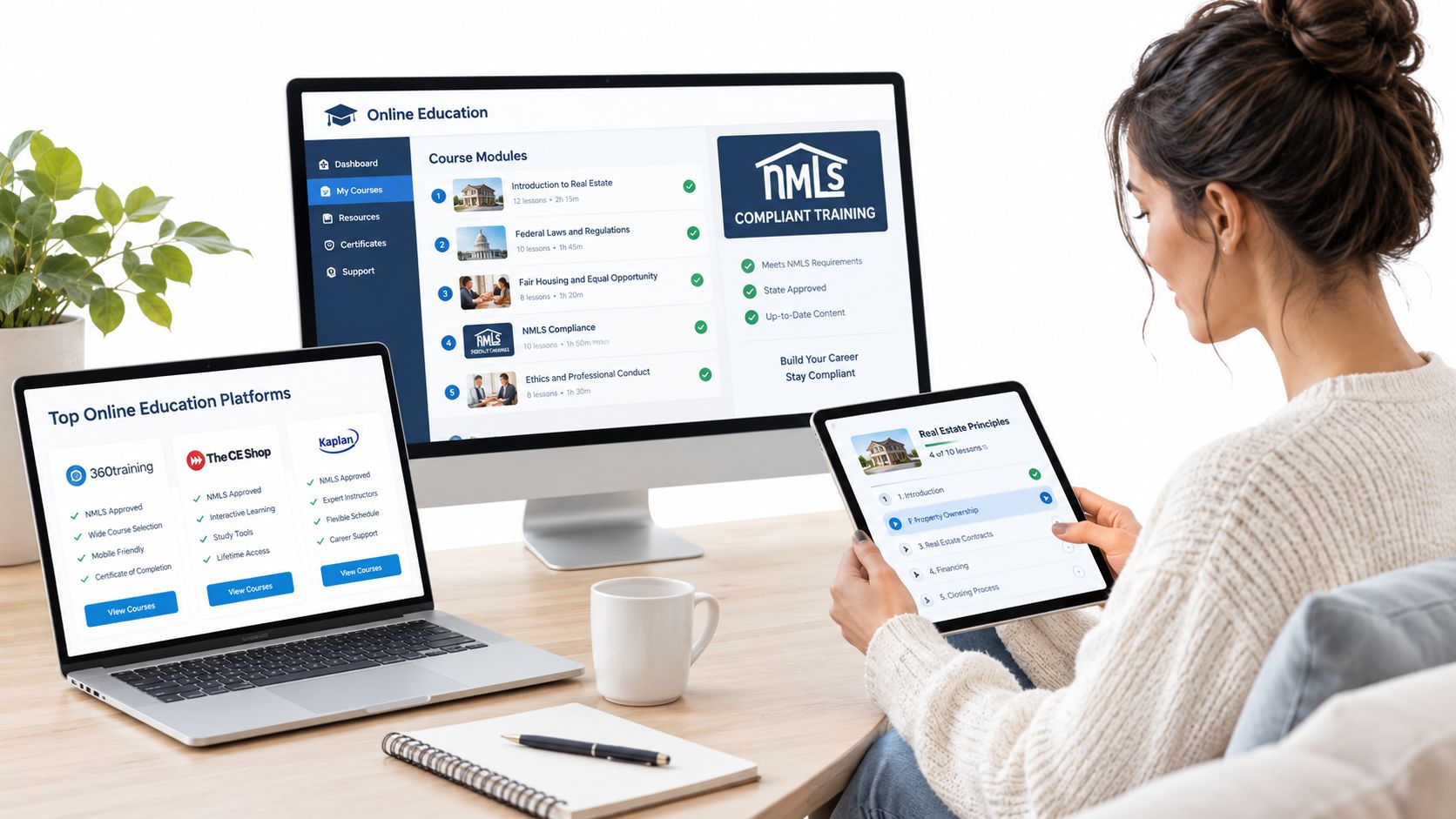
A strong provider should explain what you receive before payment. Look for an online instructor-led video course, an e-textbook, state-law options where required, exam preparation included at no additional cost, and a clear process for NMLS hours reporting. Flexible access is valuable, but structure keeps that flexibility from becoming indefinite postponement.
Evaluate the business model, not only the interface
Web-based delivery can reduce the operating costs associated with physical classrooms, which may help a provider offer affordable pricing. That saving shouldn't come at the expense of instruction or support. Ask whether the provider offers a real person to contact, whether the course explains its approval status clearly, and whether the company tells you how completion reporting works.
24hourEDU offers an NMLS-approved 20-hour MLO pre-licensing course, instructor-led online video lessons, an e-textbook, a bonus state-law module, free exam preparation, phone and email support, and complimentary NMLS hours reporting. Its NMLS Provider ID is 1405107. Verify that the specific course and state combination match your licensing plan before enrolling.
Passing the SAFE Exam and Launching Your Career
The SAFE Mortgage Loan Originator Test is the final knowledge checkpoint before you move deeper into the licensing process. The SAFE Mortgage Licensing Act requires state-licensed MLOs to pass the NMLS-developed test with a score of 75% or better. The exam includes a National Component with Uniform State Content, according to the NMLS SAFE test guide.
Use your exam preparation package as a diagnostic tool, not a last-minute reading assignment. Complete practice questions after studying each major subject, record the concepts you miss, and return to the relevant lesson or e-textbook section. If you repeatedly miss questions about a rule, definition, or calculation, slow down and explain the concept in your own words before taking another practice assessment.
A calmer test-day routine
- Study the weak areas first: Let practice results determine your review priorities.
- Read every question carefully: Regulatory questions often depend on a specific detail or exception.
- Avoid rushed cramming: Consistent review supports recall better than trying to absorb every topic in one sitting.
- Prepare your logistics: Confirm the test appointment requirements and arrive ready to concentrate.
- Use support early: Ask instructors about confusing concepts before test day, rather than carrying uncertainty into the exam.
Passing the test opens a professional path with several possible work arrangements. An MLO may work from home, choose hours that fit client and business needs, develop referral relationships, and earn commissions. Mortgage Brokers and Mortgage Loan Officers can serve borrowers in major United States cities without being tied to a traditional classroom or fixed office schedule.

Income isn't automatic, and commission-based work rewards consistent prospecting, accurate follow-up, ethical conduct, and strong relationships. For a career changer who enjoys helping people make significant financial decisions, the combination of flexibility and performance-based opportunity can be compelling.
Your Action Plan for Getting Licensed
Keep the process simple by completing one verified step at a time. Your roadmap should look like this:
- Choose your licensing states. Identify where you want to work and check each jurisdiction for state-law education or additional conditions.
- Select an approved provider. Confirm the provider, course, state coverage, support, and NMLS reporting process before enrolling.
- Complete the education. Finish the federal 20-hour curriculum and any required state-specific module.
- Use the included exam preparation. Take practice assessments, review weak subjects, and build confidence before scheduling the SAFE test.
- Pass the SAFE test. Meet the required 75% passing score and retain your test information.
- Submit your application through NMLS. Follow the application, background, bond, and other state instructions that apply to your jurisdiction.
- Verify your education record. Check that the provider reported your completed education correctly in NMLS.
A structured online program can help a working adult complete the course in a focused period, potentially two weeks or less when the learner follows a consistent schedule, as stated by 24hourEDU. Don't treat that timeline as a regulatory promise. Your actual application and approval timing depends on your preparation, test result, documentation, and state process.
The first decision is choosing education that combines approval, instruction, support, exam preparation, and reporting. Once those pieces are in place, an MLO career from home becomes a practical project rather than a distant idea.
24hourEDU offers NMLS-approved online MLO pre-licensing education with the required core course, state-law resources, included exam preparation, instructor-led lessons, and support by phone and email. Visit 24hourEDU to review the course options and take the first step toward your Mortgage Loan Originator license.