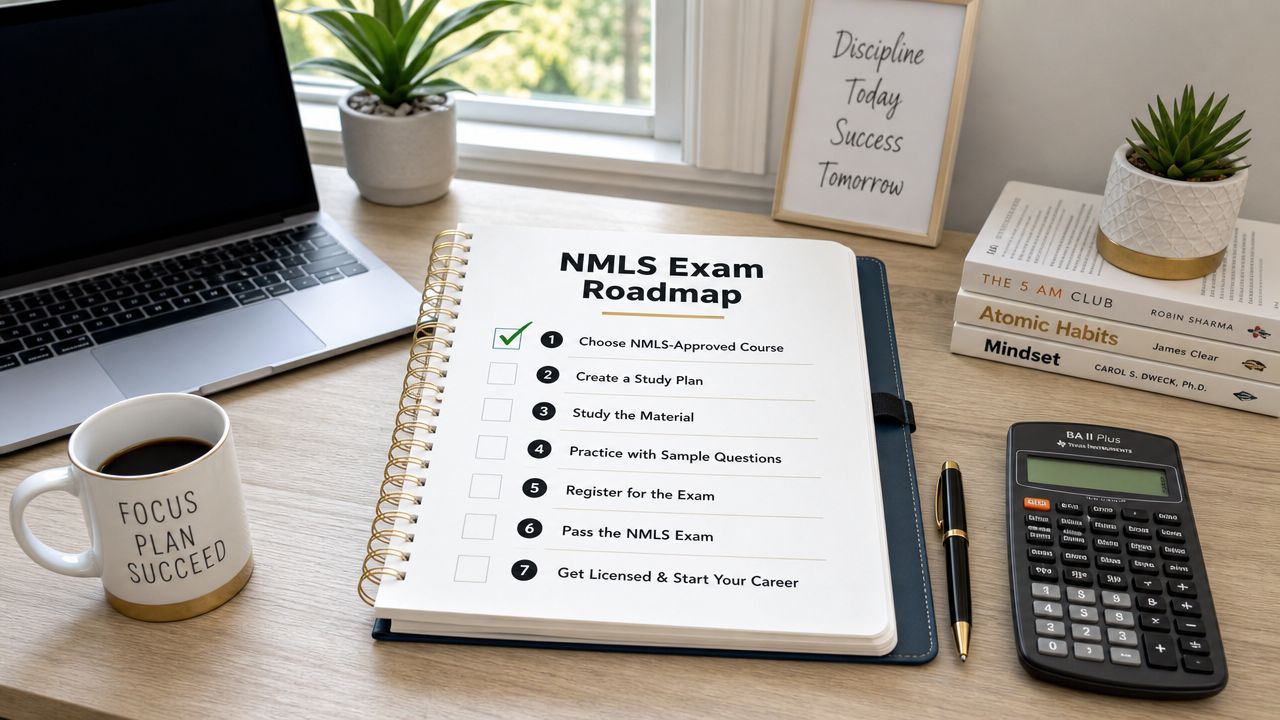
The first time many candidates sit in the Prometric parking lot, they've already done the hard part of getting started. They've read the course materials, highlighted too much, and spent the last two weeks wondering if they should've studied more, studied differently, or both. That's a normal place to be, and it doesn't mean you're behind. It usually means you're one structured plan away from being ready to pass the NMLS mortgage licensing exam.
What makes this exam feel intimidating is also what makes it manageable. The SAFE MLO Test has a clear 75% passing score and a known structure, with 115 scored questions plus 10 unscored pretest questions according to the NMLS testing handbook and exam guidance in the study materials you're using. In other words, you're not walking into a mystery. You're walking into a regulated process with fixed steps, predictable content, and a finish line you can prepare for with intention. NMLS testing handbook for the SAFE MLO Test
Why Passing the NMLS Exam Feels Within Reach
The candidate in the parking lot usually isn't failing because they're incapable. They're anxious because they've spent days trying to memorize everything at once, and the exam doesn't reward that style of studying. The better framing is simple, this is a licensed profession with a standard gate, and the gate has a known lock.
The SAFE Act of 2008 created the national licensing framework that sits behind the exam and the NMLS system. That matters because the test isn't a personality quiz or a random trivia contest. It's a professional checkpoint built to confirm that you understand the mortgage process, the rules around it, and the decisions borrowers rely on you to get right. Complete NMLS study guide with SAFE Act framework
A pipeline, not a panic test
Think of the journey as a sequence, not a sprint. First comes the required education, then registration, then focused study, then timed practice, then test day, then the state licensing steps that follow. The order matters because each stage reduces one kind of stress before the next one begins.
That's also why preparation feels easier when you stop treating every topic as equally urgent. Federal law, mortgage math, underwriting, ethics, and disclosure documents show up again and again in study guidance because they represent the core of the work. Once you see the exam that way, it stops feeling like a wall of facts and starts looking like a repeatable process.
The goal isn't to know everything at once. The goal is to build enough structure that the test feels familiar when you sit down.
A lot of people need that reminder before they do anything else. They've already started the journey by choosing the career, and the rest is sequencing.
How the NMLS Mortgage Licensing Exam Is Built
A candidate can study hard and still feel unsure about the exam until the structure makes sense. The mortgage licensing test exists because licensing is regulated, not improvised. The SAFE Act of 2008 set the national framework for mortgage loan originator licensing, and the NMLS system uses that framework to organize education, testing, and licensing. Once you see that structure, the exam looks less like a mystery and more like a measured checkpoint.
The pass line is simple. Candidates need 75% to pass, and the exam uses 115 scored questions plus 10 unscored pretest questions in the structure described by the testing handbook. The score applies only to the scored portion, not every item shown on screen. That detail matters because a missed practice question may point to a content gap, a calculation slip, or a pacing problem, and the fix depends on which one it is. NMLS testing handbook for exam structure and score threshold
What the federal structure means
The national exam focuses on mortgage operations, federal rules, ethics, and related procedures. Study materials keep returning to the same core areas, federal law and regulations, nontraditional lending, mortgage math, underwriting, and disclosure documents such as the Loan Estimate and Closing Disclosure. Those topics deserve your attention because they show up again and again in the work of a licensed MLO.
A missed question in these areas does not always mean the same thing. A content gap means you need to review the rule or process itself. A calculation error means you understood the idea but lost points in the arithmetic. A pacing issue means you knew the material, but time pressure changed how carefully you worked. A practice test works like a diagnostic check, it shows whether the weak point is knowledge, accuracy, or speed.
The state process comes after the national test and sits on top of it. The NMLS framework is set up so you complete education, register, test, and then move into the state licensing steps that apply to your location. A smooth candidate handles the steps in order instead of trying to solve every part of licensure at once.
If nerves start pulling your attention away from study, the free anxiety education hub can give you plain-language support while you prepare. Use it as a side tool while you keep your focus on the licensing process. 24hourEDU also offers a course option for NMLS pre-licensing education, which can help you stay organized as you work through the required material.
Meeting the Education and Registration Requirements
The education step comes first, and it is required before testing. Under the SAFE licensing framework, applicants must complete an approved 20-hour pre-licensing education course before they can sit for the exam. That first checkpoint is there to make sure every candidate starts with the same baseline training before tackling the national test. The Complete NMLS study guide with licensing framework lays out how that requirement fits into the broader licensing path.
The paperwork needs to be clean
After education, the next step is to create or use your NMLS account, request that your course completion be reported, and then enroll for the exam inside the system. The exam fee is $110, and the test is scheduled through Prometric once your registration is ready. Many candidates lose time here, not because the material is hard, but because they move too quickly through the paperwork and leave a small detail unfinished.
A few common issues cause headaches:
Name mismatch: Your NMLS account name needs to match your government ID.
Timing problem: Don't try to schedule before your education has been reported.
State authorization gap: If your state requires an extra approval step, make sure it is cleared first.
This is the quiet part of the process that decides whether test day happens on schedule. A candidate can know the content well and still lose weeks to a avoidable admin issue.
If you want a course option that includes online delivery and exam prep support, one place to review is the NMLS education courses page. The key is not the brand name, it is making sure the course is approved and the completion is reported correctly.
Practical rule: treat registration like part of studying. If the account details are wrong, the exam date slips, and your momentum slips with it.
Building a Study Schedule That Fits Your Life
Generic advice like “study more” does not help anyone who has a job, a family, or a career transition in motion. A better plan is to make prep part of your weekly rhythm, the same way you would build a workout routine or a class schedule. Many first-time passers spend 60 to 80 hours over 3 to 6 weeks, which works out to about 90 to 120 minutes a day, six days a week. Another study guide recommends 10 to 15 hours per week, and the point is the same, steady repetition beats frantic cramming. Study time and pacing guidance for NMLS prep
A schedule works best when it gives each topic a return visit. The SAFE exam is not a memorization contest. It is more like a series of checkpoints, where one weak answer can point to a content gap, a calculation slip, or a pacing problem. That is why a calm, repeatable plan matters. It helps you see what you know, what still needs work, and what only feels shaky because you were rushed.
A simple weekly cadence
Start with the highest-yield domains first. Give most of your attention to federal law and regulations, ethics, nontraditional mortgage lending, mortgage math, underwriting guidelines, and disclosure documents like the Loan Estimate and Closing Disclosure. These topics deserve repeated exposure because they anchor the exam's real-world content.
A workable rhythm can look like this:
Day 1: Learn a topic and do a short set of questions.
Day 2: Review the same material without notes.
Day 5: Revisit weak points and retest yourself.
Day 10: Do a mixed review and check what stayed with you.
That spaced pattern helps information move out of short-term memory and into a form you can recall under pressure. It also gives you a cleaner view of progress, because you are not judging yourself only on one good or bad study session.
A good schedule also needs a readiness benchmark. One prep source recommends aiming for at least 85% accuracy on section-level practice questions before testing. That gives you a clear signal. If you are below that mark, the issue is still teachable, not mysterious. Study benchmark and scheduling guidance for NMLS prep
Study smart, not loud: if a topic keeps missing in practice, move it to the front of the week instead of rereading the whole course.
If you need a routine that fits around work or family time, the how to study 2 hours a day guide is a useful time-management reference. It works especially well for candidates who need a predictable daily block instead of a long stretch of study time.
Turning Practice Questions Into a Diagnostic Tool
A missed practice question is more useful than a correct guess. Correct answers can feel reassuring, but the wrong ones show you exactly where your exam readiness still needs work. Treat each miss like a clue, and the practice set starts acting less like a score report and more like a mirror.
Tag the reason you missed it
The first step is to name the error type right away. Was it a content gap, a vocabulary issue, a calculation setup mistake, a scenario judgment error, or a pacing problem? That label matters because the fix depends on the cause, much like a mechanic needs to know whether a car problem comes from the engine, the brakes, or the battery before making repairs.
A math question missed because the formula was set up backward calls for a different fix than a disclosure question missed because the wording was rushed. One points to concept review, the other points to reading discipline. If you only reread everything, you may feel busy without correcting the actual weakness.
Timed full-length work makes those differences easier to see. A 125-question, 190-minute simulation gives you the kind of pressure prep guidance describes, and it shows whether your knowledge still holds when the clock starts narrowing your focus. Practice-exam guidance and diagnostic approach
The same idea works well with a miss log. Write down the question, the reason you missed it, and the fix you used, then look for patterns across several sessions. A single error might be random, but repeated misses usually point to one of a few predictable problems.
Why one practice test is never enough
The first practice exam often exposes gaps that study notes do not. You may know the definition but freeze when the question changes form. You may understand the formula but hesitate when numbers are rearranged. You may start strong and then lose accuracy as fatigue builds near the end.
Use that information instead of ignoring it. Build your review around the patterns in your miss log, then sort each item by cause so you can study the right weakness. Over time, that record becomes a personal map of what to fix first, which is more useful than rereading chapters you already recognize.
For a practical way to keep that review cycle moving, the mortgage loan originator practice exams included free page can help you set up a timed practice rhythm. The point is feedback, not volume. If you want a broader habit for handling repeated exam practice, the certification strategies from certification strategies from PIA Southern Alliance follow the same principle, review the miss, identify the cause, and train the weak spot directly.
Nailing Test Day Logistics and Mindset
The night before the exam decides more than many admit. If your sleep is poor, your bag isn't ready, or your drive is rushed, you arrive with extra stress before the first question appears. Calm test-day execution starts the evening before.
A simple run-of-show
Pack your ID, confirm the test location, and leave enough time for traffic or parking. Eat a breakfast that won't distract you, and get to the center early enough that you're not entering in a hurry. Once you're seated, use the tutorial screens to breathe and settle in before the actual test begins.
During the exam, manage the clock in passes instead of staring at every second. A two-pass method works well, answer the questions you know cleanly first, then come back to the ones that need more thought. That keeps momentum moving and prevents one hard item from draining the rest of the section.
Mindset reset: if you feel panic rising, stop for a few controlled breaths, then return to the next question only. One recovery is enough to save a stretch of the test.
A short checklist helps too:
ID and confirmation: verify both before you leave.
Arrival window: plan to be early, not barely on time.
Testing room focus: expect a quiet environment and a no-distraction mindset.
Final review: leave a few minutes to catch simple mistakes before submitting.
That last review matters because rushed submissions create avoidable errors. A deliberate pause at the end gives you a chance to catch answers you changed too quickly.
For another perspective on exam calm and structure, the certification strategies from PIA Southern Alliance offer a useful mindset parallel. The settings are different, but the habit is the same, preparation works best when it's organized and repeatable.
Your Final Checklist and What Comes After the Exam
Keep this sequence in front of you:
Choose an approved course with exam prep materials and support.
Complete the 20-hour pre-licensing education required under the SAFE framework.
Set up your NMLS account and make sure your name matches your ID.
Register and schedule the exam through the proper channel.
Study in stages with spaced review and timed practice.
Use diagnostics on missed questions instead of guessing why you missed them.
Walk into test day with a calm plan, not last-minute panic.
After the exam, the next steps are the state licensing items, not another full study cycle. You'll move into the application process, background and fingerprint steps where required, and employer affiliation before you can originate loans. From there, the license can open the door to a career with commission-based income, flexible schedules, and the possibility of working from home in the mortgage field.
If you want a direct path into that process, start with 24hourEDU. Pick the course, complete the prep, and give yourself a clean runway from education to exam day to licensing.
24hourEDU NMLS Mortgage Loan Officer Course – $189 All States