


You've decided that becoming a Mortgage Loan Originator (MLO) could be the right career move. You search for licensing information and quickly encounter unfamiliar terms such as SAFE Act, NMLS, MLO, federal registration, state licensure, MU4, testing, and sponsorship. The terminology can feel heavier than the process itself.
The SAFE Act licensing requirements create a structured path. With the right training partner, you can complete the education requirement online, prepare for the exam, submit the required information through the Nationwide Multistate Licensing System and Registry, and move toward a professional mortgage career that may support remote work, flexible scheduling, and commission-based compensation. The key is understanding which requirements apply to your employment situation and your state.
Starting Your MLO Journey the Right Way
Maya has worked in customer service and sales for several years. She enjoys helping people make important financial decisions, and mortgage lending interests her because it combines communication, organization, and financial knowledge. Her first search produces a long list of unfamiliar requirements, but the path becomes clearer once she arranges the milestones in the order they occur.
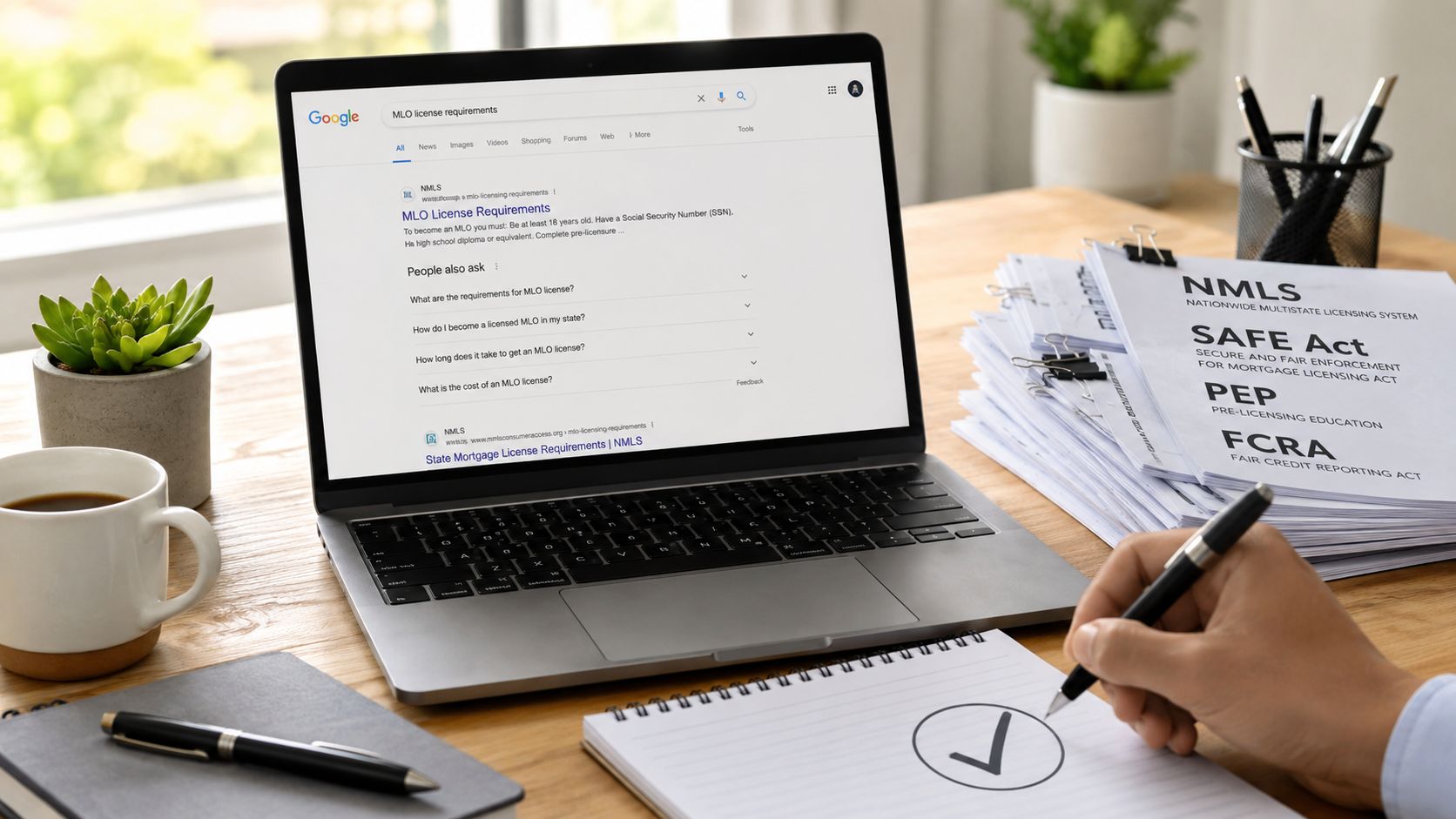
The SAFE Act established a nationwide framework for residential mortgage loan originators. It was enacted on July 30, 2008, and created licensing and registration procedures through the NMLS, as documented by the NMLS SAFE Act overview. Rather than treating licensing as a maze, think of it as a checklist with connected stages.
The five milestones
Complete NMLS-approved pre-licensing education. State-licensed MLOs need at least 20 hours of approved education before applying for a license. The NMLS education requirements identify the required subject areas.
Pass the SAFE MLO Test. State-licensed applicants must satisfy the applicable national and state testing components. Maryland's MLO licensing guidance confirms the examination requirement for applicants.
Complete fingerprint-based screening. The NMLS and applicable regulators use fingerprint information for the required criminal background review.
File through NMLS. The NMLS account connects education records, testing, fingerprints, disclosures, and the licensing application.
Secure the state license. The regulator reviews the application and determines whether the applicant meets state requirements.
Costs, processing times, sponsorship rules, and state forms can vary, so check your regulator's current instructions before submitting anything. The overall route is still predictable: learn the material, pass the test, complete screening, file accurately, and maintain the credential. The following sections unpack those milestones in the order a future MLO will usually encounter them.
What the SAFE Act Actually Does
Before the SAFE Act, mortgage originator requirements could differ substantially from one state to another. The law created a shared framework so regulators, employers, and consumers could identify mortgage professionals through a common system.
A useful analogy is a highway. Federal registration is the on-ramp, showing that an originator belongs to the federally covered registration system. State licensure is the jurisdiction-specific exit, giving a state-licensed MLO authority to conduct covered activity under that state's rules. Both paths use the NMLS, but the correct path depends primarily on the employer.
One system, two regulatory tracks
Employees of covered financial institutions, certain covered subsidiaries, and Farm Credit institutions use the federal registration pathway. Other MLOs generally need a state license plus NMLS registration, as explained in the CFPB SAFE Act examination procedures.
The distinction matters before anyone begins originating. An institution must map each employee to the correct track, maintain the individual's unique identifier, and keep required records current. A person who assumes federal registration applies to every employer can spend time preparing for the wrong compliance process.
The standardized foundation
The framework centers on three broad safeguards:
- Education, so applicants study federal law, ethics, consumer protection, and mortgage origination.
- Testing, so applicants demonstrate knowledge through the SAFE MLO Test.
- Background screening, so regulators can review fingerprint-based criminal history information.
The Conference of State Bank Supervisors supports the NMLS infrastructure used by regulators and industry participants. The Consumer Financial Protection Bureau provides federal oversight and examination guidance for the SAFE Act framework. Together, the system gives the mortgage industry a common identification and compliance structure while leaving states room to impose additional requirements.
The 20-Hour Pre-Licensing Education Breakdown
The required course isn't a generic introduction to mortgages. It's a foundation built around the legal, ethical, product, and origination knowledge an MLO needs before entering the field. The NMLS identifies 20 hours as the minimum pre-licensing education standard for state-licensed MLOs, while also allowing states to require more.
The curriculum includes 3 hours of federal law and regulations, 3 hours of ethics, 2 hours of nontraditional mortgage lending, and 12 hours of mortgage origination instruction, according to the NMLS SAFE Act education specification.
How the required hours fit together
| Hours | Topic | Why It Matters |
|---|---|---|
| 3 | Federal law and regulations | Builds familiarity with federal mortgage rules and regulatory responsibilities. |
| 3 | Ethics, fraud, consumer protection, and fair lending | Helps an MLO recognize conflicts, protect applicants, and avoid discriminatory practices. |
| 2 | Nontraditional mortgage lending | Provides context for products whose terms require careful explanation and disclosure. |
| 12 | Mortgage origination instruction | Develops the broader knowledge needed to understand the origination process and prepare for testing. |
The first federal-law block may address subjects such as RESPA, ECOA, the Truth in Lending Act, and the SAFE Act. The ethics block connects legal requirements with daily behavior, including how an MLO communicates with borrowers, handles sensitive information, and responds to potential fraud or unfair lending concerns.
Nontraditional lending deserves close attention because adjustable-rate, interest-only, balloon, and other products can create borrower confusion when terms aren't explained clearly. The larger origination block then connects these subjects to applications, disclosures, underwriting concepts, and professional responsibilities.
Choose training that supports completion
An online program can make the education milestone easier to organize, especially for career changers balancing work and family obligations. 24hourEDU offers an NMLS-approved online 20-hour SAFE course with instructor-led video lessons, an e-textbook, a state-law module, free exam preparation, support by phone and email, and complimentary NMLS hours reporting. Its NMLS Provider ID is 1405107.
You can review the 20-hour SAFE MLO course before enrolling. After completion, keep your documentation organized. A practical completion of course certificate guide can help explain why certificates matter and how learners should retain proof of completed training.
Providers report course completion through NMLS procedures, but students should still confirm that their education record appears correctly before moving to the testing stage. A missing or delayed record can create an avoidable administrative hold.
Passing the SAFE MLO Test and Clearing Background Checks
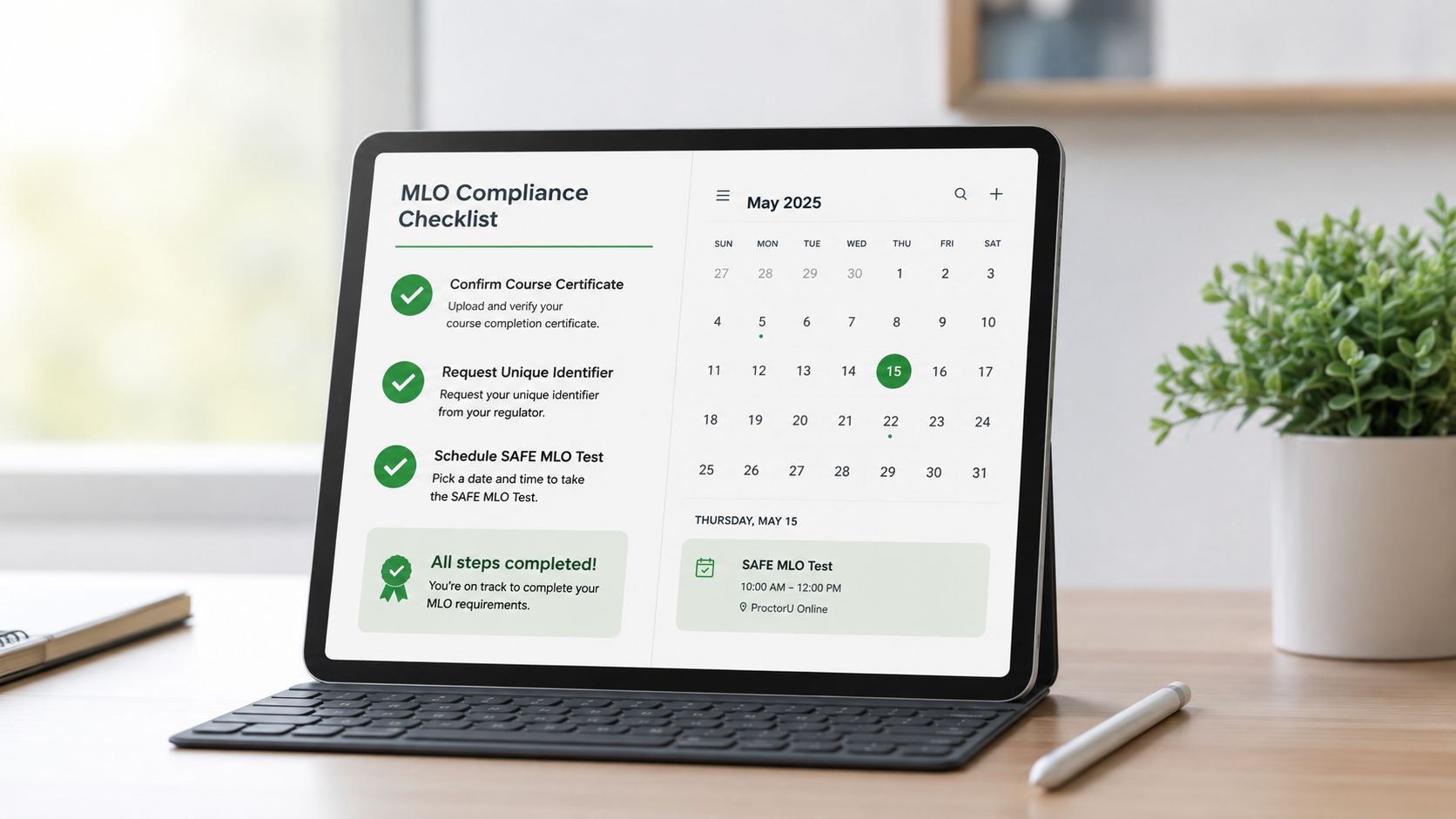
Course completion starts the next milestone, it does not automatically book the exam or finish the licensing file. Treat the process like a checklist. Confirm each item before scheduling so an administrative gap does not delay your application.
Follow the NMLS sequence
First, verify that your course completion record or certificate appears correctly in NMLS. Then request your Unique Identifier, arrange the required testing through NMLS, and schedule with Prometric once the system allows it. California's MLO licensing information explains that applicants schedule examinations through NMLS or Prometric after paying the applicable fees through NMLS.
The SAFE MLO Test contains 125 scored items and 25 pretest questions, allows 190 minutes, and requires a 75% passing score, according to the NMLS testing handbook. State-licensed applicants must pass the national component and any applicable state-specific component. The exam is one checkpoint in the file, while screening and regulator review form separate checkpoints.
Prepare for screening as well as testing
Fingerprinting supports the FBI criminal background check. Depending on the jurisdiction, the appointment may use live scan or another approved electronic method. NMLS may also collect disclosures about criminal history, regulatory actions, and financial circumstances when the application requires them. For a plain-language process overview, review our background check requirements guide.
Schedule fingerprinting early enough to allow time for regulator review. A correctly completed application can still wait if a required screening item has not posted.
Applicants who need help with screening terminology can consult this resource on a criminal background check for volunteers, while remembering that MLO screening follows NMLS and regulator procedures. Before test day, use the free NMLS test demonstration if available, review federal law and ethics, and bring the identification documents required by the testing center.
A failed first attempt is feedback, not a career verdict. Review the missed subject areas, follow the applicable waiting and retake rules, and return to targeted practice instead of rereading every topic without a plan. A focused schedule turns the exam into a manageable professional checkpoint.
Federal Registration Versus State Licensure
The most common SAFE Act mistake is treating federal registration and state licensure as interchangeable. They share the NMLS, but they serve different employment situations and authorize activity through different regulatory pathways.
Federal registration applies to MLOs employed by covered financial institutions, certain covered subsidiaries, and Farm Credit institutions. Everyone else generally needs state licensure plus NMLS registration, as outlined in the NCUA SAFE Act regulation guide.
Compare the pathways
| Layer | Governing Body | Purpose | Renewal Cycle | What It Authorizes |
|---|---|---|---|---|
| Federal registration | Applicable federal regulator and NMLS | Records MLOs employed by covered institutions | Maintained through NMLS procedures and employer compliance | Registration within the covered institutional pathway |
| State licensure | State regulator and NMLS | Licenses MLOs outside the federal registration category | State-specific renewal and maintenance requirements | Mortgage origination activity permitted under the state license |
The NMLS account is the shared administrative foundation. It carries the individual's identifier and connects education, testing, fingerprints, disclosures, sponsorship, and renewal information. An employer must still determine whether the worker belongs on the federal or state track before the person begins covered origination activity.
State rules aren't frozen. Federal guidance and state materials point to changes affecting major markets during 2025 and 2026, including North Carolina's SAFE Act modernization and Georgia's conformity changes, as noted in the state and federal SAFE Act guidance. California, Texas, Florida, New York, and Illinois may each present different filing, sponsorship, education, fingerprinting, renewal, or state-content requirements. Confirm details with the regulator where you'll work rather than relying on a national checklist alone.
Continuing Education and Annual Renewals
The original license is only the beginning of MLO compliance. State-licensed originators must complete 8 hours of annual continuing education, divided into 3 hours of federal law, 2 hours of ethics, 2 hours of nontraditional mortgage lending, and 1 hour of mortgage origination, according to the NMLS continuing education standard.
That breakdown keeps the professional connected to the same core subjects introduced during pre-licensing education. The annual course isn't just a formality. It refreshes legal knowledge, reinforces consumer protection, and gives MLOs a structured opportunity to address changes in products and origination practices.
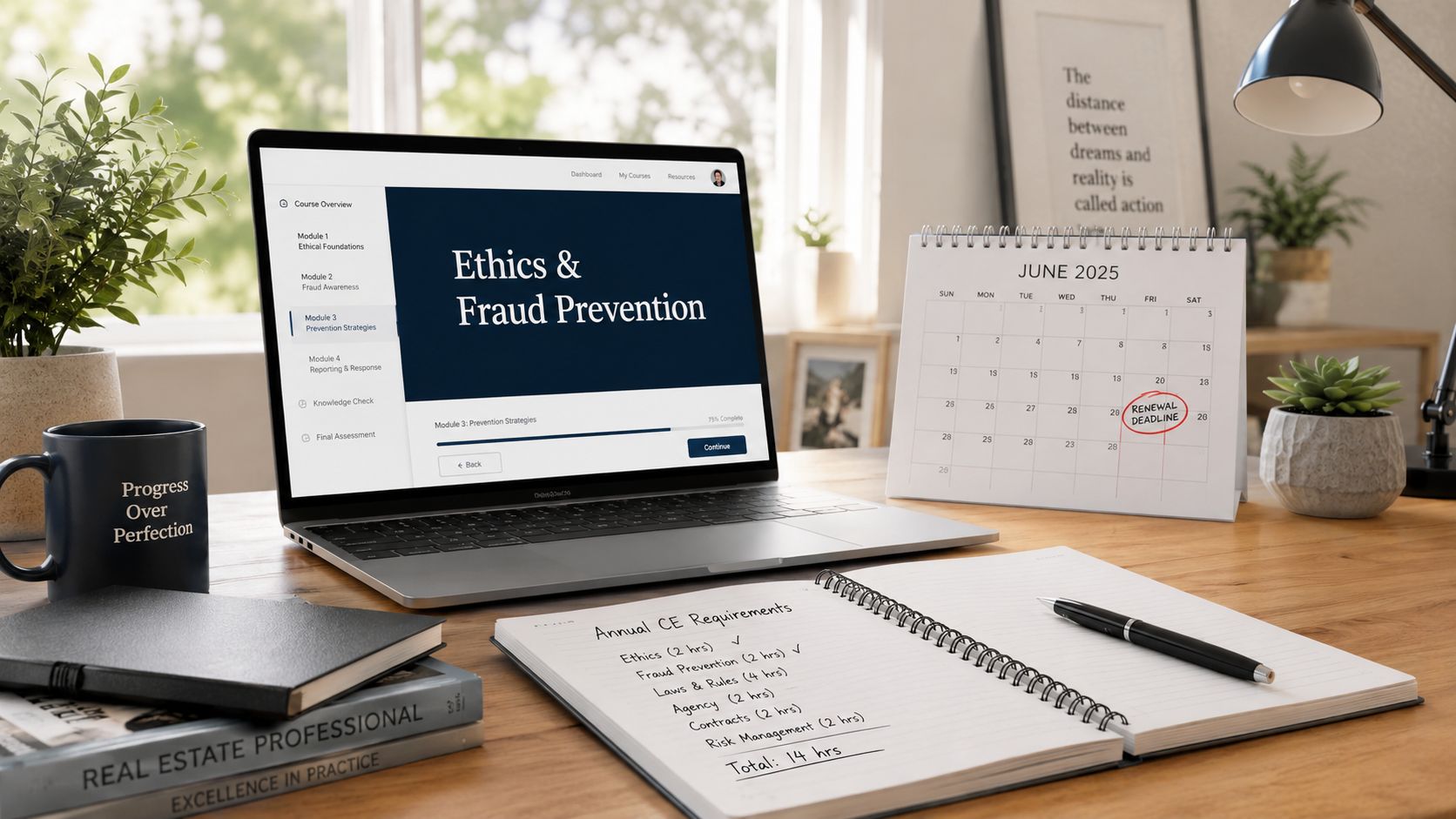
Make the renewal workflow routine
Choose an NMLS-approved provider and complete the assigned content before your state's renewal window closes. Providers generally report completion to NMLS, but you should verify the record in your account rather than assuming the update occurred.
A simple annual process helps:
- Review your record: Check education history, license status, sponsorship, and contact information.
- Complete required CE: Confirm that the selected course satisfies the applicable federal and state content.
- Check employer actions: Sponsorship and branch information may require employer participation.
- File renewal carefully: Follow the instructions in your NMLS account and respond to any regulator request.
- Monitor deadlines: Missing a renewal window can lead to additional administrative requirements or fees under applicable state rules.
The CE for NMLS course resource can help you evaluate an online continuing education option. State rules may differ, so use the NMLS record and regulator instructions as the controlling references. The NMLS identifies these education hours as minimum standards, and a state may require more.
Your Roadmap From Enrollment to Employed MLO
A future MLO can organize the process into four working phases. The exact calendar depends on your state, regulator workload, employer, appointment availability, and whether your documents are complete, but the sequence gives you a practical project plan.
Phase one, education
Begin with an NMLS-approved pre-licensing course. Complete the required curriculum, use the included exam preparation materials, and gather identity, employment, and address documentation at the same time. Parallel preparation keeps paperwork from becoming a bottleneck after the education record posts.
Phase two, testing and screening
After confirming course completion, request the Unique Identifier and arrange the SAFE MLO Test through the approved scheduling process. Complete fingerprinting and respond promptly if NMLS or the regulator requests explanations or additional documents.
Phase three, state filing
Submit the state application through NMLS and review every field before certification. Depending on the jurisdiction and employer arrangement, the file may involve sponsorship, a surety bond, state-specific education, disclosures, and other regulator requirements.
Phase four, onboarding
Once the license is approved and active, the employer can complete sponsorship and assign the MLO to the appropriate branch or operating structure. Training then shifts from licensing knowledge to practical workflow, including application intake, documentation, borrower communication, compliance controls, and pipeline management.
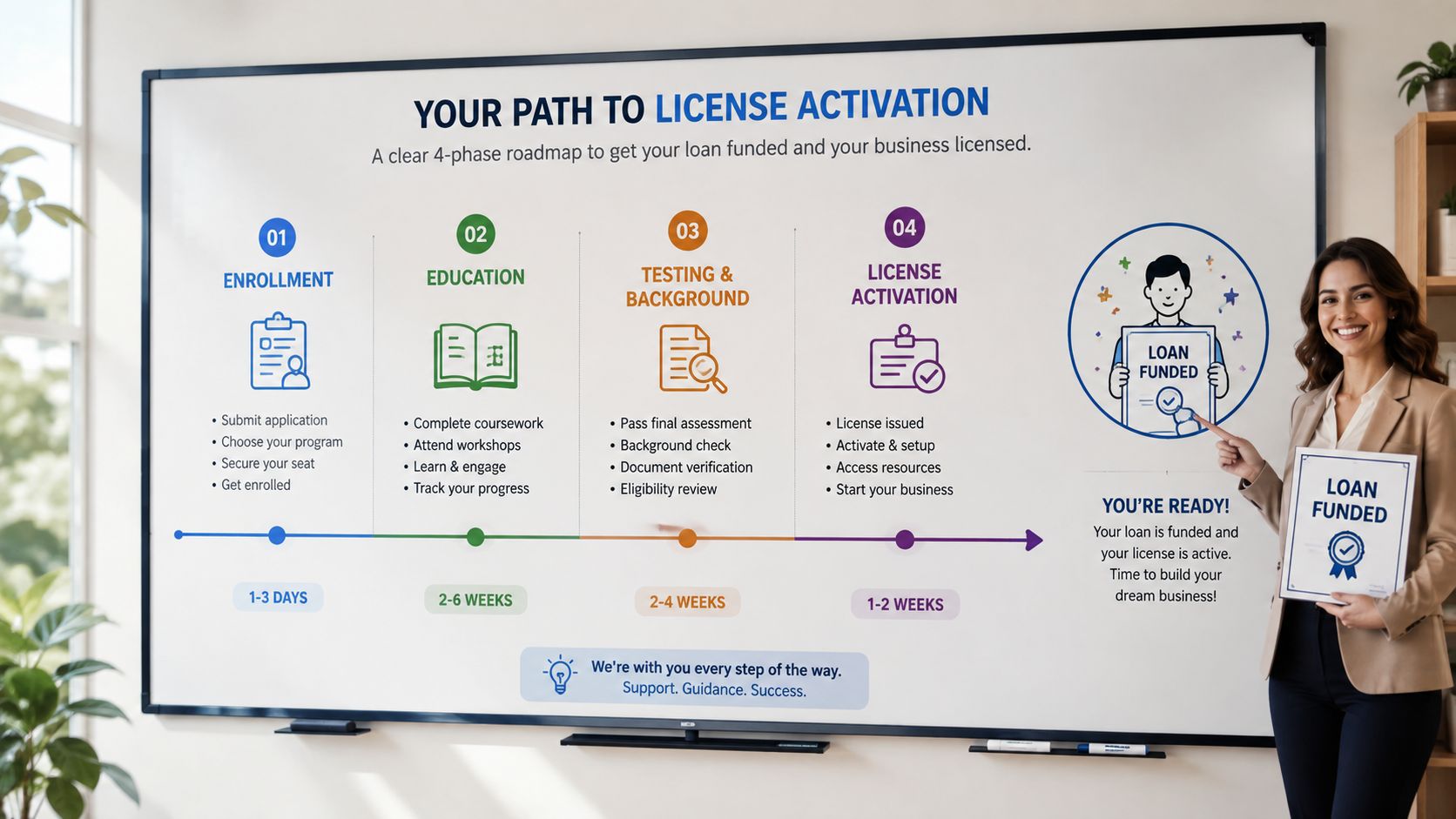
A useful planning habit: Keep one folder for education proof, testing records, fingerprint confirmation, disclosures, state documents, and employer information. Label each item as completed, submitted, or awaiting review.
Common delays include incomplete disclosures, a fingerprint appointment that isn't available when needed, state-specific review questions, and missing sponsorship information. You can reduce those risks by checking the regulator's instructions before filing and by answering NMLS messages quickly.
The process is structured and achievable. A focused online course, free exam preparation, and responsive support can help you move from unfamiliar acronyms to a clear licensing plan without leaving your current work routine behind.
24hourEDU offers an NMLS-approved online SAFE course covering the pre-licensing education requirement, with instructor-led video lessons, an e-textbook, a state-law module, free exam preparation, support, and complimentary NMLS hours reporting. Visit 24hourEDU to review the course options and begin building your MLO licensing plan.

