Select SAFE Act Training Made Simple Your MLO Path Starts Here
You may be looking at an MLO career from the edge of the starting line, wondering whether licensing will become a bureaucratic maze. It doesn't have to. With approved online education, organized study time, and focused exam preparation, you can turn the first major requirement into a clear two-week milestone and begin moving toward work as a Mortgage Loan Originator.
What SAFE Act Training Actually Is and Why It Matters
A new MLO can finish the first licensing milestone in about two focused weeks with approved online coursework. SAFE Act training supplies the education required before applying for a Mortgage Loan Originator license, while NMLS provides the national structure that connects state licensing systems. The Secure and Fair Enforcement for Mortgage Licensing Act became law on July 30, 2008, as Title V of Public Law 110-289. NMLS explains the SAFE Act's licensing framework.
The course functions like a work-ready foundation rather than a general finance class. It introduces federal law, ethics, consumer protection, fair lending, nontraditional mortgage products, and mortgage-origination fundamentals, the subjects an entry-level MLO must understand before assisting consumers with mortgage financing.
The first credentialing milestone
The federal baseline requires state-licensed MLOs to complete 20 hours of pre-licensure education and 8 hours of annual continuing education through NMLS-approved channels. SAFE training therefore begins the licensing process and continues as part of compliance after approval.
Complete the pre-licensing education before submitting a license application. An approved provider can be located anywhere in the United States, so career changers and candidates planning to work across states can start with online instruction that fits their schedule. NMLS answers questions about pre-licensure education.
After finishing the course, prepare for the national SAFE Mortgage Loan Originator Test. The minimum passing score is 75%, which makes active practice more useful than completing lessons. Read the NMLS testing guide's passing-score requirement.
To compare online formats and learning tools, review these NMLS education courses before enrolling.
Breaking Down the 20-Hour SAFE Course
Suppose you enroll on Monday and open the first lesson that evening. The course becomes easier to manage once you see how each subject supports the work of an MLO. Federal law forms the foundation, ethics strengthens the structure, nontraditional lending adds a specialized area, and mortgage-origination instruction fills the main space where daily responsibilities take place.
The NMLS framework assigns 3 hours to federal law and regulations, 3 hours to ethics, 2 hours to nontraditional mortgage lending, and 12 hours to mortgage-origination instruction. See the NMLS SAFE Act education topic map. That clear breakdown makes the milestone practical. With an online, NMLS-approved course, many students can organize the lessons around work and aim to finish within two weeks.
Why each block matters
Federal law covers the rules for communicating with consumers, documenting information, and processing transactions. The material gives you the legal context behind routine loan tasks, so you can recognize when a decision requires care or further review.
Ethics training includes fraud, consumer protection, and fair lending. These topics affect access to credit, the accuracy of information presented to applicants, and the integrity of the application process. They also give you a standard for handling pressure or conflicting instructions.
The nontraditional lending segment builds awareness of product risk. Different loan structures can bring different responsibilities and consumer considerations, so students learn to examine the product before explaining it.
The largest block, 12 hours, focuses on mortgage origination. It connects concepts to the workflow, including loan products, underwriting considerations, documentation, and closing procedures. Students gain the practical vocabulary of the job while completing the required legal and ethical coverage.
20-Hour SAFE Course Breakdown
Segment
Hours
Focus Area
Federal law and regulations
3
Federal requirements and regulatory responsibilities
Ethics
3
Fraud, consumer protection, and fair lending
Nontraditional mortgage lending
2
Product standards and risk awareness
Mortgage origination
12
Loan products, underwriting, processing, and closing fundamentals
Study each rule through a workplace decision. Ask what an MLO must recognize, explain, document, or escalate in an actual loan file. This method turns separate lessons into a usable mental model instead of a list to memorize.
For a course organized around the required framework, review the 20-hour SAFE MLO course and check whether its format and learning support fit your two-week study plan.
State Law Modules and the Local Layer of Licensing
The 20-hour federal course is consistent nationwide, but each state adds its own disclosure, licensing, consumer-protection, and supervision requirements. The federal lessons establish the shared foundation. The state module shows how those principles apply in the jurisdiction where you plan to work.
A state-specific module may cover local licensing procedures, required disclosures, consumer protections, supervisory expectations, and other rules for that jurisdiction. Education requirements differ by state, so confirm the module and hours connected to the license you are pursuing before enrolling. That check can keep a short licensing plan from turning into a last-minute correction.
What to verify before enrolling
Begin with the state where you intend to seek licensure. Confirm that the provider includes the appropriate state content alongside the federal course, and check how the module is delivered. An NMLS-approved provider should identify the jurisdictions covered and explain how completed education is reported.
Use this checklist:
Confirm the jurisdiction: Make sure the course matches the state where you will apply.
Review the module: Check that it includes local regulations and licensing procedures.
Ask about reporting: Find out how the provider reports completed education to NMLS.
Check timing: Complete every required education component before submitting the license application.
The state module is the local application of the federal foundation. It helps you recognize where a national mortgage rule connects with a state-specific obligation. Someone who studies only the federal material may understand broad requirements and still overlook a disclosure, procedure, or supervision rule required by the state.
Online education makes this part easier to fit into a focused two-week plan. Because the 20-hour requirement can be completed through an approved provider anywhere in the United States, online access can help applicants near a state border, preparing to relocate, or comparing licensing options. Choose the course package for the jurisdiction where you will apply, rather than assuming one state's content works everywhere.
How to Pick an NMLS-Approved Training Provider
Your provider affects more than the price of enrollment. It determines how easily you can access lessons, ask questions, review difficult topics, and document completion. Begin with approval, then compare the student experience.
Search the official NMLS Provider List and verify the provider's status before paying. Approval is essential because the education must count toward the SAFE Act requirements and applicable state education. After that check, examine what the course includes.
A practical comparison
Criterion
What to Look For
Red Flag
NMLS approval
Provider appears in the official NMLS records
Approval claim without a verifiable listing
Course access
Online lessons that work across common devices
Access limited to one inconvenient format
Instructor support
Clear access to knowledgeable support staff
No reliable way to ask questions
Exam preparation
Practice materials included with enrollment
Practice tests sold as unexpected add-ons
Completion records
Transparent certificate and NMLS reporting process
Unclear reporting or certificate timeline
State coverage
Federal course paired with the needed state module
Candidate must locate required content separately
Online training can remove scheduling friction for people balancing work, family, or a career change. Look for lessons you can pause and replay, readable course materials, and a support channel that responds when a regulatory concept doesn't make sense. A classroom-only option may work well for students who prefer fixed appointments, but it can create avoidable conflicts when attendance depends on one schedule.
24hourEDU offers an NMLS-approved online SAFE course, an e-textbook, a state law module, and a free exam prep package. The provider identifies its NMLS Provider ID as 1405107, and students should still verify current approval details through NMLS before enrollment.
Don't choose from the headline price alone. Compare the certificate process, state content, support, exam preparation, and reporting services together. A transparent package makes it easier to estimate the effort and avoid surprises during the licensing process.
Your Two-Week Path From Enrollment to Course Completion
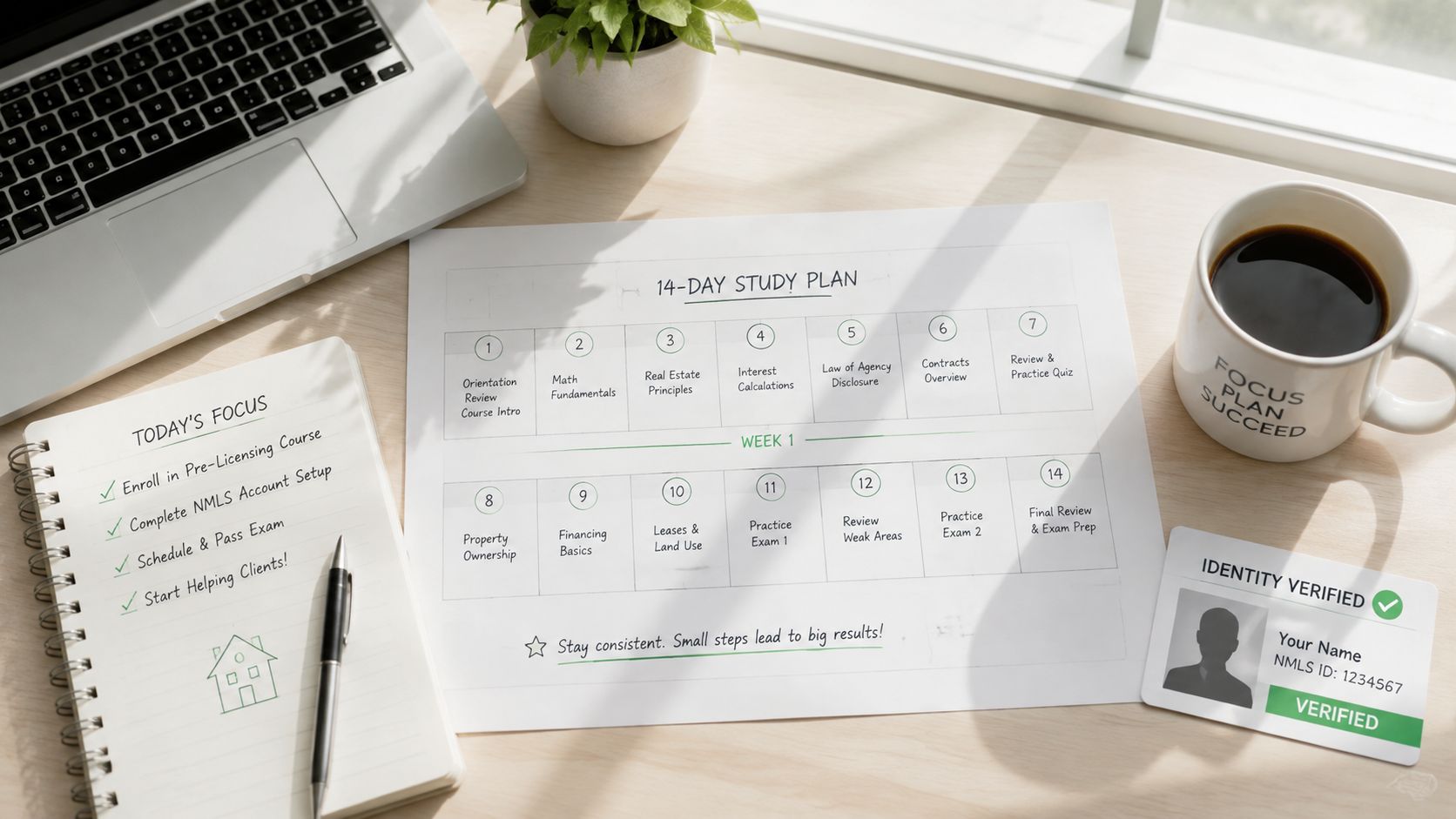
A focused two-week schedule can make the licensing process feel manageable. The point isn't to rush through material without understanding it. The point is to assign each task a place on the calendar so the work doesn't remain an indefinite project.
Days one through seven
Days one and two are for enrollment, identity verification, and NMLS account setup. Confirm that your name and identifying information match across your course account and NMLS profile. Small inconsistencies can create administrative delays later.
Days three through six focus on the federal curriculum. Study federal law, ethics, nontraditional mortgage lending, and the broader mortgage-origination material in manageable blocks. After each block, write down the rule, the consumer impact, and the type of question the NMLS exam might ask.
Day seven is for the state-specific module. Read local requirements carefully rather than treating the material as a quick add-on. State rules often make more sense when you connect them to actual application, disclosure, and supervision responsibilities.
Days eight through fourteen
On days eight and nine, revisit quiz questions you missed or guessed on, then complete the course final exam according to the provider's procedures. Don't only reread every page. Target the concepts that exposed uncertainty.
Days ten through twelve belong to exam preparation. Work through practice questions, review explanations, and create a short list of terms that still feel unfamiliar. The free exam prep package becomes useful here, because it gives you a rehearsal environment before the national test.
On days thirteen and fourteen, prepare for the NMLS national test and confirm the appointment details provided by the testing administrator. Leave room for practical issues such as travel, identification, and an unexpected need to review a difficult topic.
Practical rule: Put every study session on your calendar before you enroll. A visible appointment is easier to protect than a vague promise to study later.
The schedule can change when work or family responsibilities intervene. What matters is maintaining forward movement. Complete one defined task, record what remains, and keep the next action obvious.
Exam Prep Strategies That Help You Pass the SAFE Test
A practice question presents a borrower with an unusual loan situation. You must identify the applicable rule, separate similar concepts, and choose the response that protects compliance and the consumer. The SAFE test rewards that kind of judgment more than word-for-word memorization.
Begin with a diagnostic practice test before rereading every lesson. Its results show whether federal law, ethics, nontraditional lending, or origination fundamentals need the most work. Use the score as a study map, not as a verdict on your ability. A focused review can turn a confusing course into a manageable two-week milestone.
Convert terminology into decisions
Create a glossary for RESPA, TILA, HMDA, and higher-priced mortgage loan. Add a short scenario for each term, then write what an MLO should recognize or do. This converts vocabulary into decisions you can practice.
Use this review cycle:
Answer under time pressure: Work without checking the explanation immediately.
Review every miss: Decide whether the problem was vocabulary, a rule, or careless reading.
Explain the correct choice: Write one sentence showing why it fits better than the alternatives.
Return to the lesson: Review the specific topic rather than unrelated pages.
Test again later: Apply the rule to a different scenario and confirm that you still understand it.
An NMLS exam prep course can provide a rehearsal stage when it combines practice questions and explanations with required education. Online preparation removes much of the friction that once kept students stuck. Use the free exam prep package throughout your study period, instead of saving every practice test for the final evening.
Keep test day simple
Short daily reviews generally support recall better than one exhausting cram session. Before the appointment, organize your identification, travel plan, appointment information, and arrival time. Removing these administrative decisions leaves more attention for the questions.
Read each question twice. Eliminate choices that conflict with the rule, mark uncertain items for later, and return after completing the first pass. The passing standard is 75%, as noted earlier. Prepare for that standard by making reliable decisions across the subject areas, not by memorizing isolated definitions.
Turning Your MLO License Into a Real Career
Passing the SAFE test opens the door, but the license becomes useful when you connect it to an employer and a work environment. After testing, candidates generally work through sponsorship with an NMLS-licensed employer, background-check requirements, fingerprinting, and state application procedures. Review the specific requirements for your jurisdiction because the state controls parts of the application process.
Where the credential can lead
An MLO may pursue opportunities through:
Retail branches: Work directly with consumers through a lending institution.
Wholesale channels: Support transactions through relationships with brokers and lending partners.
Depository institutions: Build a career inside a bank or credit union environment.
Brokerages: Compare available products and guide borrowers through the application process.
Some employers structure compensation with a base component and commissions. Earnings depend on the employer, production, experience, market, and compensation agreement, so candidates should evaluate the complete offer rather than assuming a fixed income. The career can also support remote or hybrid work when the employer's systems, supervision, and state permissions allow it.
The education requirement is demanding because it establishes the knowledge base you'll use in the role. Completing it creates momentum. You've learned the vocabulary, practiced regulatory reasoning, and started building the discipline needed to communicate clearly with borrowers and business partners.
Licensing may also support broader geographic opportunity, but portability isn't automatic. Each state has its own application, sponsorship, and regulatory requirements, so confirm the process before assuming a license transfers without additional action.
Common Questions About SAFE Act Training Answered
Does the 20-hour course expire?
NMLS guidance says the pre-licensure education must be completed within three years of the license application. Check your application timing and keep completion records available so you can address questions without searching through old email.
Can I use the course again for continuing education?
You can't assume that repeating the same course will satisfy annual CE. NMLS says an MLO may not take the same approved course in the same or successive years for continuing education, and duplicate content can affect renewal eligibility. Review NMLS's successive-year course guidance.
The annual CE framework includes 8 hours, with federal law, ethics, nontraditional mortgage lending, and mortgage-origination content. Compare course titles and provider records before enrolling, especially if you've taken courses from more than one company.
Does online education have the same approval as classroom education?
An online course can carry NMLS approval when the provider and course are approved through NMLS. Verify the provider and course in the NMLS Resource Center instead of relying only on a website's marketing language.
Can I retake the final course exam?
Many providers explain their retake policy in the enrollment terms. Read that policy before beginning, and contact support if the rules aren't clear. The course final and the national SAFE test are separate assessments, so don't confuse a provider's retake process with NMLS testing rules.
Do I need mortgage experience?
Prior mortgage experience isn't required to begin the pre-licensing course. You'll still need to learn unfamiliar terminology, but a background in sales, customer service, administration, banking, or another regulated field can give you useful workplace habits.
Does the course count as college credit?
Mortgage licensing education typically doesn't count as college credit. It serves a professional licensing purpose, so confirm with the school or program administrator if academic credit matters to your career plan.
How do I handle records and related paperwork?
Keep your course certificate, application information, and professional records organized. If you're also preparing for tax or lending documentation questions, a practical resource on statement access for tax prep can help you understand why document-retention planning matters.
The fastest path is usually the simplest one: verify the provider, enroll in the correct federal and state education, follow a calendar, and begin exam preparation before the course feels finished.
24hourEDU offers NMLS-approved online SAFE Act education for aspiring Mortgage Loan Originators, including the required course framework, state law content, and a free exam prep package. Visit 24hourEDU to review the available training and start building your licensing plan today.
24hourEDU NMLS Mortgage Loan Officer Course – $189 All States