
You've decided to become a Mortgage Loan Originator, but the licensing path still feels unclear. You may be balancing a current job, family responsibilities, and a serious career change while trying to understand NMLS education, state requirements, and the SAFE exam. The right course turns that uncertainty into a sequence of manageable steps.
A SAFE mortgage course gives you the required foundation for MLO licensing, while structured exam preparation helps you apply what you've learned under testing conditions. With online education, instructor support, and state-specific planning, aspiring Mortgage Loan Officers and Mortgage Brokers can move forward with a practical roadmap instead of guessing at each requirement.
Introduction to the SAFE Mortgage Course
A career changer may finish an online lesson on federal rules, then face a state-specific requirement or an unfamiliar practice question. That experience shows why the SAFE mortgage course should be treated as a connected licensing plan, not a stack of course hours.
The SAFE Mortgage Licensing Act established a nationwide standard for MLO education and testing in 2008. Its core requirement is 20 hours of NMLS-approved pre-licensing education, while individual states may require additional instruction. The course builds a shared foundation for people entering from banking, customer service, sales, finance, or another career.
Your first decisions shape the most efficient route:
- Choose an NMLS-approved provider whose course structure matches your schedule and state.
- Complete the core education and required state modules, checking whether local content adds preparation beyond the national material.
- Prepare for and pass the National SAFE MLO Test, using practice questions to connect rules with borrower situations.
Online lessons can fit around work because you can study from home or another suitable location. Short lessons, review tools, and practice exams also reveal weak areas before test day.
Practical rule: Treat course completion and exam readiness as linked goals. Finishing the lessons supports the next licensing steps, while applied practice helps you recall and use the material under pressure.
Core Requirements and Curriculum Structure
The core SAFE curriculum works like a map for your first licensing stage. The national minimum is 20 hours of NMLS-approved education, organized around federal law, ethics, nontraditional mortgage lending, and additional instruction. Review the course structure before enrolling, especially if your state may add education.
SAFE course curriculum breakdown
| Module | Hours |
|---|---|
| Federal law and regulations | 3 |
| Ethics | 3 |
| Nontraditional mortgage lending | 2 |
| Undefined instruction | 12 |
| Total minimum | 20 |
Federal law introduces rules governing mortgage activity. Ethics examines professional conduct, consumer protection, and choices that may affect a borrower's financial interests. Nontraditional lending covers products and practices outside the most familiar conventional loan structure. The remaining instruction allows an approved provider to build broader mortgage knowledge.
These subjects connect during a real application. A borrower's question may involve a federal rule, an ethical duty, and a particular loan product at the same time. Studying each definition alone is like learning individual road signs without understanding the route. Exam preparation becomes stronger when you practice applying several concepts to one borrower situation.
Follow the curriculum in your study plan. Build vocabulary with the early modules, then connect rules to borrower scenarios and documentation decisions. A 20-hour SAFE MLO course can provide the required core education, but confirm whether your state requires additional instruction.
Course structure also affects exam preparation. Use each module's review questions to identify gaps, then revisit the underlying rule instead of memorizing an answer pattern. This approach links the NMLS education record to the knowledge tested later and can help you choose a provider whose lessons, practice work, and state coverage fit your licensing plan.
Complete pre-licensing education before submitting a license application. If you finish the education but do not obtain a valid state license or federal registration within three years, you must retake the 20 hours to remain eligible for state MLO licensure, according to NMLS education guidance.
State Law Modules and Credit Hours
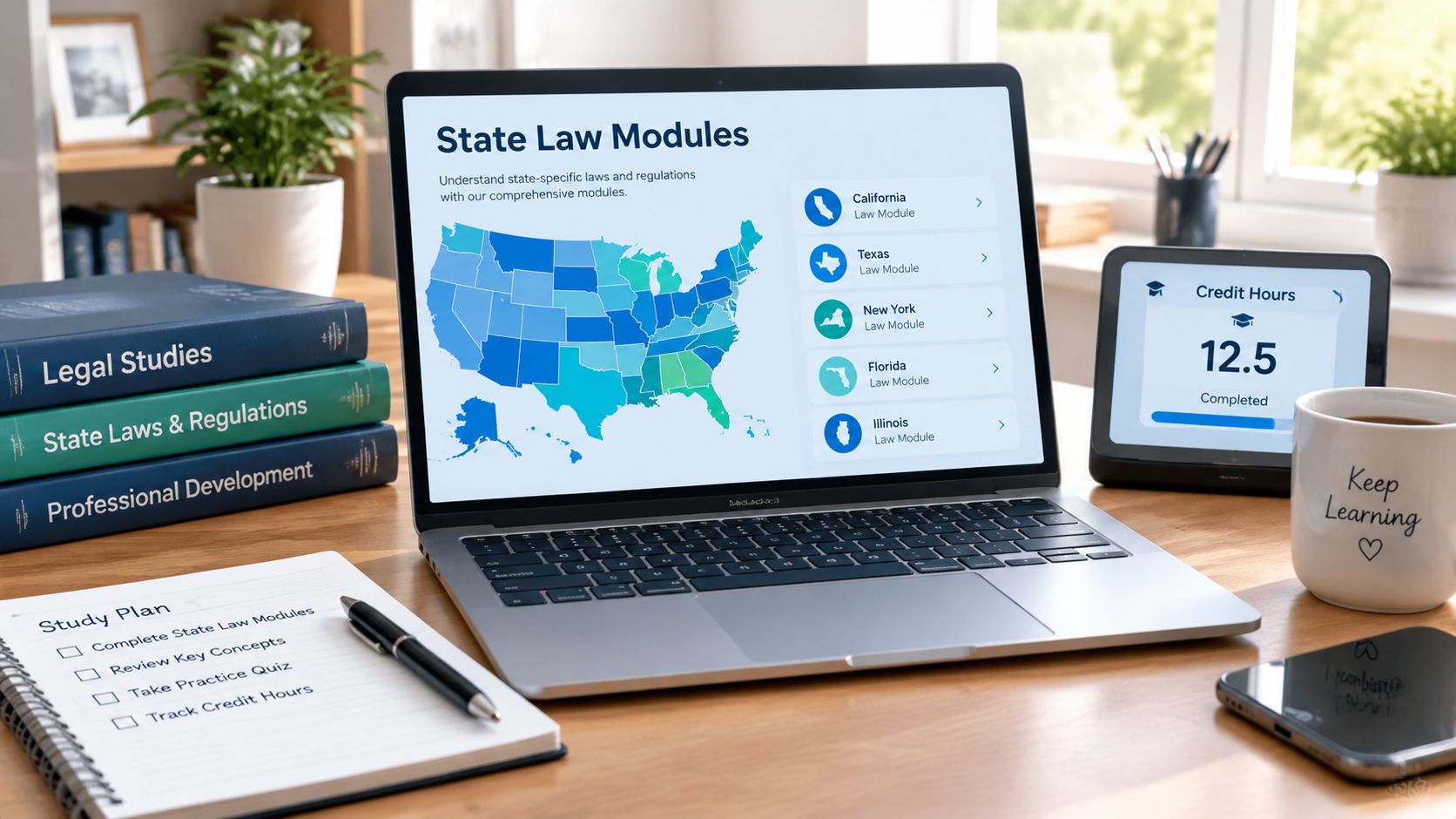
The national course gives you the common foundation, but your intended state of practice may add a local layer. State modules can address licensing procedures, state lending rules, disclosures, prohibited practices, and requirements that differ from federal standards.
Start by identifying the state where you expect to seek sponsorship and licensure. Then check that state's NMLS instructions and determine whether a state-specific course is required. Don't assume that completing the core course automatically covers every local obligation.
Build your state plan
State-specific education is often presented as an add-on to the core requirement. For example, a state may require a short module focused on its mortgage laws, licensing process, or local consumer protections. The exact requirement varies, so use your state's official licensing information rather than relying on a general course description.
A useful planning method is to create a simple checklist:
- Confirm the state: Identify where you'll apply for an MLO license.
- Check the module: Verify whether a state-specific course is required.
- Compare course records: Make sure the provider reports the correct education to NMLS.
- Plan for expansion: If you may seek authorization in another state, review that state's additional education before enrolling.
NMLS policy also affects delivery. Online instructor-led education is reserved for pre-licensure education, while pre-licensure state-specific courses of 10 hours or less must be offered in online self-study format, as described in the NMLS education delivery specifications.
The practical advantage is that state add-ons can be planned separately from the core course. You won't necessarily need to repeat the national education when preparing for another state, but you must verify the applicable state rules and course approval before proceeding.
Online Delivery Options and Exam Prep Benefits
Online education works well for aspiring MLOs who need to study around work and personal responsibilities. The important distinction isn't only whether lessons appear on a screen. It's whether the course combines compliant delivery, clear explanations, instructor access, and practice that resembles the National SAFE Test.
A course may include instructor-led video lessons, an electronic textbook, knowledge checks, and support by phone or email. Those tools serve different purposes. Video can introduce a difficult rule, text can support careful review, and an instructor can clarify why one answer fits a scenario better than another.
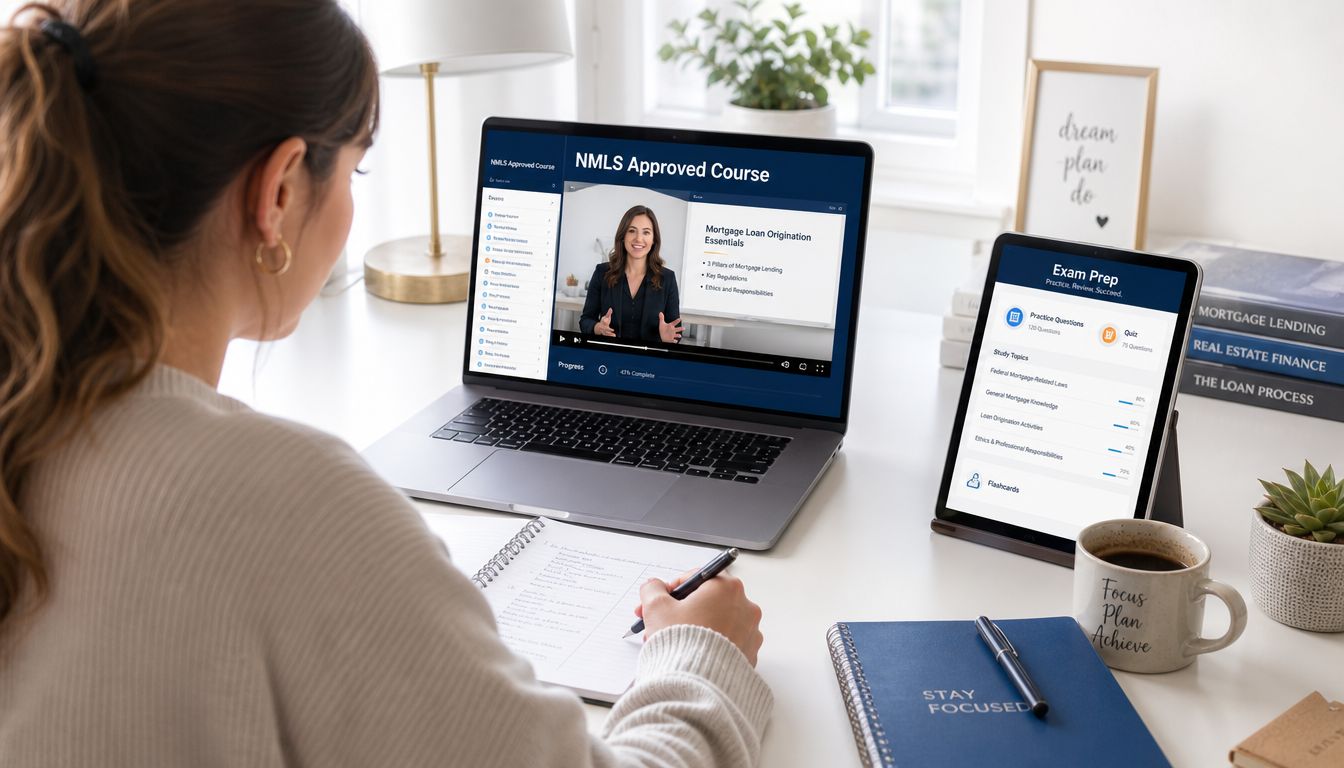
Match the format to the task
| Learning tool | Best use |
|---|---|
| Instructor-led video | Learn a new concept with guided explanation |
| E-textbook | Review terminology, rules, and examples |
| Practice questions | Test recall and identify weak areas |
| Scenario drills | Apply ethics and compliance principles |
| Instructor support | Resolve confusion before it becomes a repeated mistake |
The National SAFE MLO Test contains 120 multiple-choice items, with 115 scored, and candidates receive 190 minutes to complete it. Passing requires at least 75% correct answers, and the listed national test fee is $110, according to the official SAFE MLO Test introduction.
That format changes how you should study. Reading a definition may help you recognize a term, but a scenario question asks you to interpret facts, identify the controlling rule, and choose the most appropriate response within a limited testing period.
A provider that includes exam preparation at no additional charge can reduce the need to assemble separate materials. For example, 24hourEDU offers an online NMLS-approved course with instructor-led lessons, an e-textbook, free exam preparation, and support, under Provider ID 1405107. You can compare those features with the NMLS exam prep course before choosing a provider.
Typical Completion Timelines and Study Strategies
The required education can fit into a focused plan, but your course schedule and exam preparation schedule don't have to be identical. One learner may prefer an intensive two-week plan, while another may need a steadier month-long routine around work and family.
A focused two-week plan
During the first week, complete the early curriculum modules and create a working glossary. Don't just copy definitions. Write a short explanation of each concept in your own words, then connect it to a borrower or compliance situation.
Use the second week to finish the remaining lessons and increase practice. Set aside regular review sessions for federal law, ethics, and calculation-based applications. Complete timed question sets so you learn to make decisions without relying on notes.
A paced four-week plan
A four-week schedule gives you more room to revisit difficult topics. Assign course work across the week, reserve one session for reviewing errors, and use the final phase for mixed practice rather than watching lessons again from the beginning.
Independent exam-prep analysis indicates that first-time test takers often struggle with scenario-based ethics and application questions, not only simple definitions. The NMLS testing handbook materials support the need for targeted practice drills.
The real challenge is knowledge transfer. You must recognize the principle, apply it to the facts, and select an answer while the clock is running.
Use this study loop after every practice set:
- Review correct answers: Confirm that you understand why the answer works.
- Analyze incorrect answers: Identify whether the problem was vocabulary, math, ethics, or application.
- Rewrite the rule: Summarize the governing idea without copying the answer explanation.
- Repeat the scenario: Try a similar question later, without looking at notes.
For a broader planning guide, review how long it takes to get an MLO license. The goal isn't to rush through lessons. It's to finish the education, retain the material, and build confidence with applied questions.
How to Choose an NMLS Approved Provider
Provider selection deserves more attention than price alone. A course that lacks the correct approval, state coverage, or usable support can create avoidable delays. Start by verifying that the provider is approved through NMLS and that the course matches your licensing plan.
Questions to ask before enrolling
- Is the provider approved: Confirm the provider's NMLS status and record the Provider ID.
- Does the course fit your state: Check whether state-specific modules are included or available separately.
- What does exam preparation include: Look for practice questions, explanations, timed drills, and a study guide.
- How does support work: Ask whether learners can contact knowledgeable staff by phone or email.
- How are hours reported: Confirm how completed education is submitted to NMLS and whether you'll receive completion documentation.
- What's included in the price: Review the course package for separate charges, required materials, and state add-ons.
The provider's delivery model should also match your learning habits. Instructor-led online lessons can provide structure and explanation, while an electronic textbook supports review. Exam questions and scenario drills help you test whether you can use the material rather than merely recognize it.
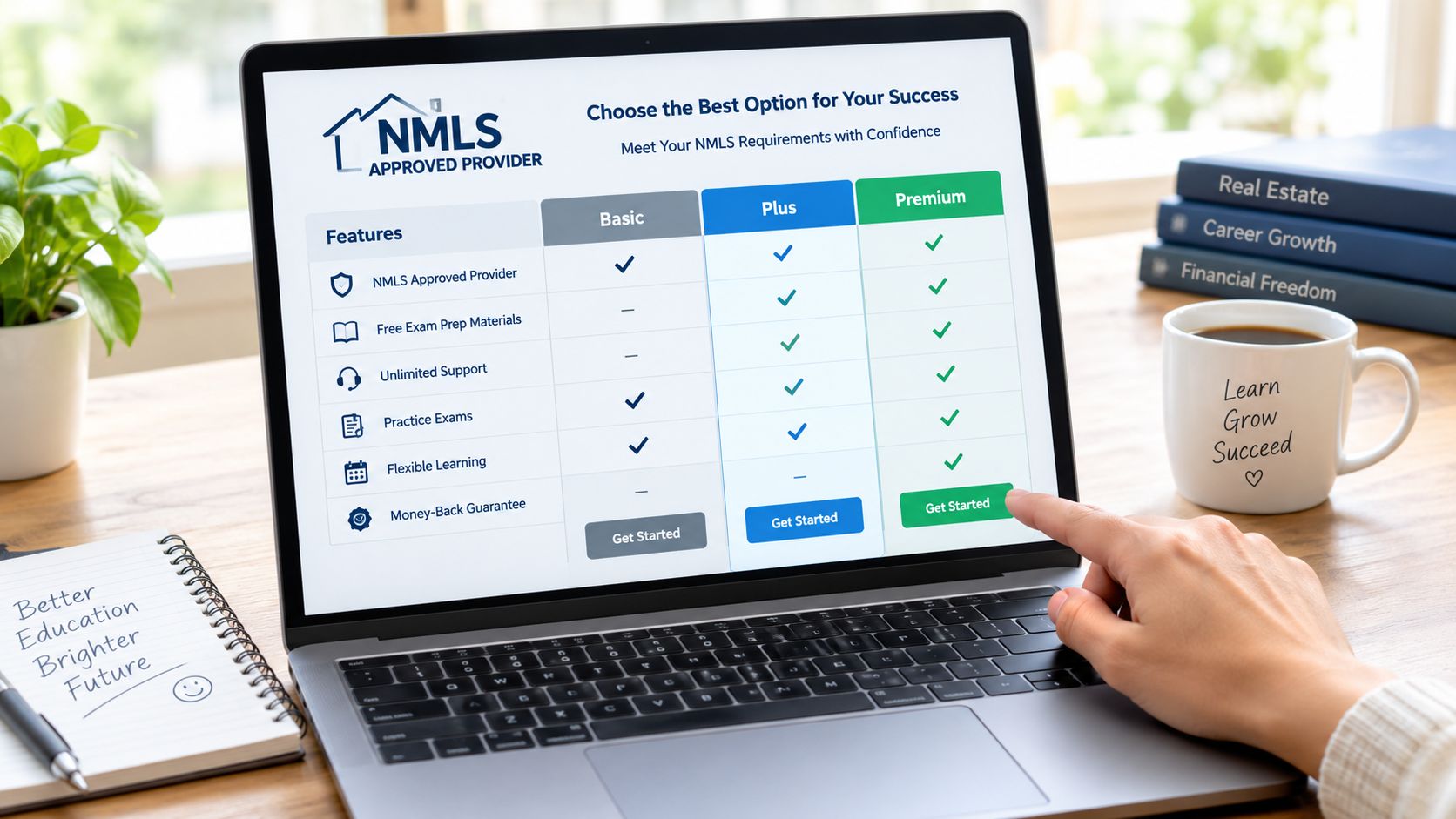
Why integrated preparation matters
A separate exam product may require you to move between different explanations, terminology, and study systems. An integrated package keeps the course content and practice work connected, which can make it easier to trace a missed question back to the relevant lesson.
Look for current content, clear completion policies, accessible support, and transparent coverage of state requirements. Avoid choosing a provider solely because it promises speed. A quick course is useful only when it leaves you ready for the licensing steps that follow.
Conclusion and Next Steps
A SAFE mortgage course is the starting point for an MLO license, not the entire professional journey. You'll need the 20-hour NMLS-approved core education, any applicable state-specific instruction, successful completion of the licensing process, and preparation for the National SAFE MLO Test.
Begin by selecting an approved provider and confirming your state requirements. Study the core subjects in an organized sequence, use scenario questions to practice application, and review mistakes until you can explain the underlying rule clearly. When you're ready for testing, follow your state's instructions for registration and testing, including any direction involving Prometric. California's licensing guidance identifies Prometric as the exam administrator and requires a score of 75 percent or higher, as stated in California's SAFE MLO Test guidance.
Online education can make the process easier to manage, especially for career changers and professionals pursuing work-from-home opportunities in mortgage lending. After licensing, continue building communication, organization, compliance, and referral skills through mentorship and daily practice.
24hourEDU offers an NMLS-approved online SAFE course, free exam preparation, an e-textbook, instructor-led lessons, state-specific resources, and phone and email support for aspiring Mortgage Loan Originators. Visit 24hourEDU to review the course options and start building your licensing plan.