

VOM stands for Verification of Mortgage, a document a current or former mortgage servicer prepares to confirm an existing loan's terms, balance, status and payment history for underwriting.
If a borrower already has mortgage statements and a credit report, why would a lender need another document? The difference is where the information comes from and what it verifies. For an aspiring mortgage loan originator, understanding that distinction helps turn a paperwork request into a useful check on the accuracy of a loan application.
What a VOM Means and What It Records
A Verification of Mortgage is a formal, servicer-prepared record of an existing mortgage obligation. As LegalClarity's guide to mortgage verification explains, it gives the lender independent confirmation of loan details and payment performance when the credit report doesn't provide enough information.
It's similar to getting confirmation directly from the company that maintains the account, rather than relying on a receipt someone keeps at home. The borrower's records can be helpful, but the VOM represents information from the servicer's own records. The servicer is the company that manages the mortgage account, including collecting payments.

Fields a Typical VOM Records and Why Underwriters Check Them
| Field | What it shows | Why the underwriter checks it |
|---|---|---|
| Original loan amount | Amount borrowed when the loan started | Confirms the loan size matches the application |
| Loan-closing date | Date the loan was originated | Establishes how long the obligation has existed |
| Unpaid principal balance | Principal still owed on the loan | Reconciles the outstanding liability reported in the application |
| Interest rate | Current contractual rate | Confirms the payment is calculated on the right terms |
| Monthly payment | Scheduled payment amount | Verifies the housing expense used in qualifying |
| Escrow amounts | Taxes and insurance collected with the payment | Shows whether the payment includes escrow |
| Loan type | Such as fixed-rate or adjustable-rate | Identifies the product and its payment rules |
| Next payment due date | Date of the next scheduled payment | Helps establish the account's payment schedule |
| Account status | Current, delinquent or not in good standing | Signals repayment behavior before underwriting |
Notice the distinction between balance and payment. The balance describes the outstanding debt, while the required monthly payment helps the underwriter evaluate the borrower's ongoing housing expense. Don't substitute the balance for the payment in a debt-to-income calculation.
Read the field labels rather than expecting every servicer's document to look identical. Then match the account identification, balance, payment and other applicable fields against the loan application. A completed form isn't the finish line, a consistent file is.
When Lenders Ask for a Verification of Mortgage
The most common reason for requesting a VOM is a gap in the mortgage information available to underwriting. A credit report might omit a mortgage account, show incomplete payment history or contain information that doesn't match the borrower's application.
Delta Community Credit Union's mortgage-verification guidance describes the VOM as a way to validate existing mortgage obligations. For the loan officer, the practical task is to obtain authorization, identify the account and reconcile the verification with the rest of the file.
Situations That Trigger a VOM Request
| Situation | Why the lender asks |
|---|---|
| New purchase while still owning a home | Confirms the existing mortgage payment and balance |
| Refinance of an existing mortgage | Verifies current terms and payment record before replacing the loan |
| Thin or incomplete credit file | Credit report does not show enough mortgage history |
| Recent servicing transfer | Ensures the new servicer's records match the application |
| Late payment on the credit report | Confirms the late entry and identifies whether further explanation is needed |
The supporting documents should address the specific gap. For a purchase or refinance, have the servicer name, loan number and recent statement ready. For a servicing transfer, gather transfer notices and statements from the affected servicers; for a disputed late entry, retain payment confirmations and relevant correspondence.
The lender decides whether a VOM is necessary under its guidelines. Understanding the mortgage underwriting process helps explain why the underwriter compares documents rather than accepting any single record as conclusive.
For broader context, Superior Credit Repair's explanation of credit factors mortgage lenders consider can help applicants understand how mortgage-payment behavior fits into a credit review.
Practical rule: If the credit report can't close a mortgage-information gap, ask early whether the lender will require servicer verification.
A VOM may confirm a late payment without explaining its cause. The borrower's explanation and supporting records serve a different purpose, so don't assume the verification will answer every underwriting question.
Payment History a VOM Reports and What Late Marks Mean
A VOM can show month-by-month payment performance, not merely whether the account is current today. Lakeview's VOM guidance describes a typical 12-month history, with some lenders requesting up to 24 months, and delinquency categories of 30, 60 or 90 days.
That distinction matters because a borrower can be current now and still have late payments within the reporting window. The underwriter needs to evaluate the timing and seriousness of those entries, not just the current account status.
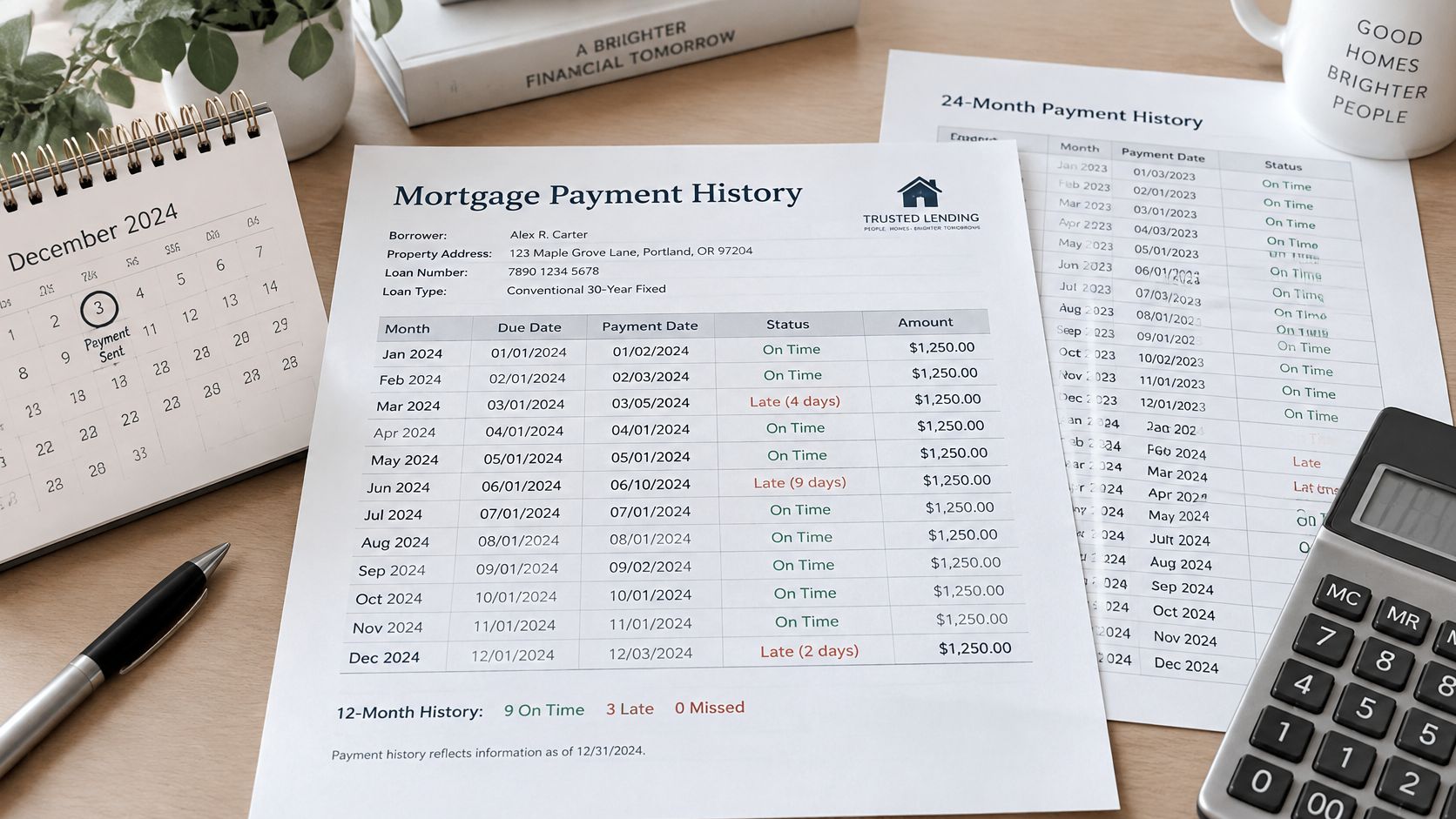
Payment Status Categories on a VOM
The delinquency categories described by DocHub's mortgage-verification form guidance distinguish 30-, 60- and 90-or-more-day late payments. The responses below are review considerations, not automatic approval or denial rules.
| Payment status | What it signals | Typical underwriting response |
|---|---|---|
| Current, no late payments | Consistent repayment across the reporting window | Usually no added review of payment behavior |
| Earliest late-payment category | A delinquency that may be isolated | May require a written explanation under lender guidelines |
| Intermediate late-payment category | More serious lateness, not necessarily repeated lateness | Closer review and possible additional documentation |
| Most severe listed delinquency category | Serious delinquency, whether isolated or repeated | May materially affect eligibility under lender guidelines |
| Forbearance, deferral or modification | Workout arrangement that may not appear as ordinary payments | Obtain arrangement documents and check whether the VOM reflects them |
Don't infer frequency from severity. A more seriously overdue installment doesn't, by itself, prove that several separate payments were late. Read the individual entries.
Workout arrangements also need separate attention. A VOM may omit details about forbearance, deferrals, repayment plans or modifications, so a clean-looking payment grid isn't a substitute for reviewing those agreements.
Before relying on the history, check:
- Reporting period: Identify the beginning and ending dates.
- Missing entries: Investigate blank months rather than treating them as on-time payments.
- Current-month treatment: Confirm whether the current month is included.
- Credit-report agreement: Compare delinquency entries and investigate discrepancies.
Repeated or severe delinquencies can affect eligibility. An isolated, documented issue may instead lead to an additional underwriting condition, subject to the applicable loan program and lender requirements.
How a VOM Differs From Other Mortgage Documents
A credit report is like a city map showing borrowing accounts across the borrower's financial life. A VOM is more like a detailed floor plan for a particular mortgage. Neither replaces the other, because they answer different questions.
The easiest way to avoid confusion is to identify who issued the document, what question it answers and what period it covers. A document can be accurate and still be the wrong evidence for the question an underwriter needs resolved.
VOM Compared With Other Mortgage Documents
| Document | Issued by | Core purpose | Shows payment history |
|---|---|---|---|
| Verification of Mortgage | Current or former mortgage servicer | Confirm loan terms, balance and payment performance | Yes, for the stated reporting window |
| Credit report | Credit bureaus | Show borrowing activity across reported accounts | Yes, based on what creditors have reported |
| Mortgage statement | Current servicer | Show the amount due and due date for the billing cycle | Primarily current-cycle billing information, sometimes with additional account activity |
| Payoff statement | Current servicer | Show the exact amount needed to satisfy the loan on a set date | No, payment history isn't its purpose |
A principal balance is not a payoff amount. A payoff statement calculates what's needed to satisfy the loan as of a specified date. A VOM verifies account information and repayment behavior, so don't use its balance field as the amount needed to close out the mortgage.
A monthly statement is useful for checking the scheduled payment, escrow and current billing details. It doesn't necessarily provide the structured historical record the lender needs. Likewise, credit-report information reflects what creditors have reported, and recent servicing activity can require additional reconciliation.
Other verification documents address entirely different parts of the application. A Verification of Deposit, for example, concerns deposit-account information rather than mortgage repayment.
Ask what the document proves before deciding whether it satisfies an underwriting condition.
Together, these records let the underwriter compare the servicer's account information, the borrower's reported liabilities and evidence of actual payments. When figures disagree, check the effective dates and payment components before concluding that a record is wrong.
How Applicants Can Prepare Before the Request
Applicants don't need to complete the servicer's verification themselves. Their job is to help the lender identify the correct account, obtain authorization and understand any discrepancies.
Use a secure lender-approved upload method for statements and account records. A mortgage documentation checklist can help keep the VOM-related materials organized alongside the other application documents.
Prepare the Account Records
Find the servicer name and loan number. Use a recent mortgage statement so the request reaches the company currently handling the account. Don't assume the company that originally made the loan is still the servicer.
Check for a servicing transfer. Save the transfer notice and identify which company handled the period under review. Asking only the current servicer may leave a historical gap that requires records from the former servicer.
Gather statements for the lender's requested period. Keep them in date order with payment confirmations and correspondence. Don't send only the latest statement if the question concerns an older payment.
Sign the borrower authorization. Follow the lender's instructions so the servicer can release the requested information. An unsigned or incomplete authorization can leave an otherwise straightforward request unfinished.
Compare the mortgage tradeline with your records. Check the account identification, balance, payment amount and reported status. Note the dates of each record, because a balance difference may reflect a payment made between reporting dates.
Prepare a factual explanation for a late payment. State when it happened, what caused it and how it was resolved, attaching supporting records where available. Don't describe an entry as a servicing error unless the evidence supports that explanation.
Reconcile the application details. Confirm the payment amount, escrow treatment and loan type against current records. Include relevant modification or forbearance documents rather than assuming the verification will contain the entire agreement.
Before submitting: Check for an overlooked servicing transfer, an outdated balance and an undisclosed payment arrangement.
Preparation doesn't mean changing records to make them agree. It means helping the lender understand what each record shows and supplying evidence when the differences need explanation.
Misconceptions and a Worked Example
A VOM isn't a universal fixed form. UWM's mortgage-verification guidance illustrates why the reporting period and current-month treatment need attention; format and coverage can differ across servicers and lender workflows.
It also isn't proof of income or proof that the borrower can afford the proposed loan. And a clean VOM doesn't replace the rest of underwriting, including the review of income, assets and other obligations.
An Illustrative Servicing-Transfer File
Suppose a borrower's mortgage moved to a new servicer six months earlier, and the credit report shows a single 30-day late payment around the transfer. These are hypothetical details, not a rule about how servicing transfers affect payment reporting.
The lender requests a VOM. The loan officer checks the reporting dates and current-month treatment, then matches the balance, required payment and escrow against the application. Rather than assuming the transfer caused the late entry, the officer asks the servicer to confirm the account record.
The borrower supplies a dated explanation and payment confirmation. In this example, the servicer provides clarification supporting a correction, and the loan officer documents the resolution before submitting the updated file for underwriting review.
The lesson isn't that an explanation letter erases a late payment. The value comes from reading the VOM alongside the other evidence, identifying the discrepancy and documenting a supported resolution.
Build VOM Knowledge Into Your MLO Career
Reviewing documents like a VOM develops the combination of borrower communication and financial analysis used in mortgage origination. The Consumer Financial Protection Bureau's MLO definition identifies taking residential mortgage applications and offering or negotiating loan terms for compensation or gain as core origination activities.
The career offers meaningful earning potential: the U.S. Bureau of Labor Statistics reports a median annual wage of $76,690 for loan officers in May 2025. That's an occupation-wide benchmark, not guaranteed starting income for a new MLO.
A Manageable Licensing Path
- Complete approved education. Take NMLS-approved pre-licensing education and check your state's additional requirements.
- Prepare for the exam. The NMLS SAFE test guide sets the passing score at at least 75%.
- Apply for your state license. Complete the applicable application, background-review and other state requirements.
Licensing becomes easier to manage when you separate education, exam preparation and application tasks. Start by checking your state's education requirements, then review a sample VOM and practice identifying its reporting period, payment components and account status before working with a real borrower's file.
24hourEDU offers an NMLS-approved 20-hour SAFE course online, with instructor-led video lessons and an exam prep package included at no extra cost, under NMLS Provider ID 1405107. Build the foundation for understanding underwriting documents like the VOM while preparing for your licensing exam. Visit 24hourEDU to explore the course and check the education requirements for your state.