
You’re in a Topeka bank or lending office, and a job posting has caught your attention. The title says banking compliance officer, but the description is vague. You know it involves regulations, audits, and policies, yet you’re not sure what fills the workday, which Kansas regulators matter, or whether a mid-sized market can support a durable career.
Working as a banking compliance officer in Topeka, Kansas means operating where state oversight, federal banking rules, financial-crime controls, consumer protection, information security, and mortgage activity meet. The local market is compact, so employers often value people who can handle several connected responsibilities instead of owning only one narrow task. The career can also connect naturally with KS MLO – Mortgage Loan Originator, mortgage broker, audit, lending, and BSA/AML experience.
A Day in the Life of a Topeka Banking Compliance Officer
At 7:45 in the morning, a compliance officer at a Topeka community bank may start with the BSA alert queue. The first task isn’t clearing alerts. It’s deciding which activity requires investigation, which item needs more information from a branch, and which matter belongs in the bank’s suspicious activity reporting process. A teller’s cash-deposit pattern, an unusual wire, or activity inconsistent with a customer’s profile can each open a different review path.
The morning may then shift to a vendor risk review for a proposed core processor contract. The officer checks whether the vendor’s services affect customer information, transaction processing, business continuity, access controls, or regulatory evidence. A compliance review doesn’t replace legal or information-security review, but it ensures the contract and oversight process answer practical questions about accountability, monitoring, incident response, and documentation.

The committee meeting changes the pace
At 10:30, the compliance committee may want a concise explanation of the latest exception aging report. The officer needs to show which findings remain open, who owns each corrective action, why a deadline moved, and whether the delay creates a larger control concern. Committee members usually need a decision-ready summary, not a recital of regulatory language.
The afternoon can be less visible but more consequential. A follow-up from a safety-and-soundness examination may require a written response to the Kansas Office of the State Bank Commissioner. The officer gathers supporting evidence, confirms that management’s response matches the actual remediation, and creates a record an examiner can follow later. A practical overview of the broader federal banking framework can also help candidates understand why regulatory obligations affect institutional governance, and the Kons Law Dodd Frank guide provides useful background for that context.
Topeka employers may include community banks near Washburn, credit unions headquartered around Huntoon, and regional mortgage lenders. The work doesn’t resemble a large-city compliance floor with separate specialists for every rule. Documentation, including testing files, committee materials, issue logs, and examination responses, can occupy a substantial part of the day. Job postings rarely show that administrative weight, but strong writing and organized evidence management often separate a dependable officer from someone who only knows the rules in theory.
What a Banking Compliance Officer Actually Does
A banking compliance officer turns regulatory obligations into repeatable controls. That means starting with an inventory of the institution’s products and channels, then asking how each one creates compliance risk.
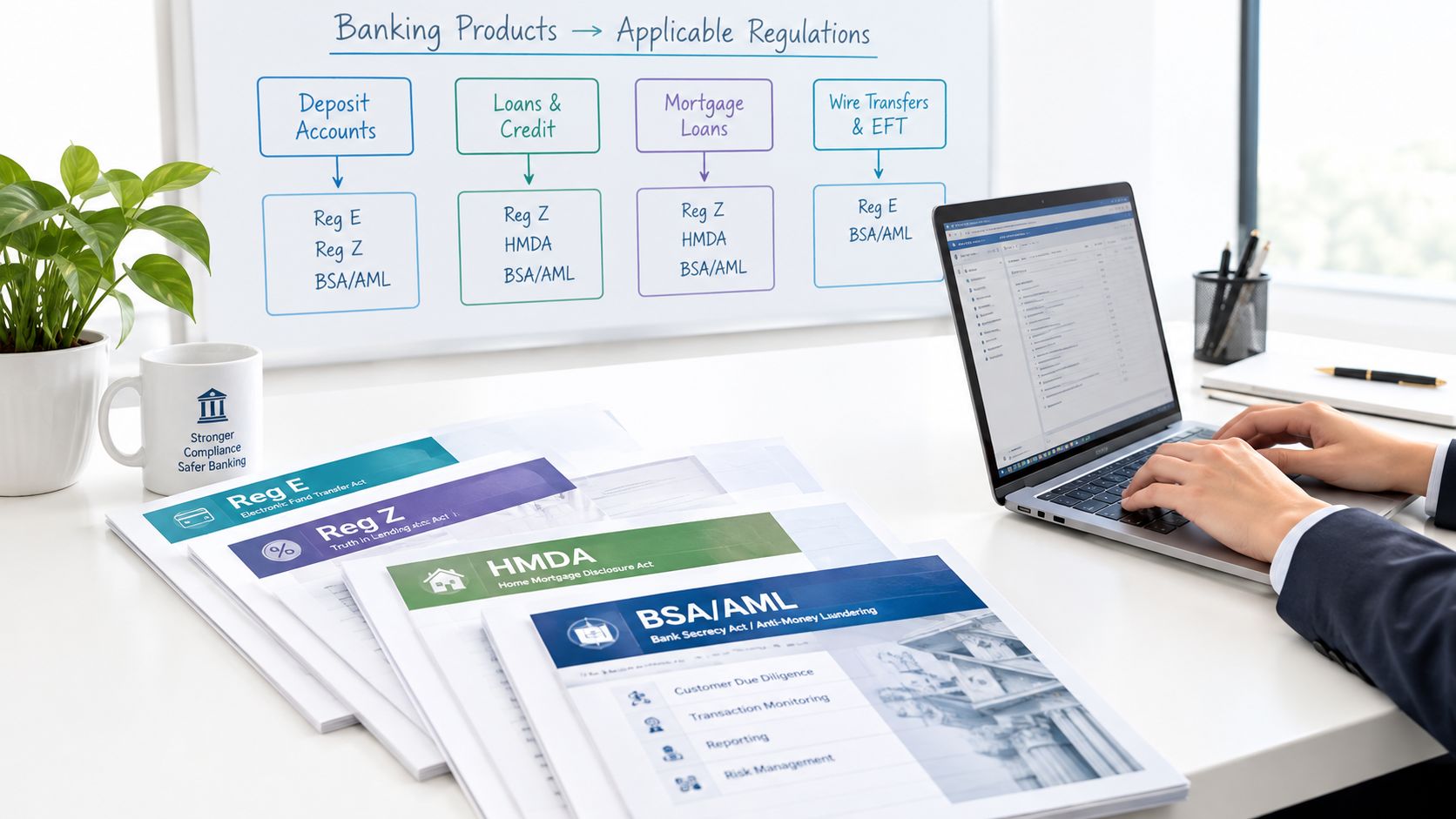
Start with the product map
A weekly review may connect:
- Deposit products: Account opening, customer identification, funds availability, overdraft practices, and electronic transfers must fit the bank’s policies and applicable consumer and BSA controls.
- Loan products: Mortgage, consumer, and commercial lending require documented processes for disclosures, underwriting decisions, fair lending monitoring, and adverse action handling.
- Digital channels: Online banking, mobile access, remote account opening, and vendor-supported systems raise questions about information security, authentication, privacy, and oversight.
The officer then maps those activities to obligations involving BSA/AML, Regulation E, Regulation Z, HMDA, fair lending, and GLBA-related information security and privacy controls. The purpose isn’t to create a binder that sits on a shelf. It’s to show who performs a control, how often it operates, what evidence it produces, and what happens when an exception appears.
Exceptions become managed decisions
Consider a wire transfer that triggers a 314(b) information-sharing request from a regional partner bank. The compliance officer verifies the request, gathers relevant customer and transaction information, coordinates with the BSA function, and documents the decision. The officer isn’t making an unsupported accusation. They’re applying a defined escalation process.
A denied mortgage application creates a different workflow. The compliance officer may review whether the adverse action notice accurately reflects the decision and whether the process aligns with ECOA and fair lending expectations. A recurring teller cash-deposit pattern may send the team into a Currency Transaction Report decision tree, where the facts, thresholds, customer history, and reporting obligations must be evaluated consistently.
Practical rule: A good compliance file lets another trained person understand what happened, why the bank made its decision, and what evidence supports it.
These examples feed several connected programs. The BSA program handles financial-crime controls and escalation. The consumer compliance management system monitors lending and deposit obligations. The information-security and GLBA program addresses customer information and technology risk.
A compliance officer usually isn’t acting as the bank’s lawyer or issuing formal legal opinions. The role owns control design, monitoring, testing cadence, issue tracking, policy maintenance, and frontline training. That operational responsibility is why clear writing and disciplined follow-through matter as much as regulatory vocabulary.
How Kansas Regulators Shape the Topeka Compliance Role
A Topeka compliance officer has to think in layers, not isolated rulebooks. A state-chartered institution works within the Kansas Office of the State Bank Commissioner’s banking laws, regulations, and special orders. It also operates under federal requirements involving BSA/AML, consumer compliance, information security, and financial protection.
The state layer is especially important because it connects policy to examination evidence. A bank may need to show how its internal controls address Kansas requirements, how management tracks exceptions, and how the institution responds when an examiner identifies a weakness. The Kansas financial services regulators overview can help candidates build a broader map of the agencies involved.
Regulatory Layers Governing Topeka Banks
| Regulator | Scope | Topeka Impact |
|---|---|---|
| Kansas Office of the State Bank Commissioner | Kansas banking laws, regulations, special orders, and state examinations | State-chartered institutions maintain controls, policies, monitoring files, and written examination responses |
| Federal functional regulator | Safety and soundness, deposit insurance, or institution-specific supervision | The applicable federal agency adds another examination and governance perspective |
| FinCEN | BSA/AML and financial-crime reporting expectations | BSA officers and compliance teams maintain monitoring, investigation, escalation, and reporting processes |
| Consumer financial protection authorities | Consumer compliance, lending, disclosures, and fair lending | Mortgage and deposit activity must be supported by consistent procedures and documented testing |
The regulatory stack also affects mortgage lenders operating from Topeka. Mortgage business involving loan origination may only be conducted by an individual registered with the commissioner as a loan originator and maintaining a valid unique identifier through NMLS, while direct owners and executive officers must undergo FBI background checks through NMLS under the state application checklist. That creates a parallel mortgage compliance environment alongside bank supervision.
Candidates moving between compliance and origination should understand the education requirements. Kansas requires an MLO applicant to complete 20 hours of NMLS-approved pre-licensure education, including 3 hours of federal law and regulations, 3 hours of ethics, 2 hours of non-traditional mortgage lending, and 12 hours of electives (NMLS education topic requirements). Kansas also requires fingerprint-based criminal background authorization through NMLS and a credit report authorization for financial-responsibility review (Kansas MLO licensing checklist).
What Banking Compliance Officers Earn in Topeka and Kansas
A Topeka candidate may see two very different salary pictures for the same job title. One estimate covers compliance officers broadly, while another focuses specifically on bank compliance. Comparing them requires checking the employer, duties, and seniority behind each figure.
Indeed reports an average Topeka compliance officer salary of $100,399 per year, based on four salary reports, with a range from $55,546 to $181,468 (Indeed’s Topeka compliance officer salary information). ZipRecruiter estimates Kansas bank compliance officer pay at $36,119 annually, or about $17.36 per hour, and lists Topeka at $38,122 annually, or about $18.33 per hour (ZipRecruiter’s Kansas bank compliance salary data).
Salary.com reports another Kansas bank compliance benchmark. Its figures show how widely pay can vary between a narrowly scoped bank role and a position responsible for controls across a larger organization.
Banking Compliance Officer Pay Bands, Kansas and Topeka
| Role or Segment | Low, Annual | Midpoint | High, Annual |
|---|---|---|---|
| Topeka compliance officer estimate | $55,546 | $100,399 average | $181,468 |
| Kansas bank compliance estimate | $36,119 | Not provided | Not provided |
| Topeka bank compliance estimate | $38,122 | Not provided | Not provided |
| Kansas bank compliance benchmark | $64,910, middle-range low | $71,610 average | $88,694, 90th percentile |
The Kansas benchmark lists the middle 50% from $64,910 to $80,552, with an average of $71,610. These figures are reference points, not a guaranteed pay ladder. They show why a job handling daily reviews may sit in a different range from one owning enterprise controls.
Compensation follows responsibility. Ownership of customer due diligence, suspicious activity escalation, vendor oversight, mortgage compliance, and examination remediation gives an employer a clearer reason to pay for specialized judgment.
Read the job description closely. Ask whether the role performs testing, prepares committee reports, manages vendor reviews, supports examinations, or mainly tracks administrative tasks. Experience and certifications can strengthen a candidate’s position, but the employer must define any premium.
Kansas also offers a broader banking market than Topeka alone. The Kansas Bankers Association stated in January 2024 testimony that Kansas banks employ 21,000 Kansans (Kansas Bankers Association testimony). Local openings may be fewer because Topeka’s specialty market is smaller, so experience with Kansas supervision, federal BSA/AML duties, and consumer compliance can stand out.
Skills and Certifications That Move a Compliance Career Forward
The strongest Topeka candidates combine regulatory interpretation with operational proof. Reading a rule is only the beginning. An employer needs someone who can cite the requirement, translate it into a procedure, test whether employees followed it, and preserve evidence for management or an examiner.
Build the working skill stack
Start with four habits:
- Regulatory reading: Learn to identify the rule, triggering event, exception, responsible owner, and required evidence.
- Exception analytics: Use Excel to sort aging, group recurring causes, compare business units, and identify unresolved patterns.
- Policy drafting: Write procedures that tell a frontline employee what to do, not just what the regulation says.
- Examiner-ready documentation: Keep workpapers organized so a reviewer can trace the sample, conclusion, exception, corrective action, and closure.
Employers may also value familiarity with Verafin or comparable AML case-management systems, Jack Henry or FIS core platforms, and HMDA or CRA reporting tools. The exact software varies, but the transferable skill is consistent. You need to understand how a transaction, application, account, or exception moves through a system and becomes evidence.
Choose credentials that match the lane
The Certified Anti-Money Laundering Specialist, or CAMS, fits candidates building a financial-crime path. The ABA Certified Regulatory Compliance Manager, or CRCM, fits broader consumer and bank compliance responsibilities. Candidates interested in state supervision can also examine certification tracks associated with the Conference of State Bank Supervisors.
Mortgage experience adds another route. NMLS-approved education can develop familiarity with Regulation Z, RESPA, TRID, disclosure timing, and mortgage process controls, while active origination experience shows how those requirements operate under production pressure. Kansas candidates can review anti-money-laundering training resources alongside formal credential requirements.
Hiring insight: A resume becomes stronger when it names the control you tested, the evidence you reviewed, the exception you escalated, and the policy you helped update.
Soft skills determine whether technical knowledge reaches the rest of the institution. Compliance officers explain findings to branch managers, write concise reports for directors, answer examiner questions without speculation, and turn rule changes into usable training. For interview preparation, reviewing scoring rubrics for compliance hires can help candidates practice evidence-based answers instead of relying on broad claims about being detail-oriented.
Industry priorities also point toward a changing skill profile. Financial institutions cite regulatory uncertainty, fair lending, limited resources, insufficient training, third-party risk, and information-security involvement as major concerns in the recent compliance survey data (future of compliance survey). The survey reports 38% citing regulatory uncertainty as the top concern, 33% identifying fair lending next, and 30% citing both limited resources and insufficient training. It also reports third-party risk rising from 31% to 41% between 2021 and 2025, while information-security involvement rose from 6% to 19%. Those figures support a practical conclusion: data literacy, vendor oversight, fraud judgment, and technology governance increasingly belong in the compliance toolkit.
Career Paths That Lead Into Banking Compliance
There isn’t one approved doorway into a Topeka compliance position. The better question is, which existing experience gives you credible control ownership fastest?
Branch operations to compliance
A teller or branch operations employee understands account opening, cash handling, customer identification, funds availability, and frontline exceptions. That person can target a BSA or compliance analyst position after building evidence of consistent procedure use and strong escalation judgment. The credential earned along the way may be internal training or formal BSA education, while the first target title is often BSA analyst, compliance analyst, or deposit compliance specialist.
Mortgage origination to mortgage compliance
An MLO route works well for candidates who already understand borrower communication and loan-file flow. Kansas requires the 20-hour NMLS-approved pre-licensure course for an MLO applicant, and the state licensing process includes background and credit authorizations. A candidate can use that foundation, then develop practical fluency in disclosures, adverse action, fair lending, and loan-file quality.
The first compliance target may be mortgage quality-control analyst, mortgage compliance analyst, or lending compliance specialist. Active origination experience is valuable because it shows how rules behave in real conversations and production workflows, not just in a textbook.
BSA analysis to officer scope
An AML queue analyst starts with transaction alerts, customer research, case narratives, and escalation decisions. The next progression can lead to investigator responsibility and then a BSA officer or broader compliance officer role. This lane rewards careful writing, consistent judgment, and the ability to explain why a case was closed or escalated.
Audit or accounting to program ownership
Internal auditors and CPAs bring sampling, controls testing, reconciliation, and issue-remediation discipline. They may need to add BSA/AML and consumer-compliance knowledge before targeting a compliance testing analyst, audit-compliance liaison, or compliance officer position. Their advantage is an existing understanding of evidence and control failure.
Privacy and information governance offer another adjacent lane. A corporate privacy position, such as the role described in this corporate privacy position overview, illustrates how privacy, data use, governance, and compliance can overlap even outside traditional bank roles.
No universal prerequisite period applies to every employer, so candidates shouldn’t invent a fixed timeline for themselves. Instead, document the scope you’ve owned, the systems you’ve used, the findings you’ve closed, and the regulations you’ve applied. Those details help a hiring manager place you accurately.
Actionable Steps to Launch a Compliance Career in Topeka
Start with a foundation that gives you both business fluency and regulatory vocabulary. A bachelor’s degree in finance, accounting, or business can help, but practical evidence matters just as much. Add exposure to mortgage compliance through an NMLS-approved pre-licensing course, even if your long-term goal is compliance rather than origination.
Build a local entry strategy
Target roles where you can see transactions and controls directly:
- Apply for analyst work: Search for BSA analyst, loan review, audit associate, lending quality-control, and compliance analyst roles at community banks and credit unions serving the Capitol area.
- Study the Kansas layer: Read the Kansas Office of the State Bank Commissioner’s banking laws, regulations, and special orders so your interview answers reflect the state environment.
- Create a tracking habit: Use Excel or a simple CRM-style case log to record issue owners, evidence requested, aging, escalation status, and closure notes.
- Volunteer for difficult work: Ask to assist with SAR narratives, exception testing, vendor reviews, fair lending monitoring, or examination-response preparation.
- Keep a results file: Record the control tested, the risk identified, the action taken, and the evidence that proved closure. Don’t disclose confidential customer information.

Position yourself for the next move
Once you’ve developed meaningful BSA or consumer-compliance exposure, consider CAMS or CRCM preparation. The right timing depends on your responsibilities and eligibility, so match the credential to the role you want rather than collecting certifications without a target.
Review openings with CoreFirst Bank & Trust, Capitol Federal Savings, local credit unions, and the Kansas Office of the State Bank Commissioner. The commissioner’s examination track can offer a different perspective because it focuses on evaluating institutions rather than operating one institution’s internal program.
Your resume should name specific work. “Supported compliance” is weak. “Tested deposit account procedures,” “reviewed mortgage disclosures,” “tracked examination exceptions,” or “assisted with vendor due diligence” gives an employer something concrete to assess. The bank skills resume resource can help you present those responsibilities in a clearer way.
24hourEDU offers an online, NMLS-approved 20-hour SAFE pre-licensing course with instructor-led video lessons, an electronic textbook, a state-law module, free exam preparation materials, support by phone and email, and NMLS hours reporting. Its NMLS Provider ID is 1405107. For a candidate exploring mortgage compliance or an MLO-to-compliance transition, that format can provide a structured way to build the mortgage rule foundation required by Kansas.
Why Topeka Is a Smart Place to Build a Compliance Career
A Topeka compliance officer may work close to the institution’s operations while interpreting rules from several layers. Kansas state supervision, federal BSA/AML duties, consumer-protection requirements, mortgage controls, vendor oversight, and information security all meet in one role. That combination gives candidates a practical way to build expertise without starting in a national banking center.
Topeka’s smaller financial-services market can make that expertise visible. Employers may include banks, savings institutions, credit unions, mortgage operations, and the Kansas Office of the State Bank Commissioner. A candidate who can explain how state examinations connect with federal control testing brings a useful perspective to each setting.
The career value comes from evidence. Documented testing, clear findings, strong writing, and practical remediation work show employers what you can handle. Those skills can support moves into bank officer roles, mortgage compliance, internal audit, or state examination.
Regulated institutions still need working controls as lending conditions change. Building a specialty and adding a matching credential can therefore support upward or lateral movement in Topeka. For mortgage compliance or an MLO-to-banking transition, 24hourEDU offers NMLS-approved education and exam preparation options. Review the course details, then apply that regulatory foundation to local roles where control experience matters.