
Yes, you can work as a loan officer on the side, but for the state-licensed mortgage path, you need a license issued and active sponsorship from a licensed company before taking any application. The baseline includes 20 hours of approved pre-licensing education, but finishing a course alone doesn’t authorize you to originate loans.
The popular advice to get licensed and start taking applications at night skips the most important step: finding a company that actually supports part-time originators. Your sponsor, supervision, and availability matter more than whether you call the work a side hustle.
The path is straightforward when you follow the right sequence. Confirm the company arrangement, complete your training, satisfy the licensing requirements, and build a schedule that works for borrowers as well as your current employer.
Yes, but Only Through a Licensed Sponsor
A Mortgage Loan Originator (MLO) helps borrowers apply for residential mortgage financing and discusses or negotiates loan terms. Working fewer hours doesn’t turn that activity into informal freelance work.
The NMLS SAFE Act requirements document explains that people who take residential mortgage applications or offer or negotiate mortgage terms for compensation generally must be state licensed or federally registered. Employees of covered banks and credit unions generally follow the federal registration route; originators at nonbank lenders and brokerages typically follow state licensing.
Side-hustle setups and whether they work
| Setup | Can you do it? | What decides it |
|---|---|---|
| Part-time W-2 loan officer at a licensed lender | Yes, with written employer approval | Employer sponsors your license and supervises your files |
| 1099 contractor under a brokerage agreement | Often yes, where the brokerage allows it | Brokerage verifies your license and the contract terms |
| Your own lending business on the side | No, not as an unsponsored individual | Origination requires sponsorship by a licensed company; operating a company requires separate authorization |
| W-2 support work for one licensed entity in Texas | Possibly exempt | Limited support role and state conditions must be met |
| Taking applications before the license is issued | No | Licensing and sponsorship must come first |
Read the table by looking at the company relationship, not just the schedule. An approved part-time employee can have a workable arrangement. Someone advertising independent mortgage services without the required company structure does not.
Support work also needs careful classification. Organizing paperwork isn’t automatically the same as discussing financing options, but a job title alone won’t establish an exemption.
Practical rule: Choose the legal working arrangement before choosing your working hours.
So, can you be a loan officer as a side hustle? The useful follow-up questions are: Who will sponsor your license, and does your day job leave room for the workload that active mortgage files create?
How to Get Licensed Before You Take a Single Application
A loan application accepted before the state approves your license counts as unlicensed origination. The path runs in a fixed order: sponsor approval, education, testing, background review, application, and only then borrower work.
You don’t need to master every mortgage rule before exploring the career. You do need a clear route from education to authorized work, because each step has to finish before the next one counts.

Complete the requirements in a workable order
-
Get written approval from a prospective sponsor. Confirm the company permits a part-time arrangement alongside your current job and ask which states it is authorized to serve. This avoids preparing for a role the company cannot offer you.
-
Complete approved pre-licensing education. The SAFE Act baseline is 20 hours of NMLS-approved education, followed by testing, a financial-responsibility review, and a character-and-fitness review. The standard course allocation is federal law, ethics, nontraditional mortgage lending, and electives. Check your state’s additional requirements before selecting classes, since some states add hours or state-specific topics on top of the baseline.
-
Prepare for and pass the required examination. NMLS SAFE MLO Test guidance identifies the National Component with Uniform State Content and advises applicants generally to finish pre-licensing education before scheduling the test. Confirm any applicable state testing steps rather than assuming your course completion satisfies them.
-
Complete the background-review steps. Arrange fingerprints, authorize the credit report, and answer disclosure questions accurately. Reviewers assess character and fitness, including relevant license revocations and certain felony convictions, so gather supporting records early if you have something to disclose.
-
Address financial responsibility. Confirm any applicable net-worth or surety-bond requirements with the state and sponsor. A company’s arrangements don’t automatically satisfy every individual requirement.
-
Submit the application through NMLS and establish sponsorship. NMLS is the licensing system used to manage your individual application and company relationship. Incomplete employment history, inconsistent disclosures, and missing documents can delay review, so reconcile your application answers with your disclosure answers before submitting.
-
Verify active authority before accepting business. Wait for the state’s approval and confirm that your sponsorship and license status permit origination. A passed test, submitted application, or job offer isn’t a substitute.
Make training fit the application plan
24hourEDU’s NMLS-approved SAFE course delivers education online through instructor-led video lessons, an e-textbook, and a state law module, with an exam prep package included free. Use the mortgage loan originator license requirements guide to organize your checklist before enrolling.
Track education, testing, documents, and sponsor approval as four separate workstreams. A missed fingerprint appointment or an unsigned disclosure can hold an otherwise complete file, so ask who owns each next step and when it is due.
Choosing Between W-2 Employee and 1099 Contractor
Choose the arrangement by looking at support and responsibilities, not the promise of freedom. A contractor agreement can offer scheduling room, but it doesn’t remove licensing requirements or company oversight.
The NMLS company-relationship and sponsorship policy recognizes both W-2 employees and 1099 contractors as company relationships. Neither classification creates an independent freelance origination credential.
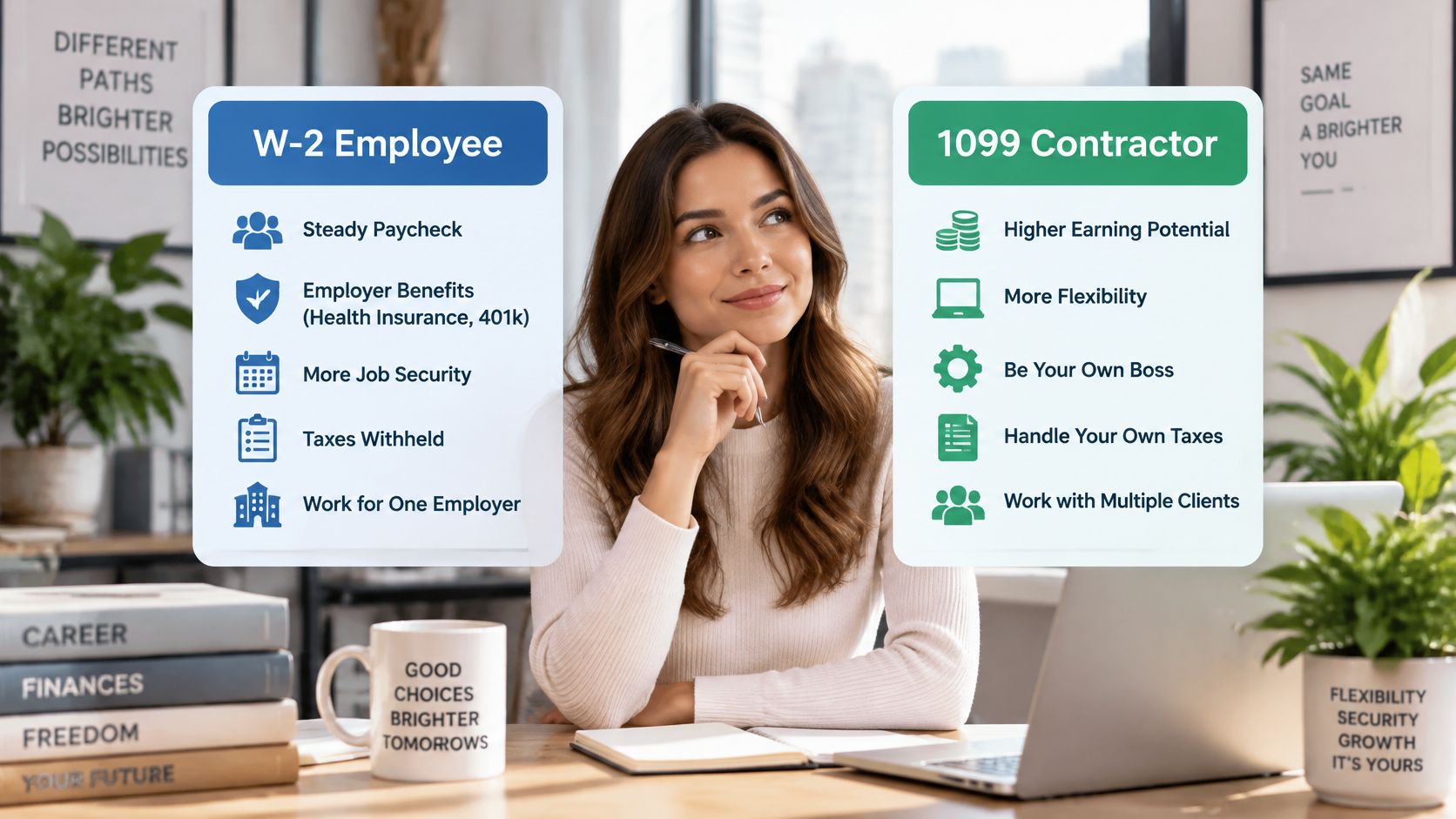
W-2 employee versus 1099 contractor for a side hustle
| Factor | W-2 employee | 1099 contractor |
|---|---|---|
| Sponsorship | Employer’s licensed company | Brokerage’s licensed company under a brokerage agreement |
| License needed | State MLO license and NMLS identifier for the nonbank origination path | Same licensing pathway, verified by the brokerage |
| Pay structure | Salary, hourly, or other permitted compensation not based on loan terms | Contract compensation must still avoid prohibited loan-term-based arrangements |
| Supervision | Employer supervises files and conduct | Brokerage supervises under the contract |
| Taxes | Employer withholds payroll taxes | You handle self-employment tax |
| Texas support role | Possibly exempt for limited support work when state conditions are met | Independent processor or underwriter generally needs an RMLO license |
| Schedule control | Set by employer policy | Negotiated in the agreement |
Pay and support work need closer attention
Commission-based doesn’t mean unregulated. A lawful commission arrangement isn’t the same as paying an originator more for placing a borrower into particular loan terms. CFPB restrictions also prohibit dual compensation in covered situations, so ask the company to explain who pays you and how it calculates compensation.
Texas illustrates why classification matters. An independent-contractor processor or underwriter generally needs a residential mortgage loan originator license, often abbreviated RMLO. A W-2 employee doing limited support work for a licensed entity may qualify for an exemption when the state’s conditions are satisfied.
Say a company offers evening document-processing work. Before accepting, ask whether you’ll only collect and organize information or also discuss loan options with borrowers. Those duties can change the licensing analysis.
Before signing, ask who supervises your files, who handles tax withholding or self-employment tax, what availability the company expects, and whether the agreement permits another job. Have a tax professional review the contractor implications rather than treating the classification as a scheduling preference.
Compliance and Supervision Rules a Side Hustler Must Follow
An MLO license does not work as a portable freelance permission slip. Sponsorship works more like a building permit tied to a contractor: the credential says you qualified, and the sponsored relationship says where you may practice.
The NMLS individual licensing overview explains that most states require an employing company to sponsor an individual, connecting that person to the company’s license. Passing the exam helps, but the active company link is what lets you take applications.
State rules can change your options
Sponsorship and inactive-status rules are state-specific. A state may limit how many companies can use your license, treat an unsponsored license as inactive, or set a different process for moving between sponsors. Confirm the rule with the state regulator and the sponsoring company before counting on evening or weekend files.
An inactive license may remain on record without giving you authority to originate.
That distinction matters when changing jobs. A borrower may still expect help, and your calendar may look open, but leaving the sponsoring company can pause or end your authority even while the license record stays visible.
Check the operating rules before advertising
- Multiple company relationships: Ask whether your state permits origination for different mortgage companies and whether either company prohibits it.
- Sponsorship changes: Find out who submits the change, when your authority stops, and when work may resume.
- Outside employment: Get written approval rather than relying on a recruiter’s informal assurance.
- Advertising approval: Confirm the sponsor’s process for websites, social profiles, business cards, and mortgage-related posts.
- Lead handling: Establish where leads enter the company’s system and who communicates with borrowers when you’re unavailable.
Ask directly: Can I legally originate for different companies, and what happens to my license when my primary job ends? A nonmortgage day job and the mortgage employer sponsoring your license can create different consequences when either one ends.
Use the banking regulations and compliance guide to build familiarity with regulated financial work. Confirm your actual arrangement with the employer and state regulator before accepting clients or advertising services.
Conflicts of Interest to Watch in a Second Job
The hidden risk of a second job is divided loyalty. If you work for a homebuilder, title company, or lender during the day, your mortgage role could influence where customers seek financing or how they interpret your advice.
A borrower shouldn’t have to guess whether your recommendation serves their needs or your other employer. Even a well-intended introduction deserves review when you have a financial or professional interest in the outcome.
Review these conflicts before taking a lead
- Referral payments: Send proposed referral fees, gifts, and third-party payments to your sponsor for review. Don’t accept an arrangement because someone calls it a marketing expense.
- Loan-term incentives: Flag any payment formula that encourages a particular rate, product feature, or other loan term.
- Payments from different parties: Have compliance review any situation where compensation might come from both sides of a covered transaction.
- Product steering: Don’t recommend financing because you expect it to pay you more. Explain the borrower-focused reasons behind your recommendation.
- Personal relationships: Disclose relationships that could affect your judgment, especially when helping relatives, coworkers, or business partners.
Keep a clear written record
Disclose outside employment in writing and ask for the employer’s conflict-of-interest policy before accepting your first lead. Route files through the sponsor’s approval process, and keep borrower disclosures complete and dated.
Say you work for a homebuilder and a buyer asks you to arrange financing after hours. Don’t move straight into collecting an application. First establish whether both employers permit the relationship and what disclosures or restrictions apply.
If a borrower could reasonably wonder whose interest you serve, document the answer before proceeding.
Good boundaries protect the opportunity. You can build a mortgage career alongside another role without mixing customer records, employer resources, or competing obligations.
Time, Costs and Balancing a Side Hustle With a Full-Time Job
Licensing costs money before it pays anything, and active files demand attention on days you are working your primary job. Plan for both.
Recurring obligations for a licensed MLO
| Obligation | Hours | When it applies |
|---|---|---|
| Pre-licensing education | 20 hours | Before the SAFE MLO test |
| Annual continuing education total | At least 8 hours | Each licensing year, subject to the same-year pre-licensing exception |
| Federal law education | 3 hours | Annual continuing education |
| Ethics education | 2 hours | Annual continuing education |
| Non-traditional mortgage lending education | 2 hours | Annual continuing education |
| Elective education | 1 hour | Annual continuing education |
| Annual license renewal | Administrative time, not a fixed education-hour requirement | Every licensing year |
The NMLS California education guidance sets out 20 hours of pre-licensing education and at least 8 hours of annual continuing education, allocated as the table shows, with an exception when pre-licensing education was completed that year. The initial curriculum includes 3 hours of federal law, 3 hours of ethics, 2 hours of nontraditional mortgage lending, and 12 hours of electives.
Education, testing, fingerprinting, application charges, and state fees all arrive before production income. Ask the sponsor which expenses it covers and which you will pay, then separate startup costs from recurring renewal costs.
Plan around active files throughout the week
The U.S. Bureau of Labor Statistics reports that most loan officers work full time and some work more than 40 hours per week, and it projects employment growth of 1% from 2025 through 2035. Treat that as a workload warning for a part-time applicant.
Borrower calls are only part of the work. You will also coordinate missing documents, underwriting conditions, disclosures, and closing deadlines. An underwriter reviews each file against lending requirements. A condition is an item that must be resolved before approval or closing.
A practical weekly routine might look like this:
- Monday: Review your active files and request missing documents.
- Tuesday: Hold borrower calls within your agreed response window.
- Wednesday: Check urgent messages and coordinate backup coverage.
- Thursday: Follow up on disclosures and underwriting conditions.
- Saturday: Schedule consultations and authorized new-lead intake.
- Sunday: Plan the coming week and reserve continuing-education time.
Treat these as work windows, since urgent files still need attention between them. Agree on daytime processing support and escalation coverage with your sponsor.
Protect your schedule and cash flow
Working from home may be possible when company policy and applicable rules allow it. You can negotiate your hours. Borrowers still need coverage during business-day deadlines.
For calendar coordination, SyncThemCalendars explains ways to avoid scheduling conflicts between companies. Keep borrower information out of shared calendar entries, and use the work-and-study planning guide to reserve training time before your workload expands.
Employers may use salary, hourly pay, or other compliant compensation structures. Commission arrangements may pay only when loans close, so early earnings can be irregular and first closings are uncertain.
Allow several months in your personal budget for training, licensing, and business development rather than treating that as a guaranteed licensing timeline. Confirm in writing that your day-job contract allows outside work before accepting a client.
Confirm Your Sponsor Before Enrolling in Training
Your next decision isn’t which laptop to buy or how to advertise. It’s whether a licensed company will support the arrangement you can realistically offer.
A good sponsor conversation turns a broad career idea into a workable plan. You should leave knowing your duties, supervision, availability expectations, and route to active licensing.
Use this approval gate
- Written outside-work approval: The sponsoring company accepts your proposed part-time arrangement.
- Classification confirmed: You know whether you’ll be an employee or contractor and have reviewed the agreement.
- Authorized states identified: The company confirms where it can operate and where you’ll need individual authority.
- Your current job permitted: Both employment arrangements allow the combination.
- An exit plan understood: You know what happens to your license and active files if sponsorship ends.
Don’t settle for a general promise of flexibility. Ask how the company handles a borrower who needs help while you’re at your primary job, and who takes responsibility for time-sensitive requests.
Choose training after the arrangement is clear
Once those answers are in place, NMLS-approved online education is a practical next step. 24hourEDU offers an NMLS-approved 20-hour SAFE course with instructor-led video lessons, an e-textbook, a state law module, and a free exam prep package.
The program includes phone and email support, complimentary NMLS hours reporting, and flexible start dates. Its NMLS Provider ID is 1405107, which readers can use to verify approval through NMLS.
Training can make the process organized and manageable, but the state still decides your application and the sponsor still controls the approved working arrangement. Choose a course schedule that leaves room for exam preparation and document collection, not just lesson completion.
Start the sponsor conversation this week. Once the company confirms the role, enroll in online training that fits around your current job and gives you a clear next step toward licensed mortgage work.
24hourEDU offers online NMLS-approved pre-licensing education with a free exam prep package and support for aspiring mortgage loan originators. If you’re preparing for a properly sponsored part-time role, visit 24hourEDU to explore the course and choose a start date that fits your work schedule.