


Yes, you can enroll in and begin an MLO course without first completing a separate prerequisite. But before you can be licensed, you still must complete 20 hours of NMLS-approved pre-licensing education.
That's where many first-time applicants get tripped up. They ask one question, but they're really asking three different ones at once. Can you sign up for the course now? Can you take the SAFE test before finishing everything? Can you get licensed without the education being done? Those are separate checkpoints, and the NMLS rules treat them differently.
A lot of articles blur those steps together and leave readers thinking there's some hidden class they have to take before they can even begin. There usually isn't. If you have a high school diploma or equivalent, want to move into a mortgage career, and you're ready to complete the required education, you can start. You don't need a college degree to become a Mortgage Loan Officer, and experience isn't required to become a mortgage broker.
The Short Answer About MLO Prerequisites
The plain-English answer is simple. There is no standalone prerequisite course you have to finish before enrolling in MLO pre-licensing education. The NMLS testing FAQ says a pre-licensure course isn't required before taking the SAFE MLO test, while still making clear that the required education must be completed before licensure is finished through the NMLS MLO testing FAQ.

Most confusion comes from treating the whole licensing path like one gate. It isn't. It helps to think in three checkpoints:
- Course enrollment. Can you sign up and start learning?
- SAFE exam eligibility. Can you sit for the national test yet?
- License issuance. Can the state approve your MLO license now?
If you separate those three moments, the phrase can you take a MLO course without the prerequisite becomes much easier to answer. You can begin the education path without some earlier qualifying class. What you can't do is skip the education and still expect a license at the end.
Practical rule: Starting is easy. Finishing the required education is what makes you eligible to move from student to applicant.
For a deeper look at the difference between myths and actual entry requirements, this guide on the real prerequisites to becoming a loan officer is a helpful companion read.
This is also why the career can feel more accessible than people expect. You don't need a college degree. You don't need prior mortgage experience. You need the required education, a passing exam result, and a completed license application. For career changers, that's a much clearer starting point than many assume.
What the NMLS Actually Treats as a Prerequisite
When people say “prerequisite,” they usually mean “something I must do before I'm even allowed to begin.” In MLO licensing, that's not how the system is organized. Educational requirement is the pre-licensing education itself.
Under the SAFE Act structure, the national education baseline is 20 hours of NMLS-approved pre-licensure education, as outlined in the NMLS SAFE Act education requirements. That's the requirement states build on. Some states mirror it exactly. Some add extra state-law content.
What counts as the real gate
If you're trying to understand what the system expects, keep these ideas separate:
- Education requirement: You must complete the required NMLS-approved pre-licensing education.
- Testing step: Passing the SAFE exam is part of the path.
- Application step: You must apply through NMLS and satisfy your state's licensing process.
That's why “no prerequisite” doesn't mean “no requirements.” It means there isn't a separate intro class you have to clear before starting the main course.
A good way to think about it is this: the course isn't locked behind another course. The course is the first formal education step.
What doesn't replace the education
People often hope prior experience will substitute for the coursework. It usually won't. A background in banking, sales, lending support, title work, or office management may help you understand the material faster, but it doesn't erase the required education. The same goes for a college degree. Helpful? Sure. Required? No.
You're not proving that you've worked around mortgages. You're proving that you completed the licensing education path your state and NMLS recognize.
If you want a broader overview of the licensing framework, this page on SAFE Act licensing requirements lays out the core steps in a straightforward way.
That's one reason this career attracts career changers. If you've got a high school diploma or equivalent, you can begin the process without waiting to build years of experience first. For people who want to work from home, build a commission-based income, and create a flexible schedule, that low-friction starting point matters.
Inside the 20-Hour National Pre-Licensing Curriculum
The federal baseline isn't vague. The required 20 hours are broken into specific subject areas in the NMLS pre-licensure education FAQ. Once you see the structure, the course feels less mysterious and more manageable.
The four required curriculum segments
| Segment | Hours | Topic Focus |
|---|---|---|
| Federal law | 3 | Federal law and regulations |
| Ethics | 3 | Ethics, including consumer protection |
| Nontraditional mortgage lending | 2 | Nontraditional mortgage products |
| Undefined instruction | 12 | General mortgage origination instruction |
That's the national floor. In practical terms, students usually encounter material on how mortgage lending works, what compliance rules govern the process, and how originators handle borrowers responsibly.
What students are actually learning
The course isn't just test trivia. It introduces the language and workflow of the job. You'll study how mortgage lending rules affect conversations with borrowers, disclosures, loan structure, and ethical conduct.
A first-time applicant often worries that they need industry experience before taking the class. In reality, the class is designed to give you the foundation you were missing. It teaches the framework first, then helps you connect the rules to daily work in mortgage origination.
Here's the practical value of each segment:
- Federal law: You learn the rules that shape compliant lending behavior.
- Ethics: This part focuses on conduct, fairness, and consumer treatment.
- Nontraditional lending: You're introduced to products that require more careful analysis.
- General instruction: The largest block gives room for broad mortgage knowledge and exam preparation.
What matters most: The course isn't a formality. It's the baseline training the licensing system expects every new MLO to complete.
If you want a more student-friendly overview of how the curriculum is organized, this 20-hour MLO course breakdown is a useful reference. One available option is 24hourEDU, which offers an online NMLS-approved pre-licensing course and includes an exam prep package at no added charge. It is approved by the NMLS Nationwide Multistate Licensing System & Registry under Provider ID 1405107.
For many new entrants, this is the encouraging part. The curriculum gives structure to a career that can lead to remote work, flexible hours, and commission income. You don't need to know everything before you start. You need a clear course path and a provider that reports your completion correctly.
How State Rules Add to the Federal Baseline
The national rule is the floor. States can add their own overlays, and that's where many applicants accidentally assume there must be some extra “prerequisite” class.
A state regulator may require state-specific education, additional review items, or application conditions beyond the national baseline. That doesn't create a universal prerequisite. It creates a state overlay.
A side-by-side view
| State | Additional Hours | Special Conditions | Where to Verify |
|---|---|---|---|
| California | None stated in the verified data beyond the national package | California uses the national baseline in the verified material | California DRE MLO license information |
| New York | 3 | State law education adds to the national baseline | Verified in the NMLS education specifications cited earlier |
| Oregon | 4 | Oregon-specific pre-licensure education, plus a surety bond or company coverage and an NMLS MU4 application | Oregon mortgage originator FAQ |
Why this changes the question
In some states, the answer to “Can I get started now?” is still yes. But the answer to “Am I fully done with education?” may depend on your state. For example, the verified Oregon guidance requires 20 hours total including 4 hours of Oregon-specific pre-licensure education, along with a surety bond or company coverage and an NMLS MU4 application.
New York is another good reminder that state law can push the total above the federal baseline. The NMLS education specifications note that New York requires 3 additional hours of state law on top of the national package.
That's why applicants should stop asking only whether there's a prerequisite. The better question is, “What does my state count as complete before it will let me move forward?” That's a much more useful licensing question.
A Realistic Timeline From Zero Coursework to Licensed MLO
The timeline matters because many people aren't asking about education in the abstract. They want to know when they can begin job hunting, when they can test, and how quickly they can move toward a working mortgage career.
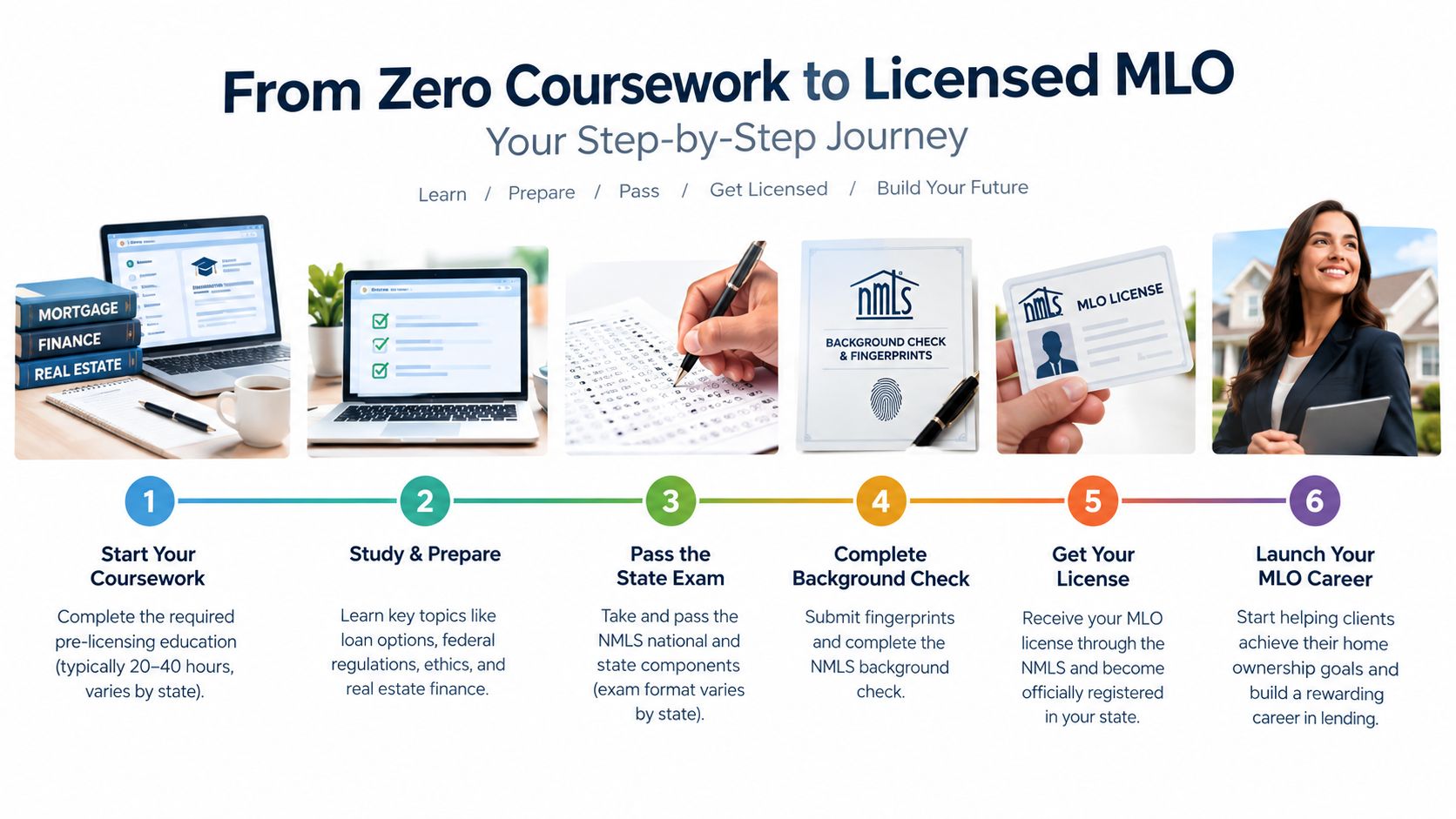
A simple example
Take a first-time applicant with a high school diploma or equivalent and no prior mortgage experience. That person can enroll with an NMLS-approved provider, complete the required coursework, prepare for the SAFE exam, and then move into the application phase.
A realistic sequence often looks like this:
- Start the course and work through the required modules.
- Finish the education requirement for the state you plan to apply in.
- Prepare for the SAFE exam using course review tools and practice support.
- Pass the exam and move into the application process.
- Submit the license application and complete state-required items.
Where delays usually happen
The course itself is usually the most predictable part because you control when you begin and how steadily you study. Delays tend to happen after that. Exam scheduling, application review, fingerprints, credit review, and state follow-up requests can all slow things down.
Some applicants think the hard part is getting permission to start. Usually, the bigger issue is completing each later step cleanly and in the right order.
This is also where good education support helps. If you're changing careers, balancing a current job, or planning to work from home after licensing, a clear online training path can make the process feel much more doable. The mortgage field appeals to a lot of people for exactly that reason. You can build toward a commission-based career without first spending years in a traditional office ladder.
Your Next Steps to Get Started the Right Way
If you're ready to move from “research mode” into action, keep it simple and verify each step before you pay for anything.
Start with provider approval
Check that your course provider is approved through the NMLS system and that the course you're buying matches the education you need. That includes the national pre-licensing requirement and any state-specific content your state may add.
A provider can offer mortgage education generally, but you still want to confirm the exact course fits your licensing path. Small mismatches create big frustration later.
Gather what you'll need early
Before you begin the application stage, pull together the basic information that people often scramble for at the last minute:
- Government ID: Make sure it's current and matches your legal name.
- Social Security number: You'll need it for the NMLS process.
- Residence history: Be ready to enter prior address details accurately.
- Disclosure answers: Review personal background questions carefully before filing your MU4.
Think in the right order
A calm, accurate sequence usually works better than trying to rush every step at once.
- Enroll first: Get the required education underway.
- Confirm your state overlay: Make sure there isn't an extra state-law module you missed.
- Use exam prep seriously: Don't treat the SAFE exam like a casual quiz.
- File cleanly: Incomplete or inconsistent application details can slow approval.
One smart habit: Verify your home state's rules before choosing a course package, not after you finish the course.
The good news is that the path is straightforward once you stop looking for a hidden prerequisite that isn't there. If you have a high school diploma or equivalent, you can begin. You don't need a college degree. You don't need prior mortgage experience. You need the right education, a passing exam result, and a complete license application.
If you're ready to start the MLO path without overcomplicating the prerequisite question, 24hourEDU offers an online NMLS-approved pre-licensing course that matches the national education requirement and includes free exam prep. You can review course options, state-specific information, and support resources by visiting 24hourEDU.

