


When you apply for a mortgage, lenders see your credit score as a direct reflection of your financial reliability. It’s not just some random number—it’s a snapshot of your entire credit history, telling them how likely you are to pay back what you borrow. This single three-digit score, usually between 300 and 850, is one of the biggest factors in whether you get approved and, more importantly, what interest rate you’ll have to pay.
Think of it this way: a higher score tells lenders you’re a low-risk borrower. In return for that confidence, they offer you a better deal in the form of a lower annual percentage rate (APR). Even a tiny difference in your APR can lead to massive savings down the road.
The Financial Impact of a Better Score
To see just how much this matters, let’s look at a real-world example. The table below shows how different FICO scores can dramatically change the cost of a standard $300,000, 30-year fixed mortgage.
| FICO Score Range | Example APR | Monthly Payment | Total Interest Paid |
|---|---|---|---|
| 760-850 | 6.48% | $1,892 | $381,257 |
| 700-759 | 6.70% | $1,936 | $396,894 |
| 680-699 | 6.88% | $1,971 | $409,615 |
| 660-679 | 7.10% | $2,015 | $425,488 |
| 640-659 | 7.53% | $2,104 | $457,419 |
| 620-639 | 8.07% | $2,216 | $507,764 |
As you can see, jumping from a “Fair” score in the mid-600s to an “Excellent” score above 760 could save you over $76,000 in interest. That’s a new car, a college fund, or a serious boost to your retirement savings.
This reality highlights a simple truth: boosting your credit score is one of the most powerful financial moves you can make before buying a home. The work you put in now pays off for decades.
Understanding the Building Blocks of Your Score
So, how do you actually improve your score? You have to know what goes into it. Lenders almost universally use FICO scores, which are calculated using five key factors. Each one tells a part of your financial story.
- Payment History (35%): This is the heavyweight champion. It’s a simple record of whether you’ve paid your bills on time. Late payments hurt. On-time payments help.
- Amounts Owed (30%): Often called credit utilization, this looks at how much of your available credit you’re using. Maxed-out cards are a red flag.
- Length of Credit History (15%): A longer track record of responsible credit management generally looks better to lenders.
- New Credit (10%): This factor considers how many new accounts you’ve opened recently and how many times lenders have pulled your credit (hard inquiries).
- Credit Mix (10%): Lenders like to see that you can successfully manage different kinds of debt, like credit cards, an auto loan, or student loans.
By focusing your energy on the two biggest pieces of the pie—your payment history and the amounts you owe—you can make the fastest and most significant improvements to your score.
To really get a handle on this, it’s worth understanding the specific credit score for mortgage benchmarks lenders use. These aren’t just abstract ideas; they are the levers you can pull to build a stronger financial profile before you apply. For a deeper dive, check out our guide on what is a credit score and why it matters.
Conducting Your Personal Credit Audit
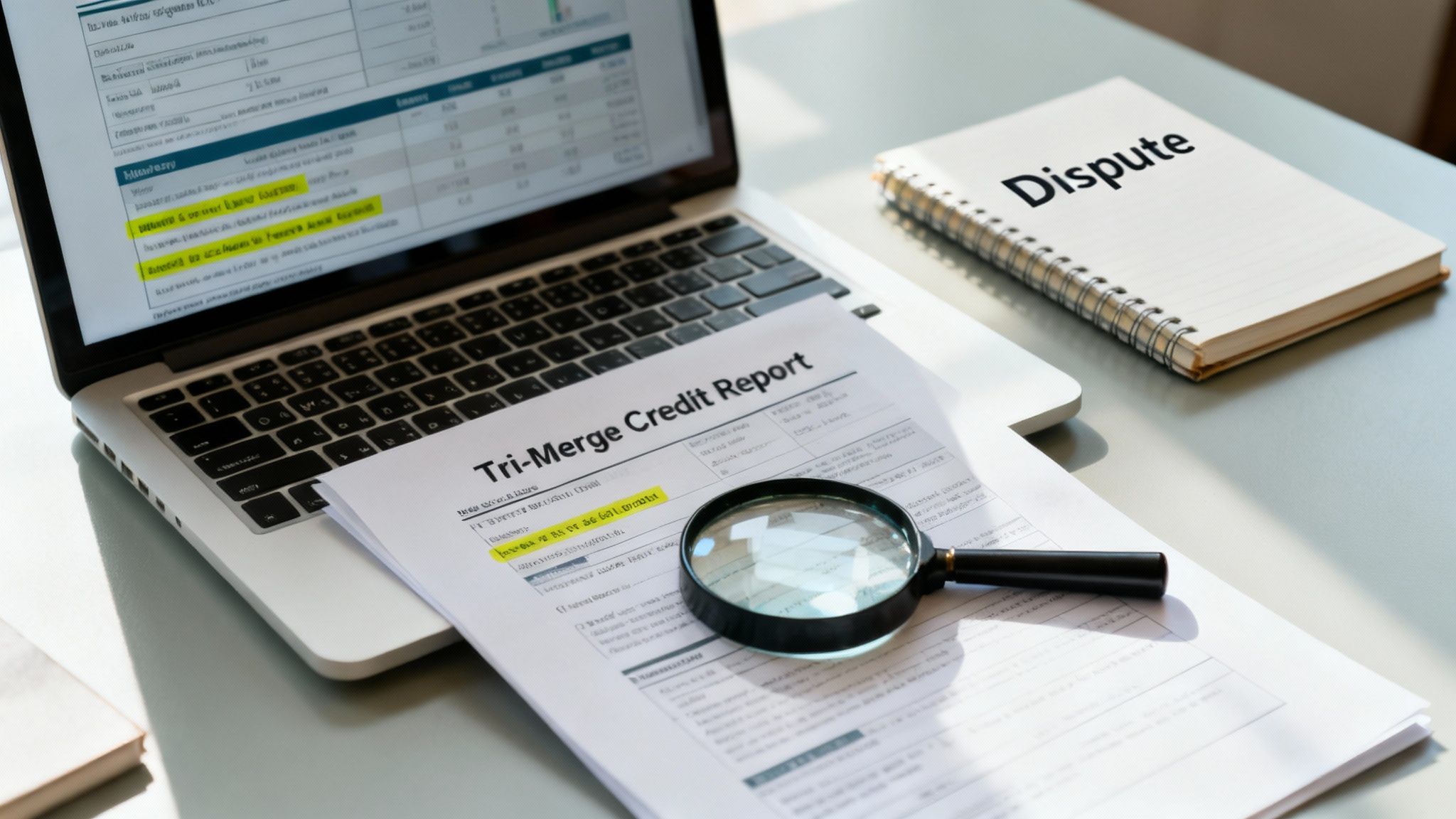
Before you can start fixing your credit, you need a crystal-clear picture of where you stand. Think of this as the reconnaissance mission for your mortgage journey. It’s not just about knowing your three-digit score; it’s about digging into the raw data that lenders will be picking apart.
Your first move is to pull your credit reports from all three major bureaus: Equifax, Experian, and TransUnion. You’re legally entitled to a free copy from each one every year. Make sure you get all three—creditors don’t always report to every bureau, so what shows up on one report might be missing or different on another.
Scrutinizing Your Reports for Inaccuracies
With your reports in hand, it’s time to put on your detective hat. You’re hunting for any piece of information that looks wrong or simply doesn’t belong to you. These errors are far more common than most people realize, and they can act like silent anchors dragging your score down.
Keep an eye out for these specific kinds of mistakes:
- Incorrect Personal Information: A misspelled name, an old address, or a typo in your Social Security number could link someone else’s bad credit to your file.
- Phantom Accounts: These are credit cards or loans you never opened. It could be a simple clerical error, or worse, a red flag for identity theft.
- Wrong Account Status: Look for accounts incorrectly marked as late or in collections, especially when you know you’ve been paying on time.
- Duplicate Debts: Sometimes, a single account gets listed twice. This can throw off your debt-to-income ratio and make you look riskier than you are. You can explore more on how to calculate debt-to-income ratio to understand this better.
- Outdated Negative Information: That late payment from eight years ago? It has no business being on your current report. Most negative items are required to fall off after seven years.
Even one small error, like a payment being incorrectly flagged as 30 days late, can knock serious points off your score. That could be the difference between a great interest rate and a much higher one. This is why a meticulous review is a non-negotiable first step to improve your credit score for a mortgage.
The Power of Disputing Errors
Finding an error is only half the job. Now, you have to get it fixed. The Fair Credit Reporting Act (FCRA) gives you the legal right to dispute any inaccurate information on your reports. It helps to get familiar with the law and learn effective methods for spotting FCRA violations that might be unfairly hurting your score.
The dispute process means contacting both the credit bureau showing the error and the creditor who supplied the information. You’ll need to clearly explain what’s wrong and provide copies of any documents that back up your claim.
Pro Tip: Always send your disputes in writing via certified mail with a return receipt requested. This creates a paper trail and holds the bureaus to their legally required 30-day investigation window. It’s the best way to prove you took action.
Understanding the Tri-Merge Report
When you finally sit down with a lender, they won’t just pull one report. They’ll order a “tri-merge” report, which combines all the data from Equifax, Experian, and TransUnion into one master document. Lenders typically look at the middle of your three scores to qualify you.
For instance, if your scores come back as 680, 695, and 710, the lender will base their decision on the 695. This is exactly why it’s so critical that all three of your reports are clean and accurate. A single error on just one report can pull that median score down and potentially change the loan terms you’re offered.
By doing a thorough audit now, you’re making sure the file your lender sees is a true reflection of your financial habits, setting the stage for a much smoother path to approval.
Nail Your Payment History and Credit Utilization for the Biggest Score Jumps

If you want to see a real, meaningful boost to your credit score, there are two areas that matter more than anything else: your payment history and your credit utilization. These aren’t just minor factors; together, they make up a massive 65% of your FICO score.
Getting these two things right is the most direct route to getting the mortgage you want.
Your payment history is the heavyweight champion, accounting for 35% of your score. Lenders look at it as a crystal ball for your future behavior. A clean, consistent record of on-time payments tells them you’re reliable. On the flip side, even one or two recent late payments can be a huge red flag.
Lock Down Your Payment History
The mission here is non-negotiable: build an unbroken streak of on-time payments. It’s shocking, but a single payment reported as 30 days late can send a good score tumbling, making it that much harder to improve your credit score for a mortgage. The good news is, there are simple ways to make sure this never trips you up.
First, automate everything. Set up autopay for at least the minimum amount due on every single account you have—credit cards, car loans, student loans, everything. Think of it as your safety net. You’ll never miss a due date because you forgot. You can always go in and pay more manually, but the minimum is guaranteed to be covered.
But what if a late payment has already happened? Don’t just accept it. If you’ve otherwise been a great customer, call your creditor and ask for a “goodwill adjustment.” Calmly explain what happened and ask if they’d be willing to remove the late mark as a one-time courtesy. It’s not a sure thing, but you’d be surprised how often it works.
Master Your Credit Utilization Ratio
Coming in at 30% of your score, credit utilization is the next most powerful lever you can pull. This is just a simple ratio: the amount of credit you’re using versus the total amount of credit you have available. When that ratio gets too high, it signals to lenders that you might be stretched thin and relying too heavily on debt.
The standard advice is to keep your overall credit utilization below 30%. But when you’re gearing up for a mortgage, you need to play at a higher level. Aiming for under 10% can give your score a serious boost and shows underwriters you manage credit responsibly, not out of desperation.
Let’s say you have one credit card with a $10,000 limit. A $2,900 balance puts your utilization at 29%. Not terrible, but not great. But if you get that balance down to $900, your utilization drops to 9%—a much more appealing number for a mortgage lender.
Next-Level Tricks for Utilization
You can actually game the system a bit to lower your reported utilization without making drastic changes to your spending. One of the best tactics is making a payment before your statement closing date.
Here’s why: most credit card companies report your balance to the bureaus just once a month, right after your statement closes.
So, imagine you charge $2,000 during the month but pay off $1,500 a week before the statement date. The only balance the credit bureaus will see is $500. This one move can dramatically lower your reported utilization for that cycle.
Another powerful strategy is simply asking for a credit limit increase on your existing cards. If you have a good payment history, your odds are high.
Check out this scenario:
- Before: You have a $5,000 credit limit with a $2,000 balance. Your utilization is 40%.
- After: Your bank increases your limit to $10,000. That same $2,000 balance now only represents 20% utilization.
Just like that, you’ve cut your utilization ratio in half and likely boosted your score. The key is to ask the card issuer if the request will trigger a “hard inquiry.” Many will grant an increase with just a “soft pull,” which doesn’t impact your score at all. Combining these simple tactics can put you on the fast track to being mortgage-ready.
Fine-Tuning Your Credit Mix and Handling New Accounts
Once you’ve got your on-time payments and credit utilization down pat, it’s time to look at the finer details that can make or break your mortgage approval: your credit mix and any new credit you take on. These two factors together account for 20% of your FICO score. That might not sound like a huge slice of the pie, but mishandling it right before you apply for a home loan can be a shockingly expensive mistake.
It’s a real balancing act. On one side, lenders want to see a healthy credit mix—that means you can successfully manage different kinds of debt, like revolving credit (credit cards) and installment loans (car loans, student loans). It shows financial maturity.
But on the flip side, applying for new credit triggers a hard inquiry, which dings your score. It’s a classic Catch-22 if you don’t play your cards right.
The “Hands-Off” Period: When to Stop Applying for Credit
Think of the six to twelve months before your mortgage application as a “credit quiet zone.” During this window, your main job is to avoid opening any new lines of credit. Seriously. That tempting offer at the checkout for a 20% discount if you open a store card? Just say no. Thinking about getting a new car loan? If it can wait, let it wait.
Every time you formally apply for credit, the lender pulls your report, resulting in a hard inquiry. While one or two inquiries over a couple of years won’t wreck your score, a sudden burst of new applications can look like a red flag to underwriters, suggesting you might be in financial trouble.
Here’s the golden rule for the mortgage prep zone: Do not open new credit accounts unless it is a deliberate, strategic move to improve your score. The small reward of a new card is almost never worth the risk of a last-minute score drop.
Can New Credit Ever Help Your Score?
Yes, but it’s all about timing and strategy. If you have a “thin file”—meaning very little credit history—or you’re bouncing back from some credit missteps, carefully adding a new account can be a smart play. The key is to do this at least a year before you plan to talk to a mortgage lender.
Here are a couple of tools designed for just this purpose:
- Secured Credit Cards: These are fantastic for building or rebuilding credit. You put down a small cash deposit, often around $300, which then becomes your credit limit. Use it for a tiny, recurring bill (like Netflix), pay it off in full every single month, and you’ll build a perfect new payment history.
- Credit-Builder Loans: Many credit unions and some banks offer these. They’re not traditional loans where you get cash upfront. Instead, the bank puts the loan amount into a locked savings account. You make small monthly payments, and after you’ve paid it all back, the money is released to you. Every single on-time payment gets reported to the credit bureaus.
These aren’t quick fixes. They are long-term tools designed to improve your credit score for a mortgage by adding positive payment history and diversifying your profile.
How to Shop for a Mortgage Without Wrecking Your Score
This is a huge fear for homebuyers: “If I shop around for the best rate, won’t all those applications destroy my credit?”
Thankfully, the credit scoring models are smarter than that.
Both FICO and VantageScore have a built-in “rate shopping” window. They understand that you need to compare offers. All mortgage-related inquiries made within a specific timeframe—typically 14 to 45 days, depending on the model—are bundled together and treated as a single hard inquiry.
So, go ahead and get pre-approved with a few different lenders. As long as you do it within a two-week period, your score will only take a small hit once. This allows you to find the absolute best deal without sabotaging all the hard work you’ve put into building your credit.
Your Mortgage Prep Timeline and Final Checklist

Timing is everything when you’re gearing up to buy a home. The moves you make—and just as importantly, the ones you don’t make—in the year before you apply can have a huge impact on your approval and the interest rate you’re offered.
Think of it as a game plan. A strategic timeline turns what could be a stressful last-minute scramble into a series of calm, manageable steps. This roadmap will help you focus on the right things at the right time, so you can walk into a lender’s office with your strongest possible financial profile.
Your 12-Month Pre-Mortgage Game Plan
Starting a full year out is the sweet spot. This is where you lay all the groundwork. You’ve got plenty of runway to make big changes and fix any deep-seated issues without the pressure of a deadline breathing down your neck.
Your main goal here is to diagnose any major problems and start the slow, steady process of building a better credit history. This is also the time for strategic moves, like opening a credit-builder loan, that need a while to mature and show up positively on your report.
Here’s your focus:
- Go Full Detective on Your Credit: Pull your full credit reports from all three bureaus. Go through them line by line and start the dispute process for any errors you find. Some of these can take months to resolve, so getting a head start is crucial.
- Create a Perfect Payment Record: If you have any accounts in collections or with late payments, now is the time to handle them. Set up automatic payments for every single bill to guarantee a perfect 12-month streak of on-time payments. Nothing is more important than this.
- Lock Down Your Employment: Lenders absolutely love stability. If you can, avoid changing jobs or switching career fields. A solid two-year history with the same employer looks fantastic to an underwriter.
The 6-Month Mark: Fine-Tuning Your Finances
With six months left, the finish line is getting closer. Your focus should shift from major repairs to fine-tuning and optimization. Those good habits you started should be paying off and reflecting on your credit reports. Now it’s all about polishing your financial picture.
This is the time to get aggressive with high-interest debt and wrestle your credit utilization down as low as you possibly can. Lenders will be looking very closely at your recent activity, so every dollar counts.
Key actions to take:
- Attack High-Interest Balances: Double down on paying off those credit cards. The goal is to get every single card’s balance below 30% of its credit limit. The real pro move? Get it under 10%.
- Build Your Closing Cost Fund: Start seriously bulking up your cash reserves for the down payment and closing costs. Lenders need to see you have the funds, and large, unexplained cash deposits at the last minute are a major red flag.
- Put a Freeze on Major Purchases: Do not—I repeat, do not—finance a new car, a bunch of furniture, or any other big-ticket item. Taking on new installment debt right before applying for a mortgage can torpedo your debt-to-income ratio.
Pro Tip: Lenders will scrutinize your bank statements for the two months right before you apply. Avoid making any large, undocumented cash deposits. Every dollar needs a paper trail to prevent concerns about undisclosed loans.
Your Final 90-Day Pre-Application Checklist
In the final three months, your mantra is simple: “do no harm.” Your credit profile should be clean, stable, and ready for inspection. The heavy lifting is done. Now it’s just about maintaining your great habits and getting your paperwork in order. For a detailed list of what you’ll need, our comprehensive mortgage documentation checklist is a huge help.
Here’s your final to-do list to cross the finish line:
- Freeze All New Credit: Don’t apply for anything. No new store cards, no personal loans, nothing. Each inquiry can ding your score.
- Confirm Dispute Resolutions: Circle back to your credit reports. Make sure any errors you disputed have actually been corrected and removed.
- Gather Your Documents: Start a folder and begin organizing your pay stubs, the last two months of bank statements, tax returns from the past two years, and any other financial documents.
- Do One Last Credit Check: Pull your credit score one last time before you talk to a lender. This ensures there are no nasty surprises and that all your hard work has paid off.
Minimum Credit Score Guidelines by Loan Type
It’s important to remember that not all mortgages are created equal. The minimum credit score you’ll need can vary quite a bit depending on the type of loan you’re aiming for. Lenders also have their own specific requirements, or “overlays,” but the table below gives you a solid idea of the baseline FICO scores for the most common loan programs.
| Loan Type | Typical Minimum FICO Score | Key Borrower Benefit |
|---|---|---|
| Conventional | 620 | Flexible terms, often lower mortgage insurance costs. |
| FHA | 580 (with 3.5% down) | Lower down payment and more lenient credit requirements. |
| VA | No official minimum (lenders often look for 620+) | No down payment and no monthly mortgage insurance for eligible veterans. |
| USDA | 640 | No down payment required for eligible rural properties. |
Knowing these targets helps you set a realistic goal. While a 620 might get you in the door for some loans, pushing your score higher will almost always unlock better interest rates and save you thousands over the life of your mortgage.
Common Questions About Boosting Your Mortgage Credit Score
When you’re working to get your credit mortgage-ready, a lot of questions pop up. Getting straight answers is key to feeling confident that you’re making the right moves to lock in the best possible loan. Let’s dig into some of the most common things people ask on this journey.
How Long Does It Take to Improve My Credit Score for a Mortgage?
This is the big one, and the honest answer is: it completely depends on where you’re starting from and what you’re doing.
For quick wins, like tackling high credit card balances, you could see a nice bump in as little as 30 to 45 days. Lenders usually report your balances to the credit bureaus once a month, so as soon as that lower balance hits your report, your score can jump.
If you’re wrestling with errors on your credit report, the process is a bit longer. The Fair Credit Reporting Act (FCRA) gives the bureaus around 30 days to look into a dispute. Factoring in communication back and forth, you’re realistically looking at one to three months to see those corrections reflected in your score.
For bigger fixes, like overcoming late payments or building a more established credit history, you have to play the long game. Lenders want to see a consistent pattern of good behavior. To really make an impression on an underwriter, give yourself at least 6 to 12 months of solid, positive credit habits.
Will Closing Old Credit Card Accounts Help My Score?
I hear this one all the time, and it’s a classic credit myth. The answer is almost always a hard no. In fact, closing old accounts can actually backfire and drop your score.
Here’s why:
- It Spikes Your Credit Utilization: When you close a card, you wipe out its credit limit. Your remaining balances now take up a much bigger chunk of your total available credit, which is a red flag for lenders and can ding your score.
- It Shortens Your Credit History: The age of your credit is a big deal. Closing that card you’ve had since college can shrink the average age of your accounts, which doesn’t look great to a lender.
My advice? Unless an old card has a crazy-high annual fee you can’t justify, keep it open. Use it for a small recurring bill—like a streaming service—and pay it off in full every month. This keeps the account active and working for you.
What Is the Minimum Credit Score I Need for a Mortgage?
While there are rock-bottom minimums, you should never aim for the bare minimum. Just getting your foot in the door often means paying a much higher interest rate.
Here’s a general breakdown:
- FHA Loans: Known for being flexible, they can sometimes go as low as a 580 score with a 3.5% down payment.
- Conventional Loans: These are the most common and typically require a FICO score of at least 620.
- VA and USDA Loans: They also generally look for scores of 620 or higher.
Think of these numbers as the starting line, not the finish line. A score that just barely qualifies will cost you. The real goal is to push your score into the 700s. That’s where you unlock the best interest rates and save yourself thousands—or even tens of thousands—of dollars over the life of your loan.
Feeling empowered by this knowledge? If you’re interested in a career helping others achieve their homeownership dreams, becoming a Mortgage Loan Originator is a high-income path that offers work-from-home flexibility. At 24hourEDU, we make getting your NMLS license simple. Our education is fully approved by the NMLS Nationwide Multi State Licensing System and Registry, it’s online, and it includes our exam prep package for free. We give you everything you need to launch your new career. Start your journey today at https://24houredu.com.