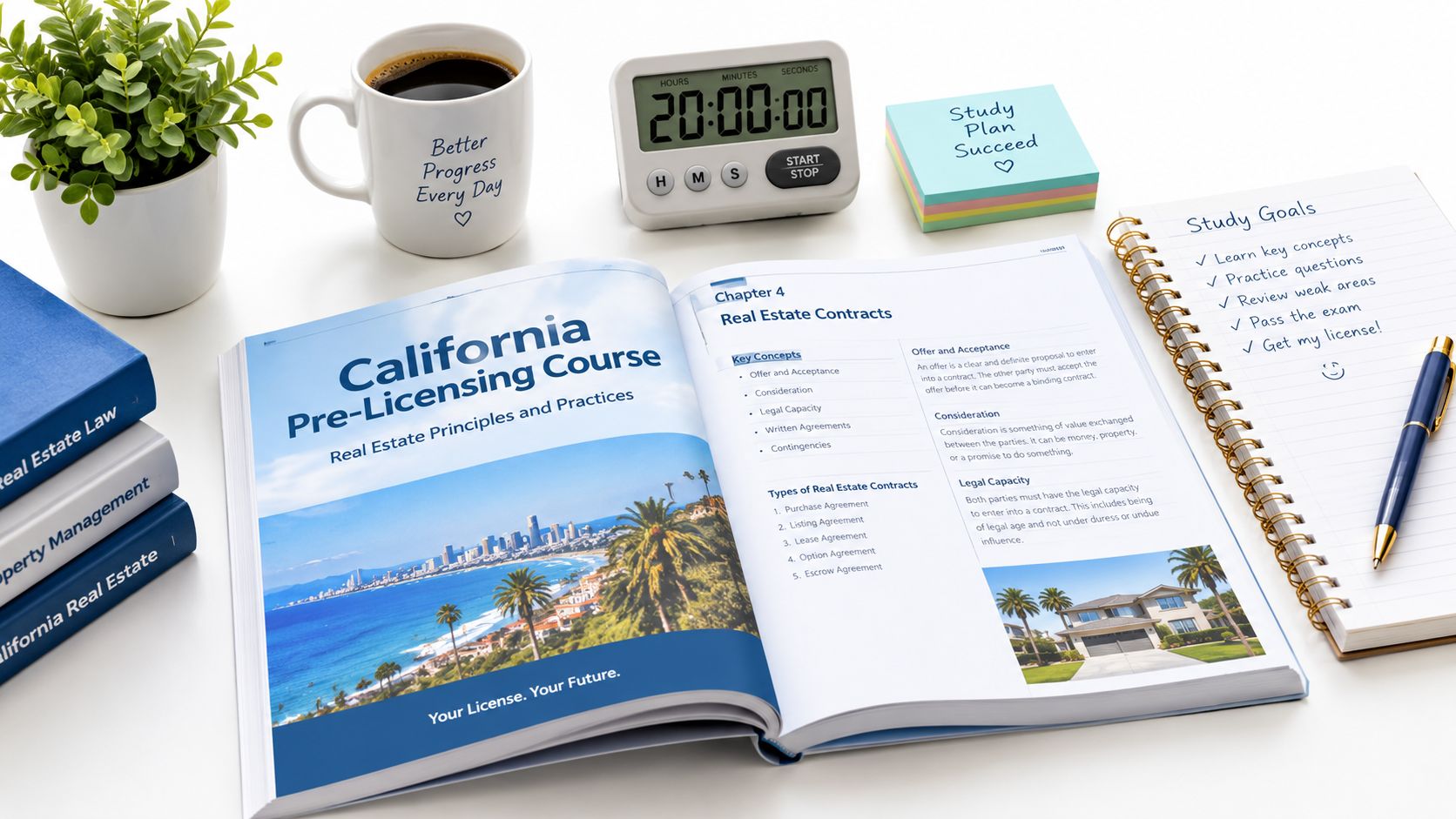
Completing a 20-hour NMLS-approved course, passing the SAFE exam, and registering through the Nationwide Multistate Licensing System are the core requirements for a loan officer license in Bakersfield, California. You can complete the education online from Bakersfield, but approval still depends on the full California application process.
You may be considering this career after working in sales, customer service, finance, or another field where communication and organization matter. The path can look complicated at first because several agencies, forms, checks, and exams are involved. In practice, California gives Bakersfield applicants a clear statewide route, and online education lets you prepare without commuting to a classroom.
A mortgage loan originator, often called an MLO or loan officer, helps borrowers apply for covered residential mortgage loans. The career can offer professional flexibility, remote work opportunities, and commission-based compensation, although earnings depend on the employer, production, experience, and market conditions. Your first objective is simple: satisfy California’s licensing requirements and connect with an appropriately licensed company.
Your Path to Becoming a Mortgage Loan Officer in Bakersfield
A Bakersfield career changer might begin by studying at home after work, completing mortgage lessons online, and then applying for positions with lenders or brokers in Kern County. Rather than attending a local city licensing program, that applicant follows California’s statewide process through NMLS. Bakersfield doesn’t issue a separate city MLO license.
The journey starts with approved education. After completing the required coursework, you prepare for the SAFE exam, submit your application, complete the required background and credit reviews, and seek sponsorship from an appropriately licensed company. Each milestone has a specific purpose, so you can handle the process in an orderly way instead of treating licensing as one enormous task.
What the Bakersfield location changes
Your location affects where you work and which employers you approach, but it doesn’t replace California’s regulatory requirements. The California Department of Financial Protection and Innovation states that MLO applications and maintenance occur through NMLS, and people originating residential mortgage loans must hold the appropriate MLO license. You’ll therefore prepare for a state credential while building local professional relationships.
Working from home can make the education stage more convenient. You can study around family responsibilities or an existing job, then use your training when speaking with prospective employers. Some companies may support remote or hybrid work, while others may expect office attendance, so ask about the employer’s operating model before accepting sponsorship.
The career opportunity behind the license
The license is more than a certificate. It gives you a regulated foundation for helping borrowers understand loan options, organizing documentation, communicating with underwriting teams, and guiding applications toward closing. You’ll still need to develop referral relationships, product knowledge, and strong follow-through, but licensing is the gateway.
A positive start comes from treating the process as a checklist. Finish the education, prepare for the exam, complete the NMLS filing accurately, respond promptly to requests, and identify a sponsoring company that fits your goals.
Step by Step Roadmap to Your California MLO License
The California pathway becomes easier to manage when you separate preparation from approval. Use these milestones as your working plan.
Complete approved education. Finish at least 20 hours of NMLS-approved pre-licensing education before taking the applicable SAFE examination components. Keep your completion documentation and confirm that your provider reports the required information correctly.
Prepare for and pass the SAFE exam. California applicants must pass the applicable national and California state portions through an NMLS-approved test provider. Your course knowledge matters because the exam tests whether you understand federal requirements, ethics, mortgage products, and California law.
Create and complete your NMLS application. File Form MU4 through NMLS, review every answer carefully, and provide the information needed for financial-responsibility and character review. An incomplete or inconsistent application can create avoidable follow-up work.
Complete fingerprints and credit authorization. California requires fingerprints for an FBI criminal-background check and authorization for a credit report review. Handle these tasks promptly and disclose relevant information accurately.
Obtain company sponsorship. An appropriately licensed company must sponsor you. Sponsorship connects your individual license application with the company responsible for your regulated mortgage activity.
Track the application through approval. Education completion doesn’t guarantee licensure. NMLS and California regulators still evaluate the application, background information, financial responsibility, and character standards.
For a more detailed preparation reference, review this California MLO licensing guide. It can help you organize the sequence before you open your application.
Practical rule: Don’t wait until the end of your course to think about sponsorship. Start identifying potential lenders and brokers early, then ask whether they sponsor new California MLOs.
California licensing also includes continuing obligations. The license renews annually during the November 1 through December 31 renewal period, and licensees must continue meeting applicable criminal, financial, and background standards throughout their careers. Put renewal tracking on your calendar from the beginning.
Understanding California Pre-Licensing Education Requirements
California’s education requirement has a precise structure. The state requires at least 20 hours of NMLS-approved pre-licensing education, and the curriculum combines national mortgage principles with California-specific law. The California DFPI MLO FAQ identifies the required subjects.
Curriculum area
Required hours
Federal law and regulations
3 hours
Ethics
3 hours
Nontraditional mortgage products
2 hours
Elective instruction
10 hours
California DFPI law
2 hours
The federal component helps you understand rules that apply across mortgage lending. Ethics training addresses conduct and consumer protection. Nontraditional mortgage product instruction introduces products that may require careful explanation, while electives let the course address additional mortgage topics. California law brings the education back to the rules governing your state license.
Why online training works for Bakersfield applicants
You don’t need to travel to a classroom in another California city to complete the education. Online training allows you to study from Bakersfield using a computer or compatible device, which can be useful if you’re working, caring for family, or testing a new career direction before leaving your current role.
24hourEDU’s California online MLO course provides NMLS-approved education for this pathway, along with online lessons and exam preparation materials. The provider’s NMLS Provider ID is 1405107. Confirm the current course details and reporting process before enrolling, because licensing offerings can change.
Exam preparation deserves its own attention. Passing the course and passing the SAFE exam are separate achievements. Use practice questions to identify weak subjects, revisit explanations instead of memorizing answers, and make California law part of your study plan rather than leaving it for the end.
Education is preparation, not approval
Completing the course demonstrates that you’ve met the education milestone. It doesn’t automatically create an active license, authorize you to originate loans, or remove the need for NMLS review and company sponsorship. Keep those distinctions clear when planning your job search.
The strongest learners treat the course as career preparation. Take notes on terminology, ask questions about borrower documentation and compliance, and connect each topic to the daily work of reviewing applications and communicating with clients. That approach helps you prepare for both the exam and the responsibilities that follow.
Completing the NMLS Registration Process Successfully
After education and testing, the NMLS application becomes your main administrative task. You’ll submit Form MU4, enter personal and professional details, authorize required reviews, and respond to document requests. Treat the application like a loan file: consistent, complete information makes review easier.
Before filing, collect your employment history, address records, identification documents, and explanations for anything that may appear in your background or credit information. Use the same names and dates throughout the forms. Save submitted materials and confirmation records so you can answer questions without starting from memory.
The checks you must complete
California applicants must satisfy several review requirements:
Character and financial responsibility: Regulators may examine unresolved liens, judgments, bankruptcies, or other issues that raise questions about financial responsibility.
Company sponsorship: An appropriately licensed company must sponsor the application.
Application disclosure: Form MU4 answers must be accurate, with explanations and supporting documents when required.
Application status: After submission, check NMLS messages and status updates for deficiencies, document requests, or instructions from the regulator.
The California DFPI overview of MLO licensing explains how these requirements reflect the federal Secure and Fair Enforcement for Mortgage Licensing Act of 2008, commonly called the SAFE Act. The NMLS registration process under the SAFE Act explains how education, testing, and background checks connect through one system. The SAFE Act established education before initial licensure and continuing education after licensing.
Addressing a difficult record
A past financial or criminal issue does not automatically determine the outcome. DFPI notes that certain fraud-related liens or judgments can affect eligibility. Felony convictions within the preceding seven years, along with fraud, dishonesty, breach-of-trust, or money-laundering felonies at any time, can trigger denial unless pardoned or expunged.
If you have concerns, prepare before submitting MU4. Gather court records, lien information, proof of resolution, and evidence of rehabilitation where relevant. Explain the matter accurately rather than guessing at disclosure language. Qualified legal guidance may help because an education provider or prospective employer cannot guarantee a regulatory decision.
Application advice: Education completion is a milestone, not a promise of approval. Prepare disclosures before filing, answer every question truthfully, and respond quickly if NMLS requests clarification.
Ask prospective employers whether they can sponsor you and which documents they expect during onboarding. A Bakersfield employer can provide sponsorship and workplace support, but you remain responsible for accurate NMLS information and timely responses. After approval, track renewal and continuing education obligations so your license stays active.
Exploring Mortgage Career Opportunities in Bakersfield
Bakersfield offers a concrete labor-market reason to investigate this career. In the U.S. Bureau of Labor Statistics’ May 2021 profile for the Bakersfield metropolitan area, the occupation classified as Loan Officers had an estimated 310 jobs. The BLS Bakersfield occupational profile reported a 0.990 location quotient, indicating that the area’s concentration of loan-officer employment was approximately equal to the national average at that time.
The same profile reported a mean hourly wage of $43.33 and an estimated annual mean wage of $90,130. Those figures are useful benchmarks, but they aren’t promises for a new MLO. Compensation can vary with experience, employer structure, production volume, commissions, and market conditions.
Reading the numbers responsibly
A mean wage describes an average across the occupation. It doesn’t tell you what every entry-level employee earns, how a particular broker structures commissions, or how quickly a newly licensed MLO builds a referral network. Ask employers how base pay, commissions, bonuses, leads, training, and chargebacks work before comparing offers.
The location quotient also deserves careful interpretation. A figure near the national average indicates that loan-officer employment had a similar concentration locally at the time of the BLS profile. It doesn’t guarantee hiring, future growth, or a specific number of available openings.
Where new MLOs can create value
Your early advantage may come from service rather than seniority. Borrowers need clear explanations, organized document collection, prompt updates, and a professional who can reduce confusion during a high-stakes transaction. A new MLO who responds reliably and learns the company’s products can become valuable while building experience.
You might pursue employment with a lender, mortgage broker, or another appropriately licensed company. Some roles may offer remote work and flexible scheduling, while others depend heavily on office collaboration and local networking. Commission potential can be attractive, but it usually depends on completed production and the employer’s compensation plan, so evaluate the full arrangement.
Career perspective: The license opens the regulated career path. Your communication habits, compliance discipline, product knowledge, and referral relationships determine how you develop within it.
Remember that BLS also separates loan officers from loan interviewers and clerks. Those classifications represent different occupations, so don’t use statistics for clerical roles as a substitute for loan-officer benchmarks.
Expanding Your License to Multiple States
A California MLO license can become the starting point for a broader career, but it doesn’t automatically authorize you to originate loans everywhere. Each state controls its own licensing requirements, and NMLS provides the central system used to manage many state applications and records.
The basic approach is methodical. First, identify the states where your employer operates or where you expect to serve borrowers. Then review each regulator’s MLO requirements, including education, testing, background review, credit authorization, sponsorship, and any state-law course or application conditions.
A practical multi-state sequence
Begin with your California foundation, then ask your sponsoring company which jurisdictions it supports. An employer with a multi-state platform may help you understand sponsorship and operational requirements, but you remain responsible for submitting accurate personal licensing information.
For each additional state:
Check the regulator’s rules: Requirements can differ even when NMLS manages the application.
Confirm education and testing status: Some states may recognize portions of your existing record, while others may require additional state-specific education or testing.
Submit the new application through NMLS: Follow the jurisdiction’s instructions rather than assuming California’s process applies without changes.
Arrange sponsorship: You may need sponsorship from a company authorized to conduct mortgage activity in that state.
Track approvals separately: Maintain a record of each license, renewal window, continuing education obligation, and employer relationship.
Why multiple licenses can help
Multi-state licensing may support remote work, relocation, and broader client coverage when your company is authorized to operate across jurisdictions. It can also make your skills more useful to a lender or broker serving borrowers in several markets. The benefit depends on the company’s business model and your ability to manage different state obligations.
Don’t treat additional licenses as a shortcut around compliance. Before discussing a loan with a borrower in another state, confirm that both you and your company are authorized for that activity. Keep state-law differences visible in your workflow, especially when disclosures, advertising, and renewal requirements vary.
Your California application gives you experience with NMLS, but every expansion still deserves its own checklist. Careful recordkeeping prevents a promising multi-state career from becoming an avoidable compliance problem.
Your Next Steps Toward Mortgage Licensing Success
You now have a practical sequence for pursuing a loan officer license in Bakersfield, California. Complete the required education, prepare for the SAFE exam, file Form MU4 through NMLS, finish fingerprint and credit requirements, secure sponsorship, and monitor the application through approval.
Start by selecting an NMLS-approved online course that fits your schedule and confirms California coverage. Then create a personal document folder for education records, exam preparation, application information, background disclosures, and employer contacts. That small organizational habit can make the process easier to manage.
Next, speak with potential Bakersfield lenders and mortgage brokers about sponsorship, training, compensation, and work arrangements. Ask direct questions before accepting a role, especially if you want to work from home or build a flexible schedule. The license provides the regulatory entry point, but your employer determines much of your initial operating environment.
Annual renewal belongs in your long-term plan as well. California’s renewal period runs from November 1 through December 31, so set reminders and maintain your continuing education records rather than waiting for a deadline.
24hourEDU offers online NMLS-approved MLO education for California applicants, including the required coursework and free exam preparation materials. Visit 24hourEDU to review the training options and begin preparing for your Bakersfield mortgage career.
24hourEDU NMLS Mortgage Loan Officer Course – $189 All States