


You've finished a lesson, highlighted a page of mortgage terms, and squeezed in a few practice questions after work. But the SAFE MLO exam still feels like a wide field of rules, disclosures, and calculations, and you're not sure whether you're studying the right things.
That uncertainty is common, especially when you're balancing a job, family, and a licensing goal. Effective SAFE Act exam prep is less about memorizing every definition and more about following the test blueprint, finding what you don't understand, and practicing how to apply the rules.
What SAFE Act Exam Prep Really Looks Like
A textbook's chapter order can help you learn the material, but it should not decide how you spend every study session. The SAFE MLO National Test is built on a weighted content outline, and NMLS pass-rate data puts the first-time pass rate near 53%. When roughly half of first-time candidates fall short, effort alone does not explain it. Study time has to point at the domains the exam scores, which is why the outline, not the table of contents, should set your plan.

It also helps to separate pre-licensing education from test readiness. State-licensed MLO applicants generally need at least 20 hours of NMLS-approved pre-licensing education, with required instruction in federal law, ethics, nontraditional mortgage lending, and mortgage origination. Those hours work like the classroom portion of driver's ed: they qualify you to sit for the test, and they are required before your license is issued. What they do not do is confirm you can pass. Candidates can sit for the exam before finishing a prep course, so completing coursework and being exam-ready are two separate milestones.
Treat preparation as its own task after the hours are done: learn the rules, test your recall, and practice applying them under question pressure. If you have studied for a different kind of assessment before, this guide for Leaving Cert Irish students offers a useful parallel on organizing revision around what an exam asks you to do.
Practical rule: A completed course tells you the lessons are done. Your practice results tell you what still needs work.
The Five Test Domains and How to Weight Your Study Time
A candidate who gives every topic the same number of study hours is preparing for a test that does not exist. The SAFE MLO National Test has 120 multiple-choice questions, including 115 scored items and five unscored pretest items, and the official NMLS content outline cited earlier assigns each domain a different weight. Just over half of first-time test takers pass, so matching your study hours to the outline is one of the simplest edges you can build into your plan.
| SAFE MLO Test Domain Weights at a Glance | Weight | What It Covers |
|---|---|---|
| Mortgage Loan Origination Activities | 27% | Working through the application and origination process, including borrower information, disclosures, qualification, and closing |
| Federal Mortgage-Related Laws | 24% | Federal rules that govern mortgage lending and the MLO's responsibilities |
| General Mortgage Knowledge | 20% | Mortgage concepts, products, and lending knowledge |
| Ethics | 18% | Consumer protection, fair lending, professional conduct, and related obligations |
| Uniform State Content | 11% | State licensing and regulatory topics included in the national test |
Origination activities and federal law together carry more weight than the other three domains combined. These questions often link a process step to a legal duty, so memorized definitions fall short. For example, a question might describe an MLO who has just received a borrower's financial documents and ask what should happen next. Answering well requires knowing both the origination workflow and the disclosure rule that applies at that moment.
General mortgage knowledge and ethics earn roughly two-fifths of the exam between them. Ethics questions in particular test judgment: a scenario may present several responses that all sound reasonable, and only one meets the consumer protection standard. Uniform State Content has the smallest share. It still deserves a focused review block, scheduled after you have built a foundation in the heavier domains.
A vocabulary list cannot carry this exam. What carries it is knowing where the points sit. Map each course lesson, quiz result, and missed practice question to one of the five categories above. Within a week, you will see clearly which domain is costing you points and which one you can maintain with light review. If you want another way to explore rules and legal topics while studying, you can browse legal research options, then keep your exam notes tied to the five-domain structure.
Building a Two-Week Study Schedule That Actually Works
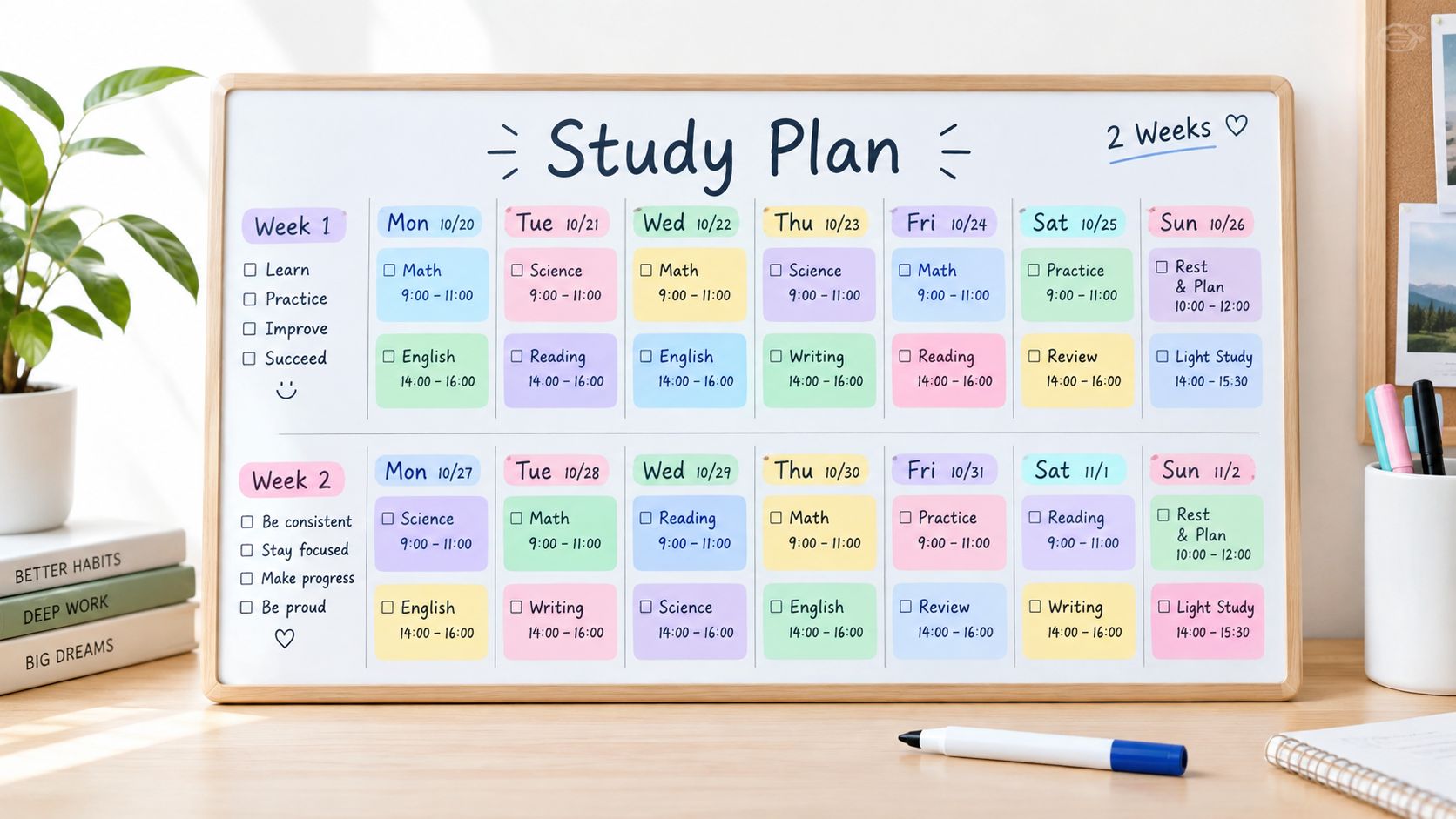
A study plan has to fit around real responsibilities. Instead of saving all your preparation for a long weekend session, divide it into manageable blocks and give the heaviest test domains more room. The sample below is a sequence of study priorities, not a promise that every candidate will be exam-ready in the same amount of time.
A practical sequence
| Study days | Main focus | Practice task |
|---|---|---|
| Early sessions | Mortgage Loan Origination Activities | Work through application, disclosure, qualification, and closing examples |
| Next sessions | Federal Mortgage-Related Laws | Build notes around the rule, its trigger, and the action it requires |
| Middle sessions | General Mortgage Knowledge and Ethics | Mix concept review with borrower scenarios |
| Later sessions | Uniform State Content and weaker domains | Review state topics, then return to your error log |
| Final sessions | Mixed-domain review | Take timed practice sets and review every missed answer |
Set aside a regular daily block that you can maintain. Use part of it to learn or refresh one topic, then close your notes and answer questions from memory. If a session goes poorly, record the issue instead of trying to fix every weakness in one sitting.
Keep the required education on a parallel track. NMLS specifies 20 hours of approved pre-licensing education, divided among federal law and regulations, ethics, nontraditional mortgage lending, and mortgage origination instruction (NMLS pre-licensure education FAQ). Check your state's rules as well, since it may require additional education.
Short, consistent sessions make it easier to revisit difficult concepts before they fade. For more ideas on organizing study time, see this guide to studying efficiently for exams.
Practice Questions as a Feedback Loop
A candidate misses three questions on a fifty-question quiz and still scores well above passing. On paper, that looks fine. Then you read the misses: all three involve the same weakness, recognizing which event triggers a disclosure requirement. The score told you almost nothing. The misses told you exactly what to fix.
That is the real job of practice work. NMLS sets the passing score at 75% (NMLS testing handbook), and each practice result should steer your next study block. Since the five domains carry different weight on the exam, a miss inside a heavily tested domain deserves more remediation time than a miss on a minor topic, even when both look identical in the score report.

Work through each round of questions like this:
- Take a baseline quiz with your notes closed. Treat it as a diagnostic reading.
- Label every miss by cause. A knowledge gap, a missed trigger, and a rule applied to the wrong situation each need different fixes.
- Return to the rule. Explain why the right answer works and why your choice was tempting.
- Log the error. Record the rule, the distractor you chose, and the correction in one line.
- Retest on fresh questions later. Unfamiliar items on the same topic show whether the concept held.
- Mix domains as accuracy improves. Moving between federal law, ethics, and origination content builds the switching skill the exam rewards.
The error log often separates two problems that feel identical while studying. Never having learned a rule is one kind of miss. Knowing the rule but overlooking the event that activates it is another, and it is the more common failure for candidates who have finished their vocabulary work. A memorized glossary handles definition questions. Scenario questions ask you to spot the trigger and apply the requirement to a borrower you have never seen.
Mixed quizzes build that application skill across the weighted outline. The NMLS SAFE exam practice questions support that review. For a general look at how a timed practice mode presents questions and feedback, Exam Practice for GCSE shows the format in a different field; keep your SAFE preparation tied to the NMLS content outline.
Why One High Practice Score Is Not Enough
One strong practice score feels encouraging, but it can reflect familiar questions, a lucky run, or strength in one domain alongside gaps in another. NMLS reported a 53% first-time pass rate as of December 31, 2024, a useful reminder that completing lessons or doing well once doesn't guarantee exam readiness (NMLS test performance data).

Use performance across several timed, mixed-domain practice exams to judge your readiness. A sensible target is at least 85% on several simulations, which gives you a buffer above the official passing threshold. That target is a preparation benchmark, not a guarantee of a particular test result.
Read the pattern, not just the score
If your accuracy is weak in one domain, review that material directly. If your topic scores look sound but you're running out of time, practice pacing. If you miss questions after skimming the wording, slow down and identify exactly what the question asks before choosing an answer.
Confidence can help you spot patterns too. Mark whether you felt sure, unsure, or rushed before answering. Consistent mistakes on questions you felt confident about often point to a misunderstanding worth revisiting. A single low-confidence mistake may call for a careful explanation, not an entire course restart.
Don't book the exam just because one practice session went well. Wait until you can show strong results across repeated simulations and explain why you chose the correct answer. If your results vary sharply, use the error log to decide whether to spend more time on content, pacing, or reading accuracy.
Tackling Scenario Questions That Mix Federal Law and Ethics
Scenario questions can combine several responsibilities in a single borrower interaction. You might need to recognize what information was received, decide whether a regulatory requirement has been triggered, and consider whether a proposed action treats the borrower fairly. Knowing separate definitions helps, but the exam can ask you to apply them together.
Consider a borrower who has provided information about a mortgage request, and the MLO is deciding what to do next. Don't jump to the answer that sounds most familiar. First identify the facts the question gives you, then ask which event or obligation those facts trigger. Separate a legal requirement from a company preference, and choose the action that follows the rule while treating the borrower fairly.
A decision sequence for mixed topics
- Find the trigger. What happened in the scenario, and which rule does that event make relevant?
- Name the duty. Is the question testing a disclosure, a qualification step, a fair-lending concern, or another responsibility?
- Check the proposed action. Does it satisfy the requirement, or does it rely on a convenience or preference instead?
- Eliminate distractors by reason. A familiar term doesn't make an option compliant. Explain why each alternative fails before settling on your choice.
For example, an answer that delays a required next step for business convenience shouldn't win over an option that follows the applicable rule. Another answer may sound supportive but fail to address the actual trigger. Your task is to identify the obligation the facts activate, not to choose whichever response appears friendliest.
Mortgage industry experience can give you useful context, but it doesn't replace careful regulatory reasoning. A familiar workplace habit may not be the rule the exam is testing. Reviewing fair-lending practices can help reinforce the habit of considering how an action affects borrowers, alongside the specific requirements covered in your course.
Exam Day Logistics and Planning for a Smart Retake
Arrive with a plan to read carefully, manage your pace, and avoid turning one difficult question into a distraction. Follow the current NMLS testing instructions for your appointment, including what identification or other materials you may bring. At the start, read the question stem and answer choices fully; when an item feels uncertain, identify the rule involved and make the best supported choice.
The SAFE Act also sets different licensing paths according to the employer. MLOs at covered financial institutions generally register with NMLS, while many MLOs at non-depository companies need a state license and NMLS registration (CFPB SAFE Act FAQ). The SAFE Act was enacted on July 30, 2008, establishing a nationwide framework for licensing and registering residential MLOs (CFPB SAFE Act procedures).
If you don't pass, use your score report to rebuild your plan. Identify the weaker domains, then check whether your mistakes came from missing knowledge, pacing, or misreading. NMLS materials describe waiting periods after failed attempts, so consult the current official testing guidance before scheduling a retake (NMLS testing handbook).
Keep your education timeline in view, too. Under NMLS policy, the required pre-licensing education may need to be repeated if you don't obtain a valid state license or federal registration within the applicable three-year period (NMLS pre-licensure education expiration policy). A retake is a reason to adjust your approach, not to repeat the same study routine unchanged.
A structured course, focused practice, and steady review can make the licensing process feel manageable. Online education can also fit around work and other responsibilities, helping you take a practical next step toward an MLO career.
24hourEDU offers an NMLS-approved online SAFE pre-licensing course with instructor-led video lessons, an e-textbook, a bonus state-law module, and exam-prep materials included. Explore the course and support options at 24hourEDU and build a study plan that prepares you for both the SAFE MLO test and your licensing requirements.
