


48% of buyers attend an open house at some point in their search, according to NAR-linked figures discussed by Investopedia. Very few of them begin their purchase there. That gap is the whole argument for treating open houses as a testable side channel rather than a paycheck.
So yes, attend, but only when the home’s price, neighborhood, and likely visitors match loans you can originate. Your job in the room is narrow: answer financing questions at the moment of interest, strengthen a referral relationship that already produces, and leave with permission for a real conversation. Run each weekend’s event through the go-or-skip test ahead, then decide with your calendar instead of your guilt.
When Loan Officers Should Attend Open Houses
Attend with a purpose, not because your calendar is empty. A suitable event gives you access to people considering a purchase you can help finance. An unsuitable one consumes preparation, travel, and follow-up time that you could spend serving borrowers already in your pipeline.
Don’t confuse property discovery with mortgage demand. In the 2024 NAR profile, 4% of buyers identified a yard sign or open-house sign as how they found the home they purchased, as reported by Robert Lilley’s industry analysis. That combined category doesn’t measure lender introductions, applications, or funded loans.
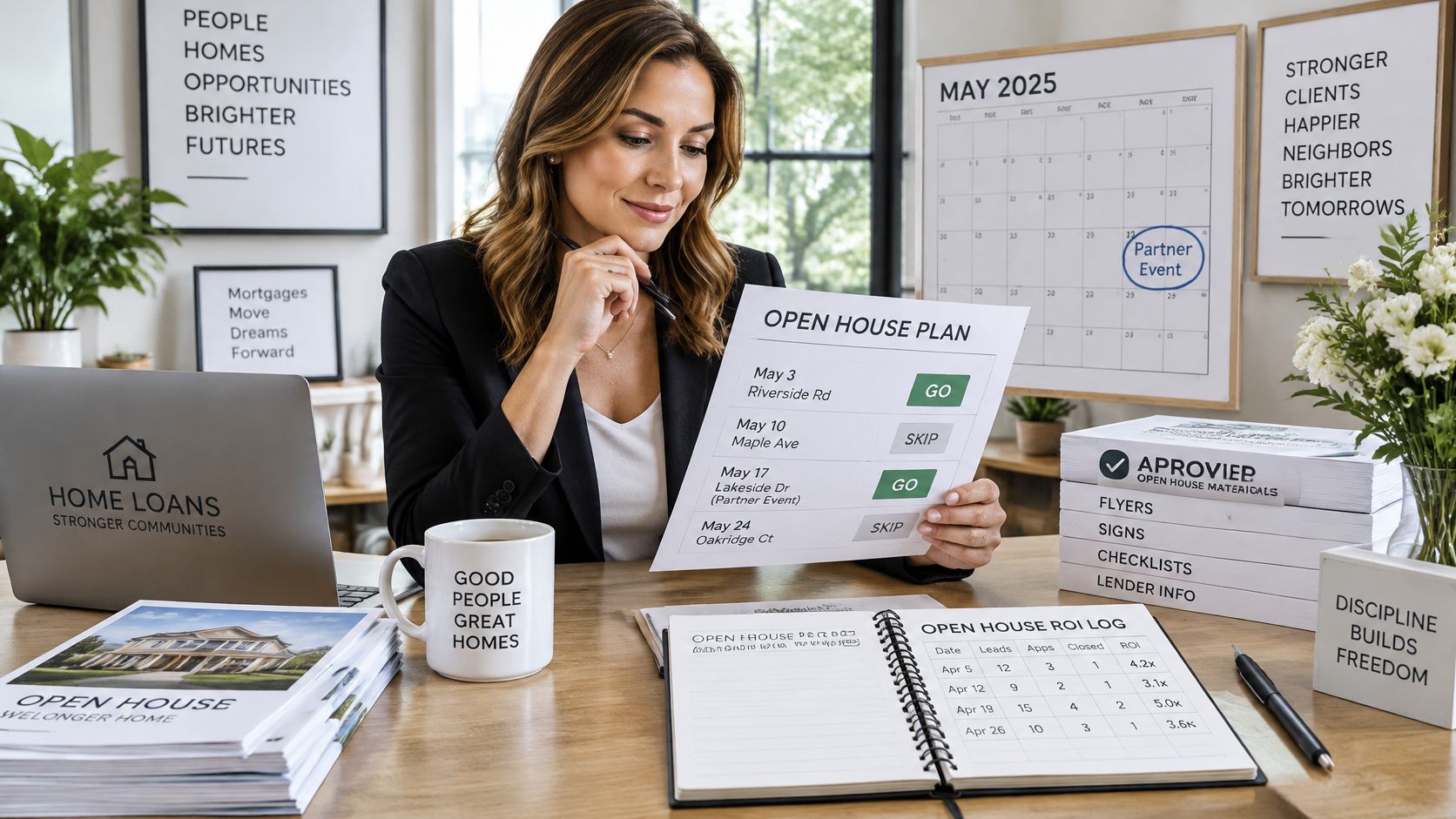
Go or skip this open house
| Situation | Decision | Why it pays or costs |
|---|---|---|
| Price and neighborhood match your loan programs | Go | Visitors are plausible borrowers |
| Host already refers clients and expects steady traffic | Go | You reinforce a referral relationship |
| You can explain preapproval and affordability without a pitch | Go | Buyers get answers at the moment of interest |
| Host asks you to be a second professional so they are not alone | Go if the crowd still fits | Safety for the host plus useful conversations |
| Sparse traffic or a price far outside your products | Skip | Time costs more than the likely conversations justify |
| Plan to take an application or quote personal terms in public | Skip | Licensing, privacy, and trust risk |
| Host expects payment for introductions | Skip | RESPA referral-fee exposure |
| Same hours could work warm referrals already in your pipeline | Skip this week | Higher expected yield elsewhere |
The host’s safety is a legitimate consideration. Having another professional present means they aren’t sitting alone in an unfamiliar property while strangers arrive. It’s a practical benefit, not a security guarantee, and it shouldn’t become an excuse to attend every poorly matched listing.
The strongest invitation sounds specific: the host expects buyers in your lending range, wants help answering financing questions, and understands that visitors aren’t required to speak with you. The weakest invitation amounts to bringing a banner and waiting.
Make the invitation earn a yes
Ask how the host attracts visitors and handles inquiries before the event. If they’re considering automated intake, Voicedial.ai’s resource on chatbot lead qualification for real estate offers context for discussing a digital qualification workflow. Keep that workflow separate from sensitive mortgage information and permission to receive lender outreach.
The upside is face time with plausible borrowers, a chance to demonstrate financing knowledge, and companionship for a host who would otherwise work alone. The downside is unpaid time, uncertain production, and limits on what you should discuss or collect publicly.
Choose a matching row for this weekend and treat attendance as a defined pilot, not a permanent Saturday obligation.
What Buyer Behavior Says About the Room
Buyers who walk through a property aren’t all at the same stage. Some are checking whether their furniture fits; others are wondering whether the payment fits. Your value comes from recognizing the financing question without interrupting the tour.
The National Association of REALTORS® 2024 Profile of Home Buyers and Sellers found that 23% of buyers considered open houses “very useful.” That’s a meaningful audience for in-person education, even though the format isn’t buyers’ dominant information source.
Prepare for more than first-time questions
NAR’s 2024 generational-trends report shows open-house use across age groups, including 57% among buyers ages 59–68, 53% among ages 49–58, 47% among ages 40–48, 43% among ages 31–39, and 46% among ages 18–30, with approximately 50% in each of the ages 69–77 and 78–98 groups.
Don’t turn those age categories into assumptions about an individual. A younger visitor might already own property, and an older visitor might be buying for the first time. Ask what they’re trying to accomplish rather than guessing from appearance.
| Visitor’s question | Useful preparation |
|---|---|
| “Can I buy before selling?” | Explain what information is needed to evaluate overlapping obligations |
| “Can family help with the down payment?” | Prepare a general explanation of gift-fund documentation |
| “Would a larger down payment help?” | Separate payment effects from cash-reserve considerations |
| “What does preapproval involve?” | Bring a concise checklist and a secure next step |
Move-up buyers may need help separating available equity from spendable closing funds. Others may be comparing a larger loan with a smaller purchase, or deciding how much cash to retain after closing. Those conversations require listening, not a rehearsed first-time-buyer presentation.
Respect the host’s limited window
According to Zillow’s 2024 Consumer Housing Trends survey, the median U.S. seller hosted 2 open houses in 2024. Treat the event as the seller’s showing opportunity, not your seminar room.
Let the host present the property and manage questions about the sale. You handle financing when invited, without offering opinions about who should live in the neighborhood or whether a visitor looks qualified.
Think of yourself as the financing help desk in a showroom. Translate the price on the flyer into the questions a buyer needs answered, then let them continue looking.
RESPA Licensing and Privacy Limits
An open house should be an education setting, not a public origination desk. Under CFPB Regulation H, an individual generally meets the mortgage-loan-originator definition when, for compensation or gain, they take a residential mortgage application and offer or negotiate loan terms. Public representations, including cards, signs, brochures, and rate lists, can also evidence engagement in the origination business.
That distinction matters before you print materials. An aspiring MLO shouldn’t present themselves as authorized to originate because they’ve enrolled in education or passed a test.
Verify your authority and the money arrangement
The CFPB’s SAFE Act FAQs distinguish state-licensed originators, generally employed by non-depository companies, from registered originators generally working for covered banks or credit unions. Confirm your company affiliation and authorization in the applicable jurisdiction before conducting regulated activity, especially when crossing state lines.
Never pay for introductions. The CFPB’s RESPA marketing-services guidance explains the prohibition on kickbacks and referral fees connected to settlement services and the compliance risks associated with marketing arrangements. Don’t condition your support on referrals, imply that buyers must use your company, or assume calling a payment “marketing” makes it acceptable.
Have compliance review proposed cost-sharing before you commit. Keep records of approved arrangements rather than trying to reconstruct them after an event.
Keep public education separate from private qualification
Use company-approved materials to explain fixed versus adjustable structures, qualification factors, and the purpose of preapproval documents. Don’t promise a rate or approval based on a brief conversation beside the kitchen island.
- Protect personal information. Don’t collect Social Security numbers, account details, tax returns, or income documents in public.
- Explain the interaction. Tell visitors that a general conversation isn’t an application.
- Obtain permission. Record contact information only after the visitor agrees to follow-up through an approved process.
- Use a consistent approach. Offer the same access to information and the same qualification pathway to every visitor.
- Move individual scenarios. Schedule a private consultation and use your company’s secure application or document portal.
Our guide to mortgage consumer protection laws can help aspiring originators understand the consumer-protection framework behind those habits. Your employer’s approved scripts, advertising procedures, retention rules, and state-specific requirements govern how you apply them.
A welcoming table is useful. A pile of financial documents on that table is not.
How to Prepare and Work the Open House
Preparation should make you easier to approach, not harder to avoid. Bring enough information to answer a buyer’s immediate question and enough judgment to know when to stop talking.
Follow a practical event routine
-
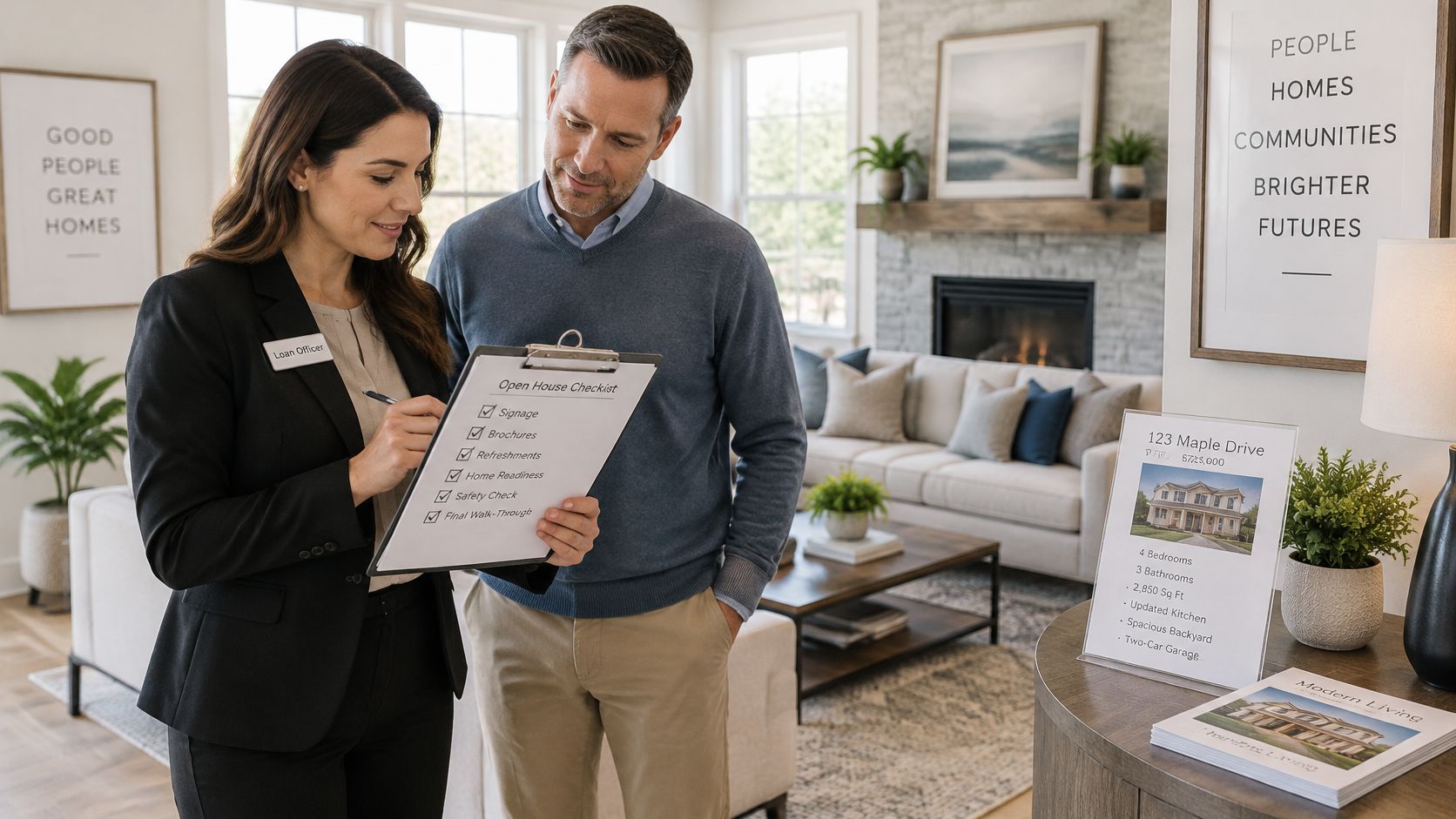
Confirm the invitation and property details. Ask for the list price, property taxes, association dues, expected visitor profile, and published hours. Agree that you won’t interrupt tours or compete with the host’s presentation.
-
Check authorization and approved materials. Verify that your license, company affiliation, and state authorization fit the activity. Pack approved cards and a concise financing sheet, not an improvised rate advertisement.
-
Prepare anonymous payment illustrations. For example, compare hypothetical scenarios with 5%, 10%, and 20% down, using approved assumptions. Label them as illustrations, not quotes, and identify taxes, insurance, association dues, and mortgage insurance where applicable.
-
Arrive early and choose an unobtrusive position. Stand where visitors can find you without blocking the entrance. Confirm with the host how you’ll introduce your role and handle financing questions.
-
Let visitors experience the home first. Try a low-pressure invitation: “Would a plain-English explanation of the financing steps help?” Don’t follow someone from room to room waiting for an opening.
-
Explain affordability without guessing approval. Distinguish the estimated housing payment from the borrower’s full budget. Describe the income, asset, credit, and debt information needed for a private preapproval review.
-
Agree on a host-safety plan. If you’ve committed to keeping the host company, remain through the agreed hours and coordinate departure. Decide how either of you will signal discomfort and seek help without escalating a situation.
-
Capture permission and the preferred channel. Ask whether the visitor wants further information before saving their details. Record what they requested so your follow-up answers a question rather than delivers a generic pitch.
-
Debrief and leave professionally. Compare financing themes with the host without sharing private borrower details. Don’t criticize the house in front of visitors, and don’t leave the host unexpectedly alone during closing tasks.
Budget for fieldwork honestly
The Bureau of Labor Statistics notes that mortgage and commercial loan officers may meet clients at homes or businesses, that most loan officers work full time and some exceed 40 hours per week, and that compensation can include salary or a base salary plus commissions. Fieldwork fits the career, but it still consumes working time.
Avoid rate shouting, hovering in bedrooms, disparaging another lender, or covering the host’s signs with your branding. Professional restraint is more persuasive than a louder display.
For relationship-building beyond event day, use our guide to connecting with local referral professionals as an MLO. A dependable partner answers questions and follows through, not just appears in the weekend photograph.
Three Open House Scenes and Follow-Up Lines
A productive conversation ends with a next step the visitor wants. Ask which channel they prefer before you treat a phone number as permission to call. Buyer communication preferences often favor text or messaging apps over phone calls, so many visitors will pick a written channel. A stated preference still is not consent, and neither replaces your company’s outreach procedures.
A first-time visitor asks about a condo
A visitor likes the condo but asks, “Could I afford this?” Don’t pull credit or announce what they qualify for. Walk through an approved sample payment, explain that preapproval involves reviewing income, assets, credit, and debts privately, and identify cash-to-close components such as the down payment, closing costs, prepaid taxes, and insurance.
After they explicitly agree to a text, send a message like this:
I enjoyed talking with you about the condo today. This message doesn’t start an application. Reply if you’d like a private preapproval checklist, and you’re free to use any lender.
Keep your sample separate from a conclusion about their finances. The useful result is a clearer process, not an on-the-spot verdict.
A move-up couple has a home to sell
Separate the sale from the proposed purchase. Suggest asking their current servicer about the mortgage payoff process, then explain that estimating sale proceeds requires more than subtracting a loan balance from a hoped-for selling price. Agent commissions, transfer costs, and repair credits all change the net number, so a sidewalk guess can mislead them twice: once on what they will pocket, and again on what they can spend next.
Offer a private review of purchase readiness without guessing their equity on the sidewalk. A next-morning email could say:
“Would a 20-minute call help you organize the sale-and-purchase questions? I can send a document checklist first. You’re free to use any lender, and I’ll include the host only if you both want me to.”
A quiet event mainly helps the host
Suppose only a couple of visitors arrive. Greet them without pressure, then use the quiet period to ask the host which financing questions buyers regularly raise. A slow afternoon that produces one well-informed host beats a busy afternoon that produces no consented contact.
Follow up with the host: “Thanks for having me. The recurring question was how buyers should compare association dues with their overall housing budget. I can prepare an approved buyer-education sheet for your next showing, making clear that visitors are free to use any lender.”
Don’t manufacture a buyer list to make the afternoon look productive. Use inclusive materials, offer accessible formats where available, and avoid assumptions about language needs, household relationships, or neighborhood fit.
How to Measure Open House ROI
Track outcomes, not how busy the living room felt. NAR-linked buyer research summarized in SixPL’s lead-generation guide indicates that only about 5% of buyers met their agent at an open house, while recommending a 90–180-day pilot for evaluating open-house contacts against other channels. That agent-introduction figure isn’t a mortgage conversion rate.
There’s no reliable neutral industry benchmark that tells you how many visitors will become funded borrowers. Build a record of your own activity and compare it with referral and digital contacts from the same period.
Open-house pilot log
| Field | What to record | Why it matters |
|---|---|---|
| Event | Address, price, host, date, hours including travel | Shows whether the listing matched your target |
| Conversations | Unique visitors who discussed financing | Separates foot traffic from real talks |
| Consented follow-ups | Name, channel, and yes to contact | Blocks unpermitted outreach |
| Applications | Files opened from those contacts | First production signal |
| Preapprovals | Letters issued from those files | Shows serious borrowers |
| Funded loans | Loans that close from that event | The outcome that pays |
| Cost per funded loan | Time value plus materials divided by funded loans | Compares Saturday hours with other sources |
Use your CRM for permitted contact details and a spreadsheet for channel totals. Count preparation, travel, attendance, and follow-up time, not merely the advertised showing hours.
A visitor who receives education but declines contact is someone helped, not a captured lead. Record that distinction without treating the conversation as a failure.
Calculate before recommitting
Consider a hypothetical pilot: four events require 16 total hours and produce six consented follow-ups, two applications, and one funded loan. Those are example inputs, not expected results.
For that example, the time component is 16 hours per funded loan. Add your chosen hourly time value and actual material costs, then divide total cost by funded loans attributable to the channel; when no loans have funded, report the cost and zero funded loans rather than inventing a unit cost.
Decision rule: Keep the events that produce useful borrower engagement or a clearly defined partner benefit. Don’t keep attending merely because you’ve already invested Saturdays.
Track follow-up response as an early indicator while loans move through the pipeline. Distinguish a new borrower sourced at the event from an existing contact whose decision you helped.
Compare alternatives using our guide to how mortgage loan officers find clients. If another channel produces more funded loans per working hour, reserve open houses for the hosts and properties that justify the difference.
Choose a Better Next Move
Should loan officers attend open houses? Yes, when the event has a defined borrower audience, a cooperative host, and a measurable purpose. If those conditions aren’t present, spend the time elsewhere without feeling that you’re neglecting your career.
Attend deliberately or switch channels
Book a suitable partner’s event and prepare approved illustrations, or choose a more direct activity:
- Ask past clients for warm introductions. Make the request personal and avoid compensation arrangements that create referral-fee concerns.
- Arrange brief partner conversations. Meet financial planners, builders, and insurance professionals who serve similar borrowers.
- Answer opted-in questions. Send a useful affordability explanation by the recipient’s preferred approved channel.
- Teach a buyer workshop. Use an online session or community venue to explain preapproval without turning education into pressure.
Apply the same time-and-outcome accounting to each option. A home-based role or flexible calendar can be attractive, but employer expectations and borrower deadlines still shape your schedule; commission income isn’t guaranteed.
Get qualified before presenting yourself as an originator
For state-licensed MLO applicants, the CFPB’s screening and training guidance describes 20 hours of pre-licensing education, required testing, and licensing reviews involving financial responsibility, character, and background. Complete the national SAFE MLO exam and applicable state and NMLS steps before conducting licensed activity.
Our NMLS-approved online education makes preparation manageable from anywhere with an internet connection. The included free exam prep package provides access to all Mortgage Loan Originator video content from the 20-hour National Course, and four free bonus courses include Become a Top Producer, Specializing in Jumbo Loans, Lead Generation, and Networking for MLOs.
Build the qualification first. Then choose business-development activities that make good use of it.
24hourEDU offers an NMLS-approved 20-hour online MLO course with free exam prep to help you prepare for licensing before you represent yourself as an originator at an open house. Visit 24hourEDU to explore the course and get help identifying your state’s licensing requirements, then build a weekend plan around useful buyer education rather than attendance alone.

