



So, what exactly is mortgage underwriting? Think of it as the final exam for a home loan application. It's that critical, behind-the-scenes financial review a lender performs to make sure everything checks out before they approve the loan.
Decoding the Mortgage Underwriting Process
At its heart, mortgage underwriting is the lender's version of due diligence. It’s the make-or-break stage where a loan file goes from a preliminary "pre-approval" to a final, binding "clear to close." During this process, an underwriter meticulously verifies every single detail a borrower has provided—from income stubs and job history to credit scores and the home's official appraisal.
For any aspiring Mortgage Loan Originator (MLO), mastering this stage is the key to building a successful, high-income career. When you submit a well-prepared loan file because you know exactly what underwriters are looking for, you can dramatically speed up the closing timeline and create a smooth, stress-free experience for your clients.
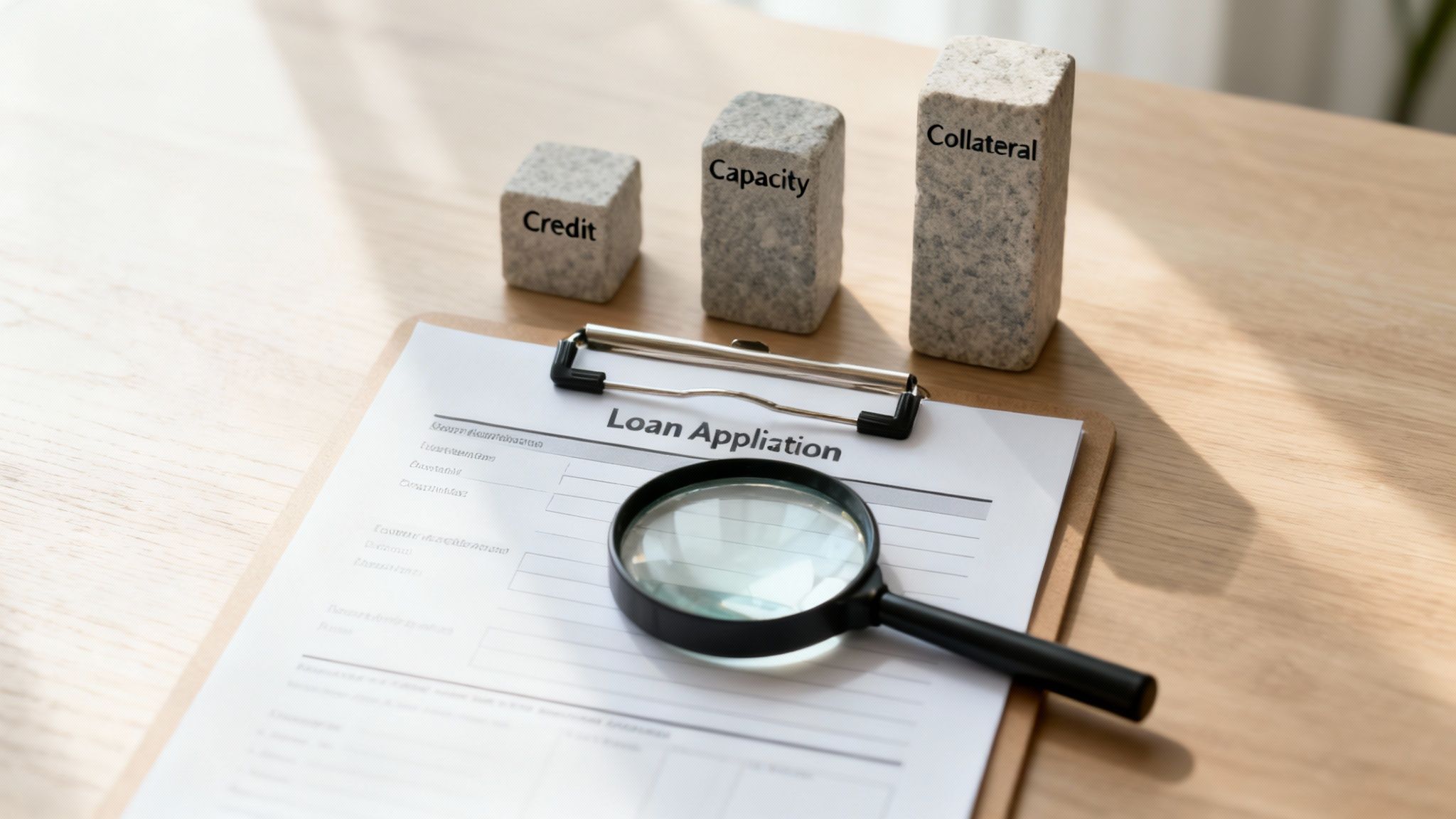
The Three Pillars of Underwriting
Every decision an underwriter makes boils down to a time-tested framework often called the "Three Cs." These pillars give them a structured way to assess the risk of lending someone hundreds of thousands of dollars. Understanding them is like getting a peek at the underwriter's playbook.
Here’s a quick breakdown of what they’re looking for:
The Three Pillars of Mortgage Underwriting
| Pillar | What It Means for the Lender | How It Is Assessed |
|---|---|---|
| Credit | Does the borrower have a reliable track record of paying back their debts? | Reviewing credit reports from all major bureaus, checking for on-time payments, and analyzing the credit score. |
| Capacity | Can the borrower actually afford this new mortgage payment each month? | Analyzing income stability, employment history, and calculating the debt-to-income (DTI) ratio. |
| Collateral | Is the property itself a safe investment for the loan amount? | Ordering an independent appraisal to confirm the home's market value is enough to cover the loan if the borrower defaults. |
Getting a solid grasp on these three pillars helps you see the loan application from the lender's point of view, making you a much more effective MLO.
The underwriting process used to be a painfully slow, manual review that could drag on for weeks. Thankfully, as Visionet points out, technology has automated many of these steps, making the process faster and more consistent.
Key Takeaway: Mortgage underwriting isn’t about finding reasons to deny a loan; it's about verifying information to confidently approve one. A great MLO acts as a guide, helping the borrower tell their financial story in a way that checks all the lender's boxes.
Becoming an expert in this field is easy. Our fully online, NMLS-approved education (Nationwide Multi State Licensing System and Registry Approved Provider ID 1405107) breaks down this entire process. With our training, which includes our exam prep package for free, you’ll gain the confidence to guide clients from application to approval and launch a successful and flexible work-from-home career.
The Key People Who Shape Your Loan's Journey
Getting a mortgage isn't a one-person show. Think of it more like a relay race, where the baton—your loan file—is passed between several key players, each with a specialized role. Understanding who does what makes the whole journey from application to closing day a lot less mysterious.
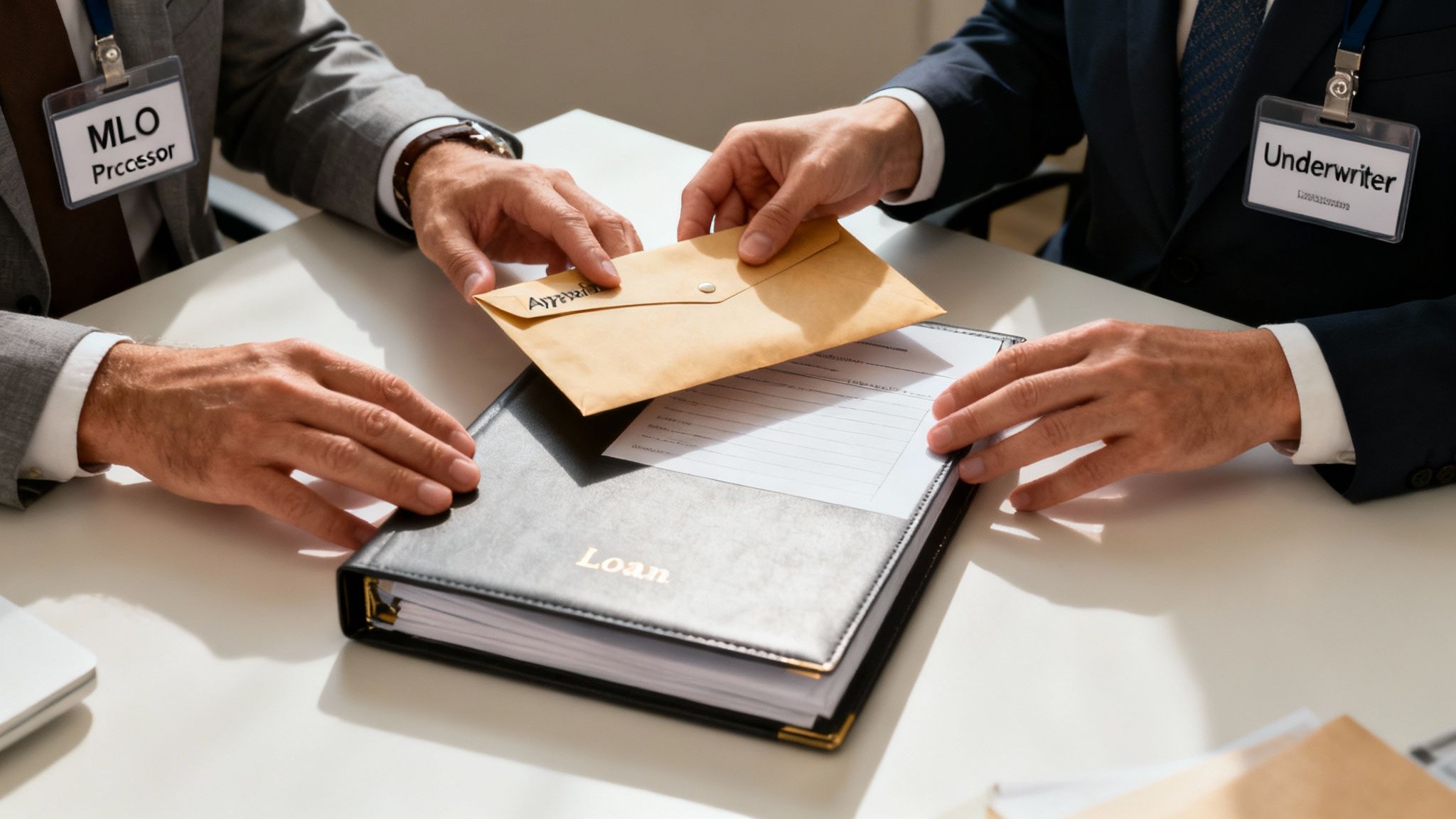
This team effort is all about making sure every detail is accurate, verified, and meets the lender's guidelines. For anyone looking to become a Mortgage Loan Originator, mastering these relationships is your ticket to a high-income career. It’s how you build a reputation for submitting perfect files that sail right through the system.
The Frontline Guide: The Mortgage Loan Originator
Your first point of contact and primary guide is the Mortgage Loan Originator (MLO), often called a Mortgage Loan Officer. The MLO's job is to sit down with you, understand your financial goals, and help you pick the right loan product. They're the ones who gather your initial application and all the necessary documents.
A great MLO is your advocate, setting the tone for the entire process. They make sure your application is complete and tells an accurate story about your finances, which is the first and most important step toward a quick approval.
The File Organizer: The Loan Processor
Once your application is in, the Loan Processor steps in. Think of them as the project manager for your loan file. Their main job is to take all your paperwork—pay stubs, bank statements, tax returns—and organize it into a neat, complete package for the underwriter.
They'll double-check for any missing information and might circle back to you for more details. The processor is responsible for getting the file "submission ready," a critical step for a smooth handoff to the final decision-maker. For a deeper dive, check out our guide comparing the roles of a loan processor vs loan officer.
A well-processed file is an underwriter's best friend. It presents a clear, concise financial story, which can significantly speed up the approval timeline.
The Final Decision-Maker: The Underwriter
The Underwriter is the star of the show and the person who has the final say. They are the lender's risk expert, responsible for digging deep into your credit, capacity, and the collateral (the property itself). Using strict lender guidelines and powerful automated systems, they make the ultimate call: approve, deny, or approve with conditions.
Of course, a few other key players feed information into this process:
- Appraisers: These pros provide an unbiased, expert opinion of the property's market value, which is essential for evaluating the collateral.
- Title Agents: They are the detectives who ensure the property's title is clean, with no liens or ownership disputes that could derail the sale.
- Transaction Coordinators: To keep all the paperwork moving and deadlines on track, it helps to understand the role of a real estate transaction coordinator, who often plays a vital part in the bigger picture.
For anyone who wants to launch a Mortgage Loan Originator career—with the freedom to work from home and name your own hours—knowing how these pieces fit together is everything. Our fully online, NMLS-approved education (Nationwide Multi State Licensing System and Registry Approved Provider ID 1405107), which includes our exam prep package for free, teaches you exactly how to manage these relationships and deliver a seamless experience for every single client.
A Step-By-Step Walkthrough of the Underwriting Timeline
So, what does the mortgage underwriting journey actually look like from start to finish? Forget the idea of a mysterious maze. It’s more like a detective solving a case, following a series of clear, predictable stages.
Understanding this timeline is a game-changer for any MLO who wants to provide a stellar client experience. While the exact duration can shift based on how complex a loan is or how busy the lender is, the core phases always stay the same. This is where a great Mortgage Loan Originator really shines—turning a confusing wait into a transparent, step-by-step process.

Phase 1: Application Submission and Initial Review
(Timeline: 1-3 Business Days)
This is the starting gun. Once you submit the complete loan package, it enters the lender’s system and almost immediately gets a once-over from an Automated Underwriting System (AUS). Think of this as a powerful software bouncer performing an initial check at the door.
The AUS zips through key metrics like credit score, debt-to-income, and loan-to-value, comparing them against the rulebooks from giants like Fannie Mae, Freddie Mac, or the FHA. Within minutes, it spits out a preliminary finding: an initial approval, a referral for a human to review, or a denial. This first step sets the tone for everything that comes next.
Phase 2: Processing and Document Verification
(Timeline: 3-10 Business Days)
After that initial digital handshake, the loan file moves to a loan processor. Their job is to verify every single piece of paper you submitted. This is where the real detective work begins as they confirm the borrower’s information is accurate and complete.
During this phase, the processor is busy:
- Ordering Third-Party Reports: This is when they order the property appraisal and the title report. They need to make sure the house is worth what everyone thinks it is and that the ownership is clean.
- Verifying Employment and Income: They’ll likely call the borrower’s employer to confirm their job status and salary are what the application says they are.
- Checking Assets: The processor will scrutinize bank statements, making sure the money for the down payment and closing costs came from legitimate sources.
Any missing documents or red flags get flagged right here. That’s why a complete, well-organized file from the MLO is so critical to keep the train moving.
Phase 3: The Underwriter’s Analysis
(Timeline: 5-15 Business Days)
Now, the file lands on the desk of a human underwriter. This is the most intense part of the whole process—where a trained professional makes the final judgment call. The underwriter dives deep, reviewing the AUS findings, the processor's notes, and every single document to ensure the loan checks all the boxes for the lender and regulators.
The outcome usually falls into one of three buckets:
- Approved as Submitted: The dream scenario. The file was perfect, and no more questions are needed.
- Conditional Approval: This is extremely common. It means the underwriter is on board, but they need a few more documents or clarifications before giving the final sign-off.
- Denied: If the loan just has too much risk and doesn't meet the guidelines, it gets denied.
This rigorous review has a massive impact on how well loans perform down the road. For example, research shows that loans from FinTech lenders using advanced underwriting tools had default rates about 25% lower on certain FHA loans compared to traditional lenders between 2015 and 2017.
Curious about how complex workflows like this are mapped out visually? It can be helpful to explore different business process mapping techniques to see how professionals structure these journeys.
Phase 4: Receiving the Clear to Close
(Timeline: 1-3 Business Days)
Once all the conditions from the conditional approval have been met and sent back, the underwriter does one last check. If everything is squared away, they issue the coveted "Clear to Close" (CTC). This is the green light everyone has been working toward.
The CTC is the official signal that the lender is ready to fund the loan. From here, the file is handed over to the closing department, which works with the title company to prep all the final documents for signing day. This is the final step that wraps up the underwriting journey, paving the way for a successful closing.
The Essential Documents Every Underwriter Scrutinizes
Think of a loan file as a financial storybook, and every document is a chapter. It’s the underwriter's job to read this story and confirm that the borrower is a reliable character. For a Mortgage Loan Officer, knowing exactly which documents to collect—and why they matter—is the secret to building a file that glides right through underwriting.
Putting together a clean, complete package from the get-go is a game-changer. It shows you’re a pro and makes the underwriter’s job way easier, which always helps your borrower’s case.

Income Verification Documents
This is where the underwriter digs into the "Capacity" piece of the puzzle. They need solid, undeniable proof that your borrower's income is stable, consistent, and more than enough to handle the new mortgage payment. It’s less about one big paycheck and more about the history of steady earnings.
Underwriters are hunting for a predictable pattern. They get that MLOs, for instance, earn high commissions, but they still need the paper trail to back it up.
Here’s the typical laundry list:
- Recent Pay Stubs: Usually the last 30 days' worth to show what they’re earning right now.
- W-2 Forms: Going back two years to establish a solid employment history.
- Federal Tax Returns: Two full years are the standard, especially for anyone who is self-employed or earns a lot in commissions or bonuses.
At the end of the day, the underwriter is just connecting the dots. They’re using past earnings to predict the borrower's future ability to make payments. Every document helps paint a clearer picture of that financial stability.
Asset Verification Documents
Next up, the underwriter has to confirm the borrower has the cash for the down payment, closing costs, and any required reserves. But it's not just about seeing the money in an account; it's about knowing where it came from. A huge, mysterious deposit is a major red flag that could signal an undisclosed loan or something fishy.
To tackle this part of the what is mortgage underwriting process, the underwriter zeroes in on:
- Bank Statements: The last two or three months for all checking and savings accounts.
- Investment Account Statements: If the borrower is pulling funds from stocks, bonds, or retirement accounts, they’ll need to show the statements.
The underwriter will comb through these statements looking for anything out of the ordinary. They want to see that the funds are "seasoned"—a fancy way of saying the money has been sitting in the account for a while.
Credit History Documents
This is a big one. The underwriter pulls what’s called a tri-merge credit report, which mashes up data from the big three bureaus: Experian, Equifax, and TransUnion. It gives them a complete 360-degree view of the borrower's financial habits.
They’re looking at way more than just the score. They analyze payment history, what kind of credit the borrower uses, how long they’ve had it, and any public records like bankruptcies or foreclosures. This is where a sharp MLO can really shine by helping clients clean up their credit before the file ever gets to underwriting.
Property and Purchase Details
Finally, the underwriter has to check out the collateral—the house itself. The lender needs to be confident that the property is actually worth what the borrower is paying for it. If things go south and the borrower defaults, the lender needs to be able to sell the house to get their money back.
Two documents are critical here:
- The Purchase Agreement: This is the legally binding contract that spells out the sales price, closing date, and all the other terms of the deal.
- The Property Appraisal: An independent, licensed appraiser gives their professional opinion on the home's market value. This number absolutely has to be at or above the sales price.
For a deep dive into all the paperwork you'll encounter, our complete mortgage documentation checklist is a fantastic tool for any aspiring MLO. Mastering these documents is a core skill we teach in our NMLS-approved online courses (Nationwide Multi State Licensing System and Registry Approved Provider ID 1405107), all designed to help you get licensed and start your career with total confidence.
How to Navigate Common Underwriting Hurdles
Hearing your loan is "conditionally approved" can sound a little scary, but in the mortgage world, it’s actually great news. It means the underwriter has given your file the green light—they just need a few last-minute items before they can stamp it "final." It’s not a rejection; it's a simple to-do list.
For a sharp Mortgage Loan Originator (MLO), this is business as usual. An experienced MLO doesn't see these requests as problems but as the underwriter's final piece of due diligence. Handling these small asks with confidence and speed is what makes a great MLO stand out.
This is where an MLO's expert touch makes all the difference, turning what could be stressful hurdles into simple, manageable tasks for their clients.
Understanding Conditional Approval
Think of a conditional approval like a teacher handing back a great essay with just a few notes in the margins. The core of the work is solid, but a few small tweaks are needed to lock in that A+.
The underwriter is basically saying, "This all looks good, I just need you to clarify this one thing." These requests, known as "conditions," are typically straightforward and designed to tie up any loose ends. The key is to respond quickly, and a professional MLO will have already anticipated most of these requests before the underwriter even asks.
Common Conditions and How to Handle Them
While conditions can vary, there are a few that pop up all the time. An MLO who knows how to prep clients for these makes the entire process feel smooth and painless.
Here are a few of the usual suspects:
- An Updated Bank Statement: If the original statements are a month old by the time the file hits the underwriter's desk, they'll almost always ask for the most recent one. They just need to see that the funds for closing are still there.
- A Letter of Explanation (LOX): This is just a simple, written note explaining anything that looks out of the ordinary. Common reasons include explaining a large deposit that wasn't from payroll (like a gift from a relative) or clarifying why there was a recent credit inquiry.
- Proof of Cleared Deposits: If a big check was recently deposited, the underwriter will want to see proof that it has officially cleared and the funds are available to use.
- Verification of Gift Funds: Is a family member helping with the down payment? The underwriter will need a signed gift letter and proof that the money has been transferred.
Knowing a borrower’s financial history is a huge part of getting ahead of these requests. You can learn more about what a credit score is and how it's calculated in our detailed guide.
An experienced MLO doesn't just react to conditions—they proactively gather the necessary documents upfront, often solving potential problems before they even come up. This kind of foresight is the mark of excellent training.
The mortgage industry is increasingly leaning on technology to make this process smoother. Globally, the underwriting software market was valued at around $5.7 billion in 2023 and is expected to hit $15.9 billion by 2032. This shows just how much tech is helping make underwriting faster and more accurate for everyone.
Becoming the kind of MLO who can expertly guide clients through these final steps is easy with the right education. Our fully online, NMLS-approved training (Nationwide Multi State Licensing System and Registry Approved Provider ID 1405107) gives you the skills to anticipate underwriter requests, advise clients with confidence, and build a successful, high-income career right from home.
Preparing for a Smooth and Fast Underwriting Experience
A smooth underwriting process isn’t about luck; it’s about smart preparation. For both borrowers and Mortgage Loan Originators (MLOs), a few key steps upfront can turn a stressful waiting game into a streamlined path to the closing table. An expert MLO knows exactly how to set the stage for success from the very first conversation.
This is where a skilled MLO’s guidance becomes invaluable. When you set clear expectations and submit a complete, accurate file from the get-go, you're not just moving a loan forward—you're demonstrating expertise and building trust. That's the foundation of a high-income career built on referrals.
Borrower Best Practices for a Seamless Process
As a borrower, the time between your application and closing is a quiet but critical phase. The underwriter is double-checking that your financial situation is stable, so the golden rule is simple: don’t make any sudden moves.
- Avoid Major Financial Changes: Don't change jobs, finance a new car, or open new credit cards. Any significant shift in your financial profile can raise a red flag and stall your approval.
- Be Transparent and Responsive: If you received a gift for your down payment or have an unusual deposit, be upfront about it. When the underwriter asks for a document, send it over as quickly and accurately as possible to keep things moving.
- Keep Your Finances Consistent: Continue paying all your bills on time. Try to avoid moving large sums of money between accounts unless you have a clear paper trail to explain the source.
MLO Strategies for a Quick Closing
For a Mortgage Loan Officer, your goal is to make the underwriter’s job as easy as possible. A clean, well-organized file is your best friend when it comes to navigating the what is mortgage underwriting process efficiently. Set clear expectations with your clients about the documents they’ll need and hammer home the importance of financial stability during this period.
A successful underwriting outcome is driven by the MLO's expertise. When you anticipate the underwriter's needs and guide the borrower effectively, you control the timeline and ensure a positive result.
Ready to launch a high-income career with the flexibility to work from home? You can become the expert every homebuyer needs. Start your journey today with our comprehensive, NMLS-approved online education (Nationwide Multi State Licensing System and Registry Approved Provider ID 1405107), which includes our exam prep package for free, and master the skills needed for a successful career in the mortgage industry.
Your Top Underwriting Questions, Answered
The underwriting stage can feel like a black box, but it doesn't have to be. Let's clear up some of the most common questions that pop up for both MLOs and borrowers during this final stretch of the homebuying journey.
How Long Does Mortgage Underwriting Actually Take?
This is the million-dollar question, and the answer is… it depends. While an automated underwriting system (AUS) can spit out an initial decision in minutes, the full, hands-on review by a human underwriter takes more time.
On average, you can expect the process to take anywhere from a few days to a few weeks. A realistic timeframe for the entire manual review and condition-clearing process is around 20-30 days. A clean, well-packaged loan file from an organized MLO can definitely speed things up by cutting down on the back-and-forth.
Pre-Approval Versus Final Underwriting Approval
It's easy to mix these two up, but they represent very different stages. Think of pre-approval as a strong handshake from the lender. They've taken a quick look at your credit and stated income and are giving you an educated guess on how much you can likely borrow. It's a conditional green light.
Final underwriting approval, often called the "clear to close," is the finish line. This is the official, binding decision that comes after an underwriter has put every single piece of your financial life under a microscope—from bank statements and tax returns to the property appraisal. This is the last hurdle before the loan is funded and you finally get the keys.
Can I Do Anything to Improve My Chances of Getting Approved?
Absolutely. You have more power than you think. Making an underwriter's job easy is the best way to get a quick and positive decision.
Here’s how you can help yourself:
- Keep your job stable. Consistency is your best friend.
- Pay every single bill on time to keep your credit score high.
- Beef up your savings for the down payment and closing costs.
- Work on lowering your debt-to-income (DTI) ratio before you apply.
The golden rule of underwriting is simple: Don't make any major financial moves. From the day you apply until you have the keys in your hand, avoid opening new credit cards, taking out a car loan, or changing jobs. A steady, predictable financial picture is exactly what an underwriter wants to see.
Are you ready to become the expert guide that homebuyers trust? At 24hourEDU, we make it easy to get your Mortgage Loan Originator license with our fully online, NMLS-approved education (Nationwide Multi State Licensing System and Registry Approved Provider ID 1405107). Our course includes our exam prep package for free to ensure you have everything you need to launch a high-income, work-from-home career. Start your journey at 24houredu.com.








1 Comment