


In 2026, a bank generally must release the first $275 of many check deposits the next business day, while amounts above $6,725 can stay held until the ninth business day under an applicable exception. For a mortgage closing, the document to check is the hold notice, not just the deposit slip.
You've deposited the money for your down payment. Your banking app shows the deposit, your receipt confirms the bank accepted it, and your closing appointment is approaching. Then you notice that your available balance is smaller than your account balance.
That mismatch doesn't automatically mean something went wrong. It means you need the bank's written release schedule before you promise that the money can reach the closing agent.
Standard Reg CC Hold Times for 2026
For a hypothetical $2,000 ordinary check deposited Monday, at least $275 generally becomes available Tuesday, with the remainder generally available Wednesday, assuming no holiday, cutoff issue, or applicable exception under Regulation CC's availability schedules. The important word is generally: the check type, deposit channel, account history, and any exception can change the result.
The framework comes from the Expedited Funds Availability Act, enacted August 10, 1987, implemented through Regulation CC, 12 CFR Part 229, as the Federal Reserve's overview explains. A teller isn't free to invent an unlimited holding period. Federal rules establish availability requirements, although a bank can release money sooner.

Why older hold charts can mislead you
The Federal Reserve's inflation-adjustment rule increased the relevant amounts effective July 1, 2025, after CPI-W rose 21.8% between July 2018 and July 2023. The next-day minimum increased from $225 to $275, the cash-withdrawal amount from $450 to $550, and the new-account, large-deposit, and substantial repeated-overdraft thresholds from $5,525 to $6,725.
Those adjustments follow a five-year cycle under the same rule. An old bank handout or saved online chart may therefore describe an outdated dollar amount even when its general explanation sounds familiar.
Regulation CC availability amounts in effect for 2026
| Deposit | When it must be available | 2026 amount | What changes the date |
|---|---|---|---|
| Cash and electronic payments | Generally next business day; cash treatment assumes an in-person deposit | Full amount | A banking-day cutoff can move the deposit to the next banking day; cash deposited otherwise can have different treatment |
| In-person next-day checks such as on-us, cashier's, certified, teller's, government, and USPS money orders | Next business day when the applicable conditions are met | Full qualifying amount | Payee, location, special deposit slip, and channel conditions can affect next-day treatment |
| Other checks | Next-day minimum, with the remainder generally available the second business day | $275 floor, up from $225 | Nonemployee channels can change treatment; nonproprietary ATMs have separate rules |
| Cash the customer wants to withdraw from funds subject to the special cash-withdrawal rule | Subject to the regulation's cash-withdrawal timing rather than an unrestricted immediate cash payout | $550, up from $450 | This is a separate cash-withdrawal provision, not a cap on every next-day deposit |
| Aggregate checks above the large-deposit line | Normal schedule on the protected portion; qualifying excess can receive an exception hold | $6,725, up from $5,525 | Only the excess qualifies for the large-deposit exception itself |
The table separates deposit availability from the special rules for withdrawing cash. Don't read the cash-withdrawal amount as permission for a bank to restrict every qualifying next-day deposit to that amount.
Start the clock with the accepted banking day
A deposit receipt's timestamp isn't always the start of the availability clock. Ask whether the bank accepted the deposit for that banking day or treated it as received on the following banking day because of its cutoff.
The channel matters, too. Handing a qualifying cashier's check to an employee isn't necessarily equivalent to placing it in an ATM, and not all ATM deposits follow the same schedule. For mobile deposits, check the bank's mobile-deposit agreement rather than assuming the teller-counter schedule automatically applies.
File rule: Record the bank's stated availability date, not merely the date printed on the deposit receipt.
A ledger balance records account activity. An available balance tells you what the bank currently permits the customer to withdraw. Neither the deposit amount nor the hold period can exceed what the applicable rule authorizes, so unexplained differences deserve a question before the funds are counted toward closing.
When Banks May Use an Exception Hold
An exception hold is a defined risk response, not a blank check to freeze money. The bank needs an applicable reason, a permissible extension, and the required notice.
The official commentary to Regulation CC discusses reasonable extensions of up to five additional business days for specified checks and six for certain other categories or emergencies, measured from the applicable starting point. Some circumstances require a different analysis, so those figures aren't a universal release promise.
For a large-deposit exception, the current regulation protects the ordinary availability schedule for the first $6,725 of aggregate daily check deposits; only the excess qualifies for that exception. That protection must not be confused with the rules for other exceptions.
Match the reason to the actual rule
Six Reg CC exception holds and their outer dates
| Exception | When the bank may use it | Amount kept on the normal schedule | Outer date for the rest |
|---|---|---|---|
| Large deposit | Aggregate check deposits exceed the large-deposit threshold during a banking day | The protected initial portion | Excess may receive the applicable extended schedule, generally no later than the ninth business day |
| New account | Account meets the regulation's new-account definition | Protected amount of certain qualifying next-day items | Excess qualifying items may wait until the ninth business day; ordinary checks have separate new-account treatment |
| Repeated overdrafts | Account meets the regulation's repeated-overdraft tests | No universal protected initial slice under this exception | A reasonable extension under the applicable check category |
| Redeposited check | A previously unpaid check is deposited again, subject to regulatory exclusions | No universal protected initial slice under this exception | A reasonable extension under the applicable rule |
| Reasonable cause to doubt collectibility | Specific facts support a belief that the check won't be paid | No universal protected initial slice under this exception | A reasonable extension supported by the stated reason |
| Emergency conditions | Communications failures, equipment problems, or other qualifying emergencies interfere with operations | Availability that remains practicable under the circumstances | Timing tied to the emergency and the applicable reasonable-extension rule |
For an account open fewer than 30 days, the Federal Reserve's compliance guide describes next-day treatment for the first $6,725 of certain qualifying next-day items, with the remaining amount potentially delayed until the ninth business day. Don't assume that this protection covers every personal check deposited into a new account.
The Federal Reserve's exception guidance also identifies returned-and-redeposited checks, repeated overdrafts, and reasonable doubts about payment as distinct grounds for a hold. A generic explanation that the bank is being cautious doesn't tell the borrower which rule applies.
A protected amount under the large-deposit exception isn't a universal protected amount under every exception.
An MLO comparing similar deposits should therefore compare the exception reason, not just the dollar amounts. One borrower may face a large-deposit hold, while another faces a collectibility concern affecting a different portion of the funds. The same deposit size doesn't establish the same withdrawal date.
How to Read the Hold Notice Line by Line
Read a hold notice as a release schedule. A verbal estimate such as about a week isn't detailed enough to plan a wire for closing.
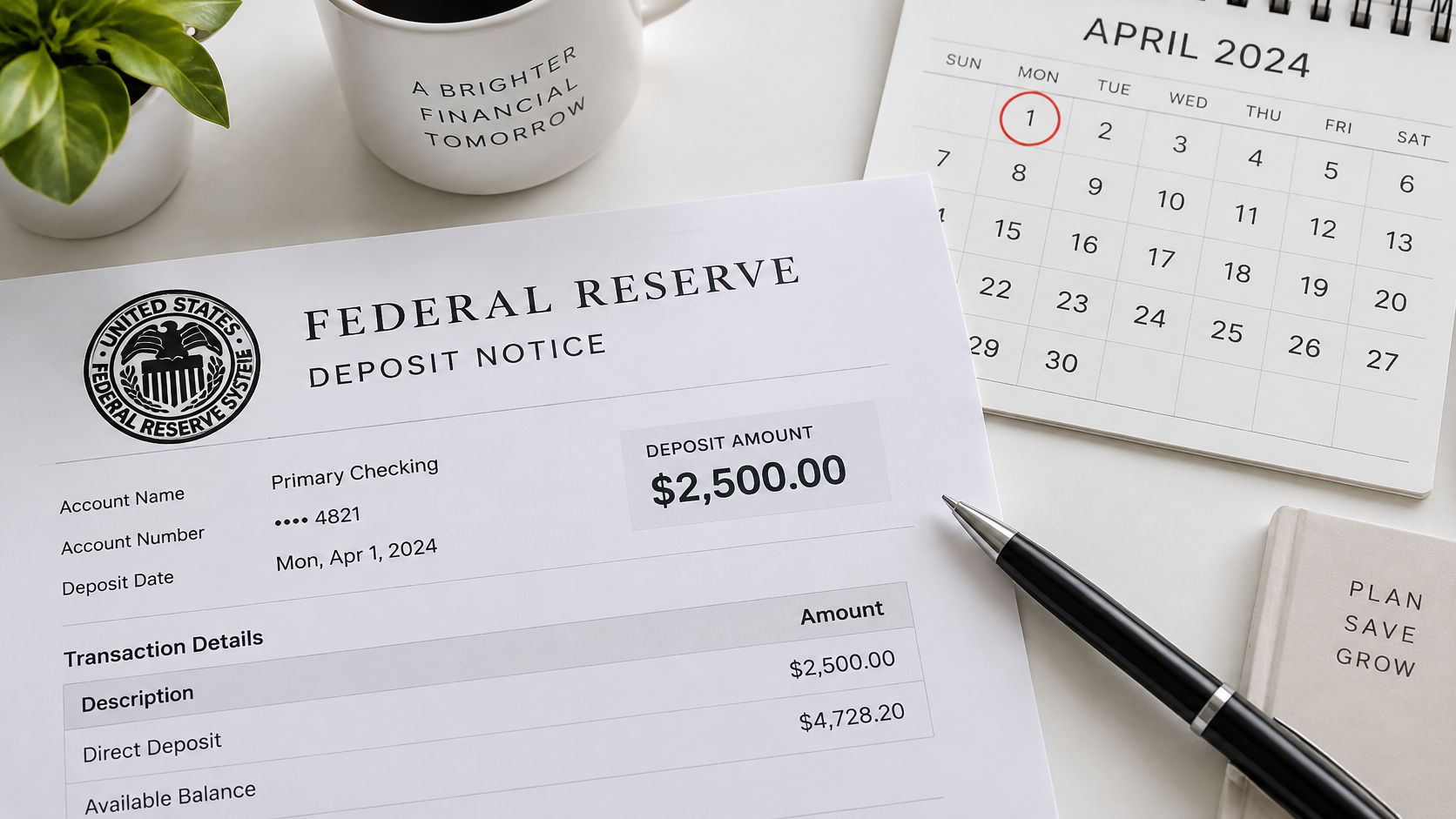
The Federal Reserve's funds-availability example releases $275 by Tuesday the 2nd, an additional $6,450 by Wednesday the 3rd, and the remaining $3,275 by Wednesday the 10th. Those amounts total a $10,000 deposit, with the initial $6,725 released in stages and the excess released later.
Audit the amounts before counting the days
The opening release satisfies the next-day floor. The following release completes the portion governed by the ordinary check schedule, while the final release covers the excess subject to the large-deposit hold.
Don't mistake an example's calendar date for a universal maximum. In a Monday-start calendar without intervening holidays, Wednesday of the following week isn't the ninth business day. The bank can release money before an outer deadline, and the actual notice should identify the date it has assigned.
For a large-deposit-only hold, freezing the entire check until the final release date would overlook the initial portion's ordinary availability treatment. If the bank cites another exception too, ask how that additional exception changes the schedule.
Use this short audit list:
- Deposit identification: Match the notice to the correct account, deposit date, and check.
- Delayed amount: Confirm exactly how much remains unavailable, including any staged releases.
- Exception reason: Identify the bank's stated basis, rather than relying on a general description of bank policy.
- Availability date: Record when each affected portion becomes available for withdrawal.
The same Federal Reserve guidance explains that notice is provided when the deposit is received or, in the described later-decision situation, by the close of the business day when the bank decides to delay availability. Save the written notice even if a teller also explains the hold.
Put the notice into the closing conversation
Photograph or download the notice and highlight the release date. Then compare it with the date the settlement agent needs the money, which may be earlier than the signing appointment.
Use the cash-to-close amount when reviewing the Closing Disclosure, but don't treat that disclosure as evidence that the bank has released the borrower's deposit. The disclosure describes the transaction's costs; the hold notice describes access to the deposited funds.
If a reason, dollar split, or release date is missing, ask the bank in writing which exception applies and when each portion releases. Keep the request date with the notice so the file shows when the question was raised.
Escalate an unresolved timing discrepancy to the bank's compliance officer. If necessary, identify the bank's regulator through its account documents or official complaint information rather than assuming every notice names one. A clear notice changes the withdrawal schedule; it doesn't create an indefinite freeze or prove final payment.
Available Does Not Mean the Check Cleared
Available funds aren't necessarily finally collected funds. A bank can permit withdrawal before it knows that a deposited check will be paid without a later return.
The Federal Reserve's Regulation CC overview describes the balance between prompt availability and the risk of unpaid checks, including fraud. For a borrower, that distinction matters most when the deposited money is immediately sent somewhere else.
Say a borrower deposits a check, sees that the bank has released the funds, and wires the down payment to the closing agent. If the check later returns unpaid, the borrower can still face a debit to the account and potentially a negative balance. Sending the money onward doesn't make the original check irrevocable.

Faster technology doesn't eliminate payment risk
In 2025, federal agencies' request for information on payments fraud discussed the tension between statutory maximum hold periods, the goal of shortening certain periods as processing improves, and the need to address fraud. The policy question isn't whether banks can move information faster. It's whether they can identify a bad payment before the customer spends the credited money.
Regulatory discussions have included CFPB participation in updating the framework, while banking-industry feedback has emphasized holds as a fraud-control tool. Those competing concerns point toward recalibration, not an automatic disappearance of check holds.
International payments introduce another set of processing relationships. For borrowers or professionals dealing with overseas business proceeds, Zaro's correspondent banking guide for SA exporters provides context for that separate topic; it shouldn't be treated as a timetable for a domestic check deposit.
Document access and payment risk separately
A verification of deposit helps establish account information, but don't assume every balance shown represents unrestricted, finally collected money. Ask what the document verifies.
- Confirm the funding method: Discuss an acceptable wire when a check creates uncertainty, following the lender's documentation requirements.
- Ask about collection status: The bank can explain what it knows about the item, although a routine release date isn't an absolute guarantee against return.
- Avoid irreversible promises: Don't tell a borrower that released funds can never be reversed.
Practical rule: Permission to withdraw isn't a promise that the underlying check can never come back.
If the borrower has already used released funds, document the transaction and discuss the remaining uncertainty. Don't substitute an arbitrary waiting period for the bank's explanation or the underwriter's requirements.
Put the Release Date Next to the Closing Date
Before you count a recent deposit toward closing, put the bank's notice beside the settlement schedule. A statement download can show that money entered the account without showing that the borrower can send it out.
Build a short funding record containing the deposit amount, applicable exception reason, and scheduled release date. Add the available balance and the amount the borrower must deliver. This makes the conversation concrete: the issue isn't whether the borrower has a receipt, but whether the required money can reach the settlement agent on time.
Catch the tripwires before scheduling the wire
A personal or gift check may need staged release rather than immediate access to its full amount. A Friday deposit can create a scheduling problem when the closing falls within the bank's hold window, especially if the bank accepted it after its cutoff or a holiday interrupts processing.
A cashier's or certified check needs a different review. Record what kind of check it is, whether it was deposited with an employee, and whether the bank's qualifying conditions were met. The label on the check alone doesn't answer every availability question.
A recently opened account deserves an early question, not a last-minute discovery. Ask the bank how its new-account policy treats that specific item before the borrower moves funds into the account for closing.
Use these questions during the funding discussion:
- What was deposited? Identify the actual instrument, not just the transaction description in the app.
- How was it deposited? Record teller, ATM, mobile deposit, or another channel.
- How old is the account? Flag a recently opened account for a specific bank-policy review.
- Were checks combined during the banking day? A large-deposit test concerns aggregate daily check deposits, not merely the largest individual check.
- When must the settlement agent receive funds? Compare that deadline with the written release schedule, not just the signing date.
These questions fit naturally into mortgage closing procedures. They also help prevent a borrower from moving money between accounts in an attempt to solve a hold, only to create more documentation questions.
Choose the funding method before the deadline
If closing falls inside the hold window, discuss a wire with the borrower, lender, and settlement agent before anyone commits to a funding date. A wire doesn't erase source-of-funds requirements, so preserve the records showing where the money came from and how it moved.
Verify wiring instructions through a trusted, independently confirmed contact method. Don't rely solely on an unexpected email directing the borrower to a new account.
Work backward from the settlement agent's receipt deadline and leave room to resolve discrepancies. If the bank changes the release schedule, obtain an updated written explanation and notify the people responsible for funding.
Cash purchases can involve a different transaction structure, but payment delivery still needs planning. Cyber Homes' explanation of how the cash home buying process works offers useful context when a borrower is comparing a financed transaction with a cash purchase.
Keep the paper trail after the hold disappears from the banking app.
The underwriter may still need the gift documentation, transfer history, check copy, or evidence of release. A cleaner available balance doesn't answer every question about the source and movement of funds.
Turn practical knowledge into a mortgage career
An originator who explains Reg CC holds calmly gives borrowers a clear next step instead of another deadline to worry about. That kind of service can support referrals and commission-based earning opportunities. Depending on the employer and role, mortgage work can also offer remote work and flexibility in arranging appointments, although client needs and funding deadlines still shape the day.
For aspiring originators, the licensing path includes SAFE pre-licensing education, the SAFE exam, and an NMLS application, along with applicable state requirements. Completing a course is an important step, not automatic license approval.
Our 20-hour SAFE pre-licensing course is delivered online through instructor-led video lessons and includes an e-textbook, a bonus state law module, exam prep at no extra charge, unlimited phone and email support, and complimentary NMLS hours reporting. We're approved by the NMLS Nationwide Multi State Licensing System and Registry, our core course is approved in all 50 states, and it's fully updated for 2026; we continuously update our courses for current licensing requirements, and students can complete the course in two weeks or less.
Learn to explain funding questions like Reg CC holds while building toward your Mortgage Loan Originator license with 24hourEDU's online education and included exam prep. Visit 24hourEDU to select your enrollment state and start planning your pre-licensing course.