
Get Your SAFE Mortgage Course & MLO Prelicensing 2026
Learn about our SAFE mortgage course: 20 hours NMLS-approved MLO prelicensing online, with free exam prep & expert support.



You're probably seeing the term subprime mortgage while studying for the SAFE exam and wondering whether it's just a history lesson. It isn't. This topic shows up in licensing education because it connects underwriting, consumer protection, loan features, suitability, and the rules that shape modern mortgage lending.
For an aspiring Mortgage Loan Originator, subprime mortgage explained isn't just about memorizing a definition. It's about recognizing borrower risk, understanding why certain loans cost more, and knowing how poor product fit can hurt both the client and your career. If you can explain this clearly to a borrower and spot the red flags on an exam question, you're already thinking like a professional.
A new MLO often focuses on passing the test first and figuring out loan products later. That's backward. Loan products are the job. If a client has bruised credit, heavy debt, or a high loan-to-value ratio, you need to understand what those risk factors mean in practice.
Subprime lending also sits at the center of why today's mortgage rules are stricter. When you study subprime, you're really studying the reason compliance matters. That includes how lenders evaluate repayment ability, why disclosures matter, and why the SAFE exam spends time on ethical lending standards.
SAFE exam questions often test your ability to connect concepts, not just define terms. You may see fact patterns involving:
Practical rule: If you understand why a loan is priced higher and how its terms can become dangerous for the borrower, you'll answer many SAFE questions more confidently.
Not every borrower fits a clean prime profile. Some are rebuilding credit. Some have prior financial setbacks. Some need guidance more than they need a sales pitch. The MLO who can explain options in plain language earns trust faster.
That trust matters if you want a long-term mortgage career with flexibility, strong commission potential, and the option to work from home. Clients remember the loan officer who helped them understand risk, not the one who rushed them to application.
If you're preparing for licensure, this is also where structured education helps. A course approved through the NMLS, such as 24hourEDU under Provider ID 1405107, can make difficult topics easier to absorb through online instruction and included exam prep materials.
A subprime mortgage is a home loan made to a borrower who doesn't meet prime underwriting standards. The key point is simple: subprime describes the borrower's risk profile, not the house.
The Federal Reserve describes subprime borrowers as people who fail prime underwriting because of weakened credit histories, low credit scores, high debt burdens, or high loan-to-value ratios, as explained in this Federal Reserve testimony on subprime lending. The Consumer Financial Protection Bureau also notes that subprime loans typically carry higher interest rates because lenders expect greater default risk.
A useful way to think about it is this. A prime mortgage is like driving on a paved highway with wide lanes and clear signs. A subprime mortgage is more like a rougher road. The destination may still be homeownership, but the route has more risk, less margin for error, and more cost.
Readers often get tripped up here. They assume a “subprime home” or “subprime neighborhood” exists. That's not the framework lenders use. A beautiful single-family home can secure a subprime mortgage if the borrower's credit and financial profile fall outside prime guidelines.
Subprime status can be tied to factors such as:
| Characteristic | Prime Mortgage | Subprime Mortgage |
|---|---|---|
| Borrower profile | Meets standard prime underwriting | Falls short of prime underwriting |
| Credit history | Generally stronger and more stable | Often weakened or impaired |
| Interest rate | Usually lower | Usually higher |
| Default risk to lender | Lower expected risk | Higher expected risk |
| Pricing approach | Standard market pricing | Risk-based pricing |
| Common concern | Affordability and documentation | Repayment sustainability and product suitability |
You can see a broader overview of loan categories in this guide to types of mortgage loans explained.
A subprime mortgage isn't automatically predatory or illegal. It's a higher-risk loan category. The real issue is whether the product is suitable, clearly disclosed, and based on the borrower's actual ability to repay.
The pricing difference confuses many new students. Lenders generally charge more when they believe the loan has a greater chance of delinquency or default. That higher rate is the lender's way of compensating for added risk.
That doesn't mean every borrower with imperfect credit should receive a harmful loan. It means the lender sees a higher probability of loss and adjusts pricing and terms accordingly. On the exam, remember this distinction: subprime is about risk and pricing, not about the type of property being purchased.
Some borrowers don't fit into the clean, low-risk box that prime lending prefers. That doesn't make them irresponsible, and it doesn't mean they can't become homeowners. It means the file raises more questions for underwriting.

The clearest official description comes from the Federal Reserve. Subprime borrowers are generally those who fail prime underwriting because of weakened credit histories, low credit scores, high debt burdens, or high loan-to-value ratios. For a new MLO, those four ideas are the mental checklist.
A borrower may land in subprime territory for one major weakness or for several smaller ones layered together.
That last point matters a lot. A borrower with modest credit issues might still be manageable. A borrower with modest credit issues, high debt, and minimal equity is a different risk profile altogether.
Risk layering is one of the easiest concepts to miss and one of the most important to understand. One weak factor may be acceptable depending on compensating strengths. Several weak factors together can make the loan much riskier than any single issue suggests.
Here's a simple way to view it:
| Borrower factor | Lower-risk signal | Higher-risk signal |
|---|---|---|
| Credit behavior | Stable recent repayment pattern | Weakened or inconsistent repayment pattern |
| Debt load | Room in monthly budget | Tight monthly budget |
| Equity position | Meaningful borrower investment | Very high leverage |
| File quality | Strong strengths offset weakness | Multiple weaknesses with little cushion |
If you need a refresher on how one major underwriting component works, this plain-language guide on what a credit score is is useful background.
Borrowers don't become “subprime” because of one label. Underwriters look at the full story the file tells.
When a client starts describing their situation, pay close attention to the signals behind the application.
A borrower may say, “My credit took a hit after a rough year.” That's not enough information by itself. You need to know whether the problem was isolated, whether payments have stabilized, and whether the borrower now has the income and reserves to support the loan.
A borrower may also say, “I can afford the payment today.” That statement needs context. Can they afford the full payment over time, under the actual terms of the mortgage, and with their current debt obligations? That's where strong MLOs separate themselves from order-takers.
Subprime lending makes more sense when you understand risk-based pricing. Lenders don't charge the same terms to every borrower because they don't face the same expected risk on every loan. When a borrower presents higher credit risk, the lender often responds with a higher rate, higher fees, stricter conditions, or all three.
That pricing approach can be logical from the lender's perspective. The problem starts when the product's structure creates a payment pattern the borrower can't realistically handle.
One major feature in pre-crisis subprime lending was the adjustable-rate mortgage, or ARM. The risk became more serious when borrowers qualified based on lower introductory payments and later faced higher required payments.
The Chicago Fed reported that about 50% of subprime mortgages were ARMs, and that more than 14% of subprime ARMs were delinquent in December 2006, according to this Chicago Fed analysis of subprime mortgage risk.
For exam purposes, the lesson is straightforward. A loan that looks affordable at the start may become unaffordable after a rate reset.
You don't need a memorized script. You need to know how each feature affects borrower payment risk.
“Payment shock” means the borrower gets used to one payment level and later faces a much higher one. That jump may happen because the rate adjusts, the interest-only period ends, or the loan reaches another trigger built into its terms.
Exam tip: When a loan combines weaker credit with a future payment increase, the risk isn't just the rate. It's the borrower's ability to survive the change.
A strong MLO learns to translate technical language into simple borrower questions:
If the answer to the third question is shaky, the loan deserves a much harder look.
A new MLO enters the business during a hot housing market. Home values keep rising, refinances seem easy, and problem loans do not look dangerous because borrowers can often sell or refinance before the pressure hits. Then prices flatten. That escape route closes, and the quality of the loan file shows up fast.
Subprime lending became a national crisis because it grew far beyond a small pocket of higher-risk lending. The Consumer Financial Protection Bureau explains that subprime loans accounted for about 14% of total residential mortgage loans in Q2 2007, and that the estimated U.S. subprime market reached $1.3 trillion with more than 7.5 million first-lien subprime mortgages outstanding by March 2007, in this CFPB explanation of subprime mortgages.

Rising home prices had been covering up weak loan structures. Once that support disappeared, many borrowers could no longer refinance out of trouble or sell quickly enough to avoid default. Loans that looked manageable on paper proved unstable in real life.
The Cleveland Fed found that performance worsened sharply for later subprime vintages. Within the first year after origination, about 10% of subprime mortgages made between 2001 and 2005 were delinquent or in default, compared with about 20% of those made in 2006 and 2007, according to this Cleveland Fed analysis of subprime mortgage performance.
For SAFE exam purposes, this is the lesson to remember. A risky loan can appear acceptable while prices are climbing. A sound loan still needs to work when prices stall, income gets tight, or refinancing is no longer available.
Many new MLOs understand borrower default but get stuck on how a loan problem turned into a system problem. Securitization is the missing step.
The New York Fed explains that subprime mortgage-backed securities often included credit enhancement features such as subordination, excess spread, shifting interest, performance triggers, and interest-rate swaps, in this New York Fed staff report on subprime securitization. In plain English, thousands of mortgages were pooled together, divided into investment pieces, and sold across the financial system. When enough of the underlying loans failed, the losses moved outward to investors, firms, and funding markets.
A simple comparison helps. One unstable loan is a file problem. Thousands of unstable loans packaged and sold broadly become a market problem.
The Financial Crisis Inquiry Commission reported that many high-cost refinance loans were underwritten largely on collateral value rather than verified repayment ability. That finding matters because it points to the core mistake. A property can support an appraisal. It cannot make the payment for the borrower.
This is one of the most testable ideas in mortgage education. Good underwriting asks whether the borrower can repay under the actual terms of the note, not whether rising home prices might rescue the transaction later.
The central lesson of 2008 is straightforward. Poor underwriting, layered risk, and weak product fit can damage borrowers first and the wider market after that.
The crisis changed how the industry trains, licenses, and supervises MLOs. Licensing standards, education requirements, ethics rules, and federal oversight became more prominent because mortgage origination affects both individual households and the broader economy.
You will also see this connection in compliance topics. Reporting and disclosure rules help regulators identify patterns in lending activity, and that is part of why it helps to understand what the Home Mortgage Disclosure Act is as you prepare for the SAFE exam.
If you remember one practical takeaway, make it this: never treat rising property values as the repayment plan. A successful MLO builds a career by matching the borrower to a loan the borrower can realistically carry.
A borrower with credit challenges doesn't need judgment. They need accuracy, honesty, and a realistic path forward. That's where a skilled MLO adds value.

The Financial Crisis Inquiry Commission found that many high-cost refinance loans were based largely on collateral value rather than verified repayment ability, as noted in this FCIC chapter on underwriting practices. For today's MLO, that lesson should stay front and center. A loan only helps the client if the client can repay it.
A strong consultation usually includes a few plain-language steps:
Mortgage clients want someone who can simplify complexity. If you can explain subprime mortgage concepts clearly, you become more useful to borrowers, referral partners, and employers. That's good for exam performance, and it's also good for long-term income potential.
This career can offer strong commission opportunities, flexible scheduling, and the option to work remotely, but those advantages go to people who know the material cold. Product knowledge builds confidence. Confidence builds trust. Trust creates repeat business and referrals.
One practical path is formal online pre-licensing training that includes exam preparation and support. For example, 24hourEDU offers NMLS-approved MLO pre-licensing education online, includes exam prep materials, and reports completed hours to the NMLS.
If you're ready to turn mortgage knowledge into a real career, 24hourEDU can help you get there. Their online NMLS-approved pre-licensing training includes your exam prep package at no extra cost, along with support designed to make the path to your Mortgage Loan Originator license feel straightforward. If you want a practical way to study, pass the SAFE exam, and move toward a mortgage career with flexible hours and strong earning potential, 24hourEDU is a smart place to start.
Learn about our SAFE mortgage course: 20 hours NMLS-approved MLO prelicensing online, with free exam prep & expert support.

24hourEDU has officially joined the Mortgage Bankers Association (MBA)! By aligning with the MBA's nationwide network, 24hourEDU continues to elevate national standards for NMLS pre-licensing, continuing education, and SAFE MLO exam prep—empowering loan originators to succeed in today's lending environment.

Discover everything about the 20-hour SAFE course online. Learn curriculum details, state approvals, exam prep, and how to launch your MLO career quickly.

SAFE Act training explained clearly. Learn NMLS requirements, course structure, provider tips, and exam prep for your Mortgage Loan Originator license.

Learn the anatomy of a house from foundation to roof, including systems, finishes, and structural details that shape every mortgage underwriting decision.
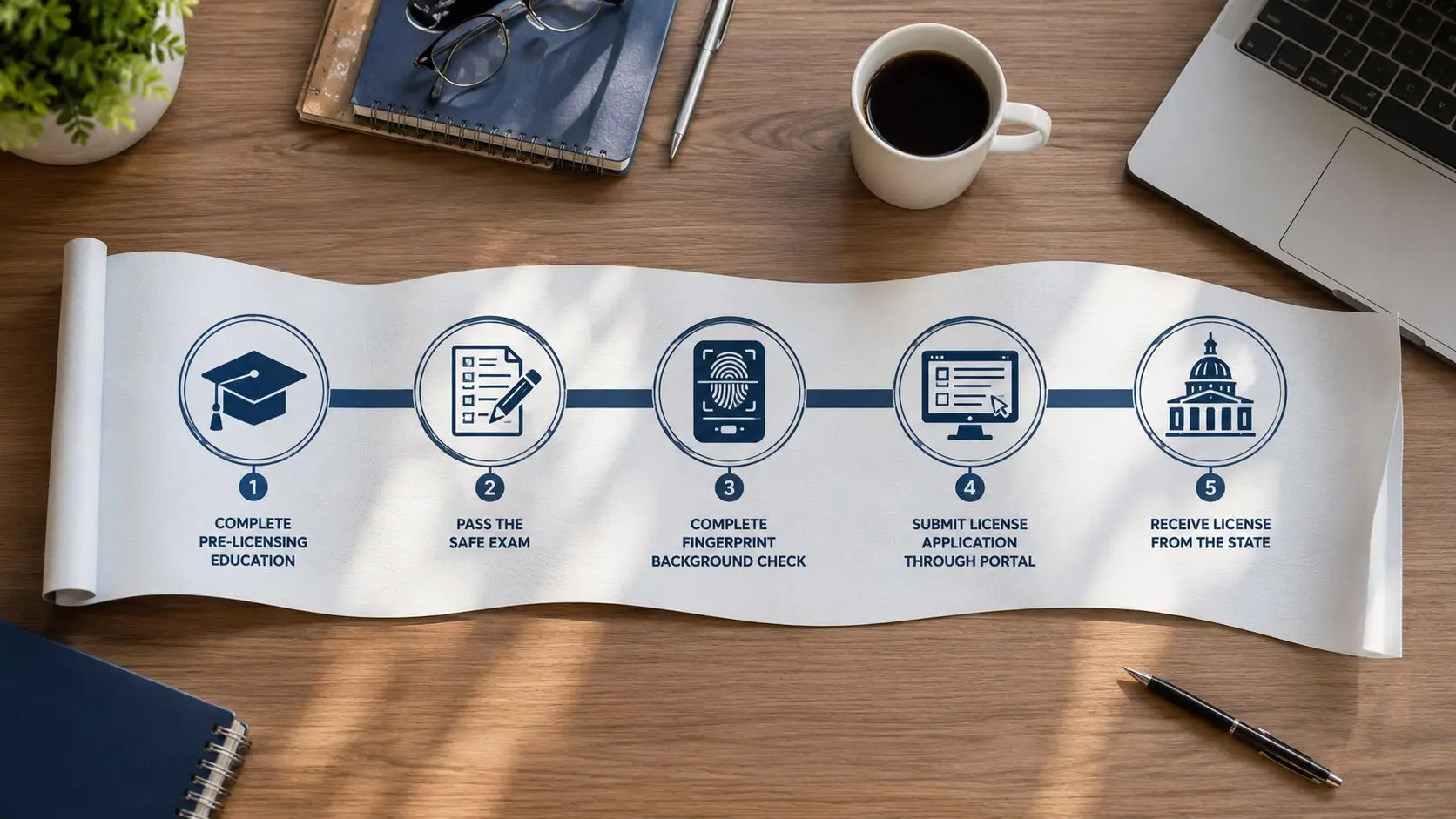
Learn safe act licensing requirements for mortgage loan originators, including the 20-hour course, SAFE exam, background checks, and state-specific rules.

Find out how an exam prep course helps you earn your Mortgage Loan Originator license. Learn features, benefits, and how to choose the right NMLS-approved

Get NMLS SAFE exam practice questions that mirror the real test, plus proven strategies to turn practice into a passing score on your first attempt.

Discover the top instructor led training benefits for MLOs, including improved retention, real-time feedback, and enhanced compliance. Learn why it works.

Fixed rate mortgage explained in plain English, with real numbers, clear examples, and practical tips every aspiring MLO should know before talking

Learn how reciprocity mortgage broker license rules actually work in 2026, why true reciprocity is rare, and how to navigate state-by-state approval.
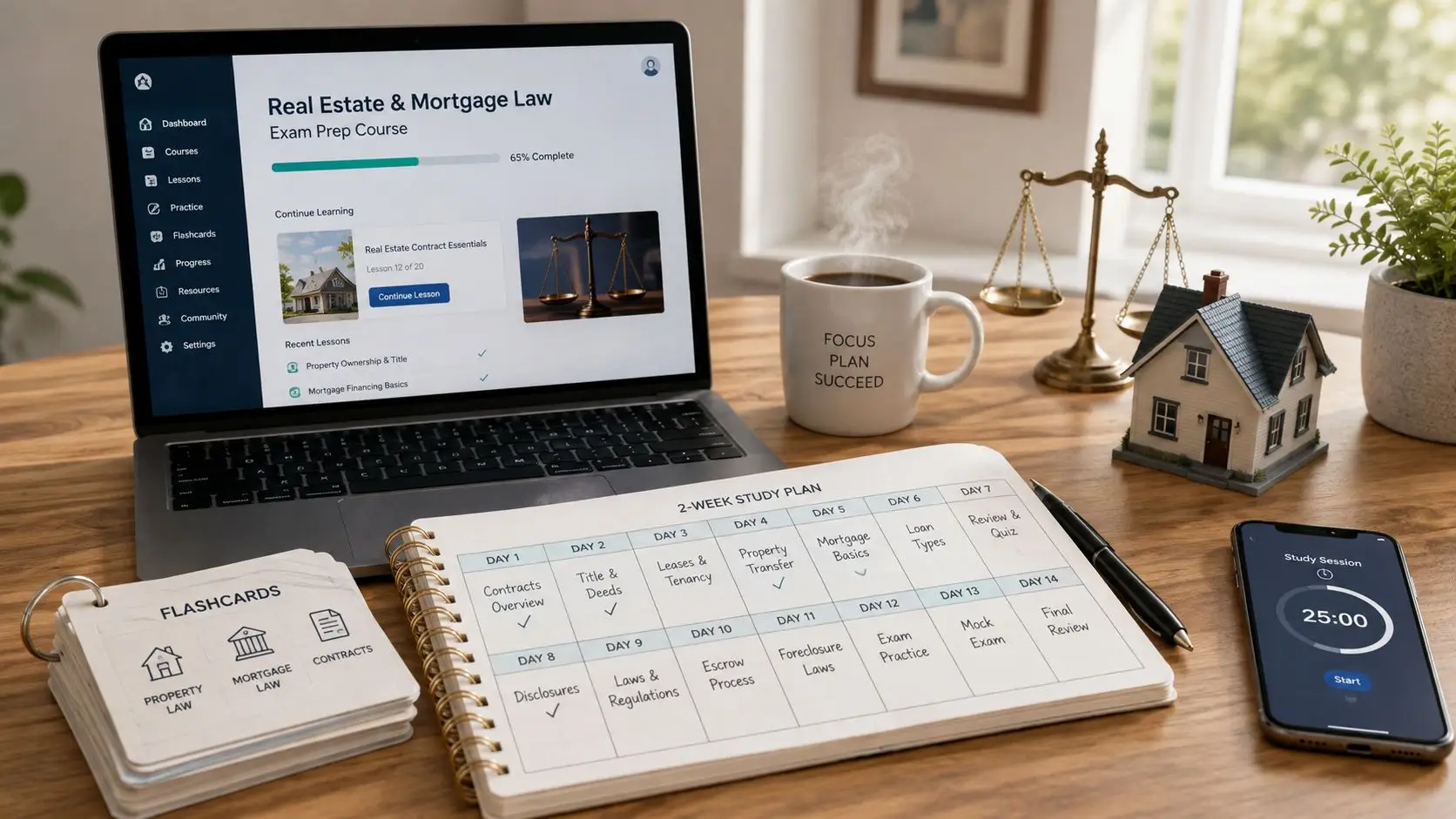
SAFE exam test prep made simple with a step-by-step study plan, practice exam strategies, and proven timelines. Pass your NMLS exam with confidence in 2026.
