


You're comparing online MLO pre-licensing courses. The pages look similar, the course hours appear identical, and every provider highlights NMLS approval. Then your login fails, a module refuses to mark complete, or your certificate doesn't arrive when you need it. Suddenly, the support department matters as much as the coursework.
Technical support and customer support solve different problems. One keeps the learning platform working. The other keeps your enrollment, compliance questions, course records, and licensing progress moving. If you evaluate only price and course content, you may discover the difference after you've already paid.
What This Guide Is Really About
Most aspiring Mortgage Loan Originators compare the visible features first. They check the number of course hours, the price, the exam preparation materials, and whether the provider is approved by the Nationwide Multistate Licensing System and Registry. Those checks matter, but they don't tell you what happens when the online experience breaks down.
A course can be legally compliant and still be frustrating to complete. A password reset that never arrives can stop your first study session. A missing completion certificate can complicate your next licensing step. A delayed answer about state requirements can leave you studying the wrong material or submitting information incorrectly.
Support is part of the licensing path
The distinction is practical. Technical support helps you access and use the course. Customer support helps you understand what to buy, what to submit, and what to do next. Both influence whether you finish your pre-licensing education without unnecessary delays.
The history of customer support shows why centralized assistance became important. Answering services became common in the 1960s, official call centers emerged in 1983, and AT&T's toll-free 1-800 number helped make phone-based support widely accessible in the early 1980s. The progression from voice support to IVR, email, and live chat created the multi-channel support model students now expect from online education. Fullview's history of customer service outlines that development.
Practical rule: Treat support quality as a licensing-success factor, not a courtesy feature.
Before paying for an online NMLS program, test how the provider handles questions. Look for a real phone number, clear operating hours, human email replies, useful help documentation, and a defined escalation path. Ask who handles NMLS reporting questions and what happens if a platform error affects your course record.
You should leave the comparison process able to answer three questions: Can I get into the course? Can I get accurate help with compliance and enrollment? Will someone take ownership when the two problems overlap? If the provider can't answer those questions before purchase, don't assume service will improve afterward.
Defining Technical Support and Customer Support
Technical support deals with the machinery of online learning. It addresses browser compatibility, video playback, mobile access, password resets, progress tracking, quiz loading, and certificate-generation errors. If a lesson freezes in the middle of a required module or your completed hours disappear from the dashboard, you need technical support.
Customer support deals with the learner's decisions and records. It answers questions about enrollment, course selection, NMLS ID handling, state-specific packages, completion rules, deadline planning, and the meaning of information on a course certificate. If you're unsure which package applies to your state, that isn't a video-player problem. It's a customer-support question.
Use the problem, not the department name
Students often contact the wrong team because providers use one general inbox. Describe the problem in operational language so the first person can route it correctly.
- Frozen quiz: Technical support should investigate the browser, course module, or platform session.
- Wrong course package: Customer support should explain the available state option and enrollment correction process.
- Missing progress: Technical support should check synchronization, while customer support may need to confirm the official record.
- Certificate question: Customer support should explain how the document supports the next NMLS step, while technical support handles a broken download.
- NMLS ID formatting: Customer support should clarify what information the provider needs for reporting.
The same representative may answer both categories at a smaller provider. That isn't automatically a problem. The practical test is whether the representative understands the difference, records the issue accurately, and transfers it without making you repeat the entire story.
Why the distinction matters to MLO students
Technical support is usually transactional. The agent needs enough platform knowledge to restore access or diagnose a malfunction. Customer support requires more context because the answer may affect your course selection, completion record, or licensing workflow.
A strong provider trains both functions to recognize handoff points. A failed login may begin with technical support, but a missed completion deadline may require customer support to review the learner's record. A certificate that won't generate may begin as a platform ticket and end with a customer-support confirmation that the document is valid.
Don't judge a provider by whether it calls the department “help desk,” “student services,” or “customer care.” Judge it by ownership, documentation, and resolution.
Side by Side Comparison of Responsibilities and SLAs
Online MLO providers should explain what each support function handles and how quickly it responds during stated operating hours. Don't accept vague promises such as “fast assistance.” Ask for the actual service commitment, the available channels, and the escalation process.
The table below gives you a practical comparison. The response expectations are decision criteria to verify with each provider, not universal industry requirements.
| Dimension | Technical Support | Customer Support |
|---|---|---|
| Primary responsibility | LMS access, browser compatibility, video playback, progress synchronization, password resets, and certificate download errors | Enrollment, state package selection, NMLS ID questions, course policies, deadline guidance, and reporting questions |
| Typical trigger | A module won't load, a video stops, or completed work doesn't appear | You don't know which course to purchase or how your completion record will be handled |
| Best first channel | Live chat, phone, or a technical ticket with screenshots and browser details | Phone or email with your order, state, NMLS ID, and specific question |
| Evidence the agent needs | Device, browser, error message, course section, and time of failure | State, enrollment details, course name, NMLS information, and desired next step |
| Escalation point | Platform administrator, LMS vendor, or technical lead | Compliance specialist, instructor, registrar, or student-services manager |
| Resolution example | Restored access, corrected progress synchronization, or repaired certificate generation | Corrected enrollment, clarified a state package, confirmed reporting data, or explained a retake policy |
| Service commitment to verify | Published response and restoration targets during support hours | Published reply, ownership, and escalation targets during support hours |
| Shared touchpoint | A technical failure may affect your official course record | Customer support may need to confirm the record or issue a corrected document |
Measure outcomes, not just speed
Fast replies are useful, but they aren't enough. In support operations, first contact resolution is commonly benchmarked around 70% to 79%, while world-class teams reach about 90%. Reopen rates should remain below 10% when fixes are durable rather than temporary, according to Kayako's customer support metrics guidance.
Technical support also needs to understand issue complexity. A cross-company dataset cited by HDI reported an average ticket resolution time of 82 hours, with top performers at 43 hours and the top 5% at 17 hours. The HDI KPI guidance notes that simpler Tier 1 issues should generally close within the same business day, while more complex Tier 2 and Tier 3 work may require 1 to 3 or more business days.
Those figures don't excuse poor service from a course provider. They show why you need to ask what happens when an issue requires escalation. A provider should tell you who owns the ticket, when you'll receive an update, and how the team protects your completion record while the platform issue is being investigated.
Support in Action Across the MLO Course Journey
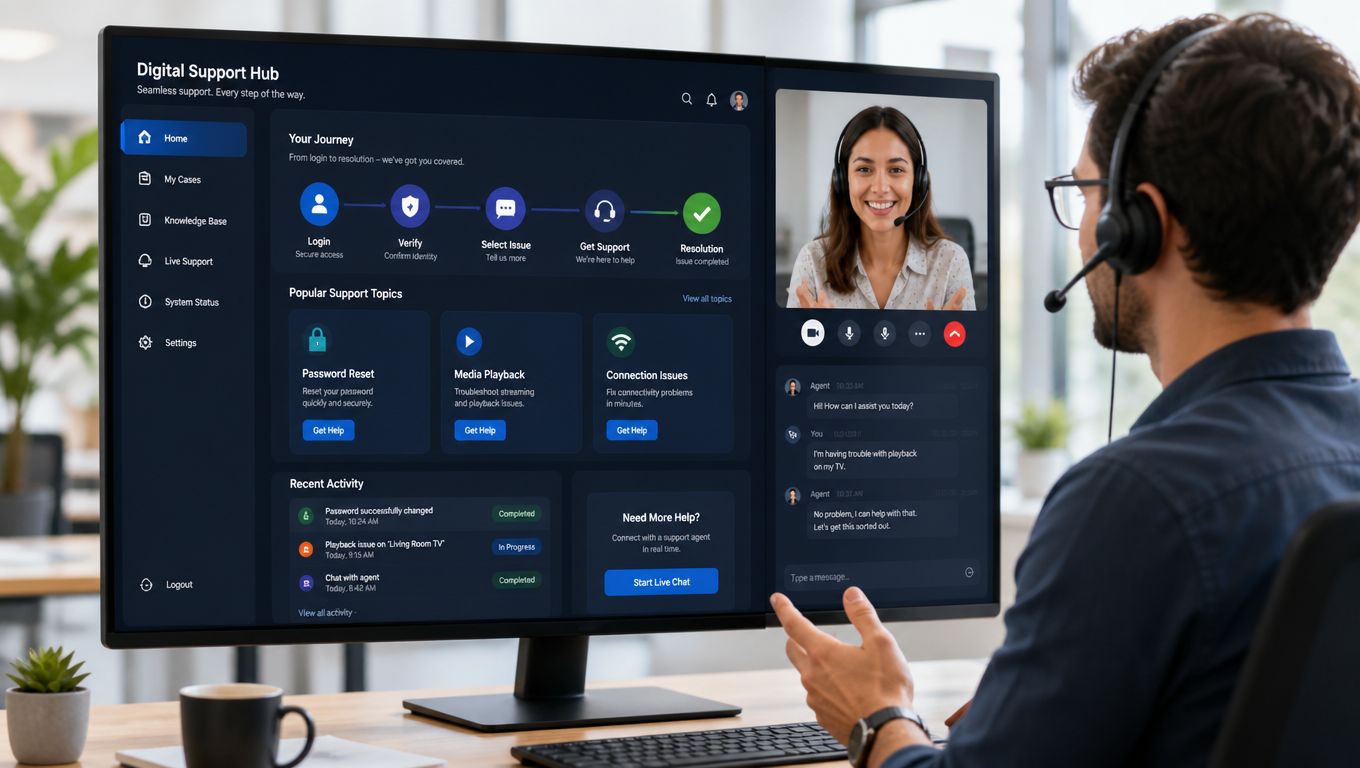
Support should serve you throughout the SAFE pre-licensing experience. Technical support keeps the learning management system, or LMS, working. Customer support keeps your motivation, course choices, and compliance steps on track. Evaluate both before you pay, because a course can offer polished lessons and still leave you stranded when a problem affects your progress.
On day one, technical support should resolve a missing password reset, an LMS that will not load, a video that stops playing, or a dashboard that fails to show your assigned module. Customer support should answer whether you purchased the correct state package and whether your account details match the order. Those are different jobs, and you should know which team owns each one.
Enrollment and early coursework
A pre-course assessment can expose both support needs at once. If the page will not open, report a technical defect. If you do not understand whether a failed assessment changes your course path, ask customer support or an instructor.
The same rule applies during coursework. Missing audio, broken videos, and pages that refuse to load belong with technical support. Questions about pre-licensing education versus continuing education require a person who understands the program rules. Do not waste hours applying browser fixes to a compliance question.
Failed modules require a clear handoff. Technical support can confirm whether the quiz recorded your attempt. Customer support or an instructor should explain whether you must retake the module, whether a retake is allowed, and which action protects your course record. Get that answer in writing when the result affects completion.
For a practical overview, read how to get started with your online Mortgage Loan Originator course. Use it to prepare for online study, then contact the provider directly when your account, eligibility, or completion record is involved.
Final preparation and NMLS reporting
A stalled timer or locked assessment near the final exam demands immediate action. Technical support should investigate the platform error and document what happened. Customer support should explain the administrative next step and confirm whether the provider can reset the attempt under its policy.
Completion creates another test of support quality. Customer support should confirm that your NMLS ID was entered in the required format, explain how course hours are reported, and identify the document you will receive. If the certificate PDF is blank or unavailable, technical support may repair the download while customer support verifies the correct replacement.
An unanswered email before an exam can disrupt scheduling, confidence, and your transition into an MLO role. Strong teams transfer the issue between departments without making you repeat the story or restart the process. That handoff is the practical difference between support that merely responds and support that helps you finish licensed and ready to work.
How to Evaluate a Course Provider's Support
Test support before you buy. A provider's sales process is the easiest time to observe its communication habits because the company has a clear incentive to answer you. If a basic question disappears into a web form, expect more friction after enrollment.
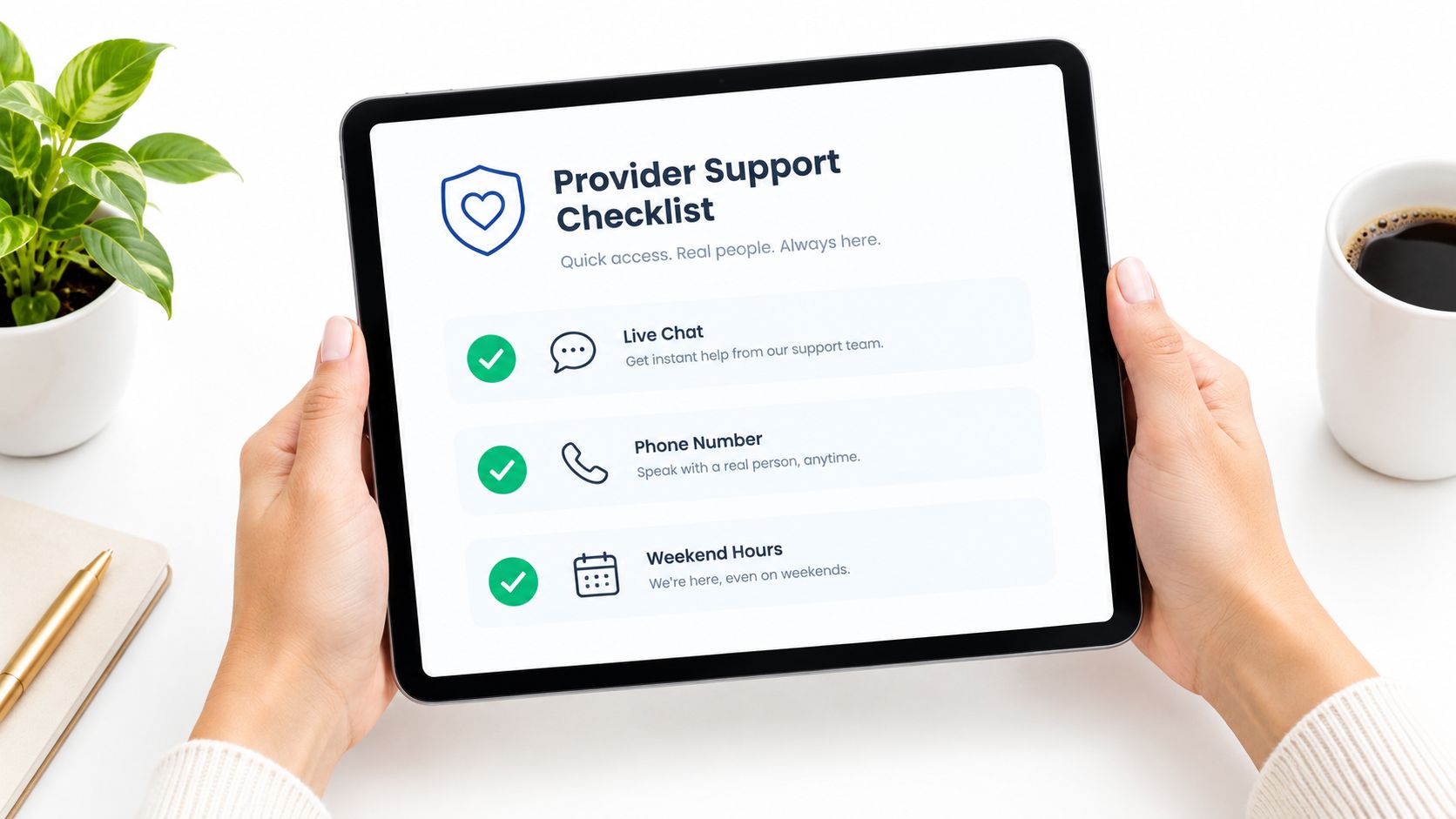
Start with the contact options. A published phone number is more useful than a contact form alone, but only if someone answers during the hours listed on the site. Check whether live chat is staffed, whether email has a stated response commitment, and whether weekend or evening coverage exists. Ask whether you'll receive a named contact or only a ticket number.
Run a short pre-purchase test
Send one specific question through each advertised channel. Ask which course applies to your state, how NMLS reporting works, or what happens after a technical interruption. Record when you sent the request, whether the response addressed the question, and whether the representative asked useful follow-up questions.
Use this checklist:
- Phone access: Confirm that the number reaches a student-support team rather than an automated directory.
- Human follow-up: Reject generic auto-replies that never lead to a personal answer.
- Escalation: Ask whether an instructor or compliance specialist can handle questions beyond basic account help.
- LMS controls: Look for password reset tools, progress visibility, and a clear process for correcting synchronization errors.
- Completion records: Ask how certificates are generated, corrected, and prepared for the NMLS reporting process.
- Failure policy: Request the written policy for technical failures, exam interruptions, and permitted retakes.
- Coverage hours: Verify the actual days and hours, not just the phrase “available seven days a week.”
- Documentation: Find out whether the provider records support conversations against your student account.
A response that takes longer than 24 business hours without a meaningful human update is a serious warning sign for a course that can determine when you start the licensing process. Don't confuse a polished chatbot with a staffed escalation path. Global CX research found that 33% of consumers had been unable to reach an agent directly from a chatbot during the prior twelve months, while only 11% described service as consistently excellent, according to the JMR Global customer experience report.
Look beyond the provider's front desk
A course provider may use an outside team for overflow calls or basic ticket handling. That arrangement can work when the outside representatives have accurate scripts, secure access to student records, and a clear path to qualified staff. It fails when every question receives the same generic response.
If you want to understand how companies structure outsourced service teams, this overview of customer support outsourcing companies provides useful context. As a buyer, your concern isn't where the agent sits. Your concern is whether the provider protects your record, answers accurately, and takes ownership.
Read the program's support terms before enrollment. For a closer look at a course that describes instructor access and support options, review the NMLS 20-hour course with unlimited instructor support. Then ask every provider the same questions so marketing language doesn't control the comparison.
Why Support Quality Predicts Licensing Success
Course price is easy to compare. Support quality is harder to see, but it has a stronger connection to whether you finish the process cleanly. A low-cost course becomes expensive when a broken exam session, missing certificate, or unanswered compliance question forces a delay or retake.
The clearest warning signs appear when a provider treats every issue as a basic service ticket. A Level 1 agent may reset a password effectively, but that person shouldn't guess about state-specific requirements, NMLS reporting, or the meaning of a completion document. Those questions need a documented answer from a qualified student-services specialist or instructor.
Separate real ownership from scripted assistance
Look for evidence that the provider has people who understand mortgage education rather than only general customer service procedures.
- Named instructors: You should know how to reach qualified teaching staff when course content or exam preparation requires explanation.
- Visible escalation: The provider should explain what happens when the first representative can't resolve the issue.
- Published commitments: Support hours and response expectations should appear before enrollment.
- Record protection: The team should document technical failures and preserve evidence of completed work.
- Consistent answers: Different channels shouldn't give contradictory information about the same course policy.
The support model matters because technical support is becoming a major service category rather than a minor internal IT function. The U.S. customer technical support services market is estimated at USD 10.82 billion in 2026, up from USD 10.06 billion in 2025, and projected to reach USD 15.61 billion by 2031, according to Mordor Intelligence's market report. That report also identifies remote and online technical support as holding 42.80% share in 2025, with voice and call-center interactions at 38.70%.
The implication for MLO students is straightforward. Online education depends on both a functioning platform and competent human backup. AI can accelerate routine replies, but it can't replace a clear escalation path for a student whose account, course record, and licensing timeline are connected. Zendesk's 2026 CX reporting says 91% of technology CX leaders believe AI materially improves first-reply and full-resolution times, as reported by GlobeNewswire. Speed helps, but a human must still handle nuanced compliance questions.

Choosing a Provider That Sets You Up to Win
You are ready to study after work, but the LMS rejects your password, your progress disappears, and no one explains whether your completed hours will still count. That situation exposes the two halves of an MLO pre-licensing experience. Technical support keeps the learning system running. Customer support keeps your motivation, records, and compliance on track. Evaluate both before paying.
Start by testing the provider's technical support. Ask whether it covers login access, course playback, progress synchronization, quizzes, and certificate downloads. Also ask who handles a failed session, how the incident is recorded, and whether your study time can be restored. A provider that cannot explain its escalation process will create avoidable licensing stress.
Then examine customer support. The team should handle enrollment, state-specific questions, NMLS reporting, completion records, and live human contact. Federal rules require at least 20 hours of NMLS-approved pre-licensing education, including 3 hours of federal law, 3 hours of ethics, and 2 hours on lending standards for nontraditional mortgage products, according to the CFPB regulation for loan originator licensing. The NMLS requires course titles to begin with the hour count and the phrase SAFE Comprehensive, including 20-Hour SAFE Comprehensive: Mortgage Loan Originator, as explained in its pre-licensing course naming requirements.
Match those commitments to your schedule. Confirm support hours, response channels, escalation steps, and the process for reporting completed education. New York, for example, requires an NMLS application, 20 hours of NMLS-approved education with 3 hours of New York law, the SAFE MLO Test with a National Component and Uniform State Content, and a surety bond after approval, according to the New York Department of Financial Services.
Resources about Lathire virtual assistants may help with later administrative workflows. They do not replace knowledgeable student support during licensing.
Use this guide to choosing the right mortgage licensing program to compare providers. 24hourEDU offers a fully online, NMLS-approved pre-licensing course with free exam preparation, phone and email support, and complimentary NMLS hours reporting. Visit 24hourEDU to review the program details.