
NMLS Credit Requirements Explained for New MLOs
Understand NMLS credit requirements, how credit checks affect MLO licensing, state variations, and how to fix issues before you apply.



You may be looking at your credit report right now, wondering whether an old bankruptcy, unpaid tax lien, or missed payment will prevent you from becoming a Mortgage Loan Originator. That concern is understandable, but NMLS credit requirements aren't built around one magic credit score. For state-licensed MLO applicants, NMLS requires credit-report authorization and review, while regulators focus on broader patterns of financial responsibility.
This distinction matters. A credit score summarizes information in a report, but licensing reviewers may pay closer attention to the circumstances, seriousness, and resolution of negative items. The process also includes education, testing, fingerprints, background screening, and application disclosures. Understanding how those pieces fit together makes the licensing path much easier to manage.

The practical approach is simple: identify which MLO category applies to you, authorize the correct report, review your history carefully, and gather documents that explain any difficult entries. Online NMLS-approved education can help you prepare for the broader licensing process while you organize your application materials.
A first-time applicant often asks a question that sounds straightforward: “What credit score do I need?” The better question is, “What will the regulator see in my credit history, and can I explain it?” NMLS public guidance doesn't establish a minimum credit score for state-licensed MLO applicants. Instead, it requires new applicants to authorize a credit report through NMLS and permits regulators to review the information as part of the licensing process. NMLS guidance on credit-report authorization provides the central compliance point.
That means a less-than-perfect score isn't automatically the same as a licensing denial. A report with a resolved hardship and clear documentation can present a different picture from a pattern of unpaid obligations, unexplained judgments, or continuing serious delinquencies. State rules can add their own review standards, so applicants should treat the NMLS requirement as a national foundation, not a complete prediction of a state regulator's decision.
You'll find the key distinctions in a practical order:
The most useful mindset is documentation-focused rather than score-focused. Read your report, identify anything a regulator could question, and prepare a factual explanation supported by records. That approach turns an uncertain concern into a manageable licensing task.
For a new state-licensed MLO applicant, the credit requirement begins with authorization. NMLS requires the applicant to authorize a credit report through the system, and a first-time authorization triggers an Identity Verification process. The report authorization is part of the MU4 application workflow, not a substitute for the criminal background check, fingerprint submission, education, or SAFE MLO Test.
Think of the application as several separate compliance lanes:
The important distinction is that NMLS doesn't publish a minimum credit score cutoff in its public guidance. A score may help you understand the report, but NMLS's documented requirement centers on authorization and regulatory review. State agencies may examine the underlying entries and apply state-specific standards.
During the relevant MU4 workflow, you should read each authorization prompt carefully and confirm that your personal information is accurate. A mismatch in identifying information can create avoidable questions during Identity Verification, so use consistent legal details across your application documents.
An amended MU4 generally doesn't require a new credit report unless a regulator requests one. That rule doesn't mean applicants should ignore changes in their financial history. It means the original authorization and report remain the normal reference point unless the regulator asks for updated information.
Regulators generally need to understand whether an applicant has demonstrated financial responsibility, rather than just whether the applicant has reached a particular score. The NMLS credit-report requirement gives the regulator access to relevant history, while the state licensing authority evaluates what that history means under applicable law and policy.
A bankruptcy, unpaid judgment, tax lien, or serious delinquency can draw attention because each may indicate unresolved financial obligations or a pattern that requires explanation. A single event tied to a documented hardship may be easier to contextualize than repeated unresolved problems. The report itself doesn't tell the full story, so your supporting records and explanation matter.

Start with the entries most likely to raise a question:
A useful self-assessment asks three questions. Is the negative item accurate? Is it resolved or actively managed? Can you explain the circumstances with records that a licensing reviewer can understand?
For a plain-language refresher on how scoring and report information differ, review what a credit score represents. The key licensing point remains broader: a score can be a useful personal indicator, but it isn't the public NMLS standard for approval.
Practical rule: Never hide a difficult credit event. Prepare a concise explanation, attach reliable documentation, and answer every application question accurately.
Credit is also only one part of the licensing decision. Education completion, examination results, criminal background information, disclosures, sponsorship, and state-specific requirements all contribute to the application. You shouldn't assume that either a strong score guarantees approval or a damaged score guarantees rejection.
The phrase “MLO credit requirements” can create confusion because state-licensed MLOs and federally registered MLOs don't follow the same credit-report authorization rule. NMLS policy materials tie credit-report authorization specifically to state licensing. Federally registered MLOs are treated differently within the system.
| Requirement | State Licensed MLO | Federally Registered MLO |
|---|---|---|
| NMLS credit-report authorization | New applicants must authorize a credit report through NMLS | The state-licensing credit authorization rule doesn't apply in the same way |
| First-time Identity Verification | Triggered by first-time credit-report authorization | Not tied to the state-licensed authorization workflow |
| State license application | Required for the state-licensed pathway | Registration pathway applies instead |
| Unique identifier | Required before engaging in covered loan-originator activity | Required as part of registration and covered activity |
| Ongoing status | Licensure must be maintained under applicable requirements | Registration must be maintained under applicable requirements |
A person working for an institution covered by the federal registration system may follow the federally registered route. Someone seeking a state license to originate under a state-licensed mortgage company generally follows the state-licensed process. Your employer, business model, and applicable regulatory status determine the category, not personal preference alone.
Federal law prohibits an individual from engaging in loan-originator activity without the appropriate registration or state license and a unique identifier. It also requires annual maintenance of registration or licensure, as described in the SAFE Act licensing provisions.
The practical takeaway is narrow but important. Don't use a federally registered MLO explanation to decide whether you must authorize a credit report for a state license. Confirm your pathway with your employer, licensing authority, or qualified compliance professional, then follow the corresponding NMLS workflow.
Credit authorization is a formal application action, so treat it like a document submission rather than a casual portal click. Before beginning, check that your legal name, address history, and identifying information are consistent with the records you'll use elsewhere in the application.
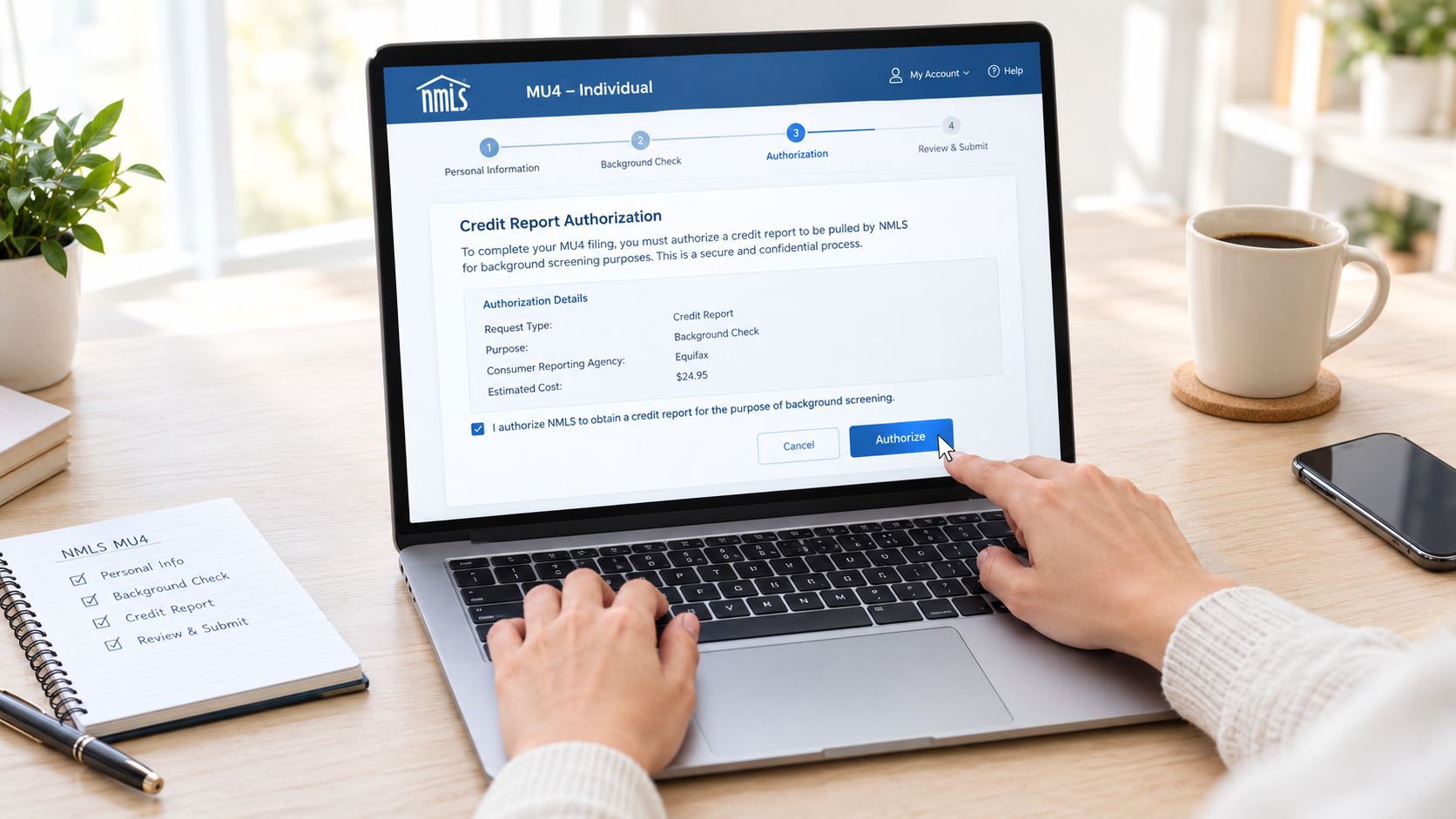
Credit authorization doesn't replace fingerprints or the criminal background check. Those are separate parts of the application and should be tracked independently so you can identify which item is complete, pending, or needs correction.
If bankruptcy appears in your history, gather the relevant records before submission. A practical overview of how bankruptcy affects your credit report can help you understand why dates, account status, and supporting documentation deserve careful attention. For legal interpretation of your specific situation, consult a qualified attorney.
An amended MU4 usually doesn't require a new credit report unless a regulator requests one. Still, an amendment should be accurate and complete. If the regulator asks for an updated report or explanation, respond through the requested process rather than assuming the original authorization answers the new question.
Credit authorization makes more sense when placed beside the rest of the application. For a state-licensed MLO, the process normally involves approved education, testing, the MU4, employer sponsorship where required, fingerprint and criminal background procedures, and credit authorization.
Federal SAFE Act education requires at least 20 hours of approved pre-licensing education before a state-license application can be submitted, with the curriculum divided into 3 hours of federal law and regulations, 3 hours of ethics, 2 hours on nontraditional mortgage lending standards, and 12 hours of undefined electives. The federal statutory language establishes those topic blocks.
Most states follow this general order:
NMLS also states that applicants who fail under the applicable federal provision must retake the full education requirement to regain eligibility. That makes accurate course completion records and careful exam preparation valuable parts of compliance planning.
Online education can simplify the study portion because you can access lessons, an e-textbook, state-law material, and exam preparation in one learning environment. 24hourEDU offers an NMLS-approved 20-hour online MLO course with free exam preparation materials, state-law content, support, and NMLS hour reporting. Verify your state's specific requirements before submitting the application.
For the separate screening component, review MLO background-check requirements so you don't mistake credit authorization for the entire suitability review.
You don't need to guess what a regulator might ask. You can create a clean review file before authorizing the report and address factual errors or unresolved obligations first.
Obtain and examine your credit reports from the reporting agencies that maintain your information. Look for accounts that don't belong to you, incorrect balances, duplicate entries, outdated statuses, and mismatched personal information. If you find an error, preserve a copy of the report, identify the specific entry, and submit a focused dispute with supporting records.
Use the FCRA dispute process to understand the documentation and communication steps involved. Keep copies of correspondence, delivery confirmations, responses, and updated reports. A regulator can evaluate a disputed item more effectively when you can show exactly what you challenged and how the matter progressed.
An unpaid judgment or tax lien deserves more immediate attention than a minor scoring fluctuation. Confirm the current status, contact the appropriate creditor or agency, and request written proof when an account is paid, released, settled, or placed under an approved arrangement.
A bankruptcy explanation should be factual and brief. Include the filing and discharge records when relevant, describe the circumstances without speculation, and show the payment history that followed. For a serious delinquency, identify the cause, the date it was resolved, and the steps you took to prevent recurrence.
Documentation habit: Create one folder for reports, dispute records, payment agreements, court documents, releases, and written explanations.
Continue making required payments on time and avoid taking on obligations you can't manage. Your aim isn't to manufacture a particular score. Your aim is to demonstrate responsible conduct and maintain records that explain any past disruption.
Review your file before submitting the MU4. If the report contains an issue you can't interpret, seek guidance from the relevant state regulator or a qualified professional. Don't submit a guessed explanation, and don't omit a required disclosure because the event feels old or uncomfortable.

Use this checklist when you're preparing your state-licensed MLO application:
Before you authorize the report, check for errors and assemble explanations for any serious entries. After authorization, save your confirmation and monitor the NMLS application for requests from the regulator. If the regulator asks for clarification, answer directly and provide organized records rather than sending an incomplete narrative.
A career as a Mortgage Loan Originator, Mortgage Broker, or Mortgage Loan Officer can offer a practical path for people who value client service, sales, flexible work arrangements, and commission-based compensation. The licensing process becomes more achievable when you treat each milestone as a separate task and use approved online education to prepare efficiently.
24hourEDU offers an NMLS-approved online 20-hour MLO pre-licensing course with free exam preparation materials, state-law resources, support, and NMLS hour reporting. Visit 24hourEDU to review the course and begin organizing your education and credit-readiness plan.
Understand NMLS credit requirements, how credit checks affect MLO licensing, state variations, and how to fix issues before you apply.

Learn about our SAFE mortgage course: 20 hours NMLS-approved MLO prelicensing online, with free exam prep & expert support.

24hourEDU has officially joined the Mortgage Bankers Association (MBA)! By aligning with the MBA's nationwide network, 24hourEDU continues to elevate national standards for NMLS pre-licensing, continuing education, and SAFE MLO exam prep—empowering loan originators to succeed in today's lending environment.

Discover everything about the 20-hour SAFE course online. Learn curriculum details, state approvals, exam prep, and how to launch your MLO career quickly.

SAFE Act training explained clearly. Learn NMLS requirements, course structure, provider tips, and exam prep for your Mortgage Loan Originator license.

Learn the anatomy of a house from foundation to roof, including systems, finishes, and structural details that shape every mortgage underwriting decision.
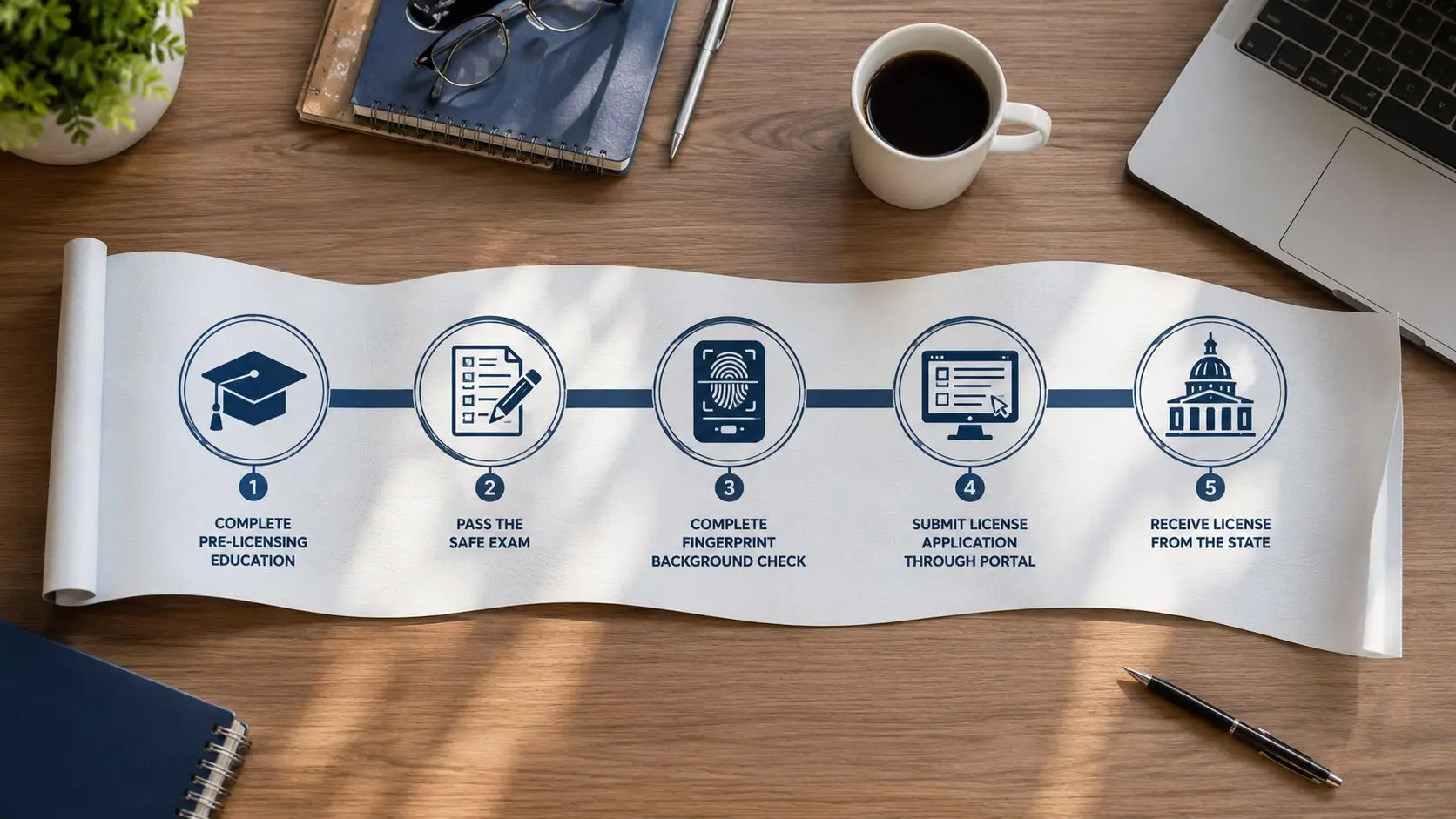
Learn safe act licensing requirements for mortgage loan originators, including the 20-hour course, SAFE exam, background checks, and state-specific rules.

Find out how an exam prep course helps you earn your Mortgage Loan Originator license. Learn features, benefits, and how to choose the right NMLS-approved

Get NMLS SAFE exam practice questions that mirror the real test, plus proven strategies to turn practice into a passing score on your first attempt.

Discover the top instructor led training benefits for MLOs, including improved retention, real-time feedback, and enhanced compliance. Learn why it works.

Fixed rate mortgage explained in plain English, with real numbers, clear examples, and practical tips every aspiring MLO should know before talking

Learn how reciprocity mortgage broker license rules actually work in 2026, why true reciprocity is rare, and how to navigate state-by-state approval.
